WORLD
WORLD
Aquilo
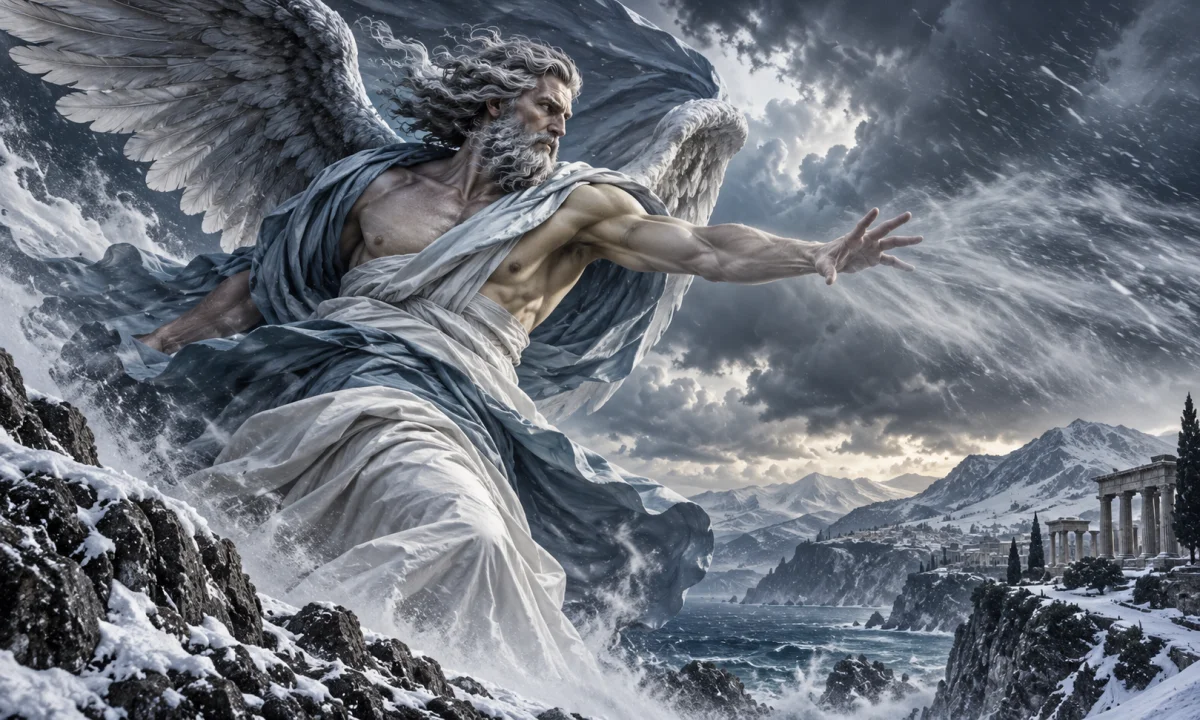
Aquilo is the Roman personification of the north wind, or in some systems the cold wind blowing from the north-northeast. He belongs to the Roman tradition of naming and humanising the principal winds, which were important both in religious imagination and in practical knowledge of weather, navigation, agriculture and architecture. Aquilo was not usually the subject of an independent mythological cycle. Instead, he appears mainly in Latin poetry, technical writing and adaptations of Greek ideas about the winds.
Origins and cultural setting
Wind was a powerful and visible force in the ancient Mediterranean world. It could bring rain, storms, dangerous seas, winter cold or favourable sailing conditions. Roman writers therefore treated the winds as more than neutral movements of air. They were often described as divine or semi-divine beings with directions, temperaments and physical effects.
The Roman system of wind-names developed alongside Greek traditions. Greek writers commonly identified the north wind as Boreas, the south wind as Notos, the west wind as Zephyros and the east wind as Eurus. Roman authors adopted many of these names while also using native or Latin forms, including Aquilo for the northern wind, Auster for the southern wind and Favonius for the western wind.
These names were not always used with complete consistency. Ancient geographical and meteorological systems differed over the exact position of each wind on the compass. Aquilo could mean the north wind generally, but some writers placed it between due north and northeast. The word therefore describes a traditional wind-region rather than a precisely fixed modern compass direction.
Name and identity
The Latin noun aquilo means “north wind” and, by extension, “the north.” Its ultimate etymology is uncertain. Ancient and modern interpreters have sometimes associated it with aquilus, a word meaning dark or dusky, perhaps referring to the appearance of storm clouds or the gloomy character attributed to the northern wind. This explanation is not universally accepted.
Despite the resemblance, Aquilo should not be identified with Aquila, the eagle. Aquila is a different Latin word and can refer to an eagle, a military standard bearing an eagle, or the constellation associated with the bird. The two names may look similar in English transliteration, but they represent different concepts.
Aquilo is grammatically masculine in Latin and is often treated as a male divine figure in poetry. This does not necessarily mean that Romans worshipped him as a major personal god with a standard biography. Ancient personifications could occupy several levels of religious meaning: a natural force could be named as a divine power, represented artistically as a human figure and addressed poetically without having a separate cult or elaborate mythology.
Aquilo among the Roman winds
Roman authors described the winds in groups that varied in number. Some systems recognised four principal winds, while others divided the compass into eight or twelve sectors. In an eight-wind arrangement, Aquilo generally occupies the northern position, with the following winds commonly associated with other directions:
- Aquilo — north, or north-northeast;
- Solanus — east;
- Eurus — southeast or east-southeast;
- Auster — south;
- Africus — southwest;
- Favonius — west;
- Caurus or Corus — northwest;
- Septentrio — a northern wind or northern sector, depending on the system.
The boundaries between these names were not uniform. Vitruvius, Pliny the Elder and other writers discuss wind directions in ways that show both a shared vocabulary and disagreements about classification. Septentrio could function as another name for the north wind, while Aquilo could be assigned to a more northeasterly position. The precise arrangement should therefore be treated as a feature of each author’s system rather than as one fixed Roman doctrine.
The name also appears in related forms such as Aquilon or Aquilō in later Latin usage and in the names of the northern wind in some Romance languages. These later linguistic developments preserve the word’s association with the north, but they do not by themselves provide evidence for a separate ancient cult of Aquilo.
Character and attributes
Aquilo is usually presented as cold, forceful and wintry. Northern winds could make the sea hazardous and bring severe weather, especially from the Roman perspective of the Mediterranean. Latin poetry often uses Aquilo to suggest chill, roughness, darkness or the hostile conditions of winter.
Like other winds, Aquilo could be imagined as a winged male figure. Artistic representations of winds in the Greek and Roman worlds commonly show human or partly human beings with wings, flying garments or inflated cloaks. However, there is no single universally recognisable canonical appearance for Aquilo comparable to the standard visual identity of some major gods. A winged figure labelled with his name may represent the north wind, but surviving artistic evidence must be interpreted in its local context.
His chief “power” is atmospheric rather than magical. Aquilo moves through the sky, roughens the sea, drives clouds and intensifies cold. In literature, these physical effects can become emotional or symbolic ones. A poet may invoke Aquilo to convey danger, resistance, isolation, winter discipline or the instability of human plans.
Roman technical writers also treated the winds as practical forces. Vitruvius discusses them in relation to the planning of cities and the orientation of streets, arguing that exposure to unhealthy or unpleasant winds could affect the well-being of inhabitants. In such contexts Aquilo is less a character in a story than a named environmental power within Roman knowledge of the built world.
Aquilo in Latin literature
Aquilo appears frequently in Latin poetry as a personified force. Virgil uses northern winds among the forces that disturb the sea, shape weather and affect human journeys. In the Aeneid, storms are described through the actions of winds such as Eurus, Notus and Africus, while the wider vocabulary of Latin epic includes Aquilo as a threatening northern power. The wind’s name carries associations of harsh weather even when no separate myth is being narrated.
Ovid’s Metamorphoses also uses the traditional wind figures when describing cosmic disorder, storms and the changing conditions of the world. Ovid sometimes uses Greek names, especially Boreas, and sometimes Latin wind-names. This is important because Latin authors did not always treat Aquilo and Boreas as two entirely unrelated beings. In translation, adaptation or poetic variation, Aquilo could serve as the Roman equivalent of the Greek north wind. At other times, the names reflect different literary or geographical conventions.
Horace and other lyric poets employ northern winds in images of winter, dangerous travel and the limits of human ambition. Aquilo may be contrasted with warmer or gentler winds, particularly Favonius, which was associated with the west and often with the return of spring. Such contrasts belong to poetic symbolism rather than to a formal theological system in which every wind has a fixed moral personality.
In prose, the name occurs in discussions of weather, geography and the arrangement of the heavens. The Roman author Seneca, writing about natural phenomena, treats winds as subjects for philosophical and scientific investigation while still using the traditional names. This combination of mythic language and natural observation is characteristic of ancient writing about the elements.
Aquilo and Boreas
The closest Greek counterpart of Aquilo is Boreas, the north wind. Greek tradition gives Boreas a more developed mythological profile than Aquilo usually receives in Roman sources. Boreas is associated with Thrace, a region imagined as cold and stormy, and is famous for carrying off Orithyia, daughter of the Athenian king Erechtheus. Their children include the winged brothers Zetes and Calais, who take part in the voyage of the Argonauts.
Roman authors knew these stories and sometimes Latinised Greek divine names. A Latin writer might call the Greek north wind Boreas, Aquilo or another traditional name depending on the purpose and style of the passage. It is therefore misleading to say that every story of Boreas automatically belongs to Aquilo. The two figures are best understood as functional equivalents with overlapping traditions, not as identical characters in every source.
The abduction of Orithyia is specifically a story of Boreas in Greek mythology. When later retellings use Aquilo as the Roman name for the same wind, they are adapting the Greek myth rather than revealing a separate, well-attested Roman legend about Aquilo and Orithyia. The distinction matters because Aquilo himself has comparatively little independent narrative material.
Relationship to other northern figures
Aquilo is sometimes confused with several other names connected with the north. Septentrio is a Latin term associated with the northern sky and the constellation Ursa Major, whose seven prominent stars were called the “seven plough-oxen.” It could also designate the north wind in some Roman classifications. This does not necessarily mean that Septentrio was a separate god with a mythology distinct from Aquilo.
Tramontana, a later term found in Romance-language traditions, refers to a north wind or the northern direction and should not be projected backward as an ancient Roman name for Aquilo. Likewise, Boreas is the Greek wind-god and a Greek cultural figure, even though Roman authors often treated him as equivalent to Aquilo.
Aquilo should also be distinguished from the Aquarii and from the constellation Aquarius. The constellation’s name means “water-bearer” and has no direct identity with the north wind. Similar spellings in modern English can obscure the distinct origins of these names.
Religious and symbolic significance
There is no strong evidence that Aquilo possessed a major, widely documented cult comparable to those of Jupiter, Mars, Venus or Neptune. His importance lies primarily in the Roman habit of understanding natural forces through divine language. Naming a wind made it possible to place it within a religiously meaningful cosmos while also discussing it in practical terms.
As a northern wind, Aquilo could symbolise the dangers that come from beyond the familiar Mediterranean climate. Rome’s literary imagination often places cold, stormy or uncivilised regions to the north and northeast. Aquilo consequently carries geographical associations as well as meteorological ones. He can represent the threatening exterior world, the severity of winter and the power of nature over ships, armies and travellers.
His symbolism was not exclusively negative. A strong wind could clear stagnant air, drive away clouds or provide useful movement for sailing. Nevertheless, literary descriptions tend to emphasise the wind’s cold and disruptive qualities. The contrast between Aquilo and milder winds helped Roman poets represent changes in season, fortune and emotional atmosphere.
Later reception
Aquilo survived most strongly as a learned Latin word and poetic image rather than as a continuing object of popular worship. Medieval and Renaissance writers familiar with classical literature continued to use Aquilo or Aquilon as a name for the north wind. In later European art and decorative schemes showing the four or twelve winds, the northern wind may appear as a winged head or figure, although the labels and visual conventions vary.
In modern English, Aquilo is relatively uncommon outside classical studies, fantasy writing and works that draw on Roman mythology. Modern fiction may present him as a fully developed wind-god with a personal history, weapons, rivalries or supernatural powers. Those features belong to contemporary invention unless they can be traced to a particular ancient source. The ancient Aquilo is more accurately understood as a Roman personification of the cold northern wind: important in language, poetry and natural philosophy, but only lightly developed as an independent mythological character.