WORLD
WORLD
Anticlea
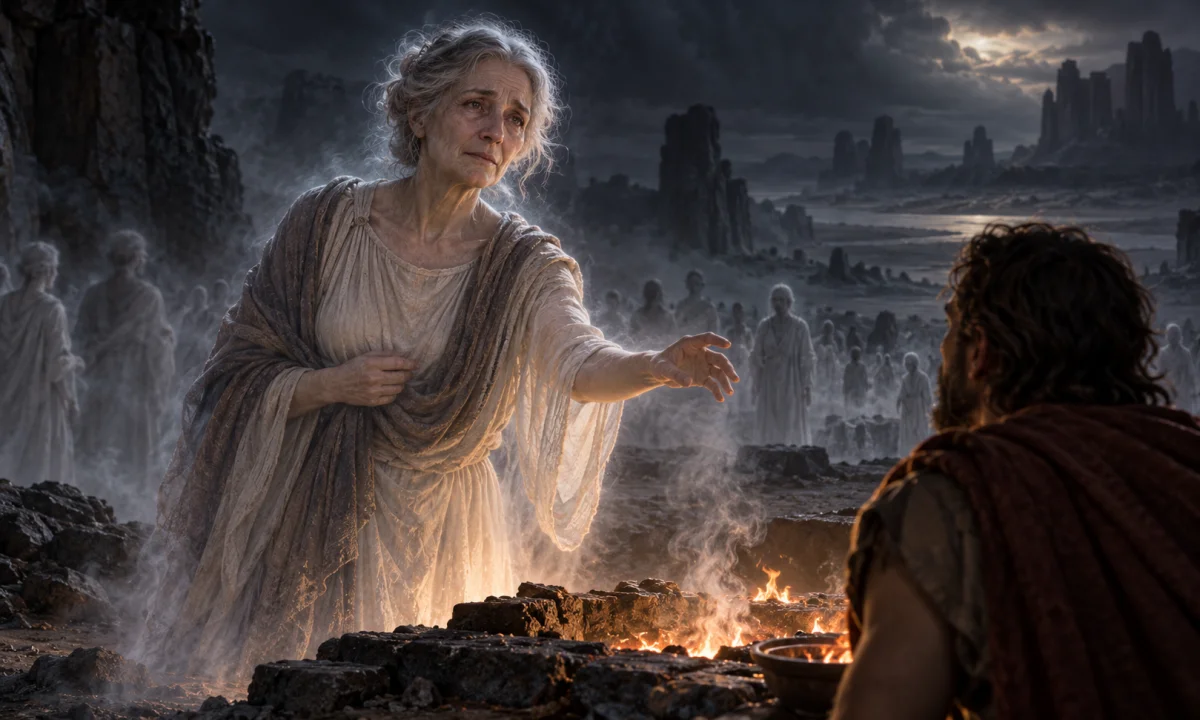
Anticlea is a figure from Greek mythology best known as the mother of Odysseus, the wandering hero of Homer’s Odyssey. She is traditionally described as the daughter of Autolycus, a famous thief and trickster, and the wife of Laertes, king of Ithaca. Anticlea’s most important appearance comes after her death, when Odysseus encounters her spirit in the Underworld and learns how deeply his long absence has affected his family.
Origins and family
Anticlea belongs to the heroic genealogies surrounding Ithaca, a small kingdom in the western Greek world. Her father, Autolycus, was renowned for his ability to steal without being detected and, in many traditions, was connected with the god Hermes. This association gave Anticlea a place within a family marked by cunning, concealment and unusual intelligence.
Her mother is not consistently identified in surviving accounts. Some genealogical traditions name Chione, while others preserve different details or leave the matter unmentioned. Because Greek myth was transmitted through poems, local traditions and later mythographers rather than through one authoritative canon, family relationships can vary between sources.
Anticlea married Laertes, the ruler of Ithaca and the son of Acrisius or Cephalus in differing genealogical traditions. In Homer, Laertes is clearly presented as Odysseus’s father, while Anticlea is his mother. Their household also includes Ctimene, usually described as Odysseus’s sister. Ctimene plays only a minor role in the Odyssey, but her presence helps establish Anticlea as the mother of a royal family rather than merely a name in Odysseus’s genealogy.
Some later accounts introduce a different paternity story. According to this version, Sisyphus fathered Odysseus after having intercourse with Anticlea before her marriage to Laertes. Sisyphus was the king of Corinth, celebrated for his cunning and for the punishment that condemned him to roll a boulder endlessly uphill in the Underworld. This story may have been used to explain Odysseus’s remarkable cleverness by assigning him a father whose intelligence and deceit were legendary.
The Sisyphus tradition is not the account given by Homer, who treats Laertes as Odysseus’s father. It is therefore best understood as a later or alternative mythological genealogy, not as a hidden fact within the Odyssey. The difference illustrates how Greek myths could preserve competing versions of a hero’s origins.
The name Anticlea
The Greek name Anticleia is commonly rendered in English as Anticlea, although Anticleia is also used. Its elements appear to be related to anti- and kleos, a word associated with fame, renown or glory. The exact force of the compound is not certain, and ancient personal names do not always function as straightforward descriptions of a character’s role.
Her name should not be confused with the names of other mythological women called Anticlea or with similarly spelled figures in later retellings. Greek mythology contains repeated names across different families and regions. The Anticlea most important to the Odyssey is specifically the wife of Laertes and mother of Odysseus.
Anticlea in the Odyssey
Anticlea appears in Book 11 of the Odyssey, the section often called the Nekyia, or account of the visit to the dead. Odysseus travels to the edge of the Underworld to consult the prophet Tiresias. There he performs rites intended to draw the spirits of the dead toward a blood offering, allowing them to speak with greater clarity and strength.
Before Odysseus speaks with Anticlea, he encounters several famous dead figures, including the seer Tiresias. Anticlea then approaches the ritual space. Odysseus recognizes her but does not immediately allow her to drink the blood, because he must follow the instructions governing the consultation. The scene emphasizes that the dead do not return to ordinary life simply because a living person wishes to see them. Communication between the worlds is conditional, ritualized and temporary.
When Anticlea finally drinks, she recognizes her son and asks why he has come among the dead. Odysseus explains that he is trying to return home after the Trojan War and that he has not yet reached Ithaca. Anticlea tells him that she did not die from a particular illness or violent event. Instead, she says that longing for him and grief over his absence consumed her life.
Her statement gives an emotional explanation for a death that heroic poetry might otherwise leave unexplained. Anticlea has remained alive long enough to see the consequences of Odysseus’s absence, but she dies before his return. The story does not present her death as a supernatural punishment or a curse. It presents sorrow, waiting and uncertainty as forces capable of destroying a person.
Anticlea also gives Odysseus news of his household. Laertes is still alive but greatly diminished by grief and old age. He avoids the city and sleeps apart from other people. Penelope, Odysseus’s wife, continues to wait faithfully for him while enduring pressure from the suitors gathered in the palace. Telemachus, their son, has become old enough to manage the household and protect its interests.
Through Anticlea’s speech, Odysseus receives information that connects the Underworld with the living world. She is not merely a sorrowful mother; she is a messenger of Ithaca. Her knowledge allows the hero to understand what his absence has cost and what kind of homecoming awaits him.
The failed embrace
One of the most memorable moments in the Odyssey occurs when Odysseus tries to embrace his mother. He attempts to hold her three times, but each time her form slips away like a shadow or dream. Anticlea explains that this is the condition of the dead: flesh and bone no longer bind them as they did in life. The goddess Persephone has allowed only an image or shade to appear.
The failed embrace is important because it makes the nature of death emotionally tangible. Anticlea looks sufficiently like herself for recognition, and she can speak with her son, but she cannot be touched. The scene refuses to treat the Underworld as an ordinary continuation of earthly life. Even a loving reunion remains incomplete.
Odysseus’s response also reveals a tension in ancient Greek ideas about the dead. The spirit retains memory, identity and the ability to communicate, yet it lacks the full vitality of a living person. In the Odyssey, the blood offering temporarily strengthens the shades, but it does not restore them to embodied life. Anticlea’s presence is therefore both personal and insubstantial: she is his mother, but she is also a powerless remnant of the person she was.
Role and character
Anticlea has no clearly defined supernatural power. She is not a goddess, prophetess or underworld queen. Her authority comes from her relationship to Odysseus and from her position within the household of Ithaca. Once dead, she can speak about the family, but she cannot alter events among the living.
Her characterization is shaped primarily through grief, loyalty and maternal knowledge. She has waited for news of her son and has suffered because she does not know whether he is alive. Yet her speech is not simply an expression of personal sorrow. She asks Odysseus about his journey, explains the state of his family and answers his questions about the home he has left behind.
The meeting also changes Odysseus’s understanding of homecoming. Before speaking with Anticlea, his return is largely an adventure involving monsters, storms, enemies and divine obstacles. Through her, he confronts a quieter danger: time has passed, loved ones have aged or died, and his home has been altered by his absence. The Underworld episode places family loss alongside heroic achievement.
Laertes, Odysseus and the Ithacan household
Anticlea’s relationship with Laertes is mostly known through the information she gives after death and through the wider narrative of the Odyssey. Laertes is not portrayed as a powerful king during Odysseus’s absence. He has withdrawn from public life and lives in a rural setting, grieving for his son. Anticlea’s report prepares the audience for the old man Odysseus later encounters in disguise.
Her relationship with Odysseus is more central. The Underworld conversation is the only substantial direct meeting between them in the surviving Homeric poem. This absence is itself significant. Anticlea is dead before the main action begins, so her motherhood is experienced through memory and testimony rather than through ordinary domestic scenes.
She also represents the people who remain behind while heroes pursue war and adventure. Epic often focuses on the warrior’s journey, but Anticlea’s story gives attention to the relatives who endure uncertainty without knowing what has happened. Her death shows that the effects of war and wandering reach far beyond the battlefield.
Alternative traditions about Odysseus’s father
The version involving Sisyphus creates a striking contrast between Anticlea’s two possible husbands or partners. Laertes belongs to the royal household of Ithaca, while Sisyphus represents cunning, transgression and resistance to divine authority. If Sisyphus is treated as Odysseus’s biological father, the hero’s intelligence becomes part of a lineage of tricksters as well as a quality developed through experience.
Ancient writers did not always treat the Sisyphus story in the same way. It appears in later mythographic and dramatic traditions rather than in Homer’s account of Odysseus’s family. Some versions may have been associated with attempts to explain the hero’s reputation for deception, disguises and strategic speech. Others may reflect local or literary competition over the origins of a famous hero.
Anticlea’s role in this alternative story can also be morally complicated. In the Homeric tradition, she is a grieving mother whose loyalty to her son is unquestioned. In the Sisyphus version, her earlier relationship becomes part of a story about sexual deception, disputed paternity and competing claims over Odysseus’s identity. These accounts should not be blended as though they formed one consistent biography.
Death, ritual and the Greek Underworld
Anticlea’s appearance is closely connected with Greek ideas about funerary ritual and the condition of the dead. The Nekyia does not describe a heaven or hell in the later Christian sense. Instead, it presents the dead as shades dwelling in Hades, separated from the ordinary world and deprived of much of the strength they possessed in life.
Blood, burial customs and proper attention to the dead were important themes in ancient Greek religious culture. The scene does not provide a general theological explanation of all Greek beliefs, but it dramatizes the necessity of ritual when the living seek contact with the dead. Odysseus cannot simply call for his mother and receive a response. He must travel to a boundary place, perform the required actions and wait for the spirits to approach.
Anticlea’s death from longing also reflects the importance of family obligations in Greek society. A son’s absence could bring honour through warfare or adventure, but it could also leave parents without support and households without protection. Her story therefore connects heroic fame with the private suffering that heroic narratives often overlook.
Artistic representation and later reception
Anticlea is less frequently depicted in ancient art than Odysseus, Penelope, Circe or the monsters he encounters. The Underworld meeting is difficult to represent because its central action is conversation between a living man and an untouchable shade. When artists or dramatists adapt the episode, they often focus on the attempted embrace, the mourning mother or the contrast between Odysseus’s living body and Anticlea’s insubstantial presence.
In modern retellings of the Odyssey, Anticlea may receive more attention than she does in the ancient poem. Adaptations sometimes expand her life before Odysseus’s departure, her relationship with Laertes or her experience of waiting in Ithaca. Such additions can make her a fuller dramatic character, but they are modern interpretations rather than details preserved in the Homeric narrative.
Modern versions also sometimes emphasize the psychological meaning of the Underworld encounter. Anticlea can be portrayed as the embodiment of Odysseus’s guilt, homesickness or fear that home has become unreachable. These readings are compatible with themes already present in the poem, but they should be distinguished from claims about ancient worship or a separate cult of Anticlea. She is known primarily as a literary and mythological figure, not as a major independent goddess or object of a widespread religious cult.
Distinction from similar figures
Anticlea should not be confused with Anticleia simply because the spelling differs; the two forms usually refer to the same mother of Odysseus. Transliteration from Greek can produce variations in the final vowel and in the representation of Greek diphthongs.
She should also be distinguished from other mythological women who may bear the same or a similar name in genealogical lists. Greek myth uses recurring personal names, and a woman named Anticlea in one local tradition is not automatically the mother of Odysseus. The defining identification of the best-known Anticlea is her place in the family of Laertes and her meeting with Odysseus among the dead.