WORLD
WORLD
Anchimallén
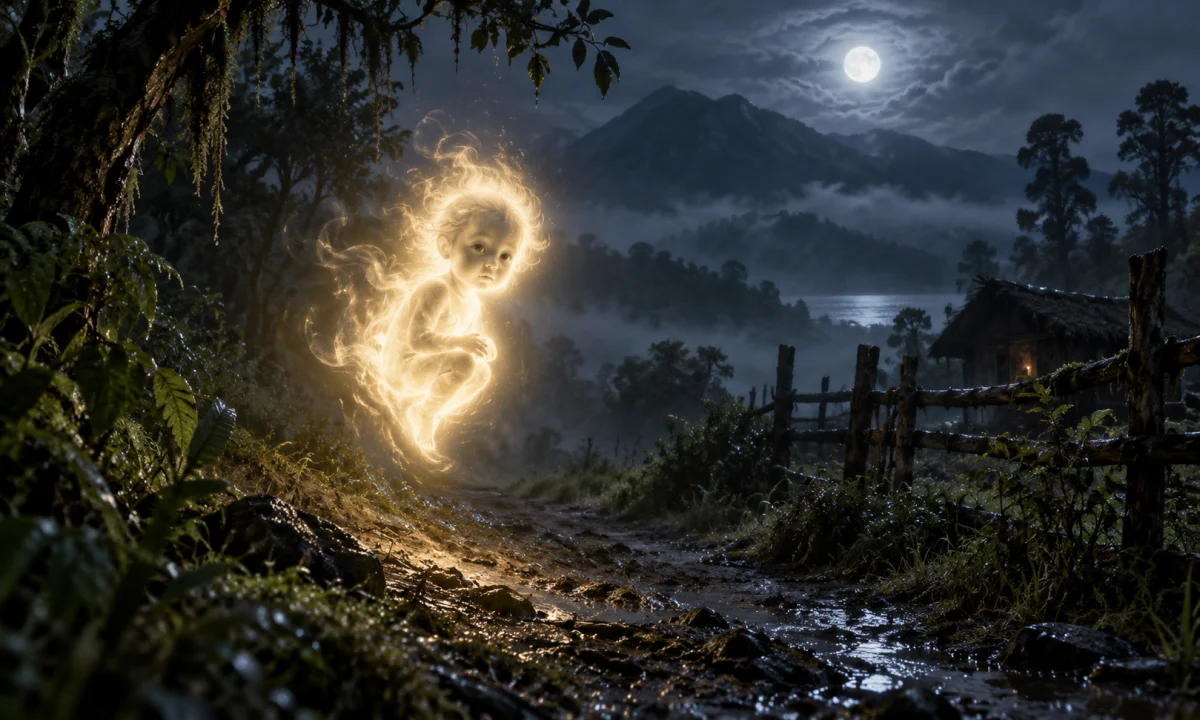
Anchimallén is a luminous spirit associated chiefly with Mapuche and, in some accounts, neighbouring southern Chilean traditions. It is usually described as a small, fast-moving light seen at night, although other versions give it a more human or childlike appearance. Its meaning changes according to the community and source: it may be a supernatural companion of a kalku (a person regarded as practising harmful or illicit magic), a dangerous familiar spirit, an omen, or an apparition connected with the dead.
Origins and cultural setting
The Anchimallén belongs to the religious and folkloric world of the Mapuche, an Indigenous people whose traditional homeland extends across parts of south-central Chile and Argentina. Mapuche spiritual ideas do not form a single, uniform system preserved in one canonical book. Knowledge has been transmitted through oral teaching, ritual practice, family stories and accounts recorded by outsiders. As a result, descriptions of supernatural beings can vary considerably between regions and between informants.
The name is also encountered in traditions from southern Chile, including areas where Mapuche cultural influence intersects with local rural and Chilote folklore. This does not necessarily mean that every account describes exactly the same being. Some regional stories may have adapted the figure to local ideas about nocturnal lights, spirits, sorcery and dangerous places. The relationship between specifically Mapuche tradition and later regional folklore should therefore be treated with care rather than assumed to be identical.
Most written information about Anchimallén comes from comparatively recent descriptions of oral traditions, especially ethnographic and folkloric records. These records do not preserve one definitive ancient version. They often use Spanish categories such as “demon,” “duende,” “ghost” or “familiar spirit” to describe beings that do not fit neatly into European classifications. Such labels can be useful for comparison, but they may also obscure the meanings the figure has within Mapuche cultural contexts.
The name and its spellings
The most familiar Spanish spelling is Anchimallén, but forms such as Anchimayén, Anchimalén and other regional or older transcriptions are also found. Mapudungun has been written using different orthographic systems, and Spanish-language writers have not always represented its sounds consistently. The variation does not automatically indicate separate beings.
The exact etymology is not securely established in the general folklore literature. Popular explanations sometimes divide the name into Mapudungun elements and assign it a precise meaning, but those interpretations are not uniformly accepted. It is safer to treat the name as a traditional designation with variant spellings than to present a speculative translation as certain.
Identity and classification
Anchimallén is most often classified as a spirit or supernatural familiar, rather than as an animal or a god. In accounts that connect it with sorcery, it functions as an attendant or servant of a kalku. A familiar, in this sense, is a being believed to assist a ritual specialist or a person engaged in harmful magic. It may carry out tasks, guard a dwelling or treasure, intimidate enemies and produce illness or misfortune.
Other traditions describe Anchimallén less specifically as a sorcerer’s servant and more generally as an uncanny nocturnal presence. It may appear independently in the countryside or near houses, and its presence can be interpreted as threatening. Some tellings connect it with the spirit of a child who died before receiving the proper protection or social incorporation associated with ordinary human life. This motif is not universal, however, and should not be treated as the single original definition of Anchimallén.
Descriptions also differ over whether the being is male, female, childlike or without a stable human identity. A few accounts portray it as a small person or infant; others emphasise only its light. The use of a childlike form may reflect the broader folkloric idea that an unfinished, improperly buried or ritually vulnerable death can produce a dangerous spirit. That interpretation belongs to particular versions and does not define every Mapuche understanding of the figure.
Appearance as a light
The most consistent feature in descriptions of Anchimallén is luminosity. It is commonly seen as a glowing point, ball or moving flame that travels through the darkness. Reports may describe a light that darts rapidly, approaches a traveller, rises into the air or disappears suddenly. The colour is not consistent across accounts. Some descriptions speak simply of a bright light, while others mention changing or unusual colours.
In versions that give the being a body, Anchimallén may resemble a very small human figure, often with a childlike appearance. The boundary between the visible body and the light is often unclear: the creature may be recognised because it shines, or it may be imagined as carrying or producing the light. This uncertainty is important because the figure is not always presented as a monster with a fixed anatomy. Its appearance is part of the experience of witnessing something unexplained at night.
The light can be associated with speed, stealth and disorientation. A person who encounters it may be frightened by its sudden movements or by the impression that it is deliberately following them. Some accounts attribute an intense brightness or a disturbing cry to the being. These details vary and are not found in every regional description.
Abilities and behaviour
Traditional accounts attribute several abilities to Anchimallén, though they do not agree on all of them. As a spirit associated with sorcery, it may be capable of moving unseen, appearing in different forms, guarding a person or object, and causing fear or harm. Its luminous form allows it to travel at night without being mistaken for an ordinary human visitor.
Some stories treat an encounter with the light as an omen of illness, death or impending misfortune. In other versions, the light is dangerous in itself rather than merely predictive. It may frighten people, pursue them or reveal the presence of a hostile supernatural power. These differences reflect two common roles in folklore: the nocturnal apparition as a warning, and the familiar spirit as an active agent of harm.
There is no single universally accepted method for dealing with Anchimallén. Advice recorded in folklore can include avoiding the light, refusing to approach it or seeking protection through recognised religious or ritual practices. Because these accounts are local and variable, they should not be presented as a standard Mapuche ritual rule. The figure’s significance depends on the beliefs and social setting in which the story is told.
Relationship with sorcery
The strongest recurring association is with the kalku, although the relationship is not identical in every account. In broad terms, Mapuche traditions distinguish between forms of spiritual knowledge used for healing and communal well-being and practices regarded as harmful or antisocial. Spanish observers often translated these complex distinctions using the language of witchcraft. Those translations can make Mapuche religious categories appear more similar to European demonology than they actually are.
When Anchimallén is described as a familiar of a kalku, it represents concealed power operating outside ordinary social trust. The being’s small size and bright appearance do not make it harmless. On the contrary, folklore frequently gives dangerous spirits an unusual or deceptively weak form. The light may signal that the being is not an ordinary wandering flame but the visible trace of an invisible relationship between a sorcerer and a supernatural helper.
Some accounts also say that a sorcerer may obtain or create such a familiar from the spirit of a dead child. This is a striking but not universally recorded motif. It links Anchimallén with anxieties surrounding premature death, improper burial and the treatment of the dead. It should be described as one strand of the tradition rather than as an established origin story shared by all Mapuche communities.
Death, the dead and unfinished existence
Stories connecting Anchimallén with a deceased infant place the being within a wider set of beliefs about spirits whose deaths were violent, premature or ritually incomplete. In many cultures, such deaths are imagined as producing restless or dangerous presences because the person did not pass through the expected stages of life and burial. The small, luminous figure can therefore be understood symbolically as an existence that remains between the human and supernatural worlds.
This interpretation also helps explain why the creature may be portrayed as both vulnerable-looking and threatening. A childlike form evokes pity or unease, while the supernatural light marks the figure as outside ordinary human life. The folklore does not necessarily invite sympathy; in sorcery-related versions, the spirit has been transformed into an instrument of power and danger.
It is important not to reduce all Mapuche beliefs about death to the Anchimallén stories. Mapuche understandings of the dead, ancestors, spirits and other non-human beings are broader than this one figure, and they differ across communities. Anchimallén is a particular folkloric presence, not a general Mapuche term for every ghost.
Distinguishing Anchimallén from similar figures
Anchimallén is sometimes compared with the will-o’-the-wisp, a European and global name for mysterious lights seen over marshes, fields or burial places. The visual resemblance is real, but the cultural meanings are different. A will-o’-the-wisp is usually explained through European folklore and later naturalistic theories concerning gases, reflections or other atmospheric effects. Anchimallén belongs to Mapuche and southern Chilean traditions in which a night light may be understood through sorcery, spirits and relations with the dead.
It should also not be automatically identified with the Chonchon, a well-known being in Chilean and Mapuche-influenced folklore often represented as a flying human head or an uncanny birdlike form associated with a sorcerer. Both figures can be linked with nocturnal danger and witchcraft, but their appearances and narrative roles are different. A luminous ball or small shining spirit is not simply another name for the Chonchon.
Nor is Anchimallén identical to the Wekufe. Wekufe is a broader and more complex category in Mapuche religious thought and Spanish-language explanation, sometimes referring to harmful supernatural forces or beings. Anchimallén may be interpreted as a dangerous spirit in some contexts, but the two terms should not be treated as exact synonyms.
Comparisons with the Tue-tue, another Chilean figure associated in some traditions with sorcery and night flight, are likewise comparisons rather than identifications. Similar themes—darkness, magic, transformation and fear—do not prove that the figures originated as one being.
Cultural significance
Anchimallén expresses several concerns that recur in regional supernatural narratives: the danger of travelling alone at night, the hidden power of sorcery, the uncertain status of the dead and the possibility that ordinary landscapes contain forces beyond human control. Its light makes the unseen briefly visible, but it does not make the supernatural understandable. A witness sees something clearly and still cannot determine what it is.
The figure also reflects the social function of folklore. Stories about a dangerous light can warn people away from particular places, reinforce caution after dark and give a community a language for discussing unexplained events. They may also encode moral judgements about secret practices, betrayal or the misuse of spiritual knowledge. The meaning is therefore not limited to fear of a monster; it includes ideas about social responsibility, ritual authority and the consequences of disturbing the boundary between life and death.
Accounts collected by folklorists should be read as records of particular tellers and regions, not as a complete map of Mapuche religion. A written description may preserve an important tradition while still reflecting the collector’s vocabulary, assumptions and selection of details. Treating the variations openly is more accurate than forcing them into one fixed biography for Anchimallén.
Later reception
Anchimallén remains relatively obscure outside discussions of Chilean, Mapuche and South American folklore. It has occasionally appeared in encyclopedic lists of legendary creatures, where the figure is reduced to a “glowing goblin,” “demon” or “witch’s servant.” Such summaries can preserve the basic image of a nocturnal light but often omit the cultural distinctions between a spirit, a familiar and a being connected with the dead.
Modern retellings may combine Anchimallén with other Chilean legends or with the international image of a ghostly floating light. That creative blending belongs to contemporary popular culture rather than necessarily to traditional Mapuche belief. When the figure is used in fiction, games or visual media, its glowing appearance may be retained while its religious and regional context is changed or removed.
For traditional interpretation, the most responsible description is therefore a qualified one: Anchimallén is a variable luminous spirit of Mapuche and related southern Chilean folklore, frequently associated with nocturnal danger and, in some accounts, with the sorcery of a kalku or the unsettled spirit of a dead child. No single appearance, origin story or supernatural function is accepted across all versions.