WORLD
WORLD
Amymone
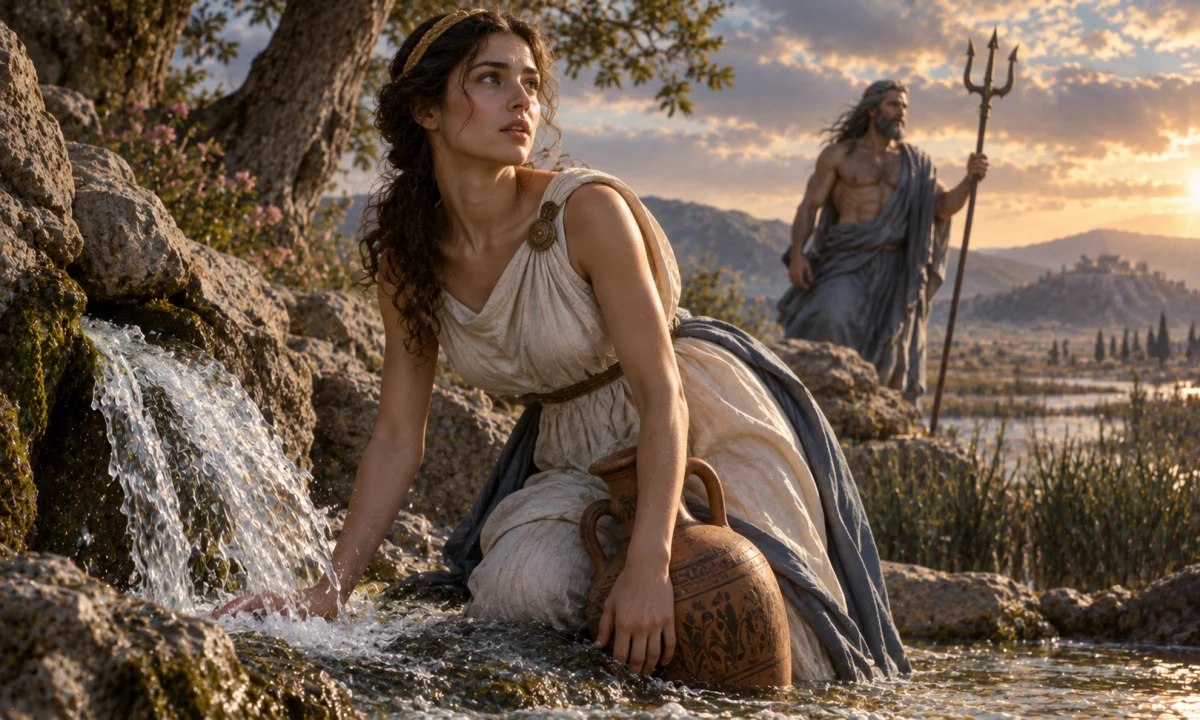
Amymone is a figure in Greek mythology, best known as one of the fifty daughters of Danaus and as the mortal woman associated with the spring of Lerna. In the most familiar version of her story, the god Poseidon rescues Amymone from a predatory satyr, becomes her lover, and reveals a source of water in the dry Argive land. Their son is usually identified as Nauplius, a later hero and the legendary founder of Nauplia.
Amymone is therefore connected with several important mythic themes: the Danaid family, the rivalry between gods over Argos, the sacred landscape of the Argolid, and the relationship between sexual encounter and the creation of springs. She is not normally treated as a goddess. Rather, she is a mortal princess whose story explains the origin or naming of a local water source and links that place to the divine genealogy of Poseidon.
Name and identity
The Greek name Amymone is commonly understood as meaning “blameless,” “without reproach,” or “faultless.” The name may be significant because Amymone belongs to the Danaids, a group whose stories often involve accusations, forced marriages, violence, and the question of guilt. The meaning does not by itself prove a particular interpretation, however, and ancient mythographers did not provide a single explanation of why she received the name.
Amymone is one of the daughters of Danaus, king of Libya and later ruler of Argos in Greek myth. Danaus is the son of Belus and the twin brother of Aegyptus. According to the larger Danaid legend, Aegyptus has fifty sons, while Danaus has fifty daughters. The sons of Aegyptus seek to marry the daughters of Danaus, but Danaus opposes the marriages and leads his daughters to Argos. The Danaids become suppliants there, claiming protection from the Argive king.
Amymone is one member of this large sisterhood, but surviving sources do not give her a fully consistent place in every version of the family tree. Ancient mythographers sometimes recorded different mothers for the daughters of Danaus, and lists of their names vary. Her identification as a daughter of Danaus is stable, while details about her marriage, descendants, and role in the Danaid crisis are less uniform.
The setting: Argos, Lerna and water
Amymone’s story is closely tied to the Argolid, the region of the northeastern Peloponnese that includes Argos, Nauplia and Lerna. In Greek mythology, Argos is an ancient kingdom with strong associations with Hera, Io, Danaus and the early generations of Greek heroes. The region also contains the springs and marshes of Lerna, a place that appears in several myths, most famously the story of Heracles and the Hydra.
The Argolid’s rivers and springs were important to its communities, and Greek myths often explained striking natural features through encounters between gods and mortals. A spring might be presented as the result of a god’s weapon striking the ground, a hero’s action, or a divine relationship with a local figure. Amymone’s story belongs to this type of etiological myth: it provides a mythic explanation for a place, a water source, and a geographical name.
In some accounts, the land of Argos is suffering from a lack of water after Poseidon has withdrawn or concealed its springs. The reason is connected with the god’s dispute with Hera over possession of the region. Hera is generally regarded as the victorious patron of Argos, while Poseidon retains a connection with the area through the sea, earthquakes and underground waters. The details of the dispute vary, but the general pattern helps explain why water becomes such an important element in Amymone’s story.
The encounter with the satyr
The best-known narrative is preserved in later mythographic tradition. Danaus sends his daughters to search for water. While Amymone is away, she throws a spear at a deer or stag. She misses the animal and strikes a sleeping satyr instead. The satyr awakens and attempts to assault her.
This scene is not a romantic courtship. The satyr’s behaviour is presented as a threat, and Amymone is placed in a dangerous situation before Poseidon appears. The god hears or witnesses the struggle and intervenes. In the mythographer’s account, Poseidon drives off the satyr and then has sexual relations with Amymone. The ancient narrative treats this encounter as the beginning of a divine-human union, but modern readers should distinguish it from a relationship based on equal consent. The power difference between a god and a mortal woman, together with the circumstances of the encounter, makes the story part of the wider pattern of coercive divine sexuality in Greek myth.
Afterward, Poseidon shows Amymone a source of water. In some versions he strikes the ground with his trident, opening the springs of Lerna. The water is called the Amymone, or is associated with Amymone as the woman through whom the spring receives its name. The story thus combines rescue, sexual violence, divine intervention and a landscape explanation in a single episode.
Poseidon and the spring
Poseidon is often remembered primarily as the god of the sea, but his ancient sphere was broader. He was also associated with earthquakes, horses, springs and subterranean waters. His power could be destructive, as when he caused earthquakes or floods, but it could also release water from the earth. The creation of the Lernaean spring is consistent with this wider profile.
The spring story also gives Poseidon a continuing connection with Argos despite Hera’s claim to the city. Mythic contests between gods frequently express the overlapping identities of Greek communities and sanctuaries. A city could honour one deity as its principal patron while retaining stories, shrines or natural features associated with another. Amymone’s encounter provides Poseidon with a local relationship to the Argolid without making him the permanent civic ruler of Argos.
Ancient descriptions of Lerna do not all use the same terminology or describe exactly the same body of water. Lerna was a watery, marshy region, and the name Amymone could refer to a spring or stream within the wider area. It is therefore safer to speak of an Amymone spring or watercourse at Lerna than to assume that every ancient reference identifies one precisely defined feature.
Amymone and Nauplius
The usual son of Amymone and Poseidon is Nauplius. In later heroic genealogy, Nauplius becomes an important figure associated with navigation, the coast and the city of Nauplia. His name is connected with the Argive landscape, and his descent from Poseidon gives him a suitable relationship to the sea.
Genealogical traditions about Nauplius are not completely consistent. Some accounts make him the son of Poseidon and Amymone, while other traditions give a different parentage to a hero named Nauplius. The divine genealogy is therefore part of a broader process by which local cities and heroic families were connected to major gods. The version involving Amymone is especially useful for linking Lerna, Poseidon and Nauplia, but it should not be treated as the only ancient genealogy.
Through Nauplius, Amymone becomes an ancestor of later heroic figures in some mythographic systems. Nauplius is associated with Palamedes, the clever hero of the Trojan War, although the exact family relationships differ between sources. These later genealogical connections expand Amymone’s significance beyond the spring at Lerna, but they are secondary to her principal myth.
Her place among the Danaids
The Danaids are best known for the violent wedding imposed on them by the sons of Aegyptus. Danaus agrees to the marriages but secretly gives each daughter a weapon and instructs them to kill their husbands on the wedding night. All but Hypermnestra obey. Hypermnestra spares Lynceus, and their descendants become part of the royal line of Argos.
Amymone’s personal role in this episode varies according to the source. Some later catalogues assign her a husband and include her among the Danaids who killed their husbands. One tradition names her husband as Enceladus, but such lists are not consistent, and the name can create confusion with the better-known giant Enceladus of the Gigantomachy. The sources do not give Amymone a single universally accepted marriage story comparable to the relationship between Hypermnestra and Lynceus.
In Aeschylus’ Suppliants, the Danaids appear collectively as suppliants seeking protection in Argos. Amymone is not developed there as an individual character. Aeschylus also wrote a drama titled Amymone, generally understood to have been a satyr play, but the work survives only in fragments and ancient testimony. Its original plot cannot be reconstructed with certainty. It may have dramatized the encounter with Poseidon and the satyr, but details of its staging and treatment are unknown.
Ancient sources and variations
No single ancient text preserves a complete and universally authoritative version of Amymone’s mythology. The story is known through a combination of mythographic, geographical and poetic traditions.
- Mythographic accounts preserve the episode in which Amymone searches for water, encounters the satyr and receives the spring from Poseidon.
- Geographical writing connects Amymone with the springs and landscape of Lerna, confirming that her name belonged to local tradition as well as to a narrative.
- Tragic drama used the Danaid family and may have treated Amymone as an individual subject, but the relevant play survives only in fragments.
- Genealogical traditions identify Nauplius as her son in some versions, while other accounts provide different origins for figures with the same name.
These traditions were written down at different times and for different purposes. A mythographer might aim to list family relationships, a dramatist might reshape the story for performance, and a geographer might preserve a local explanation for a spring. Differences between their accounts do not necessarily represent a simple contradiction; they show that Greek mythology consisted of overlapping local and literary traditions rather than one fixed canon.
Symbolism and interpretation
Amymone’s myth brings together the danger and value of water. At the beginning of the story, water is scarce and the Danaids must search for it. At the end, a spring has been opened and named through Amymone’s encounter with Poseidon. The narrative turns a moment of personal danger into an explanation for a source essential to the community.
The spear and the spring also connect hunting, violence and fertility. Amymone’s mistaken throw awakens the satyr, while Poseidon’s intervention produces water from the earth. Neither event is peaceful: the story is driven by missed violence, attempted sexual violence and divine power. Yet the result is a lasting natural feature that supports human life. Greek myths frequently use such tensions to explain how order, settlement or fertility emerges from a dangerous encounter.
Amymone’s story can also be read in relation to the status of women in the Danaid cycle. The Danaids are repeatedly threatened with marriages arranged by men and with the consequences of male power. Amymone is endangered by the satyr and then claimed by Poseidon, while the wider Danaid legend centres on forced marriage and resistance. Her name, “blameless,” may be especially striking within a family whose members are later judged for killing their husbands. Still, there is no secure evidence that ancient audiences interpreted the name as a deliberate moral defence of Amymone.
Her association with Lerna places her within a local religious landscape rather than presenting her as an independent goddess of springs. The water itself could have religious importance, and Poseidon’s presence reflects the sacred meaning of the site, but Amymone is chiefly a mythic ancestor and place-naming figure. There is no clear evidence for a widespread independent cult of Amymone comparable to the cults of major Greek deities.
Distinguishing Amymone from similar figures
Amymone should not be confused with the Danaid group as a whole. She is one of the fifty daughters of Danaus, not another name for all the Danaids. She is also distinct from Hypermnestra, the one Danaid most consistently said to have spared her husband. Amymone’s own conduct during the mass wedding is uncertain and depends on variant catalogues.
She should also be distinguished from Amymone the spring as a geographical name. Ancient writers could use the same name for the woman and for the watercourse associated with her. The relationship is one of mythic naming, not evidence that the spring and the mortal figure were separate supernatural beings.
Finally, Amymone is not the same as Amphitrite, Poseidon’s divine consort, or as any of the Nereids and Oceanids associated with the sea. Amymone is a mortal Argive princess who enters Poseidon’s genealogy through a specific local myth. Her importance lies in the meeting of human ancestry, divine power and the physical landscape of Lerna.