WORLD
WORLD
Amphitrite
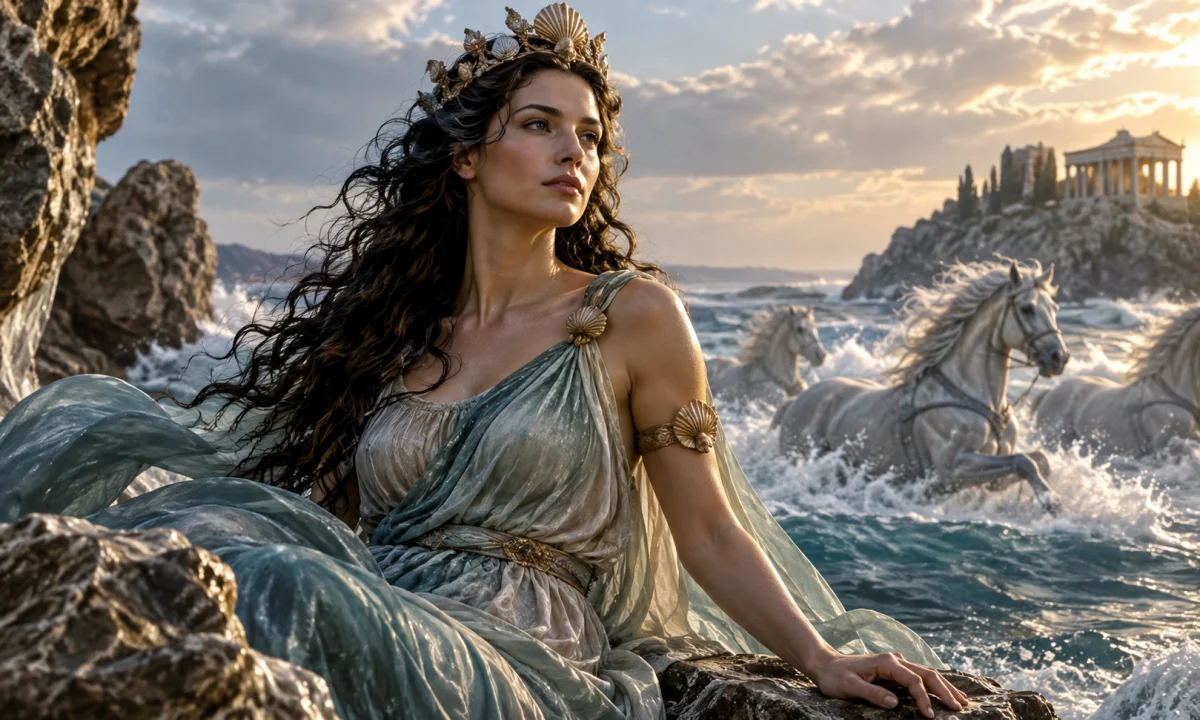
Amphitrite is a goddess of the sea in Greek mythology, best known as the wife and queen of Poseidon. In early Greek tradition she belongs to the Nereids, the fifty sea nymphs born to the ancient sea god Nereus and the Oceanid Doris. Later stories and artistic traditions give her a more exalted status, presenting her as the female ruler of the sea beside Poseidon. Although she is sometimes described in modern writing as a Greek mermaid, ancient sources portray her primarily as a divine sea woman, queen, wife, and mother rather than as a creature of a distinct merfolk species.
Origins and place in Greek mythology
Amphitrite appears within the older generation of marine deities that existed before the Olympian gods fully dominated Greek myth. Her father, Nereus, was an ancient and benevolent sea god often called the “Old Man of the Sea.” Her mother, Doris, was an Oceanid, one of the daughters of the Titans Oceanus and Tethys. Amphitrite was therefore one of the Nereids, alongside better-known figures such as Thetis, Galatea, and Psamathe.
The Nereids were associated with the sea’s changing forms and with the protection of sailors. They could appear as beautiful young women, move through the waves, and assist gods or heroes. Their number and names are most famously preserved in the Theogony attributed to Hesiod, which includes Amphitrite in its catalogue of Nereid daughters. In that setting, she is not initially presented as an independent sea empress with a large mythology of her own. Her importance grows through her marriage to Poseidon and through later visual and literary representations.
Amphitrite’s status illustrates the layered nature of Greek mythology. A deity could belong to an old divine family while acquiring a new role within the religious order associated with Zeus and the Olympians. Poseidon was a major Olympian god, ruler of the sea, earthquakes, and horses. His marriage made Amphitrite his female counterpart in royal imagery, even though she did not possess the same extensive cycle of myths or the same broad cult presence as her husband.
The name and identity of Amphitrite
The meaning of the name Amphitrite is uncertain. It is often connected with Greek words suggesting something that surrounds or flows around, leading to interpretations such as “the encircling one” or “she who is around.” Such explanations fit a sea goddess, since the sea surrounds lands and encircles the world in ancient geographical imagination. The exact linguistic history, however, is not completely settled, and the name should not be treated as having one universally proven translation.
In early poetry Amphitrite can function almost as a poetic name for the sea or for a powerful aspect of the marine realm. Homeric language uses her name in expressions connected with the loud or restless sea. The Homeric Hymn to Poseidon, for example, places Amphitrite beside Poseidon as his consort. These references do not always provide a detailed personality or narrative biography; they assume that audiences already recognized her as an important female sea divinity.
Her identity should also be distinguished from that of other ancient sea goddesses. Amphitrite is a Nereid, while Tethys is a Titan goddess associated with the nourishing waters of the world and the mother of Oceanids. Thetis is another Nereid, famous for her marriage to the mortal Peleus and for being the mother of Achilles. Galatea, also a Nereid, appears in a separate story involving the Cyclops Polyphemus. Their shared marine setting and similar names in some later retellings can lead to confusion, but they are different figures.
Marriage to Poseidon
Amphitrite’s central mythological relationship is her marriage to Poseidon. Greek myth often explains divine marriages through the establishment of cosmic or political order: a god’s consort helps define his authority and gives that authority a family and dynastic structure. As Poseidon’s wife, Amphitrite is the queen of his underwater kingdom and the principal female figure of his household.
Some later mythographers tell a story in which Poseidon desired Amphitrite, but she withdrew from him and hid near Mount Atlas. Poseidon’s search for her and her return to his kingdom are associated in different versions with the dolphin, which either discovered her hiding place or persuaded her to accept the marriage. This story is not equally prominent in all ancient sources, and details vary. The dolphin’s role is especially important in later artistic and mythographic traditions, where it becomes a symbol of the sea god’s court and of Amphitrite’s restoration to her royal position.
The ancient evidence does not present one fixed version of the relationship. In some contexts, Amphitrite is simply named as Poseidon’s wife without any account of courtship. In others, the emphasis falls on the emotional tensions familiar from myths about divine marriages. Modern retellings sometimes expand the story into a dramatic romance or present Amphitrite as jealous of Poseidon’s many affairs. Such developments draw on broader Greek stories about Poseidon’s relationships, but they should not be mistaken for a single, consistently preserved ancient biography of Amphitrite.
Children and family connections
Amphitrite is commonly identified as the mother of Triton, the herald or messenger of the sea. Triton is usually depicted as a male sea deity with a human upper body and the tail of a fish. He carries a large conch shell, whose blast can calm or stir the waves. In accounts where Amphitrite is Triton’s mother, she forms part of the divine family surrounding Poseidon’s palace beneath the sea.
Other children are attributed to Amphitrite and Poseidon in different sources or later traditions. These include Rhode, a sea-associated goddess connected with the island of Rhodes, and Benthesikyme, whose name is associated with the waves. The parentage of these figures is not uniform across Greek mythology. Ancient genealogies frequently vary according to local traditions, poetic purposes, and the interests of particular authors, so no single family tree should be assumed to represent all Greek belief.
Amphitrite is not normally described as the mother of all of Poseidon’s famous children. The heroic figures Pegasus and Chrysaor, for example, are associated with Medusa in the familiar myth, while the giant Orion has several different traditions of birth. Likewise, the Cyclops Polyphemus is generally described as a son of Poseidon and the nymph Thoosa, not Amphitrite. These distinctions matter because later summaries sometimes turn the queen of the sea into a universal mother figure without support from the older traditions.
Appearance and attributes
Ancient texts do not give Amphitrite one fixed physical appearance. As a Nereid, she could be imagined as a beautiful woman associated with the waves, but the specific combination of human and aquatic features varies by period and medium. Early Greek art often represented sea deities in fully human form. Later Greek and Roman artists increasingly developed elaborate marine imagery in which gods and nymphs travel among dolphins, sea monsters, winged sea horses, and personified waves.
Amphitrite is frequently shown wearing a crown, veil, or elaborate robes, emphasizing her status as queen. In Roman-period art, she may appear beside Neptune, the Roman god identified with Poseidon, in scenes of a marine triumph. She can ride in a shell-shaped vehicle or chariot drawn by sea creatures, including dolphins or hippocamps. A hippocamp is a fabulous creature with the foreparts of a horse and the tail of a fish; it should not be confused with a traditional mermaid or with an actual animal from Greek belief.
She may also be accompanied by Triton and other marine beings. Her imagery belongs to a broader artistic language of abundance, movement, and controlled natural power. The sea is dangerous and unpredictable, but in royal procession scenes it becomes an ordered realm governed by Poseidon and Amphitrite. Their presence transforms the waves into a divine court, complete with attendants, musicians, messengers, and fantastic animals.
The dolphin is particularly associated with Amphitrite in later representations because of the story of her discovery or persuasion by a dolphin. Dolphins already had a strong place in Greek maritime imagination. They could rescue people, guide ships, carry divine beings, and symbolize the benevolent as well as mysterious character of the sea. Their appearance beside Amphitrite therefore reflects both narrative tradition and general marine symbolism.
Role and symbolism
Amphitrite’s role is less sharply defined than that of Poseidon. Poseidon is directly associated with storms, earthquakes, horses, springs, and the authority of the sea. Amphitrite is more often presented as the sea’s queen and as a personification of its majesty, depth, and surrounding power. Her significance comes from her place within the divine household rather than from a clearly bounded portfolio.
Her marriage to Poseidon can be read as an image of partnership within the sea’s divine order. Poseidon represents a force that can be violent and disruptive, while Amphitrite’s royal presence helps express the sea as a structured realm with its own court and lineage. This should not be turned into a rigid symbolic opposition between a “masculine” storm god and a “feminine” peaceful sea goddess; Greek sources do not establish such a simple division. Both figures can be connected with the sea’s danger, power, and unpredictability.
Amphitrite’s connection with the Nereids also links her to the protective and responsive aspects of marine nature. The Nereids frequently assist sailors or heroes, particularly in stories where someone is lost, pursued, or in danger at sea. Amphitrite herself does not have a single famous rescue narrative comparable to Thetis’s role in the story of Achilles, but her family identity places her within this wider network of sea beings who mediate between humans and the ocean.
Religious evidence and cultural setting
The literary prominence of Amphitrite should not be confused with evidence for a large, independent cult devoted to her throughout Greece. Poseidon had important sanctuaries and festivals in several regions, especially places connected with maritime activity, horses, earthquakes, or competition. Amphitrite is sometimes included in artistic or religious contexts connected with Poseidon, but surviving evidence does not establish an equally widespread cult system of her own.
Greek religion was not organized around one universally standardized mythology. Local communities could honor related gods under different titles, emphasize particular myths, or combine divine figures in ways that do not appear in major poetry. Amphitrite’s relatively limited surviving cult evidence may partly reflect her role as Poseidon’s consort, but it also reflects the uneven preservation of ancient inscriptions, sanctuaries, images, and local traditions.
Her presence in poetry and art nevertheless shows that she was culturally recognizable. A reference to Amphitrite could evoke the open sea, the surrounding waters, or the royal domain of Poseidon without requiring a lengthy explanation. In visual culture, she helped identify a marine procession as a divine one and gave the sea a queenly, personified form.
Amphitrite in Greek and Roman art
Amphitrite became especially popular in Hellenistic and Roman artistic traditions, when elaborate scenes of the sea were common in mosaics, frescoes, sarcophagi, and decorative sculpture. Roman artists often adapted Greek gods to their own visual language. Amphitrite was consequently shown beside Neptune, the Roman counterpart of Poseidon, although the relationship between Greek and Roman deities is one of cultural adaptation rather than exact identity in every context.
Scenes of Neptune and Amphitrite travelling through the sea could symbolize triumph, prosperity, marriage, or the power of a ruler. Their marine procession might include Nereids, Tritons, dolphins, sea horses, and other hybrid creatures. In funerary art, sea imagery could have several possible associations, including travel, transformation, abundance, or the passage into another realm. The precise meaning of a particular image depends on its setting, date, and accompanying symbols.
Artistic convention also encouraged the development of an appearance that modern viewers may identify as mermaid-like. Yet the ancient Mediterranean visual tradition did not treat Amphitrite as the equivalent of every later mermaid figure. She was a goddess with a specific genealogy and relationship to Poseidon, and her fish-tailed or shell-borne representations belong mainly to later artistic conventions rather than to one fixed description in early Greek poetry.
Distinguishing Amphitrite from similar figures
- Amphitrite and Thetis: Both are Nereids, but Thetis is chiefly known for her marriage to Peleus and motherhood of Achilles. Amphitrite is the wife of Poseidon and queen of the sea.
- Amphitrite and Tethys: Tethys is a Titan goddess and the consort of Oceanus. She belongs to an older divine generation and is not the same figure as the Nereid Amphitrite.
- Amphitrite and Galatea: Galatea is another Nereid, associated in a later literary story with Polyphemus. Her name and marine setting do not make her an alternate identity of Amphitrite.
- Amphitrite and Salacia: Salacia is a Roman water goddess who was associated with Neptune. The two are often compared as divine sea wives, but they arise from different religious traditions and should not automatically be treated as identical.
- Amphitrite and mermaids: Amphitrite is a Greek goddess, not a generic mermaid. Fish-tailed representations belong mainly to later artistic developments, while early mythology places her among the Nereids.
Later reception
Amphitrite continued to appear in European painting, sculpture, poetry, decorative arts, and neoclassical design. Artists used her as an embodiment of the sea’s grandeur, often pairing her with Neptune in fountains, palace decoration, and allegorical scenes. In these works she may represent maritime power, abundance, navigation, or imperial control rather than a specific act from Greek myth.
Modern popular culture sometimes presents Amphitrite as a powerful ocean queen, a mermaid-like character, or a mother figure within expanded fictional versions of the Olympian family. These portrayals can draw inspiration from her ancient position beside Poseidon and her association with Triton, but they often add personalities, conflicts, powers, and relationships not preserved in classical sources. The traditional Amphitrite remains a Nereid elevated to the rank of Poseidon’s consort and sea queen: an important figure in the mythology and imagery of the Mediterranean sea, even though her individual myths are fewer and less uniform than those of many better-known Greek gods.