WORLD
WORLD
Aloadae
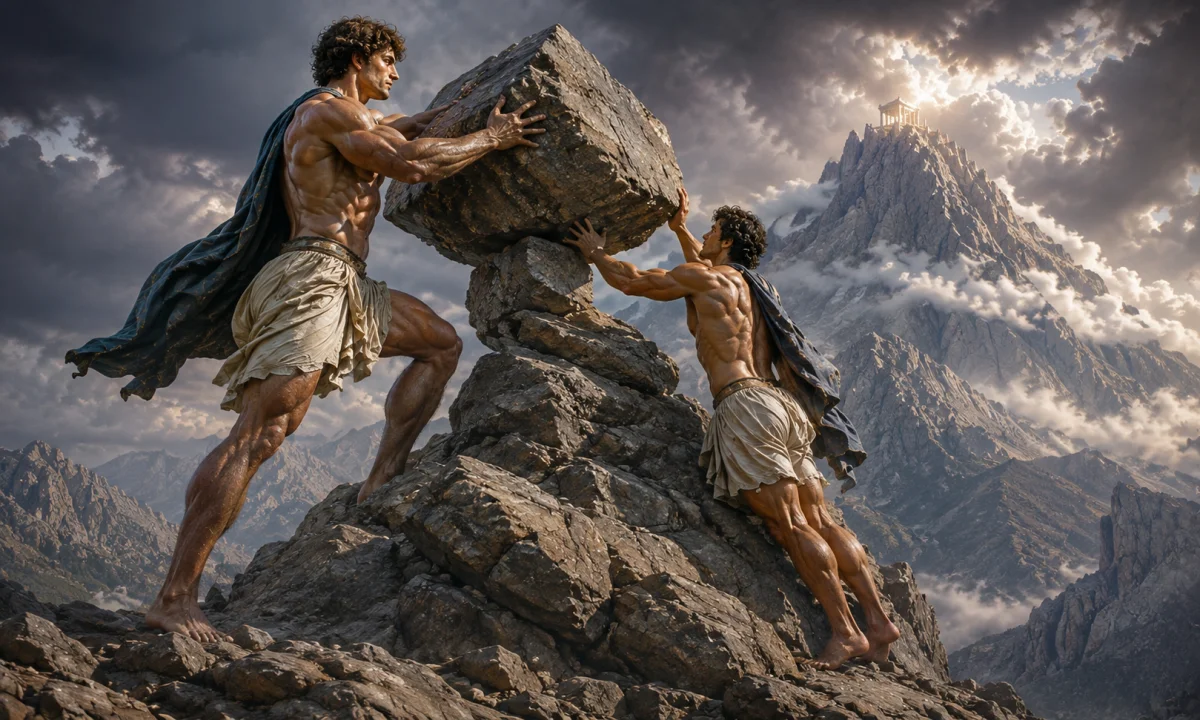
The Aloadae were Otus and Ephialtes, gigantic twin brothers in Greek mythology. Their name means the “sons of Aloeus,” although several ancient traditions identify Poseidon rather than Aloeus as their biological father. They are remembered for their extraordinary growth, an attempt to challenge the gods by piling mountains toward heaven, the imprisonment of Ares, and their unusual death through a trick involving Artemis. The Aloadae are sometimes described as giants, but they are not simply interchangeable with the older race of Gigantes who fought the Olympian gods in the Gigantomachy.
Origins and family
The name Aloadae comes from Aloeus, a Thessalian or Boeotian figure whose exact identity varies among ancient traditions. In the Odyssey, Otus and Ephialtes are presented as the sons of Aloeus. The poem does not develop their family history in detail, and later mythographers supplied explanations for why they bore his name.
One influential version makes their mother Iphimedeia, the wife of Aloeus. She had fallen in love with Poseidon and, according to the myth preserved by Apollodorus, repeatedly went to the sea, scooped up its water in her hands, and poured it over herself. Poseidon responded to her desire, and she gave birth to Otus and Ephialtes. Aloeus then raised the children, which explains their identification as his sons even if Poseidon was regarded as their divine father.
This double parentage is characteristic of Greek heroic genealogy. A child could be connected socially and legally to one mortal household while also possessing a divine biological parent. The story therefore presents the Aloadae both as members of the human heroic world and as beings with a special relationship to the gods. Their superhuman size and strength reinforce the connection with Poseidon, a god associated with the overwhelming power of the sea, earthquakes and the disruption of natural boundaries.
The name Ephialtes also appears in later Greek tradition as a word for a nightmare or a being that presses upon a sleeper. That nocturnal figure is not automatically the same as the mythological son of Aloeus. The shared name has encouraged confusion, but the Aloada Ephialtes is principally a gigantic heroic figure in epic and mythography.
The Aloadae in early Greek epic
The oldest substantial account of the brothers appears in the Odyssey, where Odysseus encounters the dead during his journey to the underworld. Otus and Ephialtes are described as exceptionally large and powerful. They are said to have grown at an astonishing rate, becoming a cubit taller and a fathom broader each month. The measurements are poetic rather than anatomical records, and their purpose is to emphasize an unnatural, almost unstoppable growth.
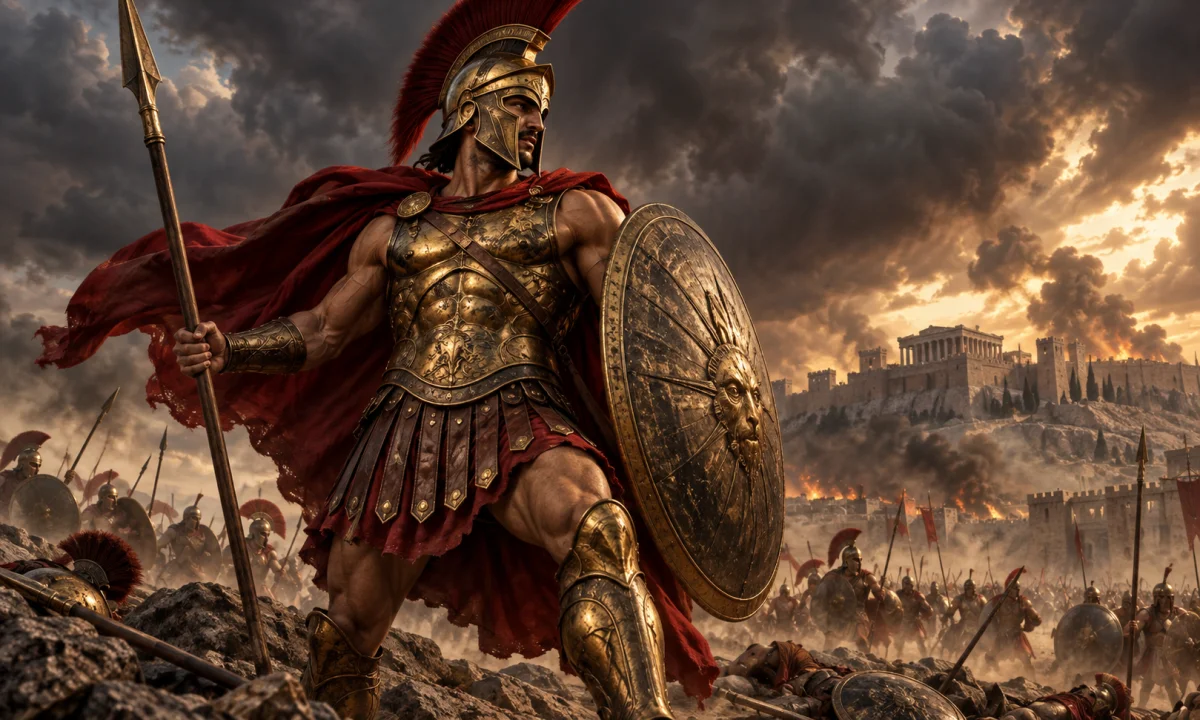
The poem says that the brothers intended to attack the gods. They planned to place Mount Ossa on Mount Olympus and Mount Pelion on Ossa, creating a stairway by which they could reach the heavens. This image became one of the most memorable expressions of the Aloadae myth. Mountains, normally symbols of divine permanence and cosmic order, become building materials in the hands of two young beings who regard the structure of the world as something that can be rearranged.
Their plan was not completed. In the Odyssey, they die before reaching full maturity. The precise manner of their death is treated more briefly than in later accounts, and the poem emphasizes what they might have accomplished if their growth had continued. Their danger lies not only in what they have done but in the possibility that their power will increase beyond all control.
The Iliad preserves another important episode. It explains that the Aloadae once captured Ares, the god of war, and confined him in a bronze vessel. Ares remained imprisoned for thirteen months, and his strength gradually failed. He would have died or disappeared from the divine world if Hermes had not discovered his location and rescued him. This story gives the brothers a striking status: they are not merely large mortals who threaten minor heroes, but beings capable of overpowering an Olympian god.
The episode also has a comic or humiliating quality. Ares is a god whose identity is bound to violence, battle and physical force, yet the supposedly invincible war god is defeated and hidden away by two gigantic youths. The myth may have functioned as a reminder that even divine power could be temporarily frustrated by cunning, surprise or the reckless strength of monstrous beings.
Names, identity and classification
Aloadae is a collective family name rather than the name of a single creature. The two brothers are usually named as Otus and Ephialtes. Their names and identities are stable across the principal versions, although details of their parentage, death and motives vary.
Ancient writers do not classify them in one consistent way. They may be called enormous men, heroes, sons of a god, or giant-like beings. Their huge stature places them close to the world of giants, but the myth does not necessarily make them members of the Gigantes, the earth-born opponents of Zeus in the Gigantomachy. In Greek mythology, “giant” can describe size and force without indicating membership in a single biological race.
The Aloadae are also distinct from Orion, another enormous hunter and heroic figure. Some ancient passages compare their stature with his, and later retellings may place several giant figures in the same imaginative category. Nevertheless, Orion has his own genealogy and myths, while Otus and Ephialtes belong specifically to the Aloeus family and the stories of their assault on the divine order.
The mountain-stacking challenge
The attempt to reach heaven by piling mountains is the central image associated with the brothers. Mount Olympus was the home of the Olympian gods, while Ossa and Pelion were prominent mountains of northern Greece. The arrangement of the mountains reflects a recognizable landscape, but the myth turns geography into a form of cosmic engineering.
Different versions present the brothers’ motives in different ways. In the oldest epic account, their ambition is simply to reach the gods and challenge them. Later mythographers sometimes give the episode a more personal and erotic dimension, saying that Otus desired Artemis and Ephialtes desired Hera. These motives should not be projected backward into every version. The earliest surviving accounts focus on physical ascent and rebellion rather than on a detailed plan to marry or seize particular goddesses.
The story belongs to a wider Greek pattern in which mortals or semi-divine beings attempt to cross the boundary between human and divine worlds. Such attempts may involve building toward heaven, attacking the gods, seeking divine partners or claiming powers that properly belong to Olympus. The resulting punishment restores the distinction between the two realms. In the case of the Aloadae, however, their youth and potential make the story more complicated: they are defeated before their strength fully matures, so the myth preserves a sense of danger that was never completely tested.
How the brothers died
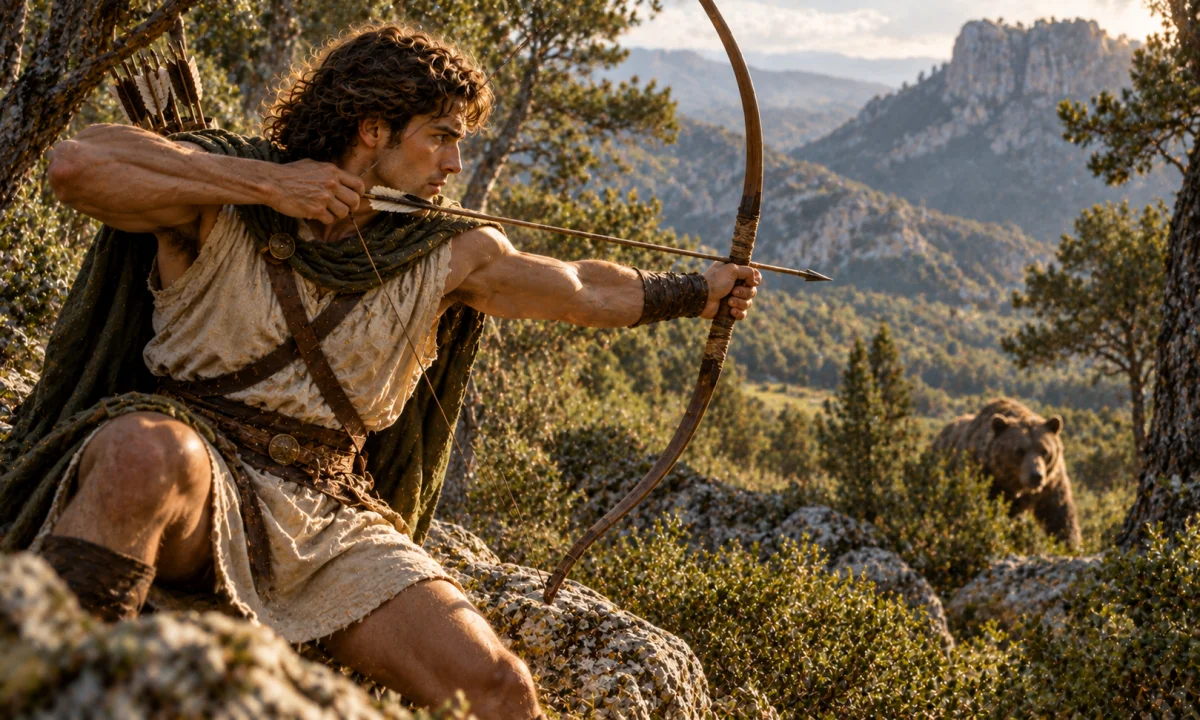
The brothers’ death is told in more than one form. In Homeric tradition, Apollo is associated with their destruction. The Odyssey says that they were killed before the first signs of manhood appeared on their faces, while later readings of the Homeric material connect their death with Apollo, the archer god. This version presents divine archery as the answer to their immense physical power.
The most famous later account appears in the mythography attributed to Apollodorus. In that version, Artemis transformed herself into a deer and ran between the two brothers while they were hunting. Otus and Ephialtes threw their spears at the animal, but the deer sprang aside. The brothers consequently struck and killed one another.
This story resembles other Greek myths in which a god uses a sudden change of shape, an animal or a deceptive movement to defeat an opponent who cannot be overcome directly. It also makes the brothers’ strength self-destructive. Their weapons are powerful enough to kill them, but their failure lies in haste and misjudgment rather than in lack of force.
Some retellings divide the credit between Apollo and Artemis, with Apollo killing one brother and Artemis killing the other; others preserve the hunting accident in which the twins kill each other. These should be treated as variant traditions rather than combined into one fixed sequence. Ancient mythology often circulated through poems, local stories and mythographic summaries, and not every version attempted to reconcile conflicting details.
The Aloadae in the underworld
The brothers’ fate after death also varies. The Odyssey places them among the dead seen by Odysseus, reinforcing their status as figures whose earthly ambition ended in destruction. Later poetic traditions, especially those influenced by underworld catalogues, depict them as bound or restrained in Hades.
In these later images, the Aloadae may be tied to a column with serpents, sometimes with an owl placed nearby. Such details are not part of every early account, and they should not be treated as the universal form of their punishment. They reflect a broader ancient interest in displaying famous offenders in the underworld, where the posture of the punished body expresses the nature of the crime.
Their restraint is especially meaningful because the brothers are defined by movement and expansion. They grow upward, climb toward heaven, move mountains and seize a god. Binding them reverses all of these actions. The beings who tried to reshape the world are reduced to immobility in the realm of the dead.
The imprisonment of Ares
The capture of Ares is separate from the mountain-stacking episode, although both stories establish the same theme: the Aloadae possess enough strength to violate the normal hierarchy between gods and other beings. The bronze vessel in which Ares is confined is an especially memorable detail. Bronze is associated with weapons, armor and an early heroic age, making the container an appropriate prison for the god of war.
The episode does not mean that the Aloadae permanently defeated Ares or replaced him. Their success is temporary, and Hermes eventually locates and frees him. The rescue preserves the divine order while allowing the brothers’ achievement to remain extraordinary. In mythic terms, they are dangerous because they can win a battle, not because they can permanently overthrow Olympus.
The story may also contrast different forms of power. Ares represents organized violence and divine warfare, while the Aloadae embody youthful physical excess and uncontrolled growth. A god who dominates battlefields can still be defeated by opponents who are stronger, more numerous or unexpectedly audacious. Yet the rescue by Hermes, a god of movement and intelligence, suggests that force alone is not the decisive power in the tale.
Symbolism and interpretation
The Aloadae can be understood as figures of unchecked growth. Their bodies increase at a rate no human life can sustain, and their ambitions expand along with their size. The myth links physical immensity with social and cosmic overreach: those who become too large for the human world attempt to enter the divine one.
The brothers are also a pair whose identity depends on cooperation. Together they imprison Ares and plan to climb into heaven. Their partnership gives them strength, but the later hunting story shows how their closeness becomes a weakness. They act as a unit, respond to the same target and fail to recognize one another as dangers. The twins’ inability to separate the true enemy from the apparent one turns shared power into mutual destruction.
The mountain episode has a geographical dimension as well. Greeks knew Ossa, Olympus and Pelion as real mountains, and their proximity helped create a vivid local landscape for a story about divine ambition. The myth does not need to be understood as a literal explanation of mountain formation. Instead, it imagines the landscape as evidence of heroic or monstrous action, transforming familiar terrain into part of a cosmic drama.
The brothers’ youth is another important feature. They are not portrayed as aged tyrants with long-established kingdoms. They are rapidly growing youths whose power has outrun their judgment. The suggestion that they might have succeeded if they had reached maturity creates a disturbing counterfactual: the gods defeat them, but only narrowly enough for the possibility of greater future danger to remain in the story.
Distinguishing the Aloadae from similar figures
- The Gigantes: The Aloadae are giant-like, but they are not automatically members of the earth-born Gigantes who fought the Olympians in the Gigantomachy.
- Orion: Orion is another gigantic hunter, but he is a separate mythological figure with different family traditions and adventures.
- Ephialtes the nightmare: The name Ephialtes was later associated with a nightmare or sleep demon. That being should not be confused with the son of Aloeus.
- Typhon: Typhon is a monstrous enemy of Zeus whose revolt belongs to a different tradition. The Aloadae are brothers with a heroic genealogy, not a single storm or serpent monster.
- The Titans: The Aloadae are not Titans, the older divine generation overthrown by Zeus and the Olympians.
Later reception
Roman poets inherited the Aloadae as examples of enormous beings who challenged divine order. Their names appear in underworld and heroic catalogues alongside other famous offenders, especially when poets wished to evoke the grandeur of ancient punishment. Later artists and writers have been drawn to the mountain-stacking image because it offers a dramatic picture of ambition made physical.
In modern popular culture, the Aloadae occasionally appear in fantasy fiction, games and retellings of Greek mythology as giant brothers or exceptionally powerful adversaries. These adaptations may combine the mountain assault, the capture of Ares and the Artemis hunting story into a single narrative. Such combinations are creative simplifications rather than evidence that every ancient source told the same story.
The traditional myths remain most distinctive when their differences are preserved. Homer emphasizes the brothers’ frightening growth, their assault on the divine realm and their imprisonment of Ares. Later mythography expands their genealogy and gives them a trickster-like death through Artemis. Taken together, these traditions present the Aloadae as an unstable boundary between heroic humanity and monstrous divinity: born into a family, endowed with divine ancestry, gifted with impossible strength and destroyed by the limits of their own ambition.