WORLD
WORLD
Alectrona
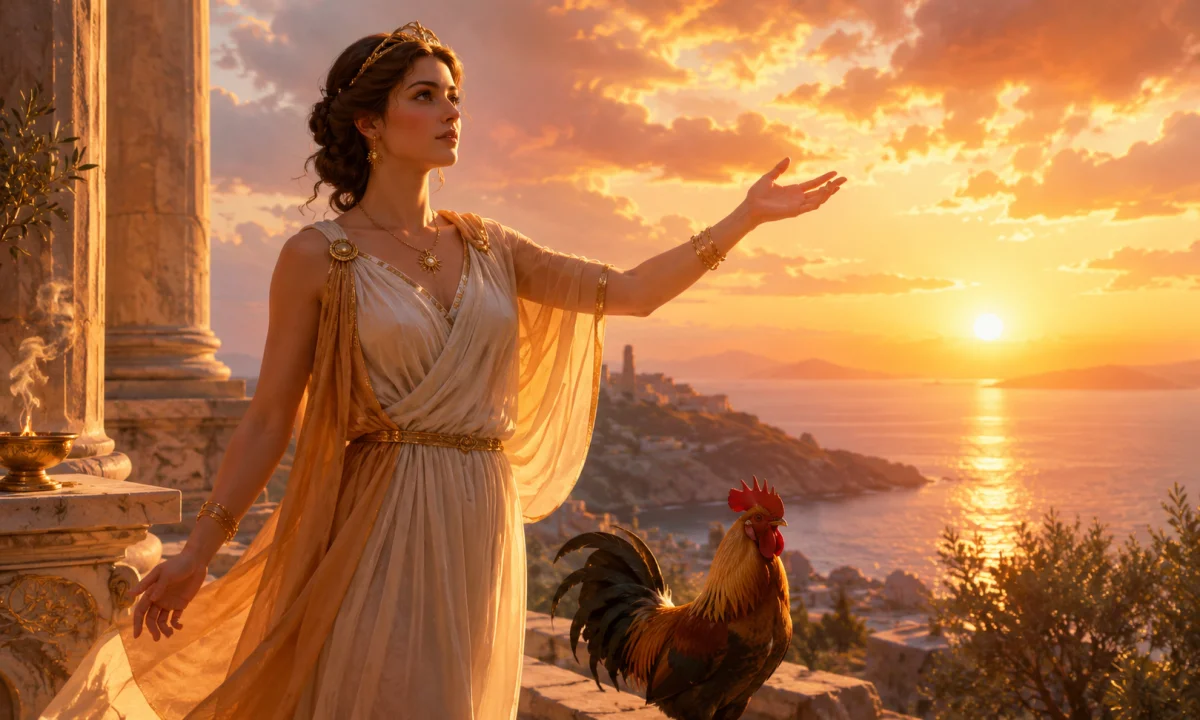
Alectrona is a little-known female figure connected with the Greek mythology of Rhodes. She belongs to the family of Helios, the sun god, and is described in ancient tradition as the daughter of Helios and the Rhodian princess Rhodos. Unlike major Olympian deities, Alectrona does not possess a substantial independent mythology. The surviving accounts present her chiefly as a local heroine of Rhodes who died unmarried and received heroic honours after her death.
Origins in Rhodian mythology
Alectrona belongs to a group of stories explaining the origins and identity of the island of Rhodes. In Greek tradition, Rhodes was especially associated with Helios. One myth told that the island rose from the sea after the other gods had divided the world among themselves and Helios was absent from the allocation. When Helios returned, Zeus allowed him to claim the newly emerged island. This story helped establish the sun god as the principal divine patron of Rhodes.
Another version describes Helios as the husband or lover of Rhodos, a daughter of the sea god Poseidon and Amphitrite, or in some accounts of another sea-related divine lineage. Their children were the Heliadae, the sons and descendants who became ancestral figures in Rhodian legend. Alectrona is presented as their sister.
The exact family arrangement varies according to the source and the way the names are transmitted. Rhodian mythology was not a single fixed narrative system, and ancient writers often preserved local traditions in abbreviated or adapted forms. The stories of Helios, Rhodos and their children functioned partly as foundation myths: they connected the island, its ruling families and its religious institutions with the divine order.
Ancient sources and local tradition
The most important surviving literary account of Alectrona appears in the fifth book of Library of History by Diodorus Siculus, a Greek historian writing in the first century BCE. In his discussion of Rhodes, Diodorus describes the island’s connection with Helios and lists the children born to Helios and Rhodos. A daughter, whose name is commonly rendered as Electryone or Alectrona, is said to have died while still a virgin. The Rhodians then honoured her as a heroine and established a cult connected with her memory.
Diodorus is not presenting Alectrona as one of the major gods of the wider Greek world. His account instead reflects a local Rhodian tradition. The distinction is important: a figure could possess a sanctuary, receive offerings or be honoured as a hero without being regarded as an Olympian deity. Greek religious practice included many local heroes and ancestral beings whose worship was meaningful in one city or region but left little trace elsewhere.
The poet Pindar also connects Rhodes with Helios and the Heliadae in Olympian Ode 7, although his account does not provide the same detailed treatment of Alectrona. Pindar’s poem celebrates the Rhodian connection with the sun god and presents the island as a place favoured by divine power. Together, Pindar and Diodorus show the importance of Helios and his family in the cultural imagination of Rhodes, while also demonstrating that individual details could differ between literary traditions.
Ancient evidence for Alectrona’s cult is limited. The literary tradition indicates that she received heroic honours, but it does not preserve a large body of hymns, myths or ritual instructions. Claims that she was widely worshipped throughout Greece, or that she possessed a clearly defined role in the daily movement of the sun, go beyond what the surviving evidence securely establishes.
Name and spelling
The name appears in more than one form because Greek names were transliterated differently and ancient manuscripts sometimes preserve variant readings. Common forms include Alectrona, Alectryona and Electryone. The Greek spelling associated with the name is related to alektryōn, a word meaning “cock” or “rooster,” although the exact significance of the personal name is not certain.
The rooster was associated with wakefulness and the announcement of dawn, which has encouraged later writers to interpret Alectrona as a goddess of morning or sunrise. Such an interpretation is understandable as a modern attempt to connect her name with solar imagery, but the ancient evidence does not clearly assign her that function. Diodorus treats her as a deceased daughter of Helios honoured as a heroine, not as a goddess who governs dawn.
The variant Electryone should not automatically be treated as a separate figure. It is generally understood as a different spelling or transliteration of the Rhodian heroine’s name. At the same time, the name must be distinguished from the better-known male figure Alectryon, who appears in a separate myth involving Ares and Aphrodite.
Family and classification
Alectrona’s parentage is usually given as follows:
- Father: Helios, the personification or god of the sun.
- Mother: Rhodos, the divine or semi-divine female figure who represents the island of Rhodes in myth.
- Siblings: the Heliadae, although the number and names of these brothers vary between accounts.
Her classification is more precise as a Rhodian heroine than as a major goddess. Greek religion did not always draw a sharp modern-style boundary between “mythological character,” “hero,” “ancestor” and “local deity.” A dead person of exceptional lineage could receive ritual respect, and a figure connected with a city’s foundation or ruling families could become part of its sacred identity.
Alectrona’s status therefore reflects the local religious culture of Rhodes. Her divine parentage gives her an elevated position, but her death as a young unmarried woman and her subsequent heroic cult distinguish her from Helios himself. There is no strong evidence that she had a broad cult across the Greek world or a standard place among the Olympian gods.
The story of Alectrona’s death
The central detail of Alectrona’s story is brief: she died while still a virgin. The surviving account does not provide a dramatic cause of death, a monster, a divine punishment or a long sequence of adventures. Her unmarried death is the significant fact preserved by the tradition.
After her death, the Rhodians honoured her as a heroine. In the context of Greek religion, this could involve a shrine, offerings or commemorative rites associated with the deceased figure. A hero cult did not necessarily mean that worshippers believed the hero to be immortal in the same way as a god. Instead, the dead person was thought to possess a continuing presence or influence that could be approached through ritual.
The story may have helped preserve the memory of a female member of the divine ancestry claimed by Rhodes. The Heliadae were associated with the island’s early population, technical skills and ruling traditions, while Alectrona offered a related female figure whose importance rested not on descendants or political power but on her sacred memory. Nevertheless, the evidence is too limited to identify a single original meaning for her virginity or death.
It is possible to interpret her as a symbolic figure connected with the purity, antiquity or sacred ancestry of the island, but these are interpretations rather than explicit statements made by the surviving ancient sources. The tradition does not explain why her death was significant, and it should not be expanded into a detailed biography unsupported by the evidence.
Helios, Rhodes and the Heliadae
Alectrona becomes easier to understand when placed within the larger Rhodian mythology of Helios. Rhodes was one of the strongest centres of the sun god’s worship. In local tradition, Helios was not merely a distant cosmic power: he was the divine patron whose relationship with the island explained its origin and prosperity.
The Heliadae, the sons of Helios and Rhodos, were often represented as exceptional or gifted ancestors. Some accounts connect them with the foundation of cities on Rhodes and with technical or artistic achievements. Their stories explain why Rhodians regarded themselves as descendants of a divine and distinguished lineage.
Alectrona occupies a quieter position within this family. She does not establish a city, rule a kingdom or produce a famous heroic line. Her importance comes from her place in the island’s sacred genealogy and from the honour granted to her after death. The contrast between her and her brothers also shows that ancient myths did not require every member of a divine family to have an elaborate narrative role.
Was Alectrona a goddess of dawn?
Modern summaries sometimes describe Alectrona as a goddess of the morning, dawn or the rising sun. This description is not securely supported by the principal ancient account. Her father Helios naturally gives her a solar association, and her name’s possible relationship to the rooster may have encouraged a connection with dawn. However, neither the surviving literary tradition nor the known outline of her Rhodian cult establishes her as a goddess with a specific duty over sunrise.
The Greek world already had better-attested figures associated with dawn and the morning. Eos was the widely known goddess of dawn, while the rooster could serve as a general symbol of daybreak and vigilance. Alectrona should not be merged with Eos merely because both can be linked by later interpretation to the beginning of day.
It is more accurate to say that Alectrona was a Rhodian heroine of solar ancestry whose name may contain a rooster-related element. Her connection with the sun is genealogical and regional in the surviving evidence, not proof of a separate universal solar office.
Distinction from Alectryon
Alectrona is often confused with Alectryon, a male figure from a different myth. Alectryon was associated with Ares, the god of war. In the story, Ares appointed him to stand watch while Ares met Aphrodite. Alectryon failed to remain alert and did not warn Ares in time when the sun god Helios discovered the affair. As punishment, Ares transformed him into a rooster, the bird that announces the coming of daylight.
The two names are linguistically related and both can be connected with the rooster, but the figures are not the same:
- Alectrona is a female Rhodian figure, usually described as a daughter of Helios and Rhodos.
- Alectryon is a male attendant of Ares in a separate transformation myth.
- Alectrona is associated with heroic honours after death, while Alectryon is associated with the mythic origin or explanation of the rooster’s vigilance.
Confusing them can produce a false story in which the Rhodian heroine becomes a transformed servant of Ares. No ancient tradition supports that merger.
Cultural significance
Alectrona illustrates the importance of local identity in Greek mythology. Greek religious culture was not based only on stories shared uniformly across all cities. Each community preserved its own genealogies, sacred places and heroic ancestors. Rhodes used the family of Helios and Rhodos to explain the island’s special relationship with the sun and to connect its people with a divine past.
Her story also demonstrates how limited evidence can affect the interpretation of a mythological figure. Alectrona is known well enough to identify her family and general cult status, but not well enough to reconstruct a complete theology. There is no surviving cycle of adventures, canonical appearance or universally agreed set of powers. Descriptions that present her as a fully developed dawn goddess therefore reflect later interpretation rather than a clearly documented ancient belief.
The combination of divine ancestry, virgin death and posthumous honour places Alectrona within the broad pattern of Greek hero cults, but it does not make her identical with other unmarried heroines. Each local tradition had its own history and ritual setting. Alectrona’s significance belongs particularly to Rhodes and to the island’s long-standing devotion to Helios.
Later reception
Alectrona has remained a minor figure in modern retellings of Greek mythology. She appears occasionally in encyclopedic lists, mythographic websites and modern discussions of obscure Greek deities. These treatments often expand her role by treating her name as evidence that she was a goddess of dawn or by assigning her powers associated with sunlight and awakening.
Such portrayals can be useful imaginative adaptations, but they should be separated from the ancient tradition. The historically grounded picture is narrower: Alectrona was a daughter of Helios and Rhodos in Rhodian myth, she died as a virgin, and the Rhodians honoured her as a heroine. Beyond those points, interpretations must remain cautious because the surviving evidence is sparse.