WORLD
WORLD
Alecto
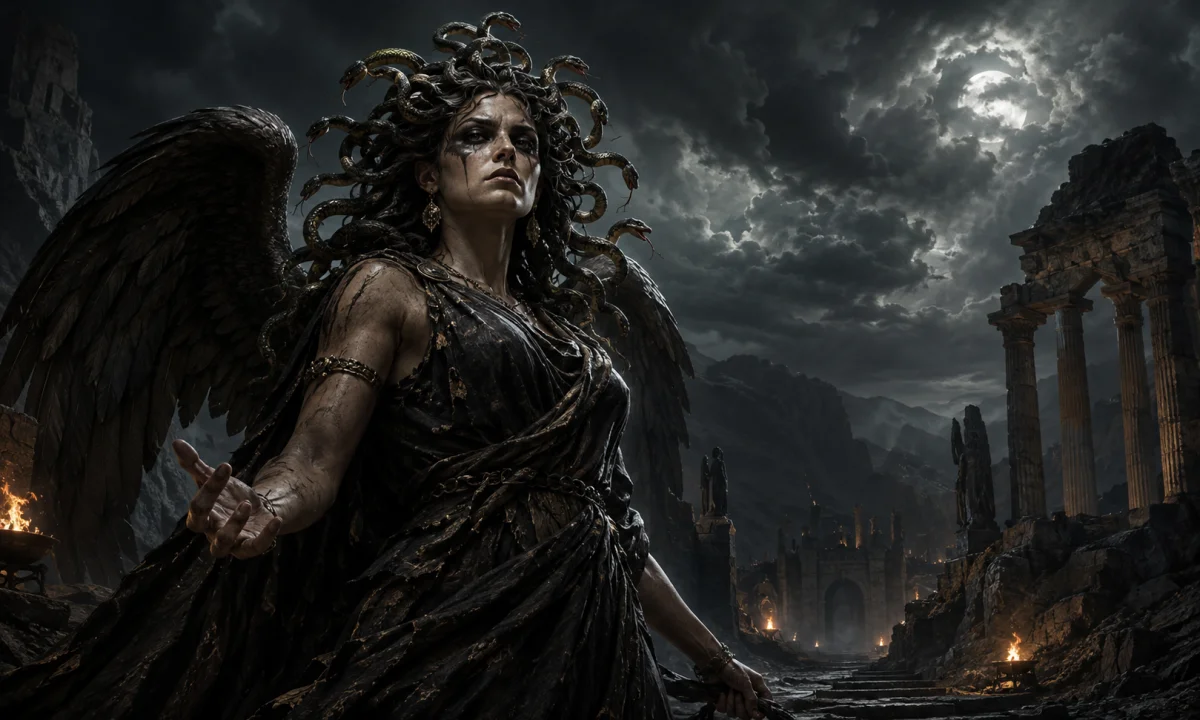
Alecto is one of the Erinyes, the terrifying avenging powers of Greek mythology. In Greek, her name is usually written Ἀληκτώ and is commonly understood to mean “unceasing” or “unrelenting,” especially in the sense of anger that does not cease. Together with Megaera and Tisiphone, she represents the relentless punishment of serious wrongdoing, particularly crimes committed within the family. Although the three Erinyes are often treated as a group, Alecto receives an especially vivid individual portrayal in the Roman poet Virgil’s Aeneid, where she becomes an agent of divine rage and a force that drives human beings toward war.
The Erinyes in Greek religious tradition
The Erinyes were ancient chthonic powers associated with vengeance, curses and the punishment of offenses that threatened the moral and social order. Their name is often translated as “the Angry Ones,” although the precise origin and meaning of the Greek word are uncertain. They were not simply monsters who attacked people at random. In religious imagination, they enforced consequences for particularly grave violations, including murder within a family, disrespect toward parents, perjury and the breaking of solemn obligations.
The Erinyes belonged to an older stratum of Greek divine tradition than the Olympian gods in their fully developed forms. They were connected with the earth, the underworld and the pollution caused by bloodshed. A person who committed an unlawful killing could be pursued by them, especially when the victim was a close relative. Their pursuit was not merely physical. The guilty person might suffer fear, madness, exile and social exclusion until the pollution had been addressed.
In some traditions, the Erinyes could also protect the established order. Their concern was not identical to ordinary human ideas of justice, and they did not function like a formal court of law. They embodied the ancient force of retribution: wrongdoing created an imbalance, and that imbalance demanded a response. This helps explain why they could appear both frightening and necessary. Without them, crimes against kin and the sanctity of oaths might go unpunished.
Origin and family
Hesiod’s Theogony gives the best-known account of the Erinyes’ birth. When Cronus mutilated his father Uranus, drops of Uranus’s blood fell upon Gaia, the Earth. From that blood came several beings, including the Erinyes, the Giants and the Meliae, or ash-tree nymphs. In this genealogy, the Erinyes arise from a violent act within the divine family, which suits their later role as avengers of blood crimes.
Hesiod names the three sisters as Alecto, Megaera and Tisiphone. He does not provide extensive individual biographies for them, and Greek literature does not preserve a single, universally accepted account of Alecto’s personal history. Their shared origin is more important in early tradition than a detailed distinction between their characters.
Other ancient traditions give different genealogies to related beings of vengeance. Some accounts connect such powers with Night or with the underworld, and later writers sometimes use “Erinyes” and “Furies” in ways that reflect different local and literary traditions. These variations should not be treated as a single fixed family tree. Greek mythology was transmitted through many poets, rituals and communities rather than through one authoritative canon.
Name and classification
Alecto’s name is generally interpreted as referring to anger that is unending, unappeased or impossible to calm. The interpretation is appropriate to her role, but the exact etymology is not completely certain. In Latin texts, her name is commonly written Allecto, with a double “l.” English usage includes both “Alecto” and “Allecto,” depending on whether the writer follows the Greek or Latin form.
Alecto is an Erinys, the singular form of Erinyes in Greek. In Latin and later European languages, the group became known as the Furies. “Fury” is therefore a translation or adaptation of the Roman conception, not the original Greek name. Alecto is sometimes described as a goddess, but her status differs from that of the Olympian gods. She is better understood as an ancient divine power or personification of retributive anger, rooted in the chthonic religious world.
The Erinyes were also known by the euphemistic name Eumenides, meaning “the Kindly Ones” or “the Benevolent Ones.” This respectful title may have been used to avoid provoking dangerous powers and to emphasize their capacity to bring reconciliation after justice had been served. Alecto is therefore associated with both fearful punishment and the restoration of order, although her individual stories focus much more strongly on her terrifying aspect.
Appearance and powers
Greek sources do not provide a complete, consistent physical description of Alecto as an individual. Artistic representations of the Erinyes often show them as winged female figures, sometimes carrying whips, torches or swords. Snakes are among their most recognizable attributes. They may appear in their hair, around their bodies or as instruments of pursuit. These images associate them with danger, pollution, the underworld and the uncontrollable force of vengeance.
In literary descriptions, the Erinyes can produce terror and madness. Their victims may flee without rest, lose their reason or become unable to escape the consequences of their actions. Their power is not limited to bodily violence. They expose guilt, awaken destructive emotions and drive the criminal into a condition of psychological torment.
Alecto’s name makes her particularly suitable for the role of unappeased anger. She does not represent anger in every possible form. Rather, she embodies a rage that continues until its purpose has been fulfilled. This distinction matters because Greek thought did not always regard anger as merely a private emotion. Anger could be a divine response to violated kinship, broken oaths or the disturbance of a sacred order.
Alecto in Greek literature
In early Greek tradition, Alecto usually appears as one member of the Erinyes rather than as a fully separate character. The surviving works of Greek mythology often emphasize the group’s collective power. In Aeschylus’s Eumenides, for example, the Erinyes pursue Orestes after he kills his mother, Clytemnestra. The drama presents a conflict between an older system of blood vengeance and a newer form of civic justice represented by Athena and the court of Athens.
Alecto is not the main individual speaker in that play, and the surviving Greek dramatic tradition does not establish a detailed set of personal characteristics for her. Her importance comes from her membership in the Erinyes and from the symbolic meaning of that group. They are ancient powers who cannot simply be destroyed when a new legal order appears. Instead, the play imagines their transformation into the Eumenides, respected guardians of Athens.
The story of Orestes helps clarify Alecto’s traditional sphere. Orestes kills Clytemnestra to avenge her murder of his father, Agamemnon, but the killing is still a pollution because Clytemnestra is his mother. The Erinyes pursue him because blood vengeance creates further blood guilt. Their presence expresses the tragic difficulty of escaping a cycle in which every act of justice can produce another crime.
Alecto in Virgil’s Aeneid
Alecto’s most famous individual narrative appears in Book 7 of Virgil’s Aeneid, written in Latin during the early Roman imperial period. Virgil presents her as one of the underworld’s terrifying avengers and as an instrument of the goddess Juno. Juno opposes the Trojan hero Aeneas and seeks to prevent or delay the establishment of the people destined to become associated with Rome.
Juno calls upon Allecto to disturb the Latins and provoke conflict between them and the Trojan newcomers. The Fury accepts the task eagerly. Virgil describes her as a dreadful underworld being with serpents in her hair and a face capable of revealing her destructive nature. Her appearance and behavior draw on older Greek images of the Erinyes, while her role in the poem is shaped by Roman epic ideas about fate, war and the origins of Rome.
Allecto first attacks Queen Amata, the wife of King Latinus. Latinus has been warned that his daughter Lavinia should not marry a local suitor, Turnus, because her destiny points toward a foreign husband. Amata resists the prospect of Lavinia’s marriage to Aeneas, and Allecto intensifies her opposition. The Fury sends a snake into Amata’s clothing and body, where it acts like a poison or hidden spark of madness. Amata becomes violently agitated and eventually takes part in ecstatic, disorderly movement among the women of the region.
Allecto then visits Turnus. She appears to him in the guise of Calybe, an aged priestess of Juno, and attempts to inflame his pride and anger. When Turnus does not respond sufficiently to the disguised figure, Allecto reveals her true nature and hurls a burning torch at him. The torch enters his body and fills him with the desire for war. In Virgil’s presentation, Turnus still possesses courage and agency, but Allecto magnifies his resentment and turns personal frustration into military violence.
The Fury also helps create the immediate incident that makes open conflict unavoidable. A tame stag beloved by Silvia, the daughter of the Latin herdsman Tyrrhus, is wounded by Ascanius, the son of Aeneas. Allecto is involved in the escalation of this event, and the resulting clash between the local people and the Trojans becomes the first outbreak of the war in Italy. What begins as a dispute among hunters develops into collective violence because divine manipulation has activated existing fears, rivalries and political tensions.
After completing her work, Allecto returns to Juno. The goddess sends her back to the underworld, declaring that the rest of the conflict will proceed without further intervention from the Fury. Virgil therefore gives Allecto a specific dramatic function: she is the supernatural catalyst who transforms latent hostility into war. Her power is psychological and social as much as physical. She does not simply kill the characters; she makes them desire destruction.
Symbolism and interpretation
Alecto can be understood as a personification of anger that becomes self-perpetuating. In the Greek religious background, this anger is connected to violated family bonds and the demands of retribution. In Virgil’s epic, the same figure is adapted to represent the passions that disrupt political settlement. She turns marriage negotiations, dynastic anxiety and local suspicion into an armed conflict that has consequences far beyond the original dispute.
Her serpents are especially meaningful. In ancient Mediterranean symbolism, snakes could be associated with the earth, the dead, hidden forces and renewal, but they could also signify poison and sudden attack. In Alecto’s encounter with Amata, the serpent makes rage feel like an infection entering the body. The victim’s thoughts and emotions are transformed from within, blurring the boundary between divine possession, madness and personal responsibility.
Her torch has a different but related force. Fire can symbolize revelation, sacrifice and divine presence, yet it can also spread uncontrollably. The torch that Allecto casts at Turnus ignites his warlike fury. It suggests that violence may begin with a spark, but once set alight it can consume individuals and communities.
The Erinyes also raise difficult questions about justice. Are they punishers, protectors or embodiments of an older order that must eventually change? Greek tragedy often refuses to give a simple answer. Their violence is horrifying, but the crimes that summon them are also horrifying. The transition from Erinyes to Eumenides in Aeschylus does not erase their authority. It relocates it within a civic and religious system that recognizes the need to control vengeance rather than allowing every injury to produce another private retaliation.
Distinguishing Alecto from similar figures
Alecto should not be confused with Hecate, although both may be connected with night, the underworld and frightening supernatural power. Hecate is a goddess associated with crossroads, boundaries, magic and several forms of protection. Alecto is specifically an Erinys, a power of relentless retribution.
She is also distinct from the Gorgons, such as Medusa. Gorgons are monstrous beings whose mythology centers on their appearance and petrifying gaze, whereas Alecto belongs to a divine group concerned with guilt, punishment and blood vengeance. Snakes appear in imagery associated with both, but that shared feature does not make them the same type of being.
The Roman Furies are not an entirely separate species from the Greek Erinyes. They are the Roman literary and religious continuation of closely related figures. “Allecto” is the Latin form of the Greek name, and Virgil’s portrayal is one of the most influential Roman adaptations of the older tradition.
Alecto should likewise be distinguished from modern uses of the word “fury” as a general term for an angry woman or a violent emotion. In mythology, the name refers to a particular supernatural figure with a place in the family and religious structure of the Erinyes.
Later reception
The image of Alecto continued into later European literature and art, often through Roman authors rather than directly through early Greek religion. Dante places Alecto with Megaera and Tisiphone among the Furies in the Inferno, where they guard the entrance to the city of Dis. Their appearance reinforces the poem’s treatment of wrath, punishment and the terrifying consequences of sin.
Later writers have also used Alecto as a name for destructive passion, vengeance or warlike agitation. Such uses often preserve her traditional association with relentless anger but may detach her from the specific religious context of Greek blood vengeance. In modern fantasy, comics, games and television, Alecto may be reimagined as a monster, warrior, demon or independent villain. These portrayals can draw on her snakes, her association with the underworld or her role in the Aeneid, but they are creative adaptations rather than evidence for additional ancient beliefs.
Her ancient significance lies less in a long catalogue of adventures than in the idea she embodies: anger that refuses to end, especially when violence has violated family, oath or sacred order. As one of the Erinyes, Alecto stands at the boundary between divine justice and destructive revenge. Her presence in Greek and Roman literature shows how the same figure could represent both the danger of uncontrolled fury and the unavoidable demand that grave wrongdoing receive a response.