WORLD
WORLD
Aestas

Aestas is the Latin personification of summer in Roman literature and artistic tradition. Her name is the Latin word for “summer,” and it is related to the language of heat and burning warmth. Unlike major Roman deities such as Jupiter, Venus, or Mars, Aestas is not securely documented as an independent goddess with a widespread public cult, priesthood, temple, or established cycle of myths. She is better understood as a seasonal personification: a human or divine image given to one part of the year.
Roman writers and artists frequently represented natural forces, social institutions, virtues, and periods of time as female figures. Aestas belongs to this broad tradition of personification. She could express the heat, abundance, brightness, and strenuous activity associated with the summer season, but the surviving evidence does not provide a single fixed description of her appearance or powers. Her identity is therefore literary and symbolic rather than that of a fully developed mythological character.
The meaning of Aestas
The Latin noun aestas means “summer.” It is connected with words describing heat, burning, and the hot season. In Roman texts, the word usually functions simply as the name of a season, but it can also be treated grammatically and poetically as a living presence. Latin authors could describe summer as arriving, standing, ruling, suffering, or departing, just as they might describe Fortune, Victory, or Peace as a person.
When the word is capitalized in modern discussions, it generally signals this personified use. Ancient Latin manuscripts did not consistently use capitalization in the modern way, so the distinction between “summer” as a season and “Aestas” as a figure can depend on context and editorial practice. Not every occurrence of aestas refers to a goddess. In many passages it means no more than the hot season itself.
This uncertainty is important. Aestas should not automatically be treated as a major Roman goddess merely because a poet gives summer human characteristics. Roman religion included many divine names and personifications, but their status could vary considerably. Some received public worship, while others existed primarily in poetry, visual art, or abstract religious language.
Aestas in the Roman cultural setting
Summer was central to Roman agricultural and civic life. The season brought long days, intense heat, ripening crops, agricultural labour, travel, military campaigning, and the maintenance of food supplies. Its character was therefore mixed. Summer could represent fertility and abundance, but also drought, exhaustion, storms, wildfire, and dangerous heat.
Roman religious life was closely tied to the agricultural calendar. Rituals and festivals marked the growth of crops, the protection of fields, and the changing relationship between human communities and the natural world. Even so, the existence of seasonal rituals does not prove that Aestas herself had a formal cult. The Romans could honour agricultural gods, household powers, or local deities without worshipping every personification used by poets.
The Roman understanding of the seasons also developed within a wider Mediterranean intellectual tradition. Greek literature had long described the year through the Horae, or Seasons, who could be imagined as divine attendants, guardians of order, or figures associated with the cycle of nature. Roman writers adopted and reshaped many Greek literary conventions, while giving them Latin names and placing them within Roman poetic settings. Aestas is related to this broader Mediterranean habit of representing the seasons as beings, but she is not simply identical with one universally defined Greek goddess.
Literary appearances
One of the clearest surviving literary settings for Aestas occurs in Ovid’s Metamorphoses. In the description of the palace of the Sun, the poet presents the seasons among the figures associated with the solar god’s ordered cosmic realm. Spring, summer, autumn, and winter appear as personified parts of the year. Their presence emphasizes the regular movement of time and the relationship between the Sun and the changing world.
In this scene, Aestas is not introduced through an independent birth story, genealogy, or adventure. She forms part of a carefully arranged sequence of seasonal figures. Ovid’s interest lies in the visual and cosmic organization of the palace, not in establishing a separate mythology for each season. The passage shows how personification could make an abstract process visible: the year becomes a procession of human-like presences governed by celestial order.
Other Latin poets also describe summer in vivid personal terms, although not every poetic use should be interpreted as evidence for a goddess named Aestas. Summer may be portrayed as hot, dusty, oppressive, bright, or productive. It can be imagined as advancing after spring, yielding to autumn, or suffering beneath the power of the Sun. Such language belongs to a normal feature of classical poetry, in which nature is frequently given emotions, clothing, bodily movement, and speech.
Because the surviving evidence is scattered, there is no canonical “story of Aestas.” Accounts that present her with a detailed family tree, a fixed set of lovers, or a long series of adventures generally go beyond what ancient Roman sources securely establish. Aestas is known chiefly through seasonal imagery and personification, not through an extensive narrative tradition.
Appearance and attributes
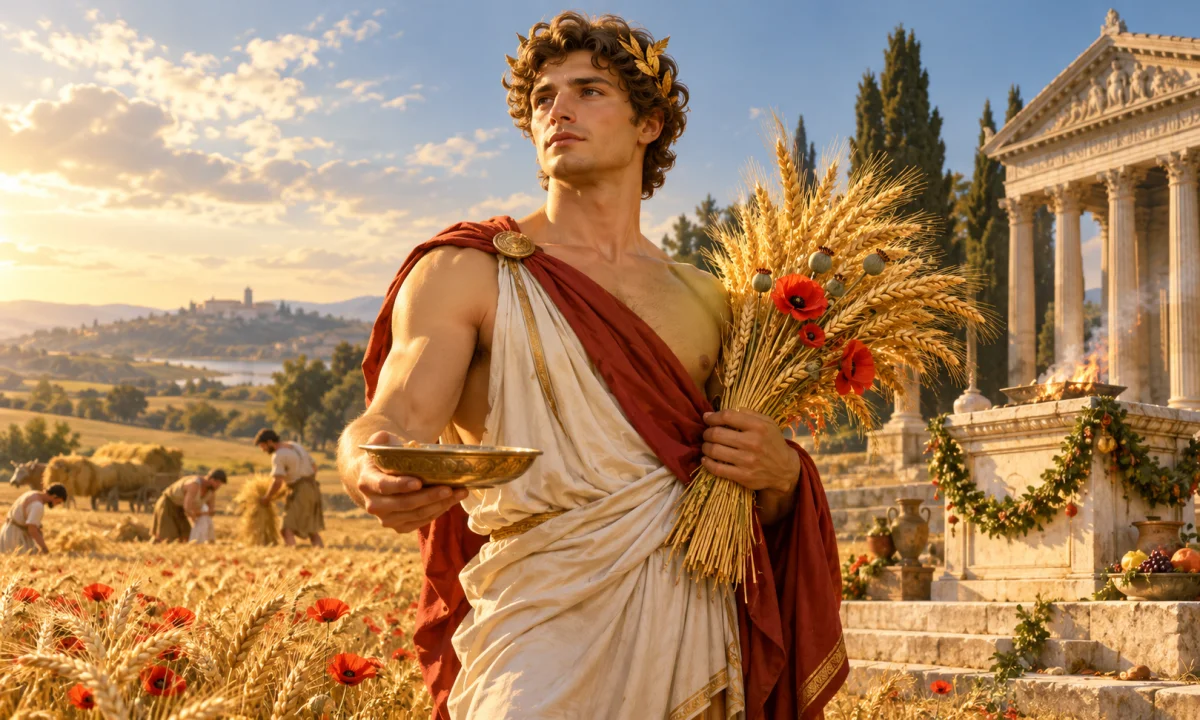
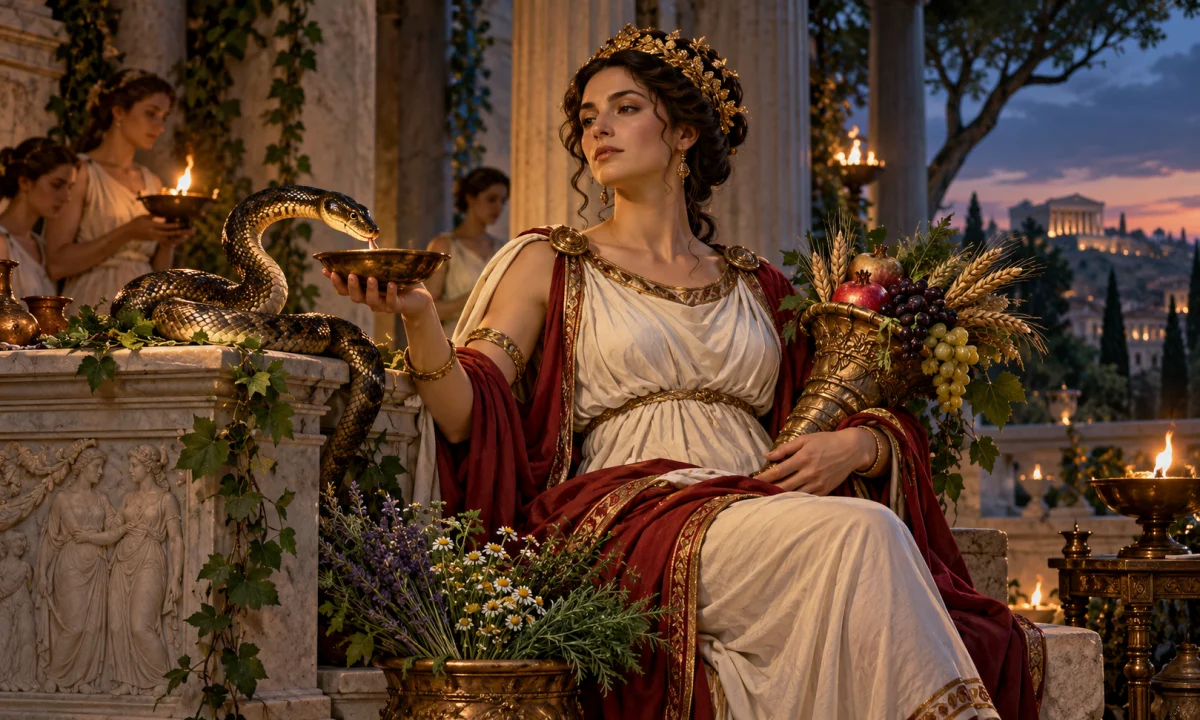
There is no universally agreed ancient portrait of Aestas. Her appearance depends on the literary or artistic context in which summer is being represented. A seasonal figure may be shown as a young woman, a mature woman, or simply as one member of a group of similarly dressed personifications. Attributes can include plants, grain, fruit, garlands, light clothing, or signs of heat, but these are symbolic possibilities rather than a fixed identifying equipment.
In the Ovidian setting, the seasons are distinguished through their seasonal qualities. Spring is associated with flowers, autumn with grapes and harvest, and winter with cold and aged or wintry features. Summer naturally belongs to the interval of heat and ripening. Depending on the representation, Aestas may therefore be suggested by exposed skin, airy garments, a wreath, ripe vegetation, or the golden brightness of the sun.
Later visual traditions sometimes give the four seasons conventional attributes. Summer may carry wheat, fruit, flowers, or a sickle, and may appear crowned with grain or foliage. These images should not automatically be labelled ancient depictions of Aestas. Many belong to later Roman, Renaissance, neoclassical, or early modern art, where the seasons became a popular decorative subject. The visual vocabulary may preserve classical inspiration while also reflecting the artistic conventions of a much later period.
Aestas has no securely established animal, sacred weapon, or distinctive emblem comparable to Minerva’s owl, Mars’s spear, or Mercury’s staff. The Sun and solar light are relevant to her seasonal identity, but this does not make her a servant, daughter, or spouse of Sol in a documented Roman myth. Likewise, heat and fire may symbolize her sphere without turning her into a fire goddess.
Role and symbolism
Aestas represents the position of summer within the ordered cycle of the year. Her symbolic meaning can include:
- the height of warmth and daylight;
- the ripening of crops and fruit;
- agricultural work and seasonal abundance;
- physical exertion, thirst, and fatigue caused by heat;
- the regular movement of time from spring toward autumn; and
- the power of the Sun over the rhythms of the natural world.
These meanings are not always positive. Roman agricultural poetry often recognizes the cost of summer as well as its benefits. Hot weather can harden the ground, threaten livestock, dry water sources, and make labour more difficult. Aestas can consequently embody both plenty and hardship. Her significance changes according to the perspective of the author: a farmer may see the season differently from a traveller, soldier, urban resident, or poet seeking relief from heat.
As a personification of time, Aestas also belongs to Roman reflections on change and mortality. Summer is powerful precisely because it does not last. It follows spring and is followed by autumn; its fullness contains the promise of decline. In this respect, Aestas participates in a recurring classical theme: the natural world appears stable because its cycles repeat, yet every individual season is temporary.
Relationship with other seasonal figures
Aestas is most naturally understood alongside personifications of the other seasons. In literary and artistic groups, the seasons form a balanced set rather than a family of gods with detailed personal relationships. Spring, summer, autumn, and winter represent successive stages in a recurring cycle. Their arrangement expresses order, sequence, and transformation.
Roman writers could also connect the seasons with the Horae, the Greek and Roman figures associated with the orderly divisions of time. However, terminology varies. The Horae were not always merely four seasonal women. In different periods and sources, they could represent the hours, the seasons, natural order, or civic order. Aestas may appear in a Roman seasonal scheme without being one of the Horae in a strict mythological sense.
Nor should Aestas be merged with agricultural and fertility deities. Ceres governs important aspects of grain, agriculture, and maternal fertility, but she is not the goddess of summer itself. Flora is associated particularly with flowers and springtime renewal, while Pomona belongs to fruit trees and orchards. Sol represents the Sun, whose course helps produce the seasons, but Sol and Aestas are separate concepts. The presence of sunlight in an image of summer does not establish an identity between them.
Aestas and similar names
Confusion can arise because Latin words connected with summer and heat resemble one another. Aestas means “summer,” while aestus can mean heat, burning heat, agitation, or the swell of the sea, depending on context. These words are related in meaning but are not interchangeable names for one deity. A personification of heat or a poetic reference to aestus should not automatically be identified as Aestas.
The Latin name can also be confused with modern names derived from it. “Aestas” may be used in contemporary fiction, games, fantasy writing, or modern naming practices as if it were the name of a fully characterized goddess. Such uses are creative adaptations, not evidence that ancient Romans assigned the figure a matching biography or set of powers.
Aestas should likewise be distinguished from modern “summer goddess” figures created by combining traits from several traditions. A contemporary character may be given links to fire, sunlight, fertility, love, or harvest. Those combinations can be meaningful within a modern story, but they should not be presented as a single inherited Roman tradition.
Religious status and historical evidence
The evidence for Aestas is strongest as evidence for Roman poetic personification. Literary depictions demonstrate that Romans could imagine summer as a female figure within a cosmic or seasonal tableau. They do not, by themselves, demonstrate regular worship. At present, there is no broadly established body of evidence showing that Aestas possessed a major temple network, an independent priesthood, a standardized festival, or a large public cult comparable to those of better-attested Roman deities.
Roman religion did not have a simple division between “real gods” and “mere metaphors.” Personified abstractions could sometimes acquire religious importance, and a name used in ritual might later be treated as a divine power. Nevertheless, each case must be examined separately. The presence of a feminine grammatical form or an artistic figure is not enough to prove formal divine worship.
For this reason, descriptions of Aestas should use careful language. It is accurate to call her a Roman personification of summer or a seasonal figure in Roman literature. It is less secure to describe her as a major goddess with a fixed mythology. The surviving tradition supports a symbolic identity, but leaves many details unknown.
Later reception
The four seasons became a persistent subject in European art, poetry, architecture, and decorative design. Summer often appears as one of four allegorical women, sometimes accompanied by grain, fruit, flowers, or signs of heat. These later works draw on classical ideas but do not necessarily preserve a direct cult or a continuous ancient depiction of Aestas.
In modern popular culture, the name Aestas occasionally appears in fantasy fiction, games, poetry, and online retellings. Modern creators may use it because it is an authentic Latin word with an evocative meaning. They may also expand the figure into a goddess of heat, sunlight, harvest, passion, or fire. Such portrayals can give Aestas a new narrative identity, but that identity belongs to the modern adaptation unless it is supported by ancient evidence.
Historically, Aestas is most significant not as the heroine of a lost epic but as an example of how Roman culture turned the calendar into imagery. Through her, summer could be placed within a divine landscape, linked to solar order, and represented as one stage in the recurring movement of nature. Her limited mythology is itself informative: Roman personification did not always aim to create an independent goddess with adventures and worship. Sometimes it provided a vivid form for an idea that remained inseparable from the natural cycle it represented.