WORLD
WORLD
Aeshma
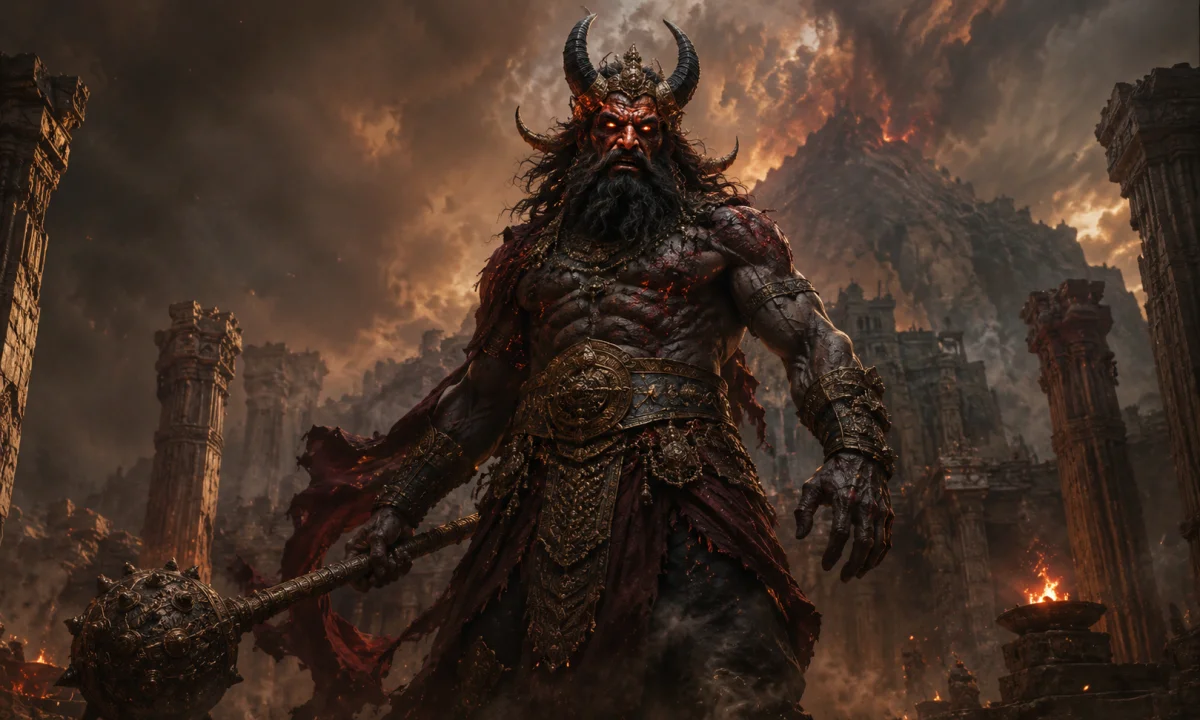
Aeshma is a demon of violence, wrath and destructive impulse in the religious traditions of ancient Iran, especially within Zoroastrianism and related Iranian religious thought. He is most often understood as a personification of fury and disorder, a force that drives people toward cruelty, conflict and moral ruin. In later tradition and scholarship, Aeshma is usually treated not as a minor monster but as one of the most important hostile beings in the Zoroastrian moral universe, where spiritual forces are arranged around the conflict between truth, order and falsehood.
Origins and cultural setting
Aeshma belongs to the broader world of ancient Iranian religion, from which Zoroastrianism developed. The clearest evidence for him comes from Zoroastrian texts, especially the Avesta and later Middle Persian literature, though his name and concept also reflect older Indo-Iranian religious ideas. In this setting, the universe is shaped by opposition between asha, meaning truth, right order and cosmic law, and druj, meaning deceit, disorder and corruption. Aeshma stands on the side of destructive chaos.
The figure is important because he does not simply represent anger as an ordinary emotion. In the religious imagination of Zoroastrian communities, uncontrolled wrath was a dangerous spiritual condition, one that could be exploited by evil powers. Aeshma personifies that danger. He is not merely a metaphor for bad behaviour, but a demonized force that tempts, inflames and unbalances human beings.
Scholars often connect Aeshma with the broader ancient Iranian category of hostile beings known as daevas. In Zoroastrian texts, the daevas are rejected as false or demonic powers. Aeshma is among the more prominent of them. The tradition about him is not uniform across all periods, however. His portrayal in the Gathas, the most archaic stratum of the Avesta, is more allusive, while later texts develop him more fully as a named demon with a specific function and mythology.
Name and identity
The name Aeshma is usually linked by scholars to the idea of wrath or violence. In Avestan, the language of the oldest Zoroastrian scriptures, the form is commonly given as Aēšma. In Middle Persian sources, the name appears as Ēšm or related forms. The exact history of the word is discussed in scholarship, but the broad sense is clear: he is the embodiment of rage.
One of the best-known epithets attached to him is “Aeshma of the bloody mace”, a phrase that emphasizes his association with force, battle and brutal assault. This is not always a literal weapon in a mythic narrative so much as a symbolic way of marking him as a violent aggressor. The epithet also reinforces the sense that Aeshma is not a subtle tempter only, but an overtly dangerous power of aggression.
In Zoroastrian tradition, Aeshma is usually counted among the great demonic adversaries, sometimes ranked with other major destructive beings. He is not identical with every spirit of anger in later Iranian lore, and he should not be confused with unrelated figures of wrath in neighbouring religions. His identity belongs specifically to the Zoroastrian and Iranian religious sphere.
Appearance and symbolism
Ancient sources do not give a fixed, detailed visual description of Aeshma in the way later folklore might describe a monster. Instead, his attributes are expressed through symbolic language. He is associated with wildness, violence, bloodshed, confusion and the breakdown of restraint. Where he appears in imagery or later commentary, he is often linked to warlike aggression and the destruction of ritual order.
Because Aeshma is primarily a moral and spiritual force, his “appearance” is often indirect. He may be imagined through the effects he produces: agitation, rage, conflict and sacrilege. In religious thought, he represents the moment when anger becomes more than a human feeling and turns into a power that breaks the bond between a person and righteous action.
That symbolic role is central to his significance. Aeshma stands for the danger of letting violence govern action. In a tradition that places great value on right speech, right action and purity, such a force is especially threatening. The demon does not merely cause harm; he corrupts judgment.
Role in Zoroastrian tradition
Aeshma’s best-attested function is as an inciter of wrath and conflict. He stirs up quarrels among human beings and opposes peace, discipline and the ordered worship of the divine. In ethical terms, he encourages people to abandon restraint and justice. In religious terms, he attacks the stability needed for proper worship and communal life.
Later Zoroastrian literature often places him in direct opposition to figures associated with divine order. One important association is with Sraoša, a divinity connected with obedience, hearing, devotion and religious discipline. In some traditions, Sraoša is the principal adversary of Aeshma. This pairing makes good symbolic sense: one figure embodies obedience and sacred attentiveness, the other violence and uproar.
Aeshma also appears in broader demonological lists and cosmological narratives where evil powers are grouped and countered by divine or righteous beings. His presence in these systems shows how important anger was as a religious and ethical concern. Rather than being treated as a private emotion only, wrath becomes a force with social and cosmic consequences.
Important texts and traditions
The earliest strata of Zoroastrian scripture mention Aeshma in a relatively compressed way. The Gathic material is difficult and often terse, and interpreters do not always agree on every detail. Even so, the tradition clearly recognizes a hostile power of wrath. Later Avestan texts develop this figure further, presenting him as a named and active daeva.
In later Middle Persian Zoroastrian writings, especially those concerned with cosmology and demonology, Aeshma becomes more fully integrated into the religion’s moral drama. These texts describe a universe in which every major evil force has a role, and Aeshma’s role is to agitate, disrupt and lead beings into violence. The exact narrative forms vary from text to text, and some accounts are more theological than mythic in style.
One recurring theme is that Aeshma’s activity is most dangerous when it enters human communities. He is not only a cosmic enemy in the abstract. He can be present in anger between people, in the breakdown of ritual concentration, and in the refusal to follow the discipline that Zoroastrian ethics requires. This makes him both a demon of mythology and a warning within religious practice.
Relationship to anger and moral thought
Aeshma is especially interesting because he illustrates how Zoroastrianism treats emotions as morally significant. Anger is not simply a neutral passion. It can become a channel for falsehood, cruelty and destructive action. Aeshma personifies that transformation.
In this sense, he functions almost as a theological language for the social consequences of rage. Violence does not arise from nowhere; it is imagined as being fed by a destructive spiritual influence. This does not mean that people are excused from responsibility. On the contrary, the tradition tends to present Aeshma as a force that exploits human weakness, especially where discipline, humility and truth are absent.
This moral aspect helps explain why Aeshma matters beyond purely mythological interest. He is part of a broader religious effort to map the inner life of the believer. The struggle against evil is not only fought in grand cosmic terms; it also takes place in thought, speech and emotion.
Variants and scholarly interpretation
Because the surviving evidence spans many centuries, Aeshma’s profile is not identical in every source. His name, rank and narrative role can vary. Some texts emphasize his general status as a daeva of wrath, while others give him a more specific position in demonological hierarchies. In scholarship, there is discussion about how far the later, more elaborate picture reflects the earliest Iranian religion and how far it reflects development within Zoroastrian tradition.
Another point of scholarly interest is the relationship between Aeshma and related Indo-Iranian or wider Indo-European concepts of fury and battle rage. These comparisons can be illuminating, but they should be handled cautiously. Similarity does not mean identity, and the Zoroastrian Aeshma must be understood within his own religious system rather than merged with comparable figures elsewhere.
There is also some variation in transliteration and spelling in modern English writing. Aeshma may appear as Aešma, Aeshm, Ēšm or with other scholarly spellings depending on the language stage being discussed. These differences usually reflect transliteration choices rather than separate beings.
Distinction from similar names and figures
Aeshma is sometimes confused with other demonic or wrathful beings because his name and function are broad enough to resemble figures from different traditions. He should not be merged with demons from Mesopotamian, Christian, Islamic or later folklore merely because they are associated with anger or war. The cultural setting matters.
Within Iranian tradition itself, it is important not to collapse Aeshma into every hostile spirit or every general term for anger. He is a named and specific daeva with a distinct place in Zoroastrian thought. Likewise, he should not be confused with benevolent or ambivalent figures whose names sound similar in translation or transcription.
Where older and later sources diverge, careful distinction is needed. The early scriptural evidence is fragmentary and often indirect, while later literature offers more developed demonology. The result is a figure whose identity is stable in outline but variable in detail. That variability is normal in long-lived religious traditions and does not imply inconsistency so much as historical development.
Cultural significance
Aeshma’s importance lies in how he expresses a central concern of Zoroastrian ethics: the need to resist disorder not only in the world outside but also within the self. Wrath is destructive because it breaks judgment, poisons speech and leads to harm against others. By turning rage into a demon, the tradition gives moral force to a spiritual warning.
He also reflects the broader Zoroastrian idea that the universe is morally structured. Human actions matter because they align either with truth and order or with deceit and corruption. Aeshma belongs to the side of corruption, but his significance depends on the fact that humans can choose to resist him. That makes him part of a religion of responsibility, not just fear.
In historical terms, Aeshma also helps show how ancient Iranian religion understood social conflict. Warfare, feud, aggression and uncontrolled speech were not merely political or personal problems. They had a spiritual dimension. The demon of wrath is therefore also a figure of social breakdown.
Later reception and modern references
In modern scholarship, Aeshma is discussed mainly in studies of Zoroastrian demonology, ancient Iranian religion and comparative mythology. He is not, however, one of the better-known figures in popular global culture. Compared with major mythic names from Greek, Norse or biblical traditions, his presence in novels, games or films is limited and usually appears only in works that draw specifically on Zoroastrian or ancient Iranian themes.
When modern popular culture does use the name, it is typically as a borrowed exotic or demonological label rather than as a faithful representation of the religious tradition. Such uses should be distinguished from the older sources. The traditional Aeshma is not a fantasy invention but a significant figure from a real religious and historical framework.
As a result, the most meaningful context for Aeshma remains the ancient and medieval Iranian material in which he developed. There he appears as a powerful embodiment of wrath, a warning against moral and spiritual disorder, and a reminder that in Zoroastrian thought even emotions have cosmic weight.