WORLD
WORLD
Adephagia
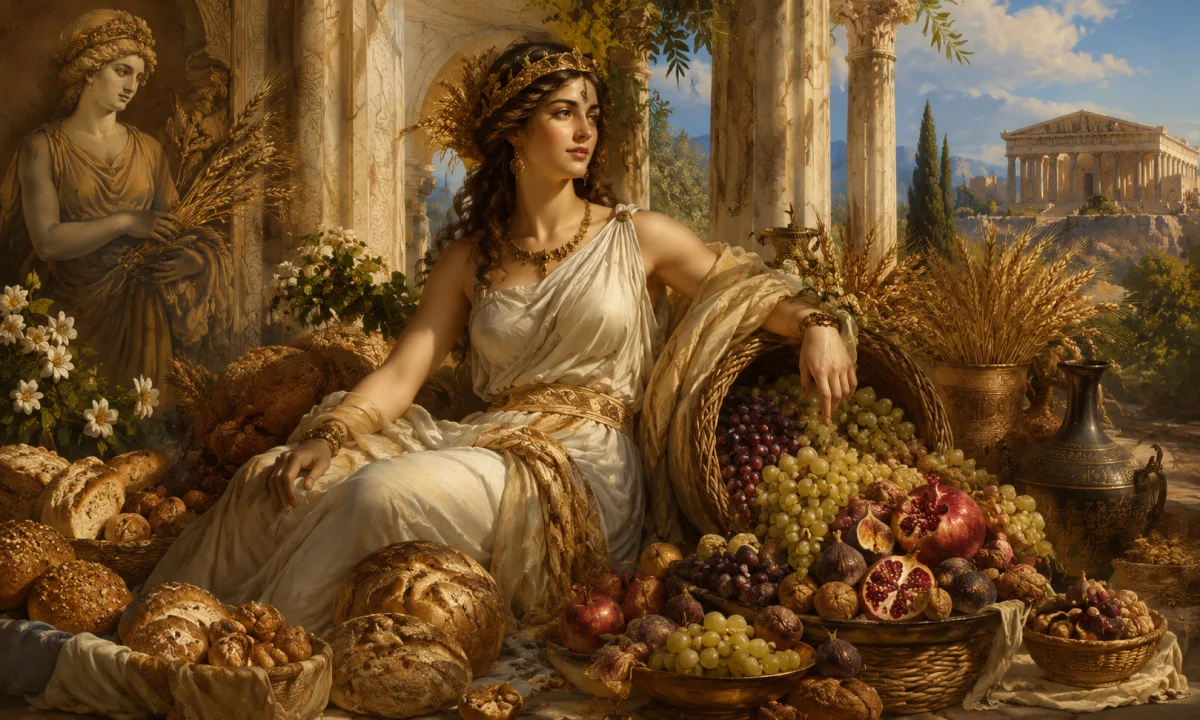
Adephagia was a Greek personification associated with gluttony, insatiable appetite and excessive eating. Her name, written Ἀδηφαγία in Greek, is generally understood as meaning “insatiability” or “gluttony,” from words connected with being unable to eat one’s fill. Unlike major Greek goddesses such as Athena, Demeter or Aphrodite, Adephagia is a shadowy and rarely mentioned figure. The surviving evidence connects her especially with Akragas, the Greek city later known as Agrigentum and today called Agrigento, in Sicily.
Adephagia is therefore best understood as a local religious personification rather than as a universally worshipped Olympian deity. Ancient Greek religion often gave human conditions, emotions, moral qualities and destructive forces a divine or semi-divine identity. Such figures could be called daimones, a broad term that did not necessarily mean “demon” in the later Christian sense. Some received cult worship, while others appeared mainly in poetry, philosophical writing or stories used to explain human behaviour.
Origins and cultural setting
Akragas was founded by Greek settlers on the southern coast of Sicily during the sixth century BCE. It became one of the most prosperous Greek communities in the western Mediterranean, with monumental temples, agricultural wealth and strong connections to the religious traditions of mainland Greece and other Greek colonies. Its population and culture were shaped by both Greek heritage and the distinctive conditions of Sicilian life, including local agriculture, trade and public festivals.
The city’s religious world included widely known Greek gods, local cults and personifications whose importance may not have extended beyond the community. Akragas was famous in antiquity for its wealth and lavish public life. Ancient writers sometimes portrayed its citizens as particularly fond of luxury, banquets and conspicuous consumption. Such descriptions may reflect local reputation, moralising stereotypes or competitive storytelling rather than an objective account of everyday life.
Within that setting, a cult or altar dedicated to Adephagia would have offered a striking religious expression of the dangers and attractions of abundance. Food was essential to household survival, agricultural prosperity and communal sacrifice, but excessive consumption could also represent a failure of self-control. Adephagia occupied the uncomfortable boundary between nourishment and excess: she embodied the appetite that no amount of food could satisfy.
The surviving evidence
Information about Adephagia is extremely limited. The most important surviving reference appears in the Deipnosophistae, or Learned Banqueters, a work by Athenaeus of Naucratis written in the Roman imperial period. Athenaeus assembled discussions about food, dining customs, luxury, poetry and learned traditions. His work preserves material from earlier authors whose writings no longer survive, but it is not a straightforward record of every practice described in it.
In a passage concerned with eating and extravagant banquets, Athenaeus mentions an altar of Adephagia at Akragas. The reference indicates that the figure was known as a religious presence associated with uncontrolled appetite. It does not provide a complete myth, a secure genealogy or a detailed description of her appearance. Nor does it establish how widely the cult was practised, how long it lasted or whether all inhabitants of Akragas regarded her in the same way.
The reference is important precisely because it is so unusual. It suggests that Adephagia was more than a later literary invention used merely as a metaphor. At the same time, the evidence is not sufficient to reconstruct a full theology. No securely preserved ancient hymn, temple inscription, canonical myth or extended ritual description gives a broader portrait of the goddess.
Accounts of Adephagia should therefore distinguish between what is directly supported and what is inferred. An altar at Akragas is the central ancient detail. Her association with gluttony follows from her name and the context in which she is mentioned. Claims about her family, appearance, specific powers or place among the gods are much less certain and should not be presented as established facts.
Name and classification
The Greek name Adephagia is related to the idea of eating excessively or being insatiable. The initial element conveys deprivation or negation, while the rest of the word is connected with eating. English translations vary because the name can suggest “gluttony,” “insatiable hunger” or “voracious appetite.” None of these translations should be treated as a separate ancient name or as evidence for different goddesses.
Adephagia is often called a goddess in modern reference works, and this is a reasonable shorthand for a female divine personification connected with an altar. However, the ancient evidence does not clearly define her rank. She may be described more cautiously as a female personification or local daimon of gluttony. Greek religious categories were not always fixed in the way later encyclopaedic classifications imply. A figure could be treated as divine in a ritual context without possessing the elaborate mythology associated with an Olympian god.
There is no reliable ancient genealogy placing Adephagia among the children of a particular god or goddess. She should not automatically be counted as a daughter of Eris, Nyx or another primordial power merely because Greek literature personified harmful conditions through such divine families. Those relationships belong to other figures or to later attempts to organise abstract beings into a mythological family tree.
Attributes and symbolic meaning
The principal attribute of Adephagia was not a distinctive object, animal or costume but an appetite that could not be satisfied. Her symbolic force lay in excess. She represented the loss of measure, the inability to stop and the transformation of a necessary pleasure into destructive compulsion.
Food had several overlapping meanings in Greek culture. It sustained life, marked hospitality, accompanied sacrifice and expressed social status. Shared meals could create bonds between households, citizens and worshippers. Public feasts also demonstrated the prosperity of a city or sanctuary. Yet Greek ethical thought frequently praised sophrosyne, a quality involving moderation, self-command and sound judgement. Adephagia can be interpreted against that ideal as the appetite that rejects limits.
Her symbolism was not necessarily limited to private overeating. Excessive appetite could serve as an image for broader forms of greed: the desire to consume resources, wealth or pleasures without restraint. In a prosperous city, a figure of insatiability could carry an implicit warning that abundance itself might become dangerous when separated from moderation and communal responsibility.
It would nevertheless be misleading to describe Adephagia simply as an evil spirit. The surviving evidence does not establish a fully developed moral doctrine in which she was the embodiment of absolute wickedness. Greek religion often acknowledged dangerous forces through ritual rather than treating them only as objects of condemnation. A personification could be feared, appeased, mocked or discussed without fitting neatly into a division between good gods and evil demons.
Stories and ritual associations
No substantial myth about Adephagia survives. There is no securely attested story describing her birth, marriage, offspring, conflict with another god or intervention in the lives of heroes. The mention of her altar at Akragas is a cultic detail rather than part of a developed narrative cycle.
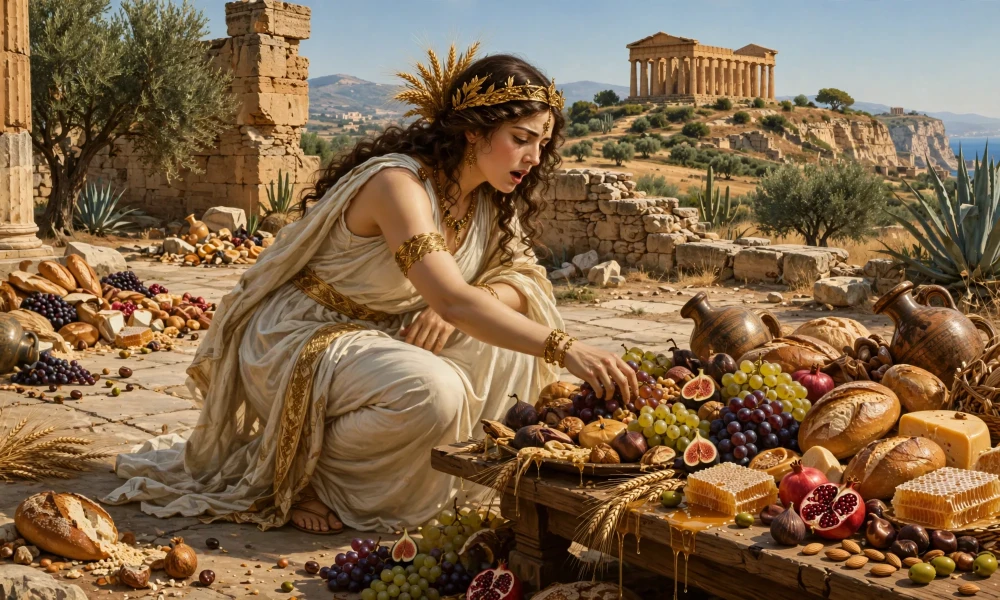
Later summaries sometimes expand the brief evidence into scenes of enormous banquets or claim that worshippers made offerings to her in order to gain an appetite. Such details require caution. Ancient discussions of Adephagia may have been connected with stories about extravagant eating, but the surviving material does not justify a detailed reconstruction of regular ceremonies or the precise purpose of the altar.
The altar may have been understood in more than one way. It could have acknowledged the power of appetite, served as a humorous or paradoxical feature of a festival, or formed part of a local tradition later reported by authors interested in unusual customs. An altar does not by itself tell us whether worshippers honoured a quality, sought protection from it, or used the figure in a ritual designed to manage a dangerous force.
The uncertainty is especially significant because much of the evidence comes through a literary work devoted to learned conversation about food and dining. Athenaeus was interested in remarkable customs, witty anecdotes and examples of excess. His treatment may preserve genuine local information, but it may also frame the subject for entertainment and moral reflection. The reference should be valued without assuming that it records a complete and neutral description of Akragantine religion.
Adephagia and related figures
Adephagia is sometimes confused with other figures connected with hunger, famine or destructive appetite. These beings are not interchangeable.
- Limos was the Greek personification of famine and hunger. Limos represented deprivation, lack of food and the suffering caused by scarcity, whereas Adephagia represented excessive or insatiable consumption.
- Erysichthon, a figure in the myth of Demeter, was punished with an unending hunger after offending the goddess. His story illustrates the consequences of impiety and the terrible separation between appetite and satisfaction, but Erysichthon is a mortal character, not another name for Adephagia.
- Fames was the Roman personification of hunger. Although Roman writers could adapt Greek ideas, Fames should not automatically be identified with Adephagia. Their apparent similarity concerns appetite, while their traditions and evidence are distinct.
- Penia personified poverty in Greek thought. Poverty may produce hunger, but Penia does not represent gluttony or the desire to consume without limit.
- Hedone was associated with pleasure. Adephagia could involve the pleasure of eating, but her defining feature was the absence of satiety and restraint rather than pleasure in general.
These distinctions matter because modern lists of “minor Greek gods” often group together every figure associated with appetite, vice or suffering. Such lists can obscure the differences between a cult personification, a literary abstraction, a mythical human being and a later Roman equivalent.
Interpretation in Greek thought
Adephagia offers a small but revealing glimpse into the Greek habit of expressing ethical and social concerns through divine language. The Greeks did not reserve religious imagination for grand cosmic gods. They could also personify qualities such as victory, persuasion, strife, fear, pity, law and hunger. Giving a condition a name and a sacred identity made it possible to discuss that condition as a force acting on individuals and communities.
Her association with Akragas also shows that Greek religion was not uniform across the Mediterranean. Local communities selected, adapted and emphasised different divine figures. A little-known personification could have practical significance in one city while remaining almost unknown elsewhere. The absence of a large pan-Hellenic myth does not make the figure meaningless; it indicates that her importance was probably local or limited in scope.
The idea of insatiability could also be read politically. Greek moral and political writers often criticised rulers, wealthy households or cities that pursued expansion and luxury beyond reasonable limits. While no surviving text explicitly turns Adephagia into a political allegory, her name naturally evokes the wider Greek concern that uncontrolled desire threatens both the individual and the community.
At the same time, modern readers should avoid reducing her to a simple personification of “sin.” Classical Greek ideas about moderation were influential, but they were not identical to later Christian moral categories. Eating, feasting and pleasure were not inherently condemned. The problem was excess, especially when appetite overpowered judgement, social obligations or the proper balance of life.
Later reception and modern use
Adephagia has had little presence in major modern retellings of Greek mythology. She is not a prominent character in the ancient epic tradition, modern novels about the Olympians or widely known films and games. When she appears in contemporary mythology databases, fantasy settings or role-playing material, she is often expanded into a fully characterised goddess of gluttony with powers, symbols and relationships that are not securely ancient.
Such creative developments can be legitimate adaptations, but they should be distinguished from the historical evidence. The ancient Adephagia is known chiefly through her name, her association with excessive appetite and the report of an altar at Akragas. Horns, monstrous features, magical abilities, specific sacred animals, elaborate parentage and membership in a fixed hierarchy of vices belong to modern invention or speculative reconstruction unless supported by independent ancient evidence.
Her limited record is itself significant. Adephagia demonstrates that Greek mythology was not a closed catalogue of famous gods with complete biographies. It was a varied religious and cultural landscape containing local cults, abstract powers, regional traditions and figures preserved only in passing by later writers. The fragmentary nature of her tradition makes careful distinction between evidence and imagination especially important.