WORLD
WORLD
Abeona
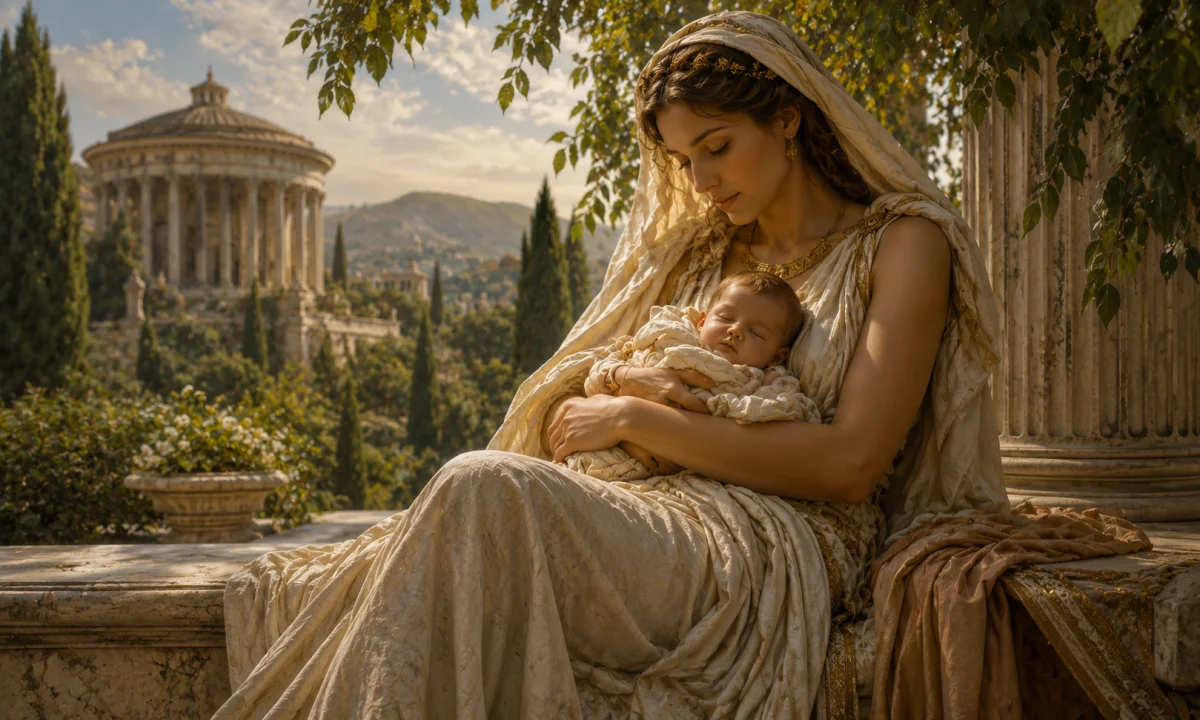
Abeona is a little-known Roman goddess associated with going away, departure and movement from one place to another. Her name is usually understood in relation to the Latin verb abire, “to go away” or “to depart.” In Roman religious interpretation, she was paired with Adeona, whose name is connected with adire, “to approach” or “to come toward.” Abeona represented departure, while Adeona represented return or arrival.
The surviving evidence for Abeona is brief and largely literary rather than archaeological. She is best known from the writings of the Christian author Augustine of Hippo, who discussed her while criticizing the complicated divisions of Roman religious practice. Augustine drew on the antiquarian work of the Roman scholar Marcus Terentius Varro, whose writings are now mostly lost. As a result, knowledge of Abeona depends on a later author reporting an earlier Roman classification, rather than on a surviving temple, myth or body of hymns dedicated to her.
Origins and Roman religious setting
Roman religion included major gods with extensive myths and public cults, but it also recognised many more specialised divine powers. Some were connected with places, occupations, stages of life, household activities or particular events. Roman authors sometimes described these powers as though every human action had its own divine guardian. This tendency was especially important in antiquarian discussions, where scholars tried to explain the names and functions of obscure gods.
Abeona belongs to this less clearly defined group of specialised divine figures. She does not appear in the surviving epic myths of Rome, and no substantial narrative tradition tells of her birth, deeds or relationships with other gods. Her importance lies in the idea associated with her name: the act of leaving or going out.
According to the account preserved by Augustine, Abeona and Adeona had a particular connection with children. Abeona was concerned with the child when the child went away from the parents, while Adeona was concerned with the child when the child came back toward them. The wording has often been interpreted as referring to a child’s first movements away from home, although the surviving evidence does not establish a detailed ritual devoted specifically to learning to walk.
This association reflects an important feature of Roman family life. The household, or familia, was a central religious and social unit. A child’s movements beyond the immediate protection of the household could be understood as a transition requiring care. Abeona and Adeona therefore fit a wider Roman habit of assigning divine protection to vulnerable stages and actions, even when those divine figures did not possess large public cults.
The name Abeona
The name Abeona is generally explained as a feminine formation from Latin abire, meaning “to go away,” “to depart” or “to leave.” The related name Adeona is associated with adire, “to go to,” “to approach” or “to come near.” Their names form a complementary pair based on direction and movement.
This kind of name-based interpretation was characteristic of Roman antiquarian thought. A divine name could be treated as a sign of the action or sphere governed by the deity. In Abeona’s case, the association between name and function is unusually transparent. She is not primarily known through a mythological personality; she is known through the meaning assigned to her name.
The exact form and status of the name should nevertheless be treated with care. The evidence does not provide a full biography or an independent theological account of Abeona. Modern descriptions sometimes present her as a fully developed goddess of travel, independence or childhood, but those broader descriptions go beyond what the ancient testimony securely establishes.
Abeona and Adeona
Abeona and Adeona are most naturally understood as complementary figures. Abeona governed movement away, whereas Adeona governed movement toward or back. Their pairing is similar to other Roman religious distinctions in which a single area of life was divided into precise actions or stages.
The pair could be interpreted at several levels:
- Physical movement: Abeona concerned going away, while Adeona concerned approaching or returning.
- Family separation and reunion: the figures were especially associated with children leaving their parents and coming back to them.
- Life transitions: later interpreters have understood them symbolically as guardians of departure from dependence and return to safety.
Only the first two interpretations are directly grounded in the ancient description. The third is a modern or symbolic extension rather than a clearly documented Roman doctrine. The surviving evidence does not tell us whether ordinary Romans regularly prayed to Abeona and Adeona, whether they had a formal priesthood, or whether their names were used in household rites.
Role and symbolism
Abeona’s principal symbolism is the threshold between staying and leaving. Her sphere is not necessarily long-distance travel or exploration. The ancient evidence points more specifically to the act of moving away from the family or household, especially in the experience of a child.
For that reason, Abeona can be associated with several related ideas:
- the first movement beyond parental supervision;
- the anxiety surrounding separation;
- the protection of a person who is leaving a familiar place;
- the beginning of independence;
- the outward direction of a journey or transition.
These meanings should not be confused with a claim that Abeona was a major travel goddess comparable to Mercury. Mercury was associated with commerce, communication, movement and travel in much broader and more prominent ways. Abeona represents a narrowly defined action rather than a general divine patronage of roads, merchants or travellers.
Likewise, Abeona should not automatically be described as a goddess of childhood in every respect. Roman sources preserve many names connected with particular stages of infancy and family life, but the available account of Abeona concerns movement away from parents. Her childhood association is important, yet it appears to arise from the context in which her function was described, not from a large body of stories about children.
Surviving sources and historical evidence
The principal surviving witness to Abeona is Augustine’s City of God, written in late antiquity. Augustine was not presenting Roman religion as a worshipper or preserving a neutral catalogue. He was arguing against traditional Roman religious ideas and used the names of obscure deities to question whether the Roman system divided divine powers into excessively small and specialised functions.
In this discussion, Augustine relied on the authority of Varro, one of Rome’s most influential scholars of religion and language. Varro wrote extensively about Roman gods, festivals and sacred institutions, but much of his religious work has been lost. What is known of his classifications often survives only through quotations, paraphrases or criticisms by later authors such as Augustine.
This chain of transmission matters. Abeona’s role is ancient in origin, but the surviving statement about her comes through a late Christian writer who had his own argumentative purpose. It is therefore safer to say that Roman religious scholarship associated Abeona with a particular kind of departure than to reconstruct a detailed popular cult from a single passage.
There is no widely established evidence for a surviving temple of Abeona, a distinctive statue type, a festival celebrated in her name or a collection of prayers addressed to her. Nor is there a substantial mythological narrative comparable to those associated with Juno, Venus, Mars or Diana. Her historical significance lies in what her name reveals about Roman ways of classifying divine protection.
Connection with childhood and first steps
Many modern accounts describe Abeona as a goddess who watched over children when they took their first steps. This description is understandable because a child moving away from its parents can evoke the image of early walking. It also fits the broader Roman interest in divine powers assigned to infancy and child-rearing.
However, the surviving ancient evidence does not clearly say that Abeona taught children to walk or presided over a formal “first steps” ceremony. The association with first steps is therefore best presented as a later interpretation or popular expansion of her function. The ancient description supports a connection with a child’s movement away from parents, but it does not provide enough information to define a specific milestone ritual.
Other Roman names are more directly connected in ancient literary discussions with the care of infants, feeding, protection in the cradle or the recognition of a child. These figures should not be merged with Abeona simply because all are sometimes grouped under the broad label of childhood deities. Abeona’s distinguishing feature is directional movement: she concerns the act of going away.
Religious significance
Abeona illustrates the Roman tendency to find sacred meaning in ordinary actions. Leaving the household might seem too small or temporary to require a separate goddess, yet Roman religious thought could treat even a brief or everyday transition as a moment under divine supervision. This did not necessarily mean that every specialised deity had an independent cult. Some names may have functioned primarily within scholarly systems that explained how divine powers could be assigned to different aspects of human life.
Her pairing with Adeona also shows how Roman religion could represent experience through oppositions. Going away and coming back are related but distinct actions. By giving each movement its own divine name, the pair turns a simple journey into a sequence of religiously meaningful stages.
The childhood context adds an emotional dimension. A child’s departure from its parents involves both danger and development. The child must move outward, but the household remains the point of return. Abeona and Adeona can therefore be read as expressions of the two-sided nature of growing up: separation is necessary, yet connection to the family remains important.
This interpretation should be distinguished from a fully developed mythological story. Abeona is not known to have undertaken a journey herself, rescued a child or acted as a character in a Roman legend. Her significance is functional and conceptual rather than narrative.
Distinguishing Abeona from similar figures
Adeona
Adeona is Abeona’s complementary counterpart. Abeona is linked with going away; Adeona is linked with coming toward or returning. They are often mentioned together and should not be treated as alternative spellings of the same goddess.
Mercury
Mercury was a major Roman god associated with trade, communication, boundaries and travel. Abeona was not a smaller version of Mercury. Her known function is far more specific and particularly connected with a child’s movement away from the parents.
Janus
Janus governed doors, beginnings, transitions and passages, and his two faces symbolised looking in opposite directions. Because Abeona is also concerned with movement and transition, comparisons are possible. Nevertheless, Abeona is not simply an aspect of Janus in the surviving evidence. Janus had a prominent public and political presence, while Abeona is known mainly as a specialised divine name.
Protection of infants
Roman antiquarian lists include several obscure divine figures associated with infancy and household care. These names are sometimes combined in modern summaries, creating the impression of a single group with a fixed hierarchy. The evidence is more limited and uneven. Abeona should be retained as the figure linked specifically with departure and movement away, rather than being assigned every protective function associated with children.
Later reception
Abeona has remained obscure compared with better-known Roman gods, but her name occasionally appears in modern discussions of minor deities, childhood symbolism and transitions. Contemporary writers may present her as a guardian of first steps, independence, leaving home or beginning a new journey. Such uses can be meaningful as modern symbolic interpretations, but they should not be mistaken for a detailed ancient cult or an extensively documented Roman tradition.
She is also sometimes included in modern lists of “forgotten goddesses” or invoked as a figure for personal change. These modern classifications reflect present-day interest in giving names to emotional experiences such as departure, separation and growing independence. The historical Abeona is more narrowly defined: a Roman divine power associated with going away, especially in relation to a child’s movement from the parental household, and known primarily through a late literary account preserving older Roman scholarship.