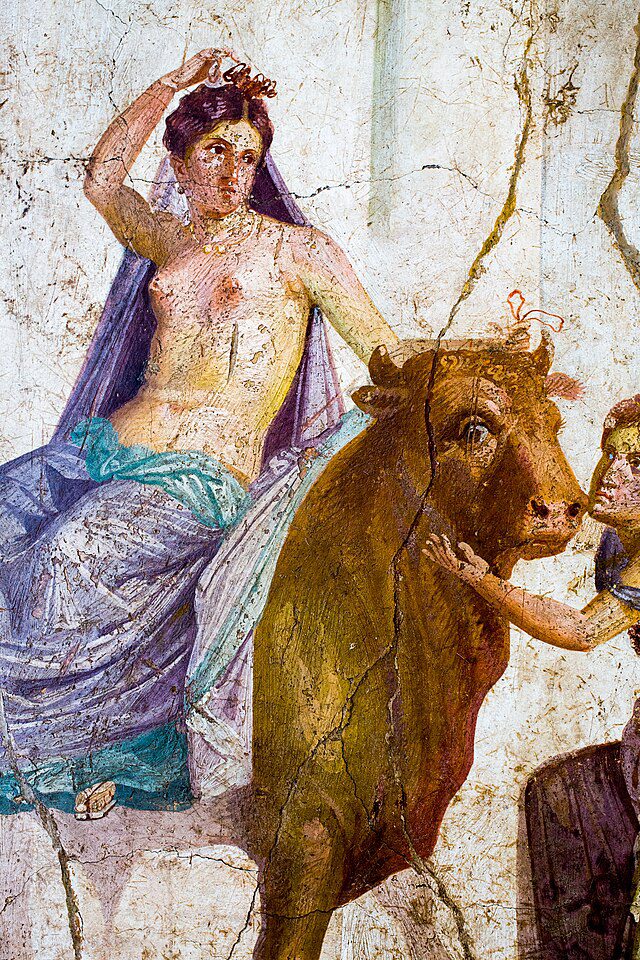
In ancient Greek mythology, Europa is a figure of great significance. She is often depicted as a beautiful princess, and her story is one of love, adventure, and transformation. The myth of Europa begins with her being a Phoenician princess, the daughter of King Agenor of Tyre. According to the legend, Europa captured the attention of Zeus, the king of the gods, who was known for his many romantic escapades. Zeus, enamored by Europa’s beauty, decided to take action to win her affection.
The Abduction of Europa
To approach Europa without alarming her, Zeus transformed himself into a magnificent white bull. This bull was not only stunning but also gentle and friendly. When Europa saw the bull grazing peacefully, she was captivated by its beauty and decided to play with it. She climbed onto its back, and in a swift move, Zeus swam across the sea to the island of Crete. This act of abduction is a pivotal moment in the myth, as it sets the stage for the many adventures that follow.
 Eurus
EurusOnce they reached Crete, Zeus revealed his true identity to Europa. He assured her that she would be safe and loved. In this new land, Europa became the queen and bore Zeus several children, including Minos, who would later become a famous king of Crete. The transformation from a mere princess to a queen signifies the profound impact of her abduction. The story also highlights the recurring theme in Greek mythology where gods interact with mortals, often leading to significant changes in their lives.
Significance of the Myth
- The story of Europa reflects the interaction between gods and humans.
- It illustrates the themes of love, power, and transformation.
- Europa’s tale is a precursor to the many myths surrounding the city of Crete.
The myth of Europa has a rich cultural significance. It is often interpreted as an allegory for the relationship between the East and West. Europa, representing the East, was taken by Zeus, symbolizing the West. This narrative has led to various interpretations throughout history, especially during the periods of colonization and cultural exchange. The tale has been a source of inspiration for many artists, poets, and writers, leading to its enduring presence in Western literature and art.
Europa in Art and Literature
Throughout history, the story of Europa has been a popular subject in art and literature. Many artists have depicted the moment of her abduction by Zeus in various forms. One of the most famous representations is the painting by Paolo Veronese, which captures the dramatic moment of Europa’s flight. In this painting, the artist uses vibrant colors and dynamic poses to convey the intensity of the scene. The bull, representing Zeus, is shown in a powerful stance, while Europa is portrayed with an expression of surprise and wonder.
 Euryale
Literature has also embraced the story of Europa. The ancient Greek poet Ovid included her myth in his work “Metamorphoses,” where he elaborates on the details of her abduction and her subsequent life in Crete. Ovid’s portrayal emphasizes the emotional aspects of the story, highlighting Europa’s feelings of confusion and eventual acceptance of her new life. This literary approach has influenced countless adaptations and retellings of the myth, ensuring its place in the cultural canon.
Europa in Modern Culture
- Europa has been referenced in various modern novels and films.
- Her story continues to be a symbol of transformation and adventure.
- Many artistic interpretations reflect contemporary themes of love and identity.
In contemporary culture, Europa’s myth has found its way into various media. Films and novels often draw on her story to explore themes of identity, love, and adventure. For instance, in some modern retellings, Europa is depicted as a strong, independent woman who navigates her circumstances with agency. This shift in portrayal reflects changing societal values and attitudes towards gender and power dynamics. The enduring nature of Europa’s story shows how ancient myths can evolve and remain relevant in today’s world.
 Eurybia
The Legacy of Europa
The legacy of Europa extends beyond her immediate myth. She is often associated with the continent of Europe, and her name is believed to be the origin of the term. This connection has led to various interpretations of European identity and culture. In many ways, Europa symbolizes the blending of different cultures and traditions that characterize the continent. The myth serves as a reminder of the rich tapestry of history that has shaped Europe into what it is today.
Moreover, Europa’s story is often seen as a cautionary tale about the nature of power and desire. Zeus’s actions, while driven by love, also highlight the complexities of consent and the consequences of manipulation. This aspect of the myth resonates with modern discussions about relationships and the dynamics of power. As such, Europa’s legacy is not only about her transformation but also about the lessons learned from her story.
Influence on European Culture
- Europa’s myth has influenced European literature and philosophy.
- Her story is often referenced in discussions about identity and culture.
- Europa serves as a symbol of unity and diversity within Europe.
Throughout history, the myth of Europa has had a profound impact on European culture. Philosophers and writers have drawn inspiration from her story to discuss themes of identity, belonging, and the complexities of human relationships. In literature, Europa often symbolizes the struggle between freedom and captivity, reflecting broader societal issues. Her narrative has been used to explore the concept of European unity, emphasizing the idea that diverse cultures can coexist and enrich one another.
Europa in Astrology and Astronomy
Interestingly, Europa’s influence extends into the realms of astrology and astronomy. In astronomy, Europa is the name of one of Jupiter’s moons. Discovered in 1610 by Galileo Galilei, Europa is one of the four largest moons of Jupiter, known as the Galilean moons. This moon has garnered significant interest due to its smooth ice-covered surface and the potential for an ocean beneath, leading scientists to speculate about the possibility of extraterrestrial life. The naming of the moon after the mythological figure connects the realms of ancient mythology and modern science.
In astrology, the name Europa is sometimes associated with themes of adventure, exploration, and the search for deeper meaning. Individuals with a strong connection to Europa in their astrological charts may be seen as wanderers or seekers, drawn to new experiences and cultures. This interpretation aligns with the essence of the myth, where Europa’s journey leads her to new lands and transformations. The legacy of Europa thus continues to inspire not only cultural and artistic endeavors but also scientific exploration.
Europa’s Symbolism in Modern Astrology
- Europa symbolizes adventure and exploration.
- Her story represents the search for identity and self-discovery.
- In astrology, Europa is linked to cultural exchange and growth.
Astrologically, Europa is often viewed as a symbol of growth through exploration and cultural exchange. Those influenced by Europa may find themselves drawn to travel, learning about new cultures, and engaging in experiences that broaden their perspectives. This aligns with the mythological narrative, where Europa’s journey leads to significant personal transformation. In this way, Europa serves as a reminder of the importance of embracing change and the richness that comes from engaging with the world around us.
the myth of Europa is a multifaceted story that encompasses themes of love, adventure, and transformation. From her abduction by Zeus to her role as a queen in Crete, Europa’s journey has had a lasting impact on culture, art, and literature. Her legacy continues to inspire modern interpretations and discussions about identity, power dynamics, and the nature of relationships. Furthermore, her connection to astronomy and astrology showcases the enduring relevance of her story across different fields of study. Europa stands as a symbol of the complex interplay between myth and reality, reminding us of the rich tapestry of history that shapes our understanding of the world today.