WORLD
WORLD
Wawalag
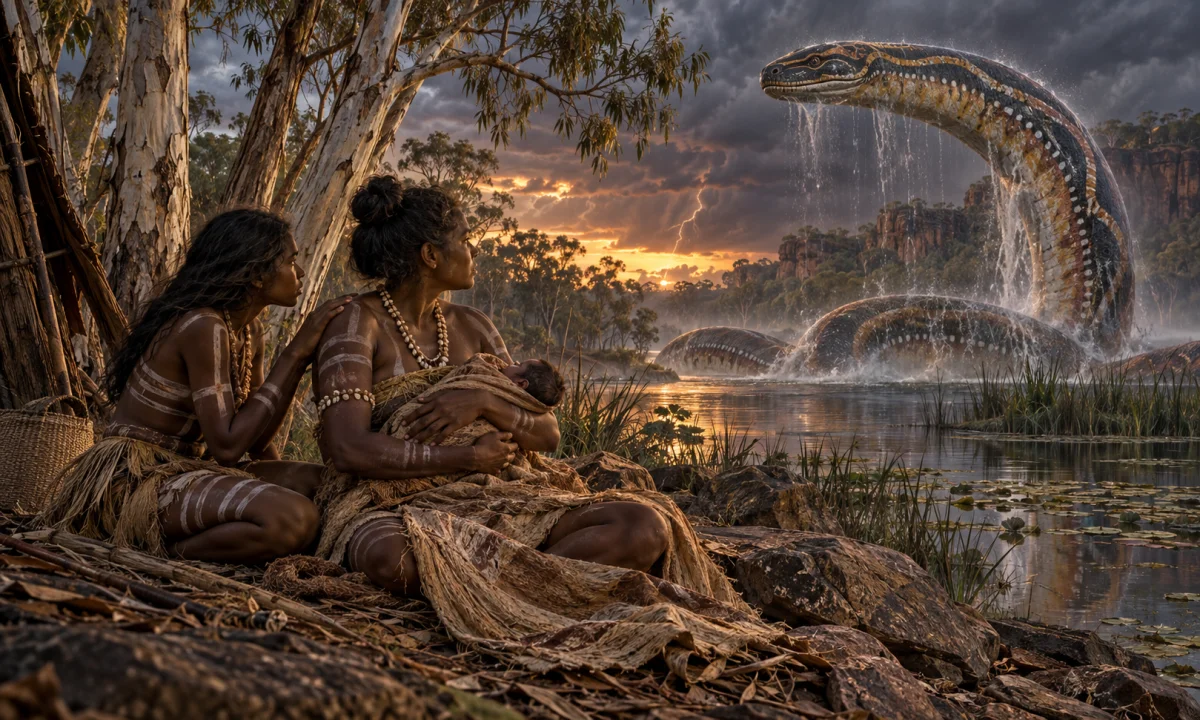
Wawalag refers most often to two ancestral sisters in the traditions of Yolngu peoples of north-eastern Arnhem Land in the Northern Territory of Australia. They are also known in English-language sources as the Wawilak or Wauwalak sisters, although spelling varies according to language, community and transcription. Their story is connected with ancestral journeys, sacred water, menstruation, birth, law and the powerful serpent being Yurlunggur. It is not simply a tale about supernatural characters: within the traditions that preserve it, the Wawalag narrative is part of a larger religious and ceremonial understanding of country, kinship and the origins of ritual.
Cultural setting and sources
The Wawalag story belongs principally to the cultural world of Arnhem Land, a region whose Indigenous societies have maintained highly detailed systems of language, clan identity, ancestral law and ceremonial practice. Yolngu traditions describe the ancestral past not as a remote period that has ended, but as a continuing dimension of reality. English often translates this broad concept as the Dreaming, though that word does not convey every meaning carried by Yolngu terms and practices.
Ancestral beings travelled through particular landscapes, named places, established relationships between people and country, and left behind patterns of ceremonial knowledge. A narrative about the Wawalag sisters may therefore refer simultaneously to events in ancestral time, visible features of the land, ritual performances, songs, paintings and rules governing social life. The story is not independent of those other forms of knowledge.
Much of the material recorded by outsiders comes from anthropological observation, conversations with knowledgeable custodians and descriptions of ceremonies. Such records are incomplete. Some elements of Wawalag tradition are restricted by gender, initiation status, clan affiliation or ceremonial authority. Public accounts may consequently omit important details, use approximate translations or combine versions that are kept distinct within Yolngu communities. A retelling should not be treated as a complete account of the tradition.
Name and identity
Wawalag is frequently used as the name of the sisters collectively, while Wawilak and Wauwalak are common variant spellings. The differences reflect the difficulties of representing Indigenous languages in English rather than necessarily indicating separate beings. Older records may use other forms, and the precise spelling preferred by a particular community or scholar can differ.
The Wawalag are generally described as sisters rather than as a single goddess or monster. In some accounts one sister is older and has a child, while the other is younger. The sisters are often portrayed as travelling ancestral women whose actions have consequences for ritual law and the ordering of the world. Their story is therefore better classified as an ancestral narrative than as a legend about a wandering pair of human-like heroines.
Details of their names, family relationships and individual roles vary. Public retellings sometimes present the sisters as though they have fixed personalities found in every version, but the surviving record does not support treating every detail as universal. The central pattern—the sisters’ journey, their encounter with a sacred waterhole and their relationship with Yurlunggur—is more consistent than the names or smaller incidents.
The journey of the sisters
In commonly recorded versions, the Wawalag sisters travel across the country carrying or caring for a child. The older sister is often described as having recently given birth. During their journey they gather food, prepare a camp and eventually come to a waterhole associated with the great serpent Yurlunggur.
The waterhole is not merely a convenient place to stop. It is a spiritually powerful site, and the sisters’ presence there sets the central events in motion. Accounts differ over the precise circumstances, but menstrual blood is an important element in many versions. The blood enters or approaches the water, and Yurlunggur becomes aware of it. The story consequently brings together female reproductive power, water, danger and the boundaries surrounding sacred places.
Yurlunggur rises from the water and swallows the sisters. Depending on the version, the child and other members of the travelling group are also taken into the serpent’s body. Some accounts describe the serpent as angered or disturbed; others place greater emphasis on the encounter as a powerful transformation rather than on a simple act of punishment. The sisters’ fate is linked to the extraordinary force of the waterhole and to the need for correct ritual relations with country.
Later, during a storm or a sequence of ceremonial actions, Yurlunggur regurgitates the people he has swallowed. The imagery of thunder, rain, water and the serpent’s movement is especially significant. The event is associated with renewal and with the transmission or establishment of ceremonial knowledge. Public summaries often reduce the episode to a monster swallowing and releasing its victims, but that version misses the story’s connections with bodily processes, fertility, weather, ritual authority and ancestral law.
Yurlunggur and the sacred waterhole
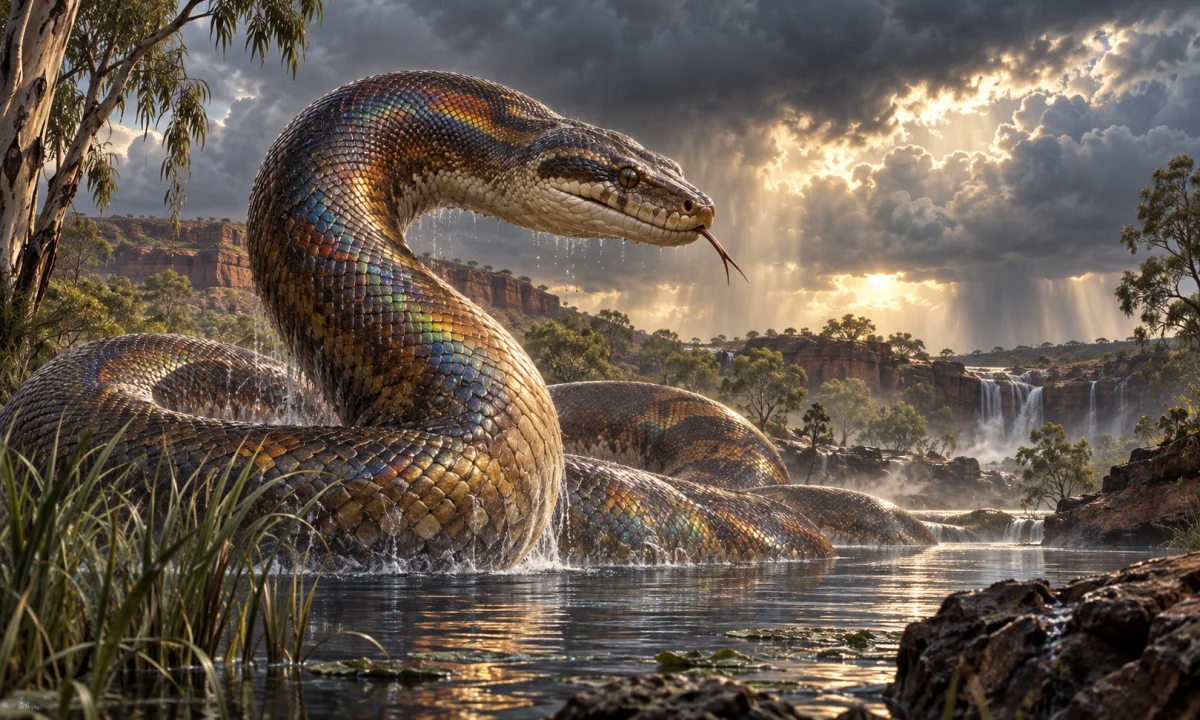
Yurlunggur is commonly identified in English as a Rainbow Serpent. This translation is useful but limited. “Rainbow Serpent” is a broad label applied to powerful ancestral serpent beings in many Aboriginal traditions across Australia. It does not mean that all such beings are the same deity, nor that every Aboriginal community shares the same story. Yurlunggur belongs specifically to the cultural and linguistic contexts in which the Wawalag narrative is maintained.
Yurlunggur is associated with water, rain, storms and the creative or destructive force of the ancestral landscape. The serpent’s presence makes the waterhole a place of power. Waterholes in Aboriginal religious traditions are often more than environmental resources: they can be sites of ancestral residence, ceremonial responsibility and strict behavioural rules. The Wawalag story expresses the danger of approaching such a place without the knowledge or circumstances required by its law.
The relation between the sisters and Yurlunggur should not be interpreted only as a conflict between good women and an evil serpent. Yurlunggur is a dangerous being, but the narrative does not necessarily place him within a simple moral category equivalent to a Western devil or villain. His actions participate in a larger process through which ancestral events, ritual relationships and the character of country are made intelligible.
Menstruation, birth and ritual power
Menstruation is central to many public versions of the story. It is sometimes described as the force that attracts Yurlunggur to the camp or provokes his emergence from the water. This detail should not be treated as evidence that Yolngu traditions regard menstruation as inherently evil or dirty. Within many Indigenous ritual systems, menstrual blood is powerful, and its significance depends on context, place, gender, ceremony and prescribed rules.
The story places menstrual blood beside pregnancy, childbirth and the care of an infant. These are not incidental details. They connect the sisters with the generation of life and with forms of knowledge that may be subject to specific ceremonial restrictions. The encounter with Yurlunggur can thus be read as involving the meeting of different kinds of ancestral power: female reproductive power, the potency of sacred water and the force of the serpent.
Interpretations that describe the story as a warning against women entering certain places may capture one aspect of some versions but can be too narrow. The narrative is also concerned with who has authority over a site, how ritual knowledge is transmitted and how relations between people and country must be maintained. Its meaning cannot be separated from the ceremonial traditions in which it has been performed and explained.
The Wawalag story and ceremony
The Wawalag narrative is strongly associated in anthropological literature with the Kunapipi ceremonial complex, also called the Gunabibi in some contexts and spellings. Kunapipi is not simply the name of a goddess or a single mythological character. It refers to an important ceremonial tradition involving initiation, ancestral beings, songs, dances, bodily symbolism, social relationships and the reproduction of religious knowledge.
Within public descriptions of Kunapipi, the swallowing and regurgitation of the Wawalag sisters by Yurlunggur may be represented through performance. Ceremonial action does not merely illustrate a story for entertainment. It can renew relationships among people, ancestors and country, teach participants about law and reproduce knowledge that is held by appropriate custodians.
The exact content and interpretation of ceremonies are not uniform, and many details are not intended for unrestricted public discussion. Descriptions based on older fieldwork may also reflect the vocabulary and assumptions of the researchers who recorded them. It is therefore important to distinguish between a public outline of the Wawalag narrative and the full ceremonial knowledge held by Yolngu communities.
Relationships with other ancestral traditions
The Wawalag sisters are sometimes discussed alongside the Djang'kawu ancestral beings, who are also associated with eastern Arnhem Land traditions, journeys, fertility and the establishment of places and practices. The traditions may intersect within wider ceremonial systems, but the Djang'kawu and the Wawalag are not simply different names for the same figures. The Djang'kawu are commonly represented as ancestral siblings who travel and bring aspects of culture into being, whereas the Wawalag narrative centres on the sisters’ encounter with Yurlunggur and its ceremonial consequences.
Confusion can also arise when the English expression “Rainbow Serpent” is treated as the name of one pan-Aboriginal being. Aboriginal Australia contains hundreds of cultural and linguistic traditions, each with its own ancestral beings and systems of law. Yurlunggur should not be merged with every serpent figure called a Rainbow Serpent, nor with unrelated water beings from other parts of the continent.
Likewise, Wawalag should not be treated as a generic term for female creator spirits. The sisters belong to particular Yolngu traditions and to specific relationships between language groups, clans, ceremonial knowledge and places. Their identity is grounded in country and inherited law rather than in a universal mythology shared in identical form throughout Australia.
Interpretation and cultural significance
The Wawalag story brings together several themes that are important in Yolngu religious thought. One is the continuing relationship between ancestral beings and the landscape. The sisters’ route and the serpent’s waterhole locate the narrative in country, while the events explain why particular places possess spiritual force and why certain rules apply there.
Another theme is the connection between bodies and social law. Menstruation, childbirth and the presence of a child are not detached biological details. They are part of a network of relationships involving gender, kinship, ritual access and responsibility. The story may therefore be approached as an account of how bodily power and environmental power meet, rather than as a simple tale of transgression and punishment.
The serpent’s swallowing and release also provide a powerful image of transformation. Being taken into the water and returned from it can be associated with death, renewal, initiation and the transmission of ancestral knowledge. These interpretations are not interchangeable explanations of a single fixed symbol; their relevance depends on the ceremonial setting and the knowledge of the people presenting the tradition.
For Yolngu communities, the value of the story lies not only in what it says about the past. Ancestral narratives can continue to authorise responsibilities, identify relationships to land and guide the performance of ceremony. Their significance is therefore practical, religious and political as well as narrative.
Later representation
The Wawalag sisters and Yurlunggur have appeared in anthropological writing, museum interpretation, books about Australian Aboriginal mythology and discussions of Aboriginal art. These representations have helped introduce the narrative to audiences outside Arnhem Land, but they can also detach it from the ceremonial, linguistic and custodial contexts that give it meaning.
Modern popular culture sometimes uses the image of a generic “Rainbow Serpent” as a symbol of Australian spirituality or environmental power. Such uses may draw loosely on traditions from many regions and should not be assumed to represent the Wawalag story. The Wawalag sisters are most accurately understood through their specific Yolngu cultural setting, their variant names, their relationship with Yurlunggur and the living ceremonial knowledge associated with them.