WORLD

Eingana
Eingana is a primordial creator figure associated in published accounts with the Gunwinggu people of western Arnhem Land in northern Australia. She is commonly described as a vast ancestral snake and as the mother of living beings. Her story belongs to the religious world often called the Dreaming or Dreamtime, although those English terms do not fully express the meanings of the Aboriginal concepts they are used to translate. The Dreaming is not simply a distant age before history: it concerns ancestral actions, landforms, laws, kinship, ceremony and continuing relationships between people and Country.
Information about Eingana is limited and comes chiefly through anthropological records, comparative writing and later reference works. It should not be treated as a complete account of one uniform Aboriginal religion. Aboriginal Australia contains many distinct peoples, languages and ceremonial traditions, and stories can vary between communities and knowledgeable custodians. The name Eingana is most often connected with traditions identified in older sources as Gunwinggu, a name now more commonly written Kunwinjku in many contexts. Older spellings and descriptions may reflect the practices of the researchers who recorded them rather than a single universally accepted form.
Origins and cultural setting
Eingana belongs to the ancestral layer of Kunwinjku-associated religious tradition. In Aboriginal Australian cosmology, ancestral beings are not always equivalent to gods in the sense familiar from Greek, Roman or Christian traditions. They may be animals, humans, plants, composite beings or powerful presences that move through a spiritually active landscape. Their actions establish features of the country and patterns of life, while their presence may remain connected with particular places, ceremonies and obligations.
For that reason, calling Eingana a creator goddess is useful as a broad description but can also be misleading. English-language writers have used the term because she is portrayed as a female or motherly source of life. Yet “goddess” may suggest a separate, human-like divine person who rules the universe from outside it. The traditions associated with Eingana instead present her as a deeply embodied ancestral power: a being connected with the origins of creatures, the landscape and the continuity of life.
The cultural setting is western Arnhem Land, a region of northern Australia with long-established Aboriginal societies and rich traditions of painting, ceremony, song and oral instruction. Kunwinjku communities maintain distinctive understandings of ancestral beings and places. A story recorded by an outside observer may therefore omit ritual knowledge, restricted information, local names or meanings that are not intended for general publication. Public summaries should be read as partial accounts rather than as substitutes for community authority.
Name and classification
Eingana is a spelling established in English-language discussions of the figure. The pronunciation, linguistic analysis and relationship of the name to other local forms are not consistently explained in popular reference works. It is therefore safer to retain the familiar spelling while acknowledging that published transcriptions can differ.
Reference books commonly classify Eingana as a female creator, mother deity, earth mother or primordial serpent. These labels describe recurring features of the available accounts, but they should not be assumed to represent a single indigenous classification. Nor should Eingana automatically be identified with every Australian Aboriginal Rainbow Serpent or creator snake. Serpent beings appear in many Aboriginal traditions, but their names, stories, ceremonial roles and relationships to particular places differ considerably.
In the accounts most often repeated, Eingana is an enormous snake-like ancestral being who existed at the beginning of the present order of life. She is associated with the generation or bearing of living creatures and with the bonds that connect life to its source. Her motherhood is therefore cosmological rather than merely biological: she represents the origin and continuing dependence of living beings.
Appearance and nature
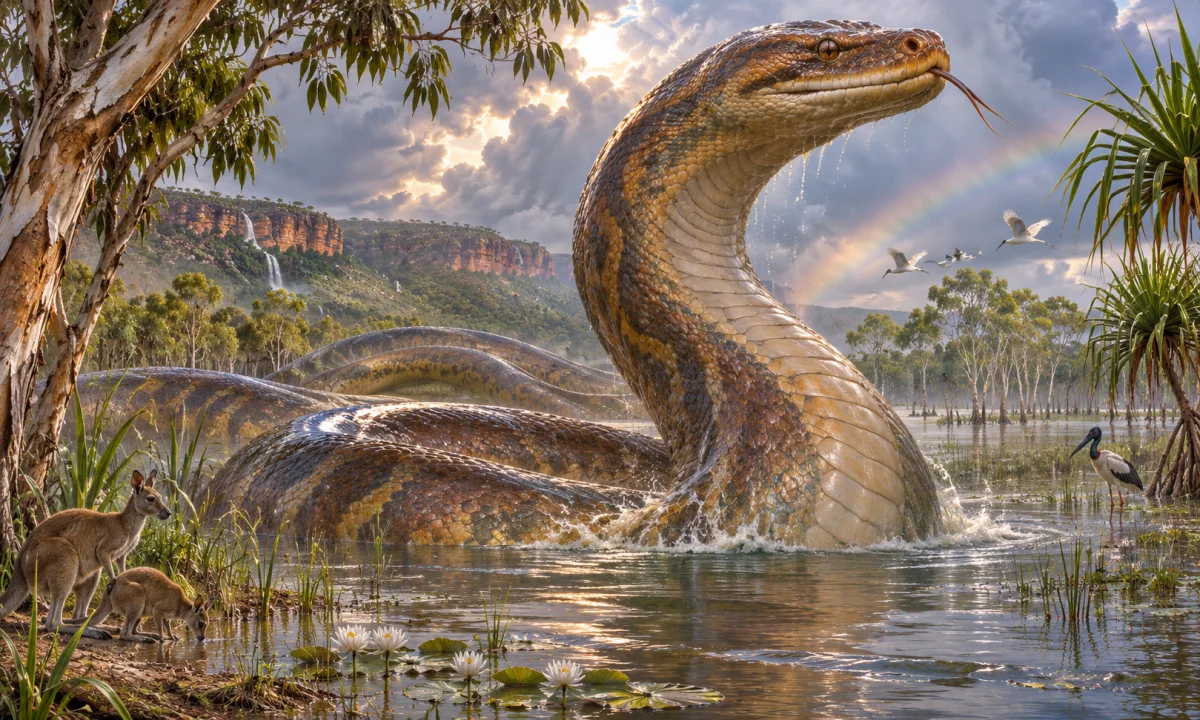
Eingana is generally imagined as a giant serpent. Descriptions of her appearance are not consistent enough to justify a single canonical image. Some retellings present her as a monstrous snake or water-serpent, while others focus less on visual detail and more on her role as a life-bearing ancestral presence. Modern illustrations may add colours, patterns or supernatural features that are not securely established in the older accounts.
Her serpentine form carries several meanings within the broader symbolic world of northern Australian traditions. Snakes are closely associated in many Aboriginal contexts with water, fertility, movement beneath the earth and the shaping of country. A snake can inhabit or connect waterways, pools and subterranean spaces, while its movement may be imagined as producing tracks, channels, hills or other features of the land. These associations are widespread, however, and do not mean that every Aboriginal snake ancestor has the same identity or function as Eingana.
Some summaries describe Eingana as lacking ordinary female sexual anatomy or as being unable to give birth in a human manner. Such details are important in certain published versions because they emphasise her extraordinary, non-human nature. They should not be presented as universal doctrine. Accounts may reflect different translations, selective recording or attempts by early writers to explain complex ideas using familiar biological categories.
Mother of living beings
The central feature of Eingana’s identity is her relationship with living things. She is described as the mother or source of creatures, and sometimes as a being from whom the many forms of life emerged. Humans, animals and other beings may be understood as connected to her through a primordial relationship rather than as independent creations.
In some retellings, her offspring or living creations remain attached to her by cords or other bodily connections. These images express the dependence of life on its ancestral origin. They also suggest that existence is relational: a creature is not merely an isolated individual but part of a network linking people, animals, country and ancestral power. When such imagery is removed from its cultural context, it can appear as a strange biological fantasy; within a religious framework, it expresses obligations and continuity.
The maternal language surrounding Eingana does not necessarily mean that she is a gentle or protective mother in the modern sentimental sense. Primordial beings can be creative, dangerous, demanding or vulnerable. Their actions may establish laws and conditions that human beings must respect. A creator’s importance lies not only in having produced life but also in defining how life is ordered and how people should live within Country.
Stories of creation and mortality
Popular accounts of Eingana often compress her tradition into the statement that she “created the world.” That wording is too broad to describe the evidence precisely. The available material more securely presents her as a mother or origin of living beings, while the creation of specific places, species, laws and ceremonial arrangements may involve other ancestral figures or local traditions.
Some versions also describe an event in which Eingana is wounded or killed by another ancestral power. The details differ in secondary sources, and the identity of the being responsible is not consistently reported. In a number of summaries, the episode is linked with the release or transformation of the life she carries. Such retellings should not be treated as one fixed canonical myth unless a particular community or source clearly establishes that form.
The possibility of Eingana’s death does not necessarily contradict her status as a creator. In Aboriginal ancestral traditions, an ancestor may undergo death, transformation, dispersal or incorporation into the landscape. A being can cease to move in an ordinary form while remaining present in a sacred site, natural feature, species, ceremony or inherited law. The distinction between “dead” and “still spiritually active” is therefore not always the same as in ordinary human biography.
Some modern summaries connect Eingana with a specific antagonist, storm being or lightning figure. Because these relationships are not consistently documented across accessible sources, it is better to avoid treating any one pairing as universal. The names and roles of powerful ancestral beings vary between language groups, and resemblance in weather or serpent imagery does not establish that two traditions share the same characters.
Symbolism and religious significance
Eingana’s importance can be understood through several related themes:
- Origin: she represents the ancestral source from which living beings arise.
- Interdependence: the connection between mother and offspring expresses the continuing relationship between creatures, ancestors and Country.
- Serpent power: her form evokes movement through water, earth and the hidden spaces of the landscape.
- Female creative force: descriptions of her as a mother challenge the assumption that cosmic creation must be represented by a male figure.
- Transformation: stories of injury, death or incorporation into the land show that creation may involve change rather than a single finished act.
These themes should not be separated from cultural practice. In Aboriginal religious life, ancestral knowledge is traditionally carried through story, song, dance, visual designs, ceremony and relationships with particular places. A figure such as Eingana is not merely a character in a narrative collection. Her significance depends on how ancestral knowledge is transmitted, who has the authority to speak about it, and how it relates to the responsibilities of living people.
The maternal imagery also has a geographical dimension. Country is not simply a physical environment but a living field of relationships. Waterholes, rivers, hills, animals and plants may be connected with ancestral actions and continuing spiritual significance. A serpent mother who generates life can therefore be understood as part of a larger conception in which the land itself is a source of identity, sustenance and law.
Evidence and limitations of the sources
There is no single ancient written scripture that sets out an authoritative biography of Eingana. The traditions were transmitted primarily through Aboriginal oral, ceremonial and artistic forms. Written records were made by outsiders, especially anthropologists and other observers, and those records were shaped by the questions, terminology and assumptions of their authors.
Older ethnographic writing may use terms such as “myth,” “primitive religion,” “tribe” or “goddess” in ways that are now considered inadequate or outdated. It may also combine information from different narrators, omit restricted knowledge or present a local version as though it represented a whole people. A careful account must distinguish what is directly recorded from what later writers have inferred.
The spelling Gunwinggu is common in older literature, while Kunwinjku is widely used today for the language and people associated with western Arnhem Land. This change is not simply a minor spelling preference: it reflects changing approaches to Aboriginal self-identification and linguistic representation. The presence of the older form in discussions of Eingana should be understood as a feature of the historical record, not as evidence that all Aboriginal groups share the tradition.
Distinction from other serpent beings
Eingana is sometimes described online as an Australian equivalent of the Rainbow Serpent. That comparison can be suggestive but should not be treated as an identification. “Rainbow Serpent” is an English umbrella expression used for a range of powerful ancestral beings in different Aboriginal traditions. Those beings may have distinct local names and may be associated with rain, rivers, fertility, initiation, punishment, creation or the protection of sacred places.
Eingana’s best-known classification is as a primordial mother and creator serpent, whereas other serpent ancestors may be male, female, multiple, gender-changing or beyond ordinary gender categories. Some are explicitly associated with rainbows or storms; Eingana is not automatically a Rainbow Serpent merely because she is snake-like and connected with life. Similarities in form reflect recurring symbolic patterns, not proof of a common character.
She should also not be confused with the many “snake goddess” figures of Africa, Asia, the ancient Mediterranean or modern fantasy. Those comparisons may help readers recognise a broad archetype, but they do not establish historical contact or shared origin. Eingana belongs to a particular Aboriginal cultural and geographical setting.
Later reception
Eingana has appeared mainly in encyclopedias, books about world mythology and educational summaries rather than in a large body of mainstream film, television or popular fiction. These retellings often make her easier to compare with creator deities from other cultures, but they can also simplify a local ancestral tradition into a single character profile: “giant snake,” “mother of all life” and “creator goddess.” Such summaries leave out the importance of Country, ceremonial authority and variation between Aboriginal communities.
Contemporary representations should therefore distinguish adaptation from tradition. An illustration, fantasy novel or game may borrow Eingana’s name or serpent imagery without preserving the religious meaning of the figure. Unless a work is created in collaboration with relevant Aboriginal knowledge holders, it should not be assumed to provide an authentic account of Kunwinjku tradition. The most responsible understanding of Eingana keeps her within the cultural world in which the name was recorded: a living Aboriginal religious context shaped by ancestral relationships, land and community knowledge.