WORLD

Gnowee
Gnowee is an ancestral woman associated with the Sun in the traditions of the Wotjobaluk people of western Victoria, Australia. In a well-known story, she searches for her lost child while carrying a burning object that illuminates the world. Her journey is used to explain the Sun’s movement across the sky, although details of the story and the way Gnowee is described vary between accounts.
Cultural setting
Gnowee belongs to the diverse traditions of the Aboriginal peoples of southeastern Australia. It is important not to treat Aboriginal Australian mythology as one single religious system. Hundreds of distinct language groups have their own ancestral narratives, ceremonial practices and explanations of the natural world. A figure associated with the Sun in one tradition should not automatically be treated as a universal Aboriginal deity.
Gnowee is most often connected with the Wotjobaluk, a group from the Wimmera region of western Victoria. The story has survived principally through oral tradition and through accounts recorded by non-Indigenous observers. Such records are valuable but limited. They were often written in English, sometimes long after the traditions had been spoken, and may compress several versions into one narrative. The spelling Gnowee represents an attempt to write an Indigenous name using English orthography, and other spellings or forms may appear in older works.
In many Aboriginal Australian traditions, ancestral beings are not simply gods in the sense familiar from classical European mythology. They may be ancestors, powerful beings, creators, culture heroes or presences whose actions established relationships between people, places, animals and natural features. For this reason, calling Gnowee a “sun goddess” is convenient for general readers but can impose a category that does not exactly match Wotjobaluk religious ideas. She is more carefully described as an ancestral or mythic woman associated with the Sun.
The story of Gnowee and the Sun
The most frequently repeated version begins in a time when the world was not illuminated by the Sun. People lived in darkness or in a dimly lit world, and ordinary activities were difficult. Gnowee lived on the earth with her young child. One day, she went out to gather food, commonly described as yams or other edible roots.
While Gnowee was away, her child left the camp. In some tellings, the child crawled away after becoming hungry; in others, the disappearance is simply discovered when Gnowee returned. She searched the surrounding country but could not find him. As her search continued, she carried a burning brand or torch. The light from this fire revealed the land to those below.
Gnowee’s search eventually took her upward, and she became associated with the Sun. In one broad interpretation of the story, the light she carried became the Sun itself. Each day, she travels across the sky with her fire, bringing daylight to the earth. When she disappears from view in the evening, she is understood in some versions to continue her journey beneath the earth or through another unseen part of the cosmos before rising again.
The story is not merely an explanation of sunrise and sunset. Gnowee’s movement expresses grief, persistence and maternal responsibility. She is not placed in the sky because she seeks power or authority. Instead, her celestial role emerges from an urgent search for her child. The Sun’s daily journey can therefore be understood as the continuing action of an ancestral person rather than as an impersonal astronomical process.
Variations in the tradition
Accounts of Gnowee do not all give the same sequence of events. Differences may concern the child’s age, the food Gnowee was collecting, the nature of the light she carried and the precise moment at which she entered the sky. Some versions present her torch as a firebrand; others use language suggesting that she lifted a burning object into the heavens. The child may remain the central reason for her journey, while in other retellings the emphasis falls more strongly on the creation of daylight.
These variations are not necessarily contradictions. Oral traditions can preserve a narrative through repeated performance while allowing differences in wording, emphasis and local interpretation. A written version usually records one telling at one time, rather than a definitive text that replaces all others. Claims that there is one fixed and universally authoritative story of Gnowee should therefore be treated cautiously.
The phrase Dreamtime is often used in English-language descriptions of Aboriginal Australian traditions, but it can be misleading if treated as a simple synonym for a distant “mythical past.” Many Aboriginal communities prefer terms such as the Dreaming, or words from their own languages, to describe ancestral realities that remain connected with the present. The events associated with Gnowee are not only about what happened long ago. They may also concern continuing relationships between land, sky, people and ancestral power.
Appearance and attributes
Gnowee is generally represented as a human woman rather than as an animal, monster or abstract force. Her most important attribute is the fire or torch that she carries during her search. This burning light links her directly with the Sun and explains why daylight reaches the earth.
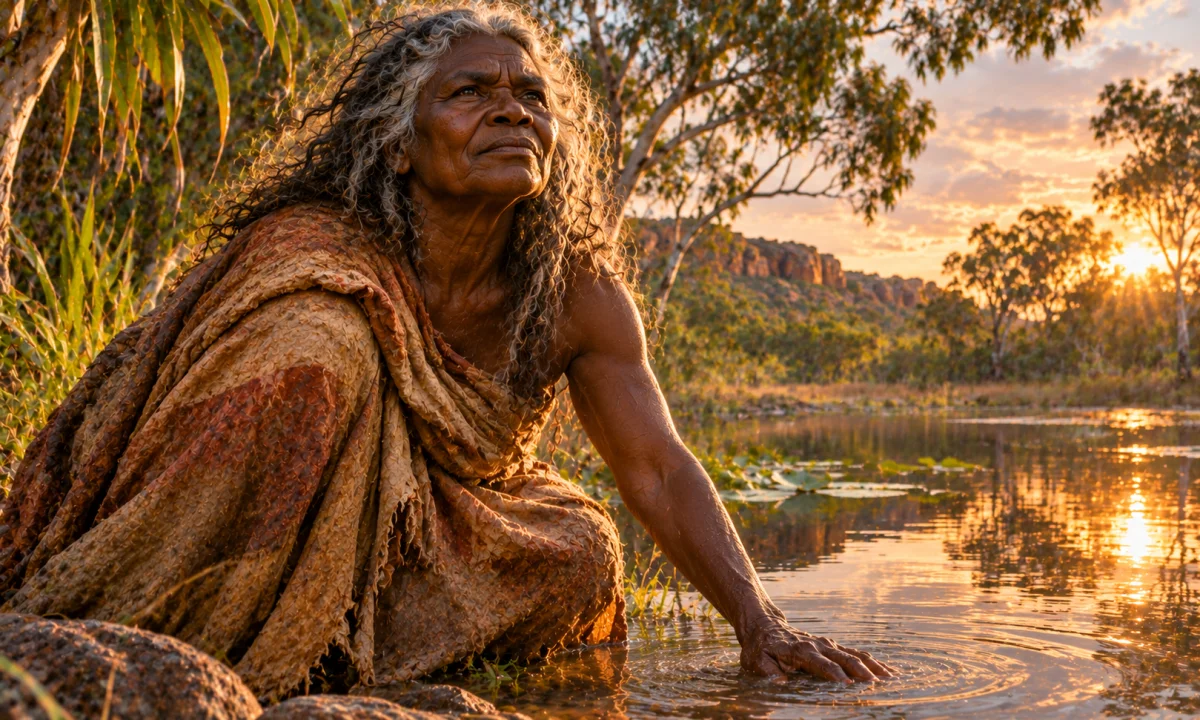
Her appearance is not consistently described in the surviving general accounts. Images of Gnowee in modern books may give her elaborate clothing, jewellery or a radiant supernatural form, but these artistic additions should not automatically be treated as traditional details. The essential features of the narrative are her identity as a woman, the loss of her child, her determined search and her association with a moving celestial light.
Gnowee’s power is therefore shown through action rather than through a long list of magical abilities. She can carry a light capable of illuminating the world, travel beyond the ordinary human sphere and become part of the structure of the sky. Her daily course gives order to time and makes the alternation of daylight and darkness intelligible within the story.
Motherhood, loss and illumination
The emotional centre of the tradition is Gnowee’s response to separation from her child. Her motherhood is not a minor detail added to an astronomical tale; it motivates the entire journey. She continues searching even when the child cannot be found, and her search transforms the conditions of life for everyone on earth.
This association gives the Sun a human and emotional dimension. Daylight is connected with care, movement and the refusal to abandon a loved one. The story can also be read as an account of how personal grief becomes part of the shared world. Gnowee’s private loss produces a light that benefits the whole community, although the tradition should not be reduced to a simple moral lesson.
The torch is equally significant. Fire is a central element in many Australian cultural traditions, with practical, ecological, ceremonial and symbolic importance. However, it would be unsafe to assume that every Aboriginal tradition gives fire the same meaning. In Gnowee’s story, the fire primarily serves as a source of illumination and as the visible sign of her continuing search. Broader statements about “Aboriginal fire mythology” should not be used to define the Wotjobaluk account without evidence from the relevant cultural context.
Gnowee and the structure of the sky
The story presents the Sun as an active ancestral presence. Sunrise is not simply the appearance of an object; it is the return of Gnowee and the continuation of her journey. Sunset marks her departure from ordinary sight, but not necessarily the end of her activity. In accounts where she travels beneath the earth, the unseen night journey explains how the Sun can disappear and return each day.
This pattern reflects a widespread feature of traditional cosmologies: natural cycles are understood through the actions and relationships of ancestral beings. The sky is not separated from the land or from human life. The movement of a celestial body can preserve a story about kinship, danger, responsibility or the origin of a customary order.
It is not clear that every Wotjobaluk interpretation treats Gnowee as a “creator” in the broad sense sometimes used by popular mythology books. The available accounts chiefly connect her with the Sun and with the explanation of daylight. Describing her as the creator of the entire world would go beyond the best-known material unless a particular source or community tradition supports that claim.
Name and classification
The spelling Gnowee is the form most familiar in English discussions, but Indigenous names recorded in colonial and later publications can vary considerably. Differences may result from dialect, pronunciation, changes in orthographic conventions or the difficulty of representing Indigenous sounds with English letters. A variant spelling does not automatically indicate a different being, but similar-looking names should not be merged without evidence.
Gnowee is sometimes listed among Australian “goddesses,” “sun deities” or “solar spirits.” These labels can help readers locate her in comparative mythology, yet they should be used with care. The word goddess usually suggests a clearly defined divine personality within a pantheon. The surviving descriptions of Gnowee instead present an ancestral female figure whose story is embedded in a particular cultural landscape and tradition.
Nor should Gnowee be treated as the Aboriginal Australian equivalent of a universal solar goddess such as the Egyptian Ra, the Greek Helios or the Japanese Amaterasu. Comparison may highlight the fact that many cultures explain the Sun through a personified being, but it does not make these figures interchangeable. Their social roles, ritual settings and religious meanings are different.
Distinguishing Gnowee from other Australian solar figures
Several Aboriginal Australian traditions include beings associated with the Sun, but they are not automatically versions of Gnowee. One figure often mentioned in comparative lists is Wala, a solar woman in Yolngu traditions of Arnhem Land. Wala belongs to a different cultural and linguistic setting in northern Australia, and her stories should not be combined with the Wotjobaluk tradition of Gnowee.
Likewise, accounts of sun women, fire beings or celestial ancestors from other regions may resemble Gnowee’s story because they address common questions about light and the sky. Similar themes do not prove that the figures are the same or that one tradition borrowed directly from another. Regional differences, local languages and distinct ceremonial contexts remain important.
Sources and interpretation
Knowledge of Gnowee available to a broad English-speaking audience comes largely from collected oral traditions and ethnographic writings. These records must be read with awareness of the circumstances in which they were produced. Early collectors did not always record the original language, the identity of the storyteller or the cultural setting in sufficient detail. They may also have translated Indigenous concepts into familiar European terms such as “god,” “goddess,” “myth” or “legend.”
For that reason, interpretations should distinguish between what the story directly describes and what later writers infer from it. The direct narrative concerns a woman, a missing child, a search, a light or fire, and a connection with the Sun’s daily movement. Interpretations about universal solar worship, a formal pantheon or a single standardized Aboriginal religion require greater caution.
The tradition also has a continuing cultural dimension. Gnowee is not only a character preserved in old collections. Stories associated with the land and sky can remain part of living Indigenous identity, even when they are not publicly shared in full. Some knowledge may be restricted, locally specific or connected with responsibilities that cannot be represented adequately in a general mythology entry.
Later retellings
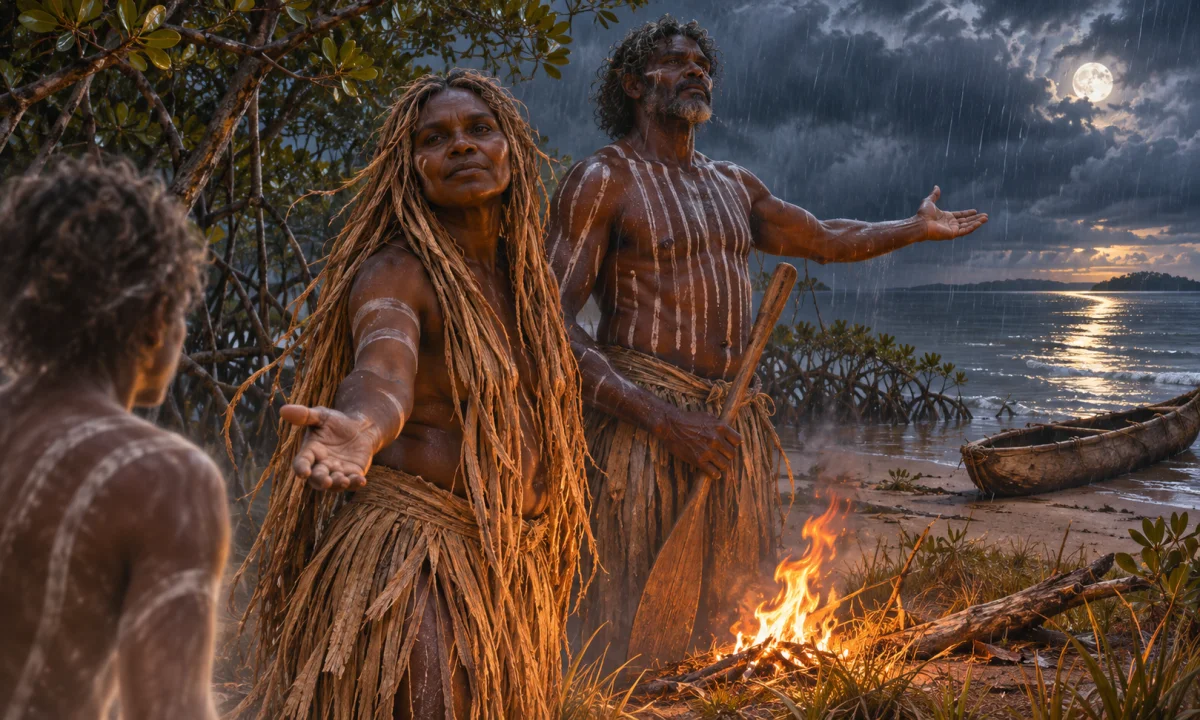
Modern reference books, classroom materials and mythology websites often shorten Gnowee’s story into a simple account of a “sun goddess carrying a torch.” This version preserves the central image but can remove the cultural setting, the variations between tellings and the distinction between an ancestral figure and a European-style deity. Illustrators and fantasy writers may also portray Gnowee as a radiant woman in a celestial palace or as a member of a worldwide pantheon; such additions belong to modern artistic adaptation, not to the core tradition.
Gnowee’s story remains most distinctive when it is understood in its Wotjobaluk context: a woman whose search for her child is inseparable from the light that orders the visible world. The daily Sun is thus connected with an ancestral journey, while the details of that journey continue to require respect for regional tradition, variation and the limits of surviving records.