WORLD

Erathipa
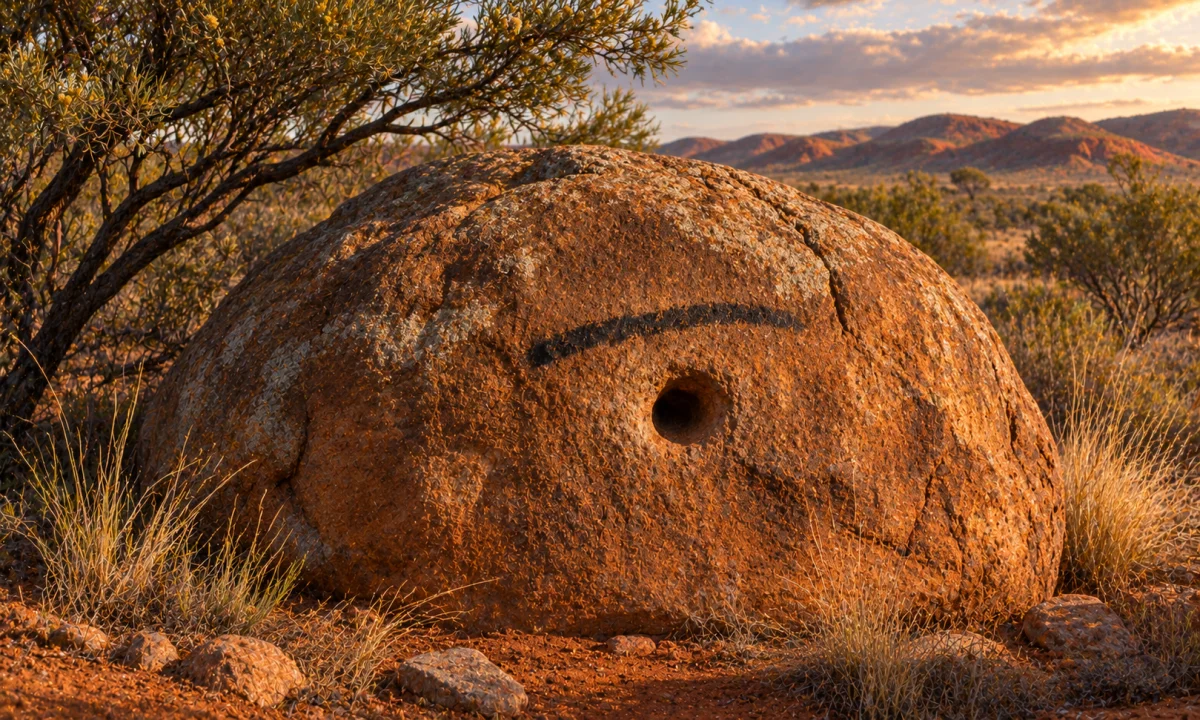
Erathipa is a figure or sacred conception site associated in ethnographic records with the Arrernte-speaking peoples of Central Australia, formerly often called the Aranda or Arunta. It is commonly described as a stone or rock formation connected with pregnancy, unborn children and the arrival of a spirit-child. Erathipa should not be treated as a pan-Aboriginal fertility goddess: the name belongs to a particular cultural and linguistic setting, and the surviving descriptions come largely from early outside observers who recorded traditions selectively and sometimes used inconsistent spellings.
Cultural setting
Erathipa belongs to the religious world often called the Dreaming in English. Aboriginal communities use different terms for the ancestral order of reality, and “Dreaming” can be an inadequate translation when treated as merely a collection of old stories. In Central Australian traditions, ancestral beings, places, songs, ceremonies, kinship obligations and patterns of land use are closely connected. The past is not simply finished history: ancestral events continue to give meaning and authority to Country, social relationships and ritual practice.
Among Arrernte peoples, particular locations may be associated with ancestral presences, spirit children, sacred objects, ceremonies and the origins of important natural features. Knowledge concerning such places has traditionally been governed by cultural rules. Some information may be restricted by gender, age, initiation status or particular ceremonial responsibilities. Consequently, accounts written by European researchers do not necessarily represent the whole tradition, and a short published description should not be assumed to disclose the full significance of Erathipa.
The Arrernte live in and around the region of Central Australia that includes the area now commonly associated with Alice Springs and the MacDonnell Ranges. Their traditional religious systems are diverse and locally grounded. A figure or site known under one name should therefore be connected with the relevant community and Country rather than presented as a belief shared by all Aboriginal peoples of Australia.
Name and identity
The spelling Erathipa reflects an English-language transcription of an Aboriginal name. Older records may use forms such as Erathippa or other variant spellings, because early researchers attempted to represent sounds from languages that had no standardised written form in the systems they were using. Such variations do not automatically indicate different beings.
Erathipa is sometimes described as a spirit, sometimes as a sacred stone, and sometimes as both. This difference arises partly from the tendency of European writers to classify Aboriginal religious entities according to familiar categories such as “god,” “spirit,” “idol” or “mythical creature.” Those categories do not always fit Arrernte understandings. A sacred place can be a physical manifestation of ancestral activity, a point of access to spiritual power, and a location where particular beings or life forces are present.
For this reason, it is safer to describe Erathipa as a sacred conception-associated figure or site rather than as a goddess in the classical European sense. The available accounts do not establish that Erathipa was worshipped as a single anthropomorphic deity with a fixed personality, family tree or complete cycle of adventures.
Appearance and symbolic form
Descriptions of Erathipa commonly refer to a rock or stone whose shape was understood to resemble a pregnant woman, or a woman with a child within her. The physical form is significant because the stone makes conception and gestation visible in the landscape. It links the human body with Country and presents pregnancy not as an isolated biological event but as part of a wider spiritual order.
In some versions recorded by outsiders, the stone is associated with the spirits of children who have not yet been born. These spirits may be understood as potential human lives located at a sacred place. A woman who approached or passed the site could, according to the account, become pregnant when one of these child spirits entered her. Other summaries say that women seeking children visited or contacted the stone. The precise action, interpretation and ritual circumstances are not consistent in every retelling.
These descriptions should not be read as evidence that Arrernte people regarded every pregnancy as the result of a simple mechanical transfer from a rock. Ethnographic summaries often compress complex teachings into a sentence or two. Ideas about conception may involve the interaction of ancestral power, spirit-child sites, social identity, ritual knowledge and the mother’s relationship to Country. The published accounts rarely provide enough detail to reconstruct the complete religious framework.
Erathipa and conception
The central theme associated with Erathipa is fertility and the origin of human life. In traditions reported from Central Australia, conception could be explained through the entry of a spirit-child connected with a particular sacred site. Such a belief does not necessarily deny the physical aspects of reproduction. Instead, it gives pregnancy a spiritual and territorial dimension: a child’s existence may be connected to an ancestral place before birth.
Under this interpretation, Erathipa is not merely a charm intended to make a woman fertile. The site forms part of a system in which children, land, ancestry and social belonging are related. A child’s connection with a place could carry implications for identity, ritual responsibility and totemic affiliation. The significance of the site would therefore extend beyond individual hopes for pregnancy.
Some popular reference works describe Erathipa as a “fertility stone,” but that label can be misleading if it suggests a universal magical object or a goddess who grants wishes. It is a convenient modern shorthand for the conception-related reports, not necessarily a traditional Arrernte category. The surviving evidence supports an association with pregnancy and spirit children, while leaving many details uncertain.
Stories and traditions
Unlike better-known figures from Aboriginal traditions, Erathipa is not preserved in a widely circulated body of narrative episodes. The name is generally encountered in brief accounts of sacred places and beliefs concerning conception. These accounts do not provide a securely established set of stories describing Erathipa’s birth, journeys, conflicts or relationships with other ancestral beings.
There are several reasons for this limited record. First, Aboriginal traditions are often transmitted through ceremony, performance, song, place-based teaching and customary practice rather than through detached written narratives. Second, sacred knowledge may not be available for public explanation. Third, early anthropologists frequently selected material according to the questions and assumptions of their own societies. A description of Erathipa as a stone connected with pregnancy may preserve an important idea while omitting the ceremonies, restrictions and local history that gave it meaning.
It is therefore unwise to expand Erathipa into an invented narrative cycle. There is no reliable basis for assigning the figure a spouse, children, enemies, animal form or role in a universal creation story. Nor should accounts of unrelated Central Australian beings be attached to Erathipa simply because they also concern fertility, ancestral power or sacred stones.
Religious significance
Erathipa illustrates the close relationship between body, land and ancestry in many Aboriginal religious traditions. Pregnancy is represented through a feature of the landscape, and the possibility of new life is connected with a spiritually significant place. This relationship challenges modern assumptions that religion is confined to temples, images or named supernatural personalities. A rock, spring, hill or waterhole may be a religious presence because of the ancestral events and obligations associated with it.
The tradition also shows why the phrase “fertility cult” should be used cautiously. In older comparative mythology, scholars sometimes grouped any belief concerning childbirth under a broad category of fertility religion. Such classifications can obscure the particular social and territorial meanings of an Aboriginal tradition. Erathipa is better understood through Arrernte relationships to Country and spirit children than through comparison with figures such as Greek Aphrodite, Demeter or Near Eastern mother goddesses.
The idea of a spirit-child site also reflects a conception of personhood in which an individual may be linked to a place before birth. This does not mean that every Arrernte group holds an identical doctrine or that the published accounts capture contemporary beliefs in full. Arrernte communities have endured severe disruption through colonisation, mission activity, forced movement, introduced diseases and the suppression of languages and ceremonies. At the same time, Arrernte cultural knowledge and authority have not simply disappeared. Living traditions must be approached through the communities who maintain them, not only through colonial-era books.
Historical records and uncertainty
Most widely circulated information about Erathipa comes from descriptions made by European anthropologists and writers working in Central Australia during the late nineteenth and early twentieth centuries. These records are valuable because they preserve names and observations that might otherwise have been lost from the written record. They are also limited evidence. Researchers often relied on particular informants, translated Aboriginal concepts into European vocabulary and recorded material outside its full ceremonial context.
Older writings may use “Aranda,” “Arunta” or similar spellings for Arrernte people and language. They may also present local traditions as if they were uniform across a large region. Modern readers should distinguish between what an early source explicitly reported, what later encyclopedias inferred from it and what can responsibly be said about Arrernte tradition today.
The identity of Erathipa is consequently somewhat uncertain in classification. It may be described as a sacred stone, a place inhabited by child spirits, an ancestral power or a named conception-related being. These descriptions overlap but are not identical. The safest account acknowledges the variation rather than choosing one rigid definition and treating it as universally authoritative.
Distinguishing Erathipa from other figures
Erathipa should not be confused with the Rainbow Serpent, one of the most widely known figures in discussions of Aboriginal mythology. Rainbow Serpent traditions vary greatly among different communities, but the figure is often associated with water, rain, landscape formation, ancestral power and law. There is no sound reason to identify Erathipa as a form of the Rainbow Serpent merely because both are connected with sacred Country.
Erathipa is also distinct from named Arrernte ancestral beings and spirit figures whose traditions concern initiation, death, animals, weather or the formation of specific landscapes. Similarities in the words “spirit,” “ancestor” or “sacred” do not establish that different figures belong to one mythological system.
The name should likewise not be confused with unrelated Australian Aboriginal terms that happen to have similar spellings in English transcription. Aboriginal Australia contains hundreds of distinct language groups, and a name from one region cannot be generalised to all Indigenous traditions. Even within Central Australia, religious knowledge is often local, and variant spellings can conceal differences between languages or communities.
Modern reception
Erathipa has not become a major character in international popular culture. It appears mainly in encyclopedias, comparative mythology websites and lists of Aboriginal mythological beings, where it is sometimes reduced to a single sentence about a pregnant stone or a fertility goddess. Such summaries can preserve the broad association with conception while losing the cultural setting that makes the tradition meaningful.
Modern retellings should avoid presenting Erathipa as an exotic magical object or treating an Arrernte sacred tradition as freely available fantasy material. Responsible discussion keeps the name connected to its particular cultural context, acknowledges the limits of colonial records and avoids claiming certainty where the evidence is fragmentary. The most important feature of Erathipa is not a dramatic supernatural power but the relationship it represents between human birth, spirit presence and Country.