WORLD

Vucub Hunahpu
Vucub Hunahpu is a figure in the K’iche’ Maya narrative preserved in the Popol Vuh, the best-known surviving account of K’iche’ mythology. His name is often written Wuqub Junajpu in modern K’iche’ orthography and may be translated as “Seven Hunahpu.” He is the brother of Hun Hunahpu, or “One Hunahpu,” and together they form the first important pair of brothers in the story of the Maya Hero Twins.
Vucub Hunahpu should not be confused with Hunahpu, the younger Hero Twin who, together with Xbalanque, defeats the rulers of Xibalba. The two figures belong to different generations. Vucub Hunahpu is an uncle and companion of the later Hero Twins, while Hunahpu is one of the sons of Vucub Hunahpu’s brother, Hun Hunahpu.
Origins in K’iche’ Maya tradition
The principal account of Vucub Hunahpu comes from the Popol Vuh, a K’iche’ Maya creation narrative, mythology, genealogy and history. The work was written down in the colonial period in the K’iche’ language using the Latin alphabet, probably drawing on older oral and manuscript traditions. The surviving text is therefore neither a simple pre-Columbian document nor a Christian invention. It preserves Indigenous K’iche’ traditions recorded under colonial conditions, and its wording and interpretation have been debated by scholars.
The story belongs to the highland Maya cultural world of what is now Guatemala. It presents creation as a process involving several attempts to make beings capable of speaking, recognizing and honouring the makers. The adventures of Vucub Hunahpu and Hun Hunahpu occur after earlier creation episodes and before the establishment of the present human order associated with maize.
Within the narrative, the brothers’ fate is part of a larger cycle. Their defeat in the underworld does not end their family line. Instead, Hun Hunahpu becomes the father of the Hero Twins after death, and the later twins return to Xibalba to challenge the powers that killed their father and uncle.
Name and identity
The spelling Vucub Hunahpu reflects an older Spanish-based transcription of the K’iche’ name. Modern orthographies commonly write it as Wuqub Junajpu. The first element, wuqub, means “seven,” while jun means “one.” The second element, often rendered Hunahpu or Junajpu, is also the name of a day in the 260-day Maya calendar.
The meaning of Hunahpu is not entirely settled. It has sometimes been translated as “one hunter,” “one blowgunner” or “one Hunahpu,” depending on the translator’s interpretation of the term and its relationship to the calendrical day name. These translations should not be treated as equally certain. The name may evoke hunting or blowgun use, but the Popol Vuh does not present Vucub Hunahpu primarily as a deity of hunting.
The number seven may be significant within Maya calendrical and symbolic systems, but the narrative does not provide a direct explanation of why the elder brother is called “Seven Hunahpu.” It is safest to regard the name as a distinctive personal and calendrical designation rather than assigning it a single universally accepted symbolic meaning.
Vucub Hunahpu is sometimes described loosely as a god because he appears in a sacred myth and participates in events involving supernatural beings. However, the Popol Vuh does not classify him in the same way as a major creator power or a ruler of the underworld. He is better understood as a mythic ancestral figure, a member of a heroic family whose death and legacy shape the central drama of the narrative.
Family and relationship with Hun Hunahpu
Vucub Hunahpu and Hun Hunahpu are sons of Xpiyacoc and Xmucane, an elderly ancestral pair associated with divination, creation and the ordering of the world. Xmucane later becomes especially important in the story of the Hero Twins, since she raises or receives the next generation after their mother arrives at her household.
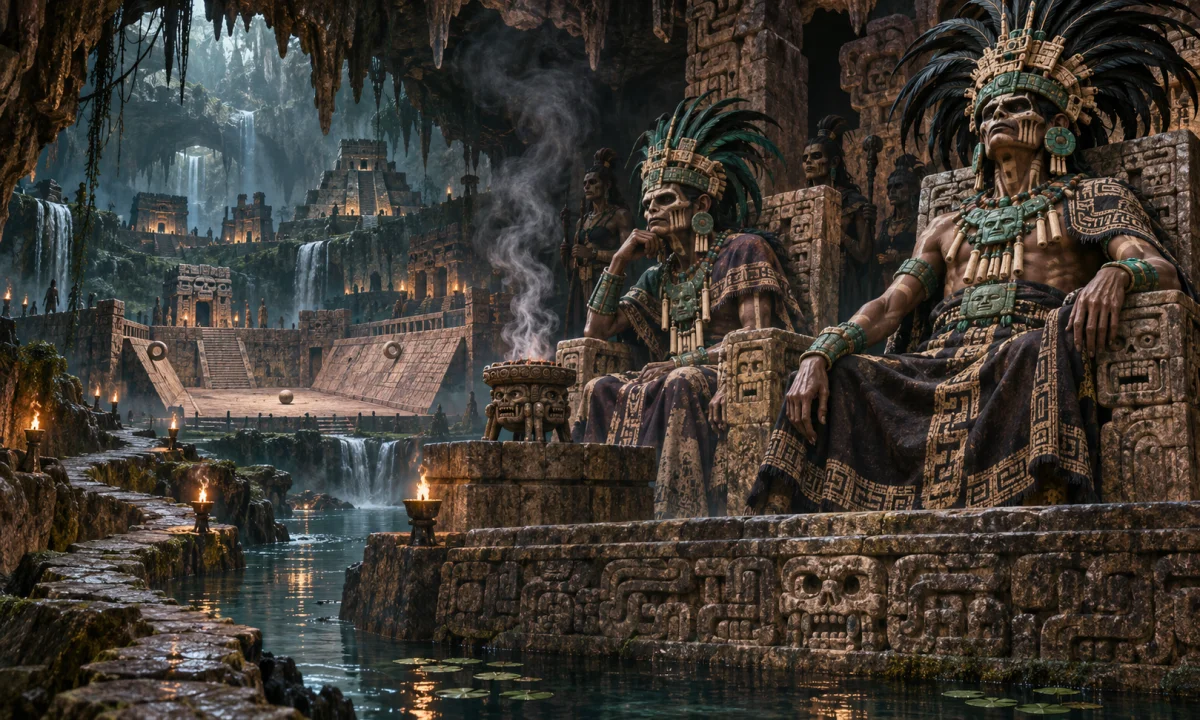
The two brothers are presented as skilled ballplayers. They play together on a ball court, and the sound of their game reaches Xibalba, the dangerous underworld inhabited and governed by powerful lords. Their activity is not portrayed as an isolated pastime. In Maya cultures, the ballgame could carry political, ritual and cosmological meanings, and the Popol Vuh uses the game as the beginning of a contest between the brothers and the underworld powers.
The brothers’ closeness also establishes a contrast with the later Hero Twins. Vucub Hunahpu and Hun Hunahpu possess ability and confidence, but they do not overcome the tests prepared by Xibalba. Their failure creates the circumstances that allow the younger twins to learn from the previous generation and eventually reverse its defeat.
The summons to Xibalba
The Lords of Xibalba hear the brothers playing and become angered or disturbed by the noise. They send messengers to summon them to the underworld for a ballgame. The invitation is presented as a challenge, but it is actually a trap. The underworld rulers intend to humiliate, defeat and kill the brothers.
In the journey to Xibalba, the brothers encounter a series of deceptive places and objects. They must pass through crossroads and face the tricks of the underworld lords. One well-known episode involves a seat that appears to be a stone bench but is actually painfully hot. The brothers are also given tasks involving torches and cigars. The lords demand that these remain lit, yet the brothers are expected to complete the test without consuming the supplies. They fail to recognize the deception or cannot satisfy the impossible conditions.
The exact arrangement of the tests varies in translation and in the way individual passages are interpreted. The important narrative point is consistent: Vucub Hunahpu and Hun Hunahpu enter a hostile realm where ordinary skill is insufficient. Xibalba operates through false invitations, hidden rules and transformations of familiar objects into instruments of danger.
The brothers are eventually defeated and sacrificed. Vucub Hunahpu receives no separate heroic triumph after this point. His identity remains tied to Hun Hunahpu, and the two are treated as a pair whose destruction initiates the next stage of the story.
The death of the brothers
After their deaths, Hun Hunahpu’s head is placed in a calabash tree in Xibalba. The tree becomes remarkable because it begins to bear many fruits that resemble human heads. The head of Hun Hunahpu is therefore concealed among the fruit, and the tree becomes an important boundary between death and renewed life.
Vucub Hunahpu is not the speaking or supernatural head in this episode. The famous encounter involves Hun Hunahpu’s head and Xquic, the daughter of one of the Xibalban lords. Curious about the tree, Xquic approaches it. The head speaks to her and spits into her hand, causing her to conceive the future Hero Twins.
This episode establishes a form of generation that does not depend on ordinary human marriage or bodily survival. Hun Hunahpu, although dead, continues to produce descendants. Vucub Hunahpu’s death is part of the same defeat, but the text does not give him an equivalent role in Xquic’s conception. Keeping this distinction is important, since summaries sometimes incorrectly attribute the conception or the speaking head to both brothers.
Xquic later travels to the household of Xmucane. She is initially rejected because Xmucane knows that her sons have died and doubts Xquic’s claim of pregnancy. Xquic eventually proves her connection to the family through a miraculous gathering of food, especially maize. The event links the new generation to both ancestral descent and the agricultural foundations of Maya life.
Connection with the Hero Twins
The Hero Twins are usually named Hunahpu and Xbalanque in English-language discussions, with K’iche’ spellings such as Junajpu and Xb’alanke. They are the sons of Hun Hunahpu and Xquic. Since Vucub Hunahpu is Hun Hunahpu’s brother, he is their uncle.
The younger twins repeat some of the activities associated with the older brothers, particularly the ballgame, but they approach the dangers of Xibalba with greater cleverness. They understand that the underworld lords rely on pride, appearances and rigged contests. Through deception, disguise, sacrifice and miraculous return, they survive challenges that defeated their father and uncle.
The contrast between the two generations is central to the structure of the Popol Vuh. Vucub Hunahpu and Hun Hunahpu represent a heroic generation that is overcome by the underworld. Their defeat is not meaningless, because it leads to the birth of the twins and gives the younger heroes a task: to confront the powers responsible for the earlier deaths.
When the Hero Twins finally outwit the Lords of Xibalba, they avenge their father and uncle in symbolic as well as personal terms. The story does not simply portray the younger heroes as stronger warriors. Their success depends on intelligence, performance, ritual knowledge and the ability to manipulate the expectations of their opponents.
Symbolism and cultural significance
Vucub Hunahpu’s significance lies less in a catalogue of individual powers than in his place within a larger pattern of death, transformation and succession. He is one of the figures through whom the Popol Vuh connects the ballgame, the underworld, ancestry and the emergence of a new generation.
The ballgame provides a meeting point between the human and supernatural worlds. The brothers’ game attracts the attention of Xibalba, while the younger twins later use the same arena to challenge the underworld rulers. The court is therefore not merely a setting for athletic competition. It becomes a ritual and cosmological space in which life, death, honour and political power are contested.
The brothers’ journey also shows that Xibalba is not simply a place of punishment in the later European sense of the word “hell.” It is a dangerous underworld populated by lords with names connected to death, disease, fear and suffering. At the same time, it is part of the world’s sacred structure. The underworld can kill, but it also serves as the place from which transformation and renewed life emerge.
The calabash tree episode reinforces this connection. The dead Hun Hunahpu becomes associated with fruitfulness and generation, while the later birth of the twins connects the underworld to the continuation of a family line. The image does not make Vucub Hunahpu a vegetation god, and the text does not assign him control over plants or fertility. Rather, his death belongs to a story in which destruction becomes one stage in the renewal of life.
The myth also reflects the importance of maize in K’iche’ Maya understandings of human identity. The later creation of successful humans from maize and the miraculous food associated with Xquic’s acceptance into Xmucane’s household place the family drama within a broader agricultural and cosmological framework. Vucub Hunahpu is therefore part of the ancestral prehistory leading toward the human order described later in the narrative.
Variants and interpretive cautions
Translations of the Popol Vuh differ in spelling, punctuation, terminology and the treatment of personal names. Readers may encounter Vucub Hunahpu as Seven Hunahpu, Vucub-Hunahpu or Wuqub Junajpu. These forms generally refer to the same figure, but a translated name can sometimes obscure the fact that the second element is connected with a Maya calendrical name.
The surviving narrative does not provide a full independent biography for Vucub Hunahpu. Information about his appearance, personality and individual abilities is limited. Descriptions that present him as a heavily armed warrior, a god with a fixed portfolio, or a ruler with a detailed divine genealogy usually go beyond what the Popol Vuh actually says.
Vucub Hunahpu should also be distinguished from Vucub-Caquix, the boastful supernatural being defeated by the Hero Twins in an earlier episode. The names share the element vucub, meaning “seven,” but the characters are different. Vucub Hunahpu is the brother of Hun Hunahpu and a victim of Xibalba; Vucub-Caquix is a separate figure associated with false brilliance, vanity and the violent claim to be the sun and moon.
Nor should Vucub Hunahpu be merged with the Lords of Xibalba named Hun-Came and Vucub-Came. Those names contain numerical elements and refer to underworld rulers, whereas Vucub Hunahpu belongs to the family of the Hero Twins. Similar numerical names reflect features of K’iche’ naming and calendrical language, not shared identity.
Later reception
Vucub Hunahpu is less prominent in modern retellings than Hunahpu, Xbalanque, Xquic or the Lords of Xibalba. Adaptations often compress the opening generation of the story and concentrate on the Hero Twins’ adventures. When Vucub Hunahpu appears, he is usually portrayed as part of the doomed older pair whose defeat sets the main plot in motion.
Modern novels, games, illustrations and other popular works may reinterpret the Hero Twins as fantasy heroes or assign additional powers and personalities to the characters. Such portrayals belong to contemporary creativity rather than directly documented K’iche’ tradition. In the traditional narrative, Vucub Hunahpu’s importance comes from his relationship to Hun Hunahpu, his encounter with Xibalba and his place in the generational pattern that leads to the birth and eventual victory of the Hero Twins.