WORLD

Valac
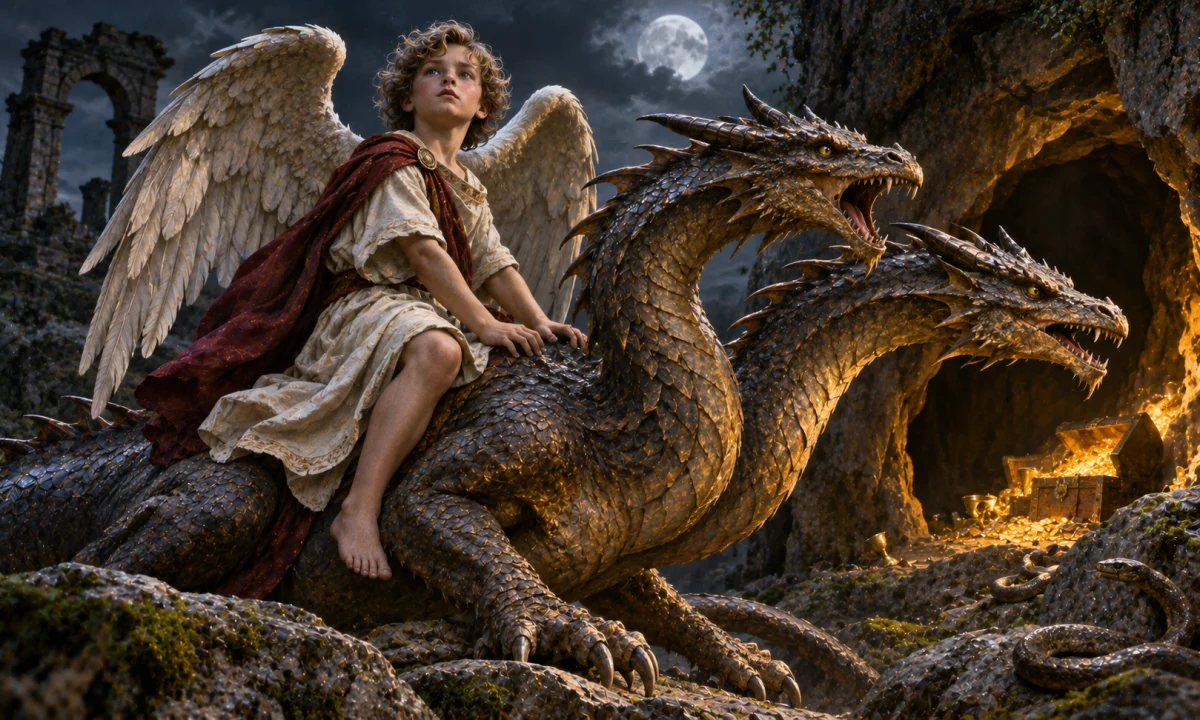
Valac is a demon described in the Solomonic grimoire tradition, especially in versions of The Lesser Key of Solomon. He is listed among the 72 spirits of the Ars Goetia, where he is identified as a powerful president of Hell. The grimoire portrays him as a child with angelic wings, riding a two-headed dragon. His principal functions are revealing hidden treasures and locating serpents, which he can supposedly bring before the magician.
Origins in the grimoire tradition
Valac belongs to the learned demonological literature of early modern Europe rather than to an ancient mythology with a continuous independent cult. His best-known description occurs in the Ars Goetia, the first part of The Lesser Key of Solomon, a collection of ritual and magical materials assembled in its surviving form during the seventeenth century. The work presents a hierarchy of spirits that a ritual practitioner may summon, question and command through prescribed ceremonies.
The Ars Goetia is associated with the wider Solomonic tradition, which attributes magical authority to the biblical King Solomon. There is no reliable historical evidence that Solomon wrote the work or that the named spirits were figures of ancient Israelite religion. The attribution to Solomon is part of the literary and ritual framework of European occult books, which often claimed that the king possessed extraordinary wisdom and control over spirits.
The catalogue of spirits in the Ars Goetia did not emerge in isolation. It draws on earlier European demonological lists, including material connected with Johann Weyer’s Pseudomonarchia Daemonum, published in the sixteenth century, as well as other magical and clerical compilations. The relationships among these texts are complex, and spellings, descriptions and numbering can vary between manuscripts and editions. Valac is therefore best understood as a figure shaped by the transmission of grimoire literature rather than as a demon with one universally fixed ancient identity.
Name and spelling
The name appears in several forms. Valac is a common spelling in English-language discussions, while Volac, Valak and Valu are among the variants found in editions, manuscripts or later references. Other transcriptions may also occur because early magical texts were copied by hand, printed with inconsistent orthography and translated across languages.
The original meaning of the name is uncertain. No secure etymology establishes Valac as a surviving deity, spirit or monster from a particular pre-Christian culture. Similar-looking names in unrelated religious, folkloric or literary traditions should not automatically be treated as forms of Valac. In particular, a resemblance between “Valac” and other names is not sufficient evidence of a historical relationship.
In the standard ordering of the Ars Goetia, Valac is the sixty-second spirit. The text calls him a “great president,” using “president” as a rank within its infernal hierarchy. This title should not be confused with a modern political office. In the catalogue, it functions as one of several grades assigned to spirits, alongside kings, dukes, princes, marquises, counts, knights and other authorities.
Appearance and distinguishing features
The traditional Goetic description gives Valac an unusual hybrid appearance: he appears as a child with angelic wings and rides upon a two-headed dragon. This brief image is the main physical portrayal associated with him. The text does not provide a detailed biography, genealogy or account of his personal history.
Each element of the image carries associations familiar from European religious and magical symbolism. Wings connect Valac visually with angels, although the grimoire classifies him as a demon. The childlike form contrasts with the authority implied by his title and with the threatening dragon beneath him. The two-headed dragon adds a strongly fantastic element, combining reptilian power, watchfulness and otherworldly mobility.
These features should not be treated as evidence that Valac originated in a particular dragon mythology. European grimoires frequently use visual combinations drawn from Christian angelology, biblical imagery, classical monsters and medieval folklore. The image may be read as an example of the genre’s interest in combining familiar religious symbols in unsettling or paradoxical ways, but the surviving description does not explain why Valac has this form.
Abilities and role
Valac’s stated abilities are relatively specific. He is said to give truthful answers about hidden treasures and to reveal where serpents may be found. The text also says that he can bring serpents to the operator without the use of force or physical struggle.
The treasure-finding ability places Valac within a common area of grimoire magic. Early modern magical texts often assign spirits practical tasks such as discovering concealed objects, locating stolen property, revealing secrets, teaching sciences or influencing human relationships. Treasure in this context may refer to buried wealth, hidden valuables or knowledge of concealed riches. The description does not identify a particular treasure, location or legendary hoard connected with Valac.
The reference to serpents is more unusual, although it fits the interests of magical and natural-historical writing in the period. “Serpents” may be understood literally as snakes, since the text explicitly describes their location and transportation. It is also possible for later readers to interpret them symbolically, especially because serpents have long carried multiple meanings in religious and folkloric traditions. The Goetic entry itself, however, does not explain a symbolic interpretation or connect Valac to a particular serpent deity.
The description does not present Valac primarily as a tempter, military adversary, disease-bringer or ruler of the dead. Nor does it give him a narrative role in a mythic conflict. Like many spirits in the Ars Goetia, he is defined mainly by his rank, appearance and practical functions in ritual magic.
Valac within Christian demonology
Valac’s classification as a demon reflects the worldview and vocabulary of Christian European demonology. In that setting, demons were commonly understood as hostile or deceptive spirits opposed to God and capable of misleading human beings. Magical books sometimes treated these beings as members of an organized infernal court, complete with titles, offices, seals and chains of command.
This system should not be confused with a single official Christian doctrine. The catalogue of the Ars Goetia was not a standard list accepted by all Christian churches, and the hierarchy of its spirits does not correspond to a universally recognized theological structure. Clergy, theologians, inquisitors, occult practitioners and folklorists could describe spirits in very different ways. Valac’s status belongs specifically to the grimoire’s ritual demonology.
Nor is there substantial evidence for a widespread historical religion devoted to Valac. The surviving material presents him as a name in a magical catalogue, not as the centre of an established public cult. References to him in modern occult communities may continue or reinterpret the grimoire tradition, but such practices should be distinguished from evidence about medieval or ancient religion.
Textual variants and uncertainty
The details associated with Valac are comparatively stable in popular summaries, but textual variation remains important. Different editions may use different spellings, alter small parts of the wording or present the spirit’s rank in slightly different forms. The name may appear as Valac or Volac, while Valak is especially common in modern adaptations and online discussion.
Earlier demonological catalogues may contain related entries under variant names, but identifying every appearance as exactly the same being can be misleading. Early modern authors copied, rearranged and modified lists of spirits, and the boundaries between one catalogue and another were not always clear. A similar name may indicate textual descent, a scribal alteration or an independent borrowing; the evidence does not always allow a definite answer.
For this reason, claims that Valac was originally an ancient pagan god, a pre-Christian dragon spirit or a figure from a specific non-European tradition require strong evidence and should not be accepted merely because the name sounds old or exotic. The secure historical context is the European grimoire tradition in which the figure is recorded.
Symbolism and interpretation
Valac’s image can be interpreted through the symbolic language available to early modern readers. His wings suggest a distorted or ambiguous relationship with angelic imagery. Christian demonology often represented demons as fallen or deceptive spirits whose appearance could imitate holiness, beauty or authority. The presence of angelic wings does not make Valac an angel; it creates a visual tension between a celestial sign and an infernal classification.
The child form may likewise be read in several ways, none of which is explicitly confirmed by the source. A child can symbolize vulnerability, innocence, disguise or an unsettling contrast between appearance and power. In combination with the dragon and the title of “great president,” the form makes Valac appear paradoxical: youthful in body but authoritative in rank.
Dragons and serpents were already associated with ambivalent meanings in European religious culture. They could represent danger, chaos, forbidden knowledge, guardianship and hidden wealth. Dragons in medieval stories frequently guarded treasures, while serpents could signify both wisdom and deception, healing and poison, renewal and death. Valac’s role in revealing treasures and locating serpents therefore fits a broader imaginative pattern, even though the Goetic text does not spell out a symbolic programme.
Interpretations should remain separate from documented description. The source states what Valac looks like and what he is said to do; it does not explain the psychological meaning of his childlike form, prove that his two-headed dragon represents a particular doctrine or identify a pre-Christian origin for his serpents.
Distinction from similar figures
Valac is sometimes confused with other beings because demonological names are frequently spelled in more than one way. Volac and Valu can refer to textual variants of the Goetic spirit, but variant spelling alone does not establish a separate demon. Valak may also be used for the same grimoire figure in modern occult writing, although that form has gained a much stronger popular association through horror fiction.
Valac should not be conflated with biblical serpents, dragons from Near Eastern mythology or named serpent beings from South Asian, African or Indigenous traditions. The fact that the Goetic entry mentions serpents does not make him a serpent god or a member of any of those religious traditions. Nor does his dragon mount make him identical with a dragon-rider from medieval romance or another mythology.
He is also distinct from demons such as Bael, Paimon, Buer or Astaroth, even though all appear in Goetic or related demonological catalogues. Each has a separate entry, name history and set of attributed functions. Later lists sometimes flatten these differences into a general collection of “demon names,” but the original catalogue gives each spirit its own rank and description.
Modern popular culture
The name Valak became widely known through the modern horror films The Conjuring 2 and The Nun. In those films, Valak is presented as a powerful demonic antagonist whose most recognizable form is a sinister nun. This image is a modern fictional invention and is not the appearance given in the Ars Goetia.
The cinematic Valak and the Goetic Valac share a name variant, but their characters, appearances, stories and dramatic functions are substantially different. The film version does not preserve the traditional description of a winged child riding a two-headed dragon, nor does it centre on finding hidden treasure or bringing forth serpents. The connection is therefore one of adaptation and naming rather than continuity of a complete ancient legend.
Modern internet lists, games, novels and occult-themed entertainment may further alter the spelling, rank, powers or appearance attributed to Valac. Such portrayals can be culturally significant as contemporary reinterpretations, but they should not be presented as evidence for the historical contents of the Solomonic grimoires. In the older tradition, Valac remains a relatively briefly described spirit of Goetic demonology, defined chiefly by his unusual form, his presidential rank and his association with hidden treasures and serpents.