WORLD
WORLD
Paimon
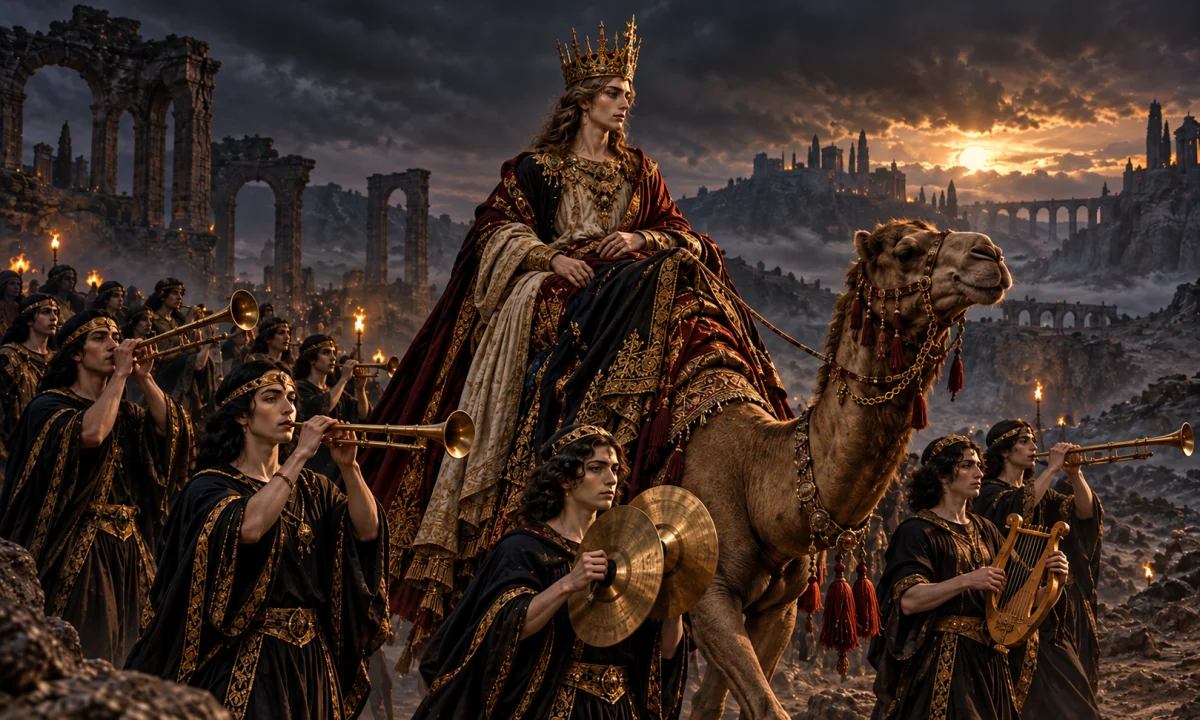
Paimon is a king among the spirits described in European grimoire magic, especially the Ars Goetia, the first section of the seventeenth-century compilation known as the Lesser Key of Solomon. In that tradition, Paimon is a powerful demon associated with knowledge, authority, music and the granting of social rank. His famous image—a crowned figure riding a dromedary and accompanied by musicians—comes from these early modern magical texts rather than from a securely documented ancient religion.
Origins in European demonology
Paimon belongs to the tradition of Christian-influenced ceremonial magic that catalogued spirits, angels and demons for use in ritual. These texts were written in a world where learned magic, astrology, theology and folklore often overlapped. Their authors commonly presented magical operations as the recovery or transmission of ancient wisdom, even when the surviving manuscripts were products of the medieval or early modern period.
The most important source for Paimon is the Ars Goetia. Its title refers to goetia, a Greek-derived term associated with spirit conjuration and, in later Christian usage, illicit or demonic magic. The Ars Goetia lists seventy-two spirits, giving each a name, rank, seal, appearance, abilities and number of subordinate legions. Paimon is usually placed ninth in the sequence.
The Lesser Key of Solomon survives in manuscripts and printed editions from the seventeenth century onward, but its contents draw on older demonological lists and magical handbooks. Related descriptions of Paimon appear in earlier or parallel catalogues, with differences in spelling and wording. These variations show that the figure developed within a manuscript tradition rather than being preserved through one single, fixed canonical text.
Paimon should therefore be understood primarily as a figure of early modern Western esotericism. There is no strong historical evidence that he was an ancient Near Eastern, Egyptian or pre-Christian deity later transformed into a demon. Claims of a direct ancient origin are speculative unless supported by specific historical evidence.
Name and identity
The name is commonly written Paimon, though forms such as Paymon and Paimonia occur in related material. The spelling is not completely stable, and the origin of the name remains uncertain. Various modern writers have proposed connections with words or names from different languages, but no etymology has achieved broad scholarly acceptance.
Some occult interpretations attempt to connect Paimon with older deities or with a pre-Christian spirit whose identity was supposedly suppressed by Christian demonology. Such theories can be interesting as examples of modern esoteric speculation, but they should not be confused with established historical evidence. The surviving grimoire descriptions themselves present Paimon as a demon or spirit king within a Christian demonological framework.
In the Ars Goetia, Paimon is described as a great king who is particularly obedient to Lucifer. This statement places him within the text’s hierarchical universe, in which demons possess ranks and command subordinate spirits. The reference to Lucifer reflects the theological language of Western Christian demonology, where Lucifer is often treated as a supreme rebellious or fallen power. It does not by itself establish a connection to every figure called Lucifer in earlier religious traditions.
Appearance and procession
Paimon is said to appear as a crowned man riding a dromedary. The crown signifies kingship and authority, while the dromedary gives the scene an exotic and ceremonial character. The image does not come from a continuous ancient iconographic tradition. It is a literary and ritual description preserved in early modern magical texts.
A procession of spirits is said to precede or accompany him. These spirits carry trumpets, cymbals and other musical instruments. Music is a significant part of Paimon’s presentation: his arrival is not quiet or hidden, but announced with the pageantry appropriate to a monarch. The combination of a royal rider, a formal procession and loud instruments emphasizes rank, spectacle and command.
The text also describes Paimon’s voice as initially loud and difficult to understand. The conjurer is instructed to make him speak clearly. This detail contributes to the spirit’s imposing character and may reflect a practical concern within ritual literature: the operator must be able to hear and interpret the being’s answers. It also suggests that Paimon’s authority is expressed through sound, proclamation and controlled speech.
Descriptions and illustrations vary among editions. Some visual representations emphasize the crowned rider, while others focus on the dromedary, the accompanying musicians or the seal associated with the spirit. There is no single universally authoritative portrait of Paimon outside the conventions of the goetic tradition.
Powers and functions
Paimon is chiefly associated with the transmission of knowledge. The Ars Goetia credits him with teaching arts and sciences, revealing secret things and answering questions about matters past, present and future. These powers place him among the spirits who function as instructors and informants rather than primarily as destroyers or tempters.
His abilities also include granting dignities and confirming them. In the social world imagined by the grimoires, a dignity could mean office, status, honour or authority. Paimon’s role therefore extends beyond abstract learning: he can represent access to institutions, rank and influence. His royal identity corresponds closely to these powers, making him a spirit of hierarchy as well as knowledge.
The text further attributes to him the ability to subject people to the magician’s will. This reflects the coercive structure of goetic magic, in which the operator seeks to summon, command or constrain a spirit through divine names, ritual tools and formal instructions. The descriptions are not modern psychological accounts of influence; they belong to a magical system based on command, obedience and supernatural hierarchy.
Paimon is also said to provide good familiars. In European magical and witchcraft vocabulary, a familiar is a spirit or supernatural helper associated with a practitioner. The term can describe a companion, servant or source of assistance, although its meaning changes across different traditions. In Paimon’s case, the familiar is presented as one of the benefits he may grant to the operator.
His entry assigns him a large number of subordinate spirits, commonly given as two hundred legions. The exact presentation can vary with the edition and manuscript tradition. Such numbers should be read as part of the symbolic bureaucracy of demonological catalogues rather than as independently verifiable information. The use of legions gives spirits like Paimon the structure of military or imperial commanders.
Role in ritual magic
Within the goetic system, Paimon is not merely a character in a story. He is presented as a spirit to be invoked through a structured magical operation. The operator would traditionally prepare a ritual space, use divine names and protective or commanding formulas, display the spirit’s seal and address the being according to prescribed instructions.
The spirit’s seal is a distinctive diagram associated with his name and authority. Goetic seals function as identifying marks within the ritual system, although their designs can differ between manuscripts and modern editions. They are not equivalent to universally recognized religious symbols, and their meaning depends on the magical tradition in which they appear.
Traditional grimoires often frame these operations as acts performed under the authority of God. This creates a complicated relationship between the conjurer and the demon: the spirit may be called, threatened or commanded, but the magician is expected to rely on a higher divine power. The system is therefore not simply demon worship. It is better described as a form of ceremonial conjuration shaped by Christian theology, Jewish-derived divine names and Renaissance occult ideas.
There is no evidence that these instructions represent a continuous public religious practice from antiquity. They belong to the textual culture of learned magic, in which manuscripts circulated among a relatively small number of readers. Modern occult groups may reinterpret or revive these practices, but those modern uses should be distinguished from the historical context of the grimoires.
Symbolism and interpretation
Paimon’s imagery brings together several themes. The crown and royal procession express political authority. The dromedary suggests travel, distance and an imagined eastern or desert setting, though the text does not provide a detailed cultural explanation for the animal. The instruments associate him with ceremony, proclamation and the disciplined organization of a court.
His connection with arts and sciences gives him a different character from demons depicted mainly as embodiments of bodily temptation, violence or disease. Paimon represents knowledge that may be powerful, forbidden or socially consequential. In the moral framework of Christian demonology, even useful knowledge can be dangerous when obtained through illicit supernatural means.
The spirit’s promise of status and obedience also reflects concerns about ambition. A person seeking secret knowledge, influence or advancement might be imagined as entering an alliance with a dangerous power. Paimon’s royal identity consequently supports both fascination and warning: he is an impressive source of learning and authority, but his assistance belongs to a realm that the texts treat as spiritually perilous.
Scholars and historians generally approach Paimon as evidence of how early modern Europeans organized ideas about supernatural power. The catalogue reveals an interest in ranking, classification and specialization. Each spirit receives a particular office, just as an official or noble might hold a defined place in a human court. Paimon’s entry shows how magical literature transformed broad fears about demons into a detailed administrative universe.
Distinctions from similar figures
Paimon should not automatically be identified with every king, desert spirit or crowned supernatural being found in older mythology. His dromedary and exotic setting can encourage comparisons with Middle Eastern or North African traditions, but visual resemblance is not proof of historical identity. The goetic figure is specifically documented in European demonological literature.
He is also distinct from Paimonia when that name is used in modern occult writing as an alternative feminine form or variant spelling. Different authors may use the terms inconsistently, and not every occurrence represents a separate being. The safest approach is to examine the source in which the name appears rather than assume that all forms have the same meaning.
Paimon is sometimes confused with unrelated modern fictional characters. In particular, the small companion character named Paimon in the video game Genshin Impact is not a traditional demon and is not a historical depiction of the grimoire spirit. The shared name reflects modern borrowing, not an established relationship between the two figures.
Modern popular culture
Paimon has become more widely known through contemporary horror, especially the 2018 film Hereditary. The film presents him as a central supernatural power connected with a secret cult and a series of disturbing events. Its imagery draws on selected elements associated with the goetic Paimon, including kingship and the crowned figure, while creating an original fictional mythology around him.
The film’s version should not be treated as a documentary account of occult tradition. It combines grimoire imagery with invented plot elements, symbolic interpretation and the conventions of supernatural horror. Its popularity has nevertheless made the name Paimon familiar to audiences who may never have encountered the Ars Goetia.
Other novels, games, films and occult illustrations use Paimon in different ways. Some retain the idea of a king who grants knowledge, while others turn him into a general demon, an ancient god or a purely symbolic figure. These adaptations demonstrate the flexibility of the name, but they do not erase the distinction between modern fiction and the early modern source tradition in which Paimon is most clearly documented.