WORLD
WORLD
Urubutsin
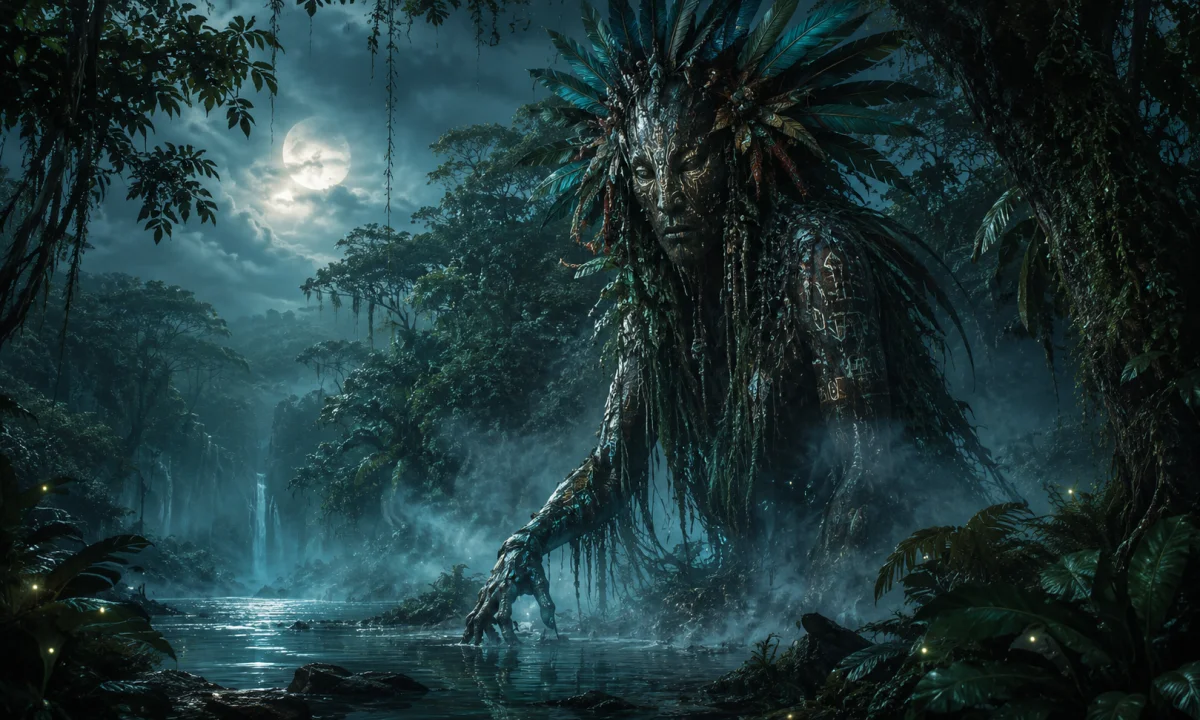
Urubutsin is a name associated with South American mythology, but its exact identity, cultural origin, and meaning are not firmly established in widely available reference material. That uncertainty matters: unlike better-documented beings from Andean, Amazonian, or southern Cone traditions, Urubutsin does not have a single, securely attested profile in standard scholarship. In many cases, names like this survive in fragmentary ethnographic notes, local oral tradition, or scattered later retellings, and the result can be variation in spelling, description, and even classification.
Because of that, Urubutsin is best approached as a figure or name preserved in the broader mythic landscape of South America rather than as a neatly defined deity, monster, or culture hero. Where traditions are unclear, it is more accurate to say so than to force a fixed identity onto the name. The safest reading is that Urubutsin belongs to a body of indigenous or regionally transmitted lore whose details may differ depending on community, language, and collector.
Traditional context
South American mythology is not one tradition but many. It includes the narratives of Quechua, Aymara, Mapuche, Guaraní, Tupi-Guarani, Amazonian, Chaco, and other peoples, along with highly localized stories passed down in villages, mission settings, and family memory. A name such as Urubutsin may belong to one of these traditions, but without more secure documentation it should not be assigned to a specific people with confidence.
In many South American societies, myth and everyday life are closely connected. Stories explain the ordering of the world, the behavior of animals, the origins of places, the dangers of forests, rivers, mountains, and night travel, and the proper relationship between humans and nonhuman powers. A name preserved in this kind of setting may refer to an ancestral being, a spirit, a guardian, a trickster, a transformer, a celestial figure, or a local supernatural presence. Urubutsin cannot responsibly be fixed into one category without stronger evidence.
Name and spelling
Urubutsin appears to be a transliterated form, and names transmitted from indigenous languages are often spelled in more than one way when rendered into Spanish, Portuguese, or English. That is especially true where the original language includes sounds that are difficult to represent consistently with Latin letters. As a result, different publications or oral renderings may preserve different spellings, pronunciations, or segmentations of the name.
The name itself may also have been recorded outside its original linguistic context, which can make later interpretation difficult. In many cases, a name that looks singular in print may actually reflect a local pronunciation, a shortened form, or an orthographic compromise made by a collector. Without a clear philological record, it is not safe to infer a specific meaning from the name alone.
When a figure’s identity is uncertain, the name should be treated as part of a living or historical transmission rather than as proof of a standardized mythological personality. Urubutsin may therefore refer to a being whose exact traits differ by storyteller or region, or whose original meaning has been partially obscured over time.
Identity and classification
Urubutsin is not securely classifiable from the available information. It is not widely established as a god in the sense of a formal high deity with a clearly defined cult. It is also not securely documented as a hero, ancestor, demon, or animal spirit in the way that many better-known South American beings are described. In the absence of dependable tradition-specific evidence, the most careful description is that Urubutsin is a mythic or supernatural name of uncertain classification.
That uncertainty is itself important. South American mythic systems often do not separate “gods,” “spirits,” and “monsters” in the same way that modern outsider categories do. A being may act as an ancestor in one story, a dangerous presence in another, and a landscape force in a third. If Urubutsin belongs to such a tradition, its role may be relational rather than fixed: what it is may depend on where it appears, who tells the story, and what human beings do in response.
Possible attributes and functions
Because the surviving record is not clear, no single set of attributes can be stated as certain for Urubutsin. Still, names preserved in indigenous and regional mythologies often carry one or more of the following functions: guarding a place, punishing taboo-breaking, shaping landscapes, influencing hunting or travel, interacting with animals, or serving as a warning figure in moral storytelling. Urubutsin may have occupied one of these roles in the tradition where it is known, but that should remain a possibility rather than a claim.
In South American mythic thought, supernatural beings commonly embody the power of a specific environment. A forest spirit may be linked to growth, concealment, and predation; a river being may govern movement, fertility, danger, and drowning; a mountain presence may symbolize endurance, weather, or ancestral authority. If Urubutsin is associated with a particular place or natural force, that association would fit a common pattern across the continent, though the specific ecology and symbolism would depend on the tradition in question.
It is also possible that Urubutsin belongs to a didactic or cautionary tradition. Many stories about supernatural beings are not merely entertainment: they teach children how to behave, encourage respect for sacred spaces, and explain why certain acts should be avoided. In such narratives, the power of a being lies not only in what it does physically but in the social order it enforces.
Stories and narrative context
No single canonical story of Urubutsin can be stated with confidence from the available evidence. That does not mean that no stories exist; it means that the publicly accessible record does not preserve them in a way that allows firm reconstruction. In traditions of this kind, a name may be attached to several short episodes, allusions in ritual speech, or fragmentary accounts that were never standardized into one authoritative version.
If Urubutsin belongs to an oral tradition, the narrative may have been shaped by performance, audience, and setting. A storyteller may emphasize fear, humor, or respect depending on the occasion. The figure may appear briefly as an obstacle, a test, a warning, or a source of transformation. In oral traditions, such flexibility is normal and should not be mistaken for inconsistency.
Where mythic names survive in isolated records, later retellings sometimes expand them into detailed biographies. That process can be useful for storytelling but misleading for scholarship. For Urubutsin, any elaborate account should be treated cautiously unless it can be tied to a clearly identified community tradition.
Symbolism and interpretation
Even when a figure’s exact profile is uncertain, its mythic function can still be approached carefully. A South American supernatural being may symbolize the relationship between humans and the more-than-human world: the limits of human control, the consequences of disrespect, or the need for balance with animals, plants, weather, and land. Urubutsin may belong to that general symbolic field.
Mythic names also often preserve cultural memory. A being may stand for an older way of living with the landscape, a remembered historical conflict, or a social value that communities continue to uphold. In that sense, Urubutsin may be less important as a fixed character than as a carrier of meaning. The name itself may mark a place where language, belief, and identity intersect.
Scholars studying underdocumented figures often note that uncertainty should not be read as insignificance. On the contrary, a sparsely documented name may point to a local tradition that was never fully recorded, or to a body of knowledge that remained within the community rather than entering colonial archives. Respecting that limitation is essential.
Relationship to other beings and traditions
Urubutsin should not be automatically merged with similar-sounding beings from other traditions. South American mythologies include many figures whose names may resemble one another by chance, through shared linguistic elements, or because later writers have conflated distinct traditions. A careful approach requires resisting the temptation to combine unrelated beings simply because they sound alike or occupy broadly similar roles.
Likewise, Urubutsin should not be confused with better-known mythic figures unless a source explicitly identifies the connection. Some South American beings are widely documented in modern ethnography and popular writing; others are local, rare, or region-specific. Similarity in function does not prove identity. A guardian spirit, trickster, or forest being in one tradition may have no historical relationship to a figure with a similar description elsewhere.
When names are transferred across languages, confusion can increase. A collector may spell a local name in a way that resembles another term from a different region. Later readers may then assume a shared origin that does not exist. For that reason, Urubutsin should remain separate from any figure to which it has not been securely linked.
Historical and cultural significance
The historical significance of Urubutsin lies as much in the survival of the name as in any fixed narrative. Names like this often survive at the edges of written history, where oral tradition, colonial transcription, and local memory meet. Their preservation may indicate that a community once told stories about the being, invoked the name in particular contexts, or used it as part of a wider body of knowledge.
In South America, many indigenous traditions have experienced disruption through colonization, conversion campaigns, language loss, migration, and schooling systems that marginalized local beliefs. As a result, some mythic figures are known only in partial form. Urubutsin may be one such case. The fragmentary nature of the record is not unusual, and it reflects historical conditions rather than the absence of a tradition.
From a cultural perspective, even an uncertain name can matter because it reminds readers that mythology is not confined to the best-known pantheons. South America’s mythic heritage includes innumerable local and regional beings whose stories are less widely circulated but still significant to the communities that remember them.
Modern reception
Urubutsin does not appear to have a substantial or widely recognized role in modern popular culture, at least not in commonly available international media. Unlike prominent mythic figures that have entered literature, film, games, or internet folklore, Urubutsin remains obscure. If the name does circulate in contemporary retellings, that circulation seems limited and should be distinguished from traditional usage.
Modern writing about lesser-known mythic names sometimes adds invented details, especially when creators want a striking supernatural figure without a well-known backstory. That tendency can quickly distort the historical record. For Urubutsin, any modern adaptation should be treated separately from traditional belief unless it can be traced to a community-based retelling or a documented cultural revival.
In educational and folkloric contexts, obscure names such as Urubutsin are sometimes presented as examples of the diversity of South American myth rather than as fixed characters. That approach is useful if it preserves uncertainty honestly. It becomes misleading only when it presents speculation as fact.
Why uncertainty matters
With figures like Urubutsin, restraint is more accurate than overdefinition. It is tempting to supply a detailed appearance, powers, family tree, or origin story, but doing so would risk inventing material that may not belong to the tradition at all. Careful description must leave room for incomplete transmission, spelling variation, and different local understandings.
That caution also respects the cultural context from which the name may come. Indigenous and regional traditions are not raw material for filling encyclopedic gaps. When knowledge is partial, the honest answer is to say that the available record is partial.
Urubutsin therefore stands as a reminder that South American mythology includes both celebrated and obscure beings, and that some names survive without a full narrative frame. The figure’s exact nature may be uncertain, but the name still points to a real cultural world in which stories, landscape, memory, and belief are closely interwoven.