WORLD
WORLD
Uaica
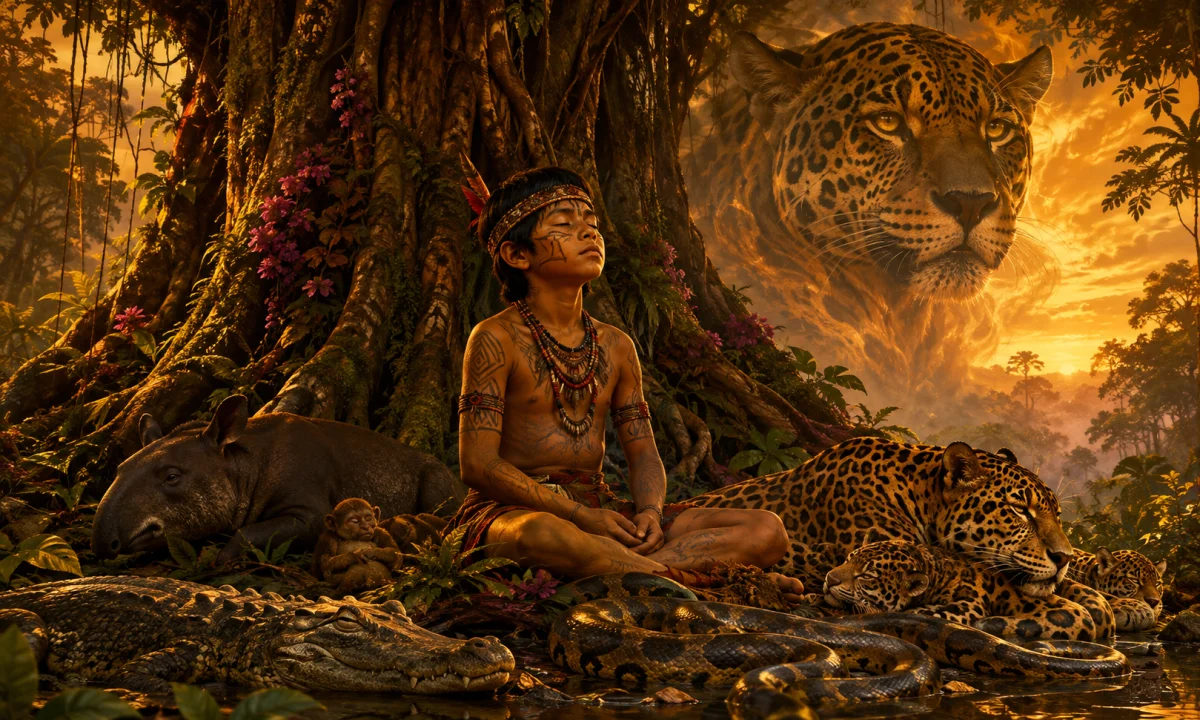
Uaica is a name recorded in South American mythological and ethnographic materials, but the figure is not widely standardized in the way better-known gods, spirits, or legendary heroes are. Depending on the source, Uaica may appear as a local supernatural being, a name linked to a specific Indigenous tradition, or a variant spelling whose exact identity is difficult to fix with certainty. Because surviving references are limited and sometimes inconsistent, any account of Uaica has to be cautious and attentive to the cultural setting in which the name appears.
In South American mythologies, many beings are known through oral tradition rather than through a single authoritative text. Names may shift across languages, regions, and collectors’ transcriptions. That is especially important for Uaica, whose spelling and classification can vary. In some contexts the name is treated as a spirit or mythic personage; in others, it may reflect a local rendering of a broader Indigenous concept that later writers recorded imperfectly. For that reason, Uaica is best understood not as a universally fixed character, but as a tradition-specific figure whose identity depends on the source tradition being cited.
Origins and cultural setting
South American Indigenous religions and mythologies are highly diverse. They include cosmologies shaped by rainforest, highland, savanna, riverine, and coastal environments, and they often explain hunting luck, illness, weather, social behavior, and the relationship between humans and non-human powers. In such systems, spirits and culture heroes are not always separated into neat categories. A being may be both ancestral and dangerous, both sacred and ambiguous, or both a story character and a presence believed to act in the world.
Uaica belongs to this broader setting of oral, regional, and often locally preserved mythic knowledge. The name appears in discussions of South American mythology rather than in a single well-known canonical corpus. That means the surviving evidence is usually indirect: ethnographic notes, later summaries, or local retellings. In some traditions, a figure like Uaica may function as a spirit associated with a particular landscape, a mythic ancestor, or a being connected to moral instruction. In the absence of consistent documentation, it is not safe to assign a single role to all occurrences of the name.
The uncertainty is important because many South American mythological names were written down by outsiders using Portuguese, Spanish, or other alphabetic spellings that did not always capture the original pronunciation. One collector’s “Uaica” may represent a name that elsewhere appears differently, and a similar-looking word may not refer to the same being at all. The name therefore needs to be read with attention to the source language and regional tradition behind it.
Name and identity
The identity of Uaica is not universally agreed upon. Some references treat the name as if it belonged to a spirit or mythic being, while others leave its category unstated. Because of this, it is more accurate to say that Uaica is a reported mythological name than to define it as a single, settled figure with a fixed biography.
That uncertainty can arise for several reasons:
- the original oral tradition may have multiple local versions;
- the name may have been transcribed in different ways by different collectors;
- the figure may have changed meaning over time;
- later writers may have conflated separate beings with similar names.
When such variation exists, a responsible account should avoid forcing the name into an artificially precise category. It is better to acknowledge that Uaica may denote a spirit, ancestral being, or mythic presence in a specific South American tradition, while the surviving records do not allow a more exact identification with confidence.
Because the evidence is limited, the name should also not be assumed to refer to a pan-Indigenous deity or a major continental figure. South American mythologies are not organized around one shared pantheon. They are made up of many distinct traditions, each with its own sacred history and local meanings.
Appearance and characteristics
There is no single securely established description of Uaica’s appearance. In mythologies preserved primarily through oral retelling, a being may be described differently depending on the storyteller, the audience, and the purpose of the tale. Some beings are given human form, while others are understood more as forces, presences, or transformations than as clearly visualized bodies.
Where Uaica is mentioned, the name may be associated with traits typical of many South American supernatural figures:
- an ability to move between ordinary and non-ordinary realms;
- a connection to specific places, such as forests, waters, or remote territories;
- an ambiguous moral role, neither purely benevolent nor purely hostile;
- an influence on human conduct, especially where taboos or proper ritual behavior are concerned.
These features, however, should be understood as possibilities within regional mythic patterns rather than as confirmed attributes of Uaica in every source. If a particular community’s tradition describes Uaica more precisely, that localized meaning should take precedence over broad generalizations.
Roles in tradition
In South American Indigenous mythologies, a spirit or figure named in oral narrative often serves several related purposes. A being may explain a natural feature, warn against dangerous behavior, establish social norms, or embody the power of a landscape. Uaica may belong to that kind of tradition-specific role, though the exact details vary by source and are not always fully preserved.
Possible functions of such a figure include the following:
- Guardian or spirit of place - linked to a particular territory, animal world, or natural environment;
- Trickster-like presence - associated with deception, shifting forms, or unpredictable behavior;
- Moral warning - used in stories to teach children or reinforce community rules;
- Ritual or cosmological being - part of a larger understanding of how human and non-human worlds interact.
It is important not to impose a single model onto all possible references to Uaica. A figure in one Indigenous tradition can resemble a guardian spirit, while a similarly named being in another region may play a very different part. Oral traditions often preserve this diversity without trying to make every variant conform to one fixed image.
Stories and variants
Because the surviving record for Uaica is limited, there is no widely known cycle of stories that can be confidently summarized as definitive. Instead, the name seems to belong to a smaller and more local body of tradition. That makes the figure especially vulnerable to misunderstanding, because later retellings may detach a name from its original narrative setting.
Where mythological beings are less widely documented, it is common for the story material to focus less on heroic adventures and more on episodes of encounter, warning, transformation, or consequence. A being like Uaica may appear in a brief tale about crossing a dangerous boundary, violating a social rule, or entering a sacred place without proper respect. In such narratives, the point is often not entertainment alone, but the instruction of listeners through memorable supernatural events.
Different communities may preserve different versions of the same figure, or may use the same name for closely related but distinct beings. Such variation is normal in oral traditions. It does not necessarily mean the tradition is confused; rather, it reflects the flexibility of storytelling in living cultural practice. Where modern readers expect a single canonical account, Indigenous mythic traditions may instead preserve a network of local versions.
If Uaica appears in ethnographic collections, those records should be read carefully. Early collectors often summarized stories briefly, omitted ritual context, or standardized names that were originally more fluid. A fragmentary mention of Uaica may therefore preserve only a small part of a much richer oral tradition.
Symbolism and interpretation
Interpreting Uaica requires attention to South American Indigenous cosmology rather than to later fantasy-style expectations. In many Indigenous systems, supernatural beings are not merely “characters” but active expressions of relations between people, animals, ancestors, and places. A spirit name can therefore point to ecological knowledge, ethical teaching, and sacred geography at the same time.
If Uaica functions as a local spirit or mythic entity, its symbolism may be understood in several ways:
- as a reminder that the landscape is inhabited and morally charged;
- as an explanation for unexplained events or dangers;
- as a figure embodying the power of unseen forces;
- as a marker of identity tied to a specific people and territory.
Scholars studying Indigenous mythology often note that beings of this kind should not be reduced to “demons” or “fairy-tale monsters.” Those labels come from outside systems of classification and can distort the original meaning. A figure such as Uaica may be feared, respected, or propitiated without fitting Christian or European categories of evil. The traditional role may be more relational than moralistic: the being may punish disrespect, maintain balance, or reveal the consequences of human behavior.
Because the documentation is sparse, it is also possible that Uaica has ritual significance in a context not widely published. In many Indigenous traditions, some names are not freely explained outside the community or are only spoken in certain settings. Limited public information does not necessarily mean the figure was unimportant; it may reflect cultural privacy, the fragmentary nature of record-keeping, or the selective interests of early collectors.
Distinctions from similar names and figures
Uaica should not be casually merged with similarly spelled names from other traditions. South American oral literatures contain many words that look alike in transcription but belong to different languages and different cultural histories. A resemblance in spelling does not establish identity.
That caution matters for at least three reasons:
- different languages may produce similar-looking spellings when recorded by outsiders;
- regional variants may preserve distinct beings with overlapping functions;
- later authors sometimes combined unrelated names into a single invented profile.
Uaica also should not automatically be equated with better-known figures from Amazonian, Andean, or Caribbean mythologies. Even where a being shares functions such as guarding forests, causing illness, or testing human conduct, those similarities do not prove direct equivalence. Comparable roles can emerge independently in different cultures.
In academic and popular writing alike, it is easy to overstate certainty when a name is obscure. A careful treatment of Uaica must preserve the distinction between what is actually documented and what is merely inferential. If a source does not clearly identify the being’s ethnicity, language, or mythic role, that uncertainty should remain visible.
Historical evidence and transmission
Unlike figures known from written mythological corpora, Uaica appears to survive mainly through scattered references. That means its tradition depends heavily on oral transmission and on the survival of ethnographic records. Such evidence can be valuable, but it is often incomplete. A single note in a field notebook, a brief mention in a regional study, or a paraphrased story may be all that remains in widely accessible form.
Oral traditions do not require the kind of fixed textual authority that modern readers often expect. Their accuracy lies in repetition, adaptation, and community memory. But once they are written down, they can become flattened or misunderstood. A collector may miss tone, metaphor, or ceremonial context. The result is that a name like Uaica can survive in print while the full significance of the figure remains only partially visible.
This also means that interpretations of Uaica may change as additional local research becomes available. New documentation could clarify whether the name refers to a spirit, an ancestor, a mythic ancestor-being, or something else entirely. Until then, the safest approach is to present Uaica as a tradition-specific mythological figure whose precise classification is uncertain.
Modern reception
Uaica does not appear to have a large presence in global popular culture, and there is no well-established modern adaptation that can be identified as central to the figure’s reception. That absence is itself revealing: many local mythic beings remain little known outside their communities or specialist scholarship. Their importance is cultural rather than commercial.
Where modern interest does arise, it is usually through regional folklore studies, Indigenous cultural preservation, or broader attempts to document South American mythologies. In such settings, the name may be mentioned as part of a wider effort to recover endangered oral traditions. Any modern retelling should be handled carefully, especially if it removes the figure from its original cultural setting or treats it as generic “exotic mythology.”
For readers encountering Uaica today, the most meaningful context is not fantasy reinterpretation but respect for the tradition from which the name comes. The figure stands as an example of how much South American mythological heritage remains local, varied, and incompletely recorded. Its scarcity in widely circulated literature does not diminish its value; instead, it highlights the depth and diversity of the continent’s living and remembered sacred traditions.