WORLD

Tukupar Itar

Tukupar Itar is a name associated in some English-language reference works with Hopi tradition, usually described as a war deity, warrior spirit, or protective supernatural figure. The identification is uncertain, however. Tukupar Itar is not one of the best-documented figures in published accounts of Hopi religion, and surviving references do not provide a consistent body of myths, ceremonies, or physical descriptions. Claims about the figure should therefore be treated cautiously rather than presented as established Hopi doctrine.
Hopi cultural setting
The Hopi are a Pueblo people whose traditional homeland lies in what is now northeastern Arizona. Hopi religious life is expressed through relationships among ancestral beings, spiritual powers, the land, seasonal cycles, communities, and ceremonial societies. English-language descriptions often use words such as “god,” “spirit,” “deity,” or “mythological being,” but these categories do not always correspond neatly to Hopi concepts.
Hopi traditions have been transmitted primarily through oral teaching, ritual performance, community practice, and knowledge held by particular religious societies. Some information was recorded by outsiders, especially during the nineteenth and twentieth centuries, but those records vary greatly in purpose and accuracy. A short name in an English catalogue may preserve only a fragment of a much richer tradition, or it may represent an outsider’s interpretation of a Hopi term.
This context is especially important for Tukupar Itar. The name is encountered far less often than those of major Hopi figures such as Tawa, the sun-associated power; Sotuknang, a creator and ordering figure in widely published accounts; Spider Woman; and Masauwu, a powerful being associated with death, the earth, and the human relationship to the world. Unlike these figures, Tukupar Itar does not have a broadly agreed narrative profile in accessible ethnographic or traditional materials.
Name and classification
“Tukupar Itar” should be regarded as a transcription or English-language rendering whose exact linguistic form is not secure. Hopi words have been written in different ways by missionaries, travellers, ethnographers, museum catalogues, and later popular writers. Differences in spelling can arise from attempts to represent Hopi sounds with English orthography, from incomplete knowledge of the language, or from copying an earlier publication.
The name is commonly classified as belonging to Hopi mythology, but that label should not be taken as proof that Tukupar Itar was a universally recognised Hopi god. In popular mythology lists, the figure is often assigned a simple category such as “god of war.” Such labels may be useful as rough descriptions, yet they can conceal important distinctions between a deity, a culture hero, an ancestral presence, a ceremonial being, and a spirit associated with a particular social or religious context.
There is no reliable consensus about the meaning of the name itself. Attempts to translate it directly, or to derive a detailed personality from its components, are therefore unsafe unless supported by a competent linguistic and cultural source. The spelling should not be silently normalised into another Hopi name, and Tukupar Itar should not be identified with a better-known figure merely because both have martial or protective associations.
Reported role as a warrior figure
The most frequent description attached to Tukupar Itar is that of a war deity or warrior spirit. In this interpretation, the figure represents strength, courage, defence, or the capacity to confront danger. Some modern summaries imply that Tukupar Itar was connected with warfare in a general sense, but they do not preserve a dependable account of particular battles, enemies, sacred weapons, or heroic exploits.
It is important not to expand this limited description into an invented mythology. There is no securely established traditional account that gives Tukupar Itar a standard appearance, a spouse, a genealogy, a set of powers, or a sequence of adventures. Nor is there a well-attested story that can confidently be called the central myth of Tukupar Itar.
If the martial classification reflects an authentic traditional association, it may have referred to a narrower religious function than the modern word “war god” suggests. Indigenous religious beings connected with danger or conflict can also be associated with protection, communal responsibility, ritual authority, hunting, travel, or the maintenance of balance. A figure described in a brief English source as a “war god” might not have occupied the same conceptual position as Ares in Greek mythology or Mars in Roman religion.
Appearance and powers
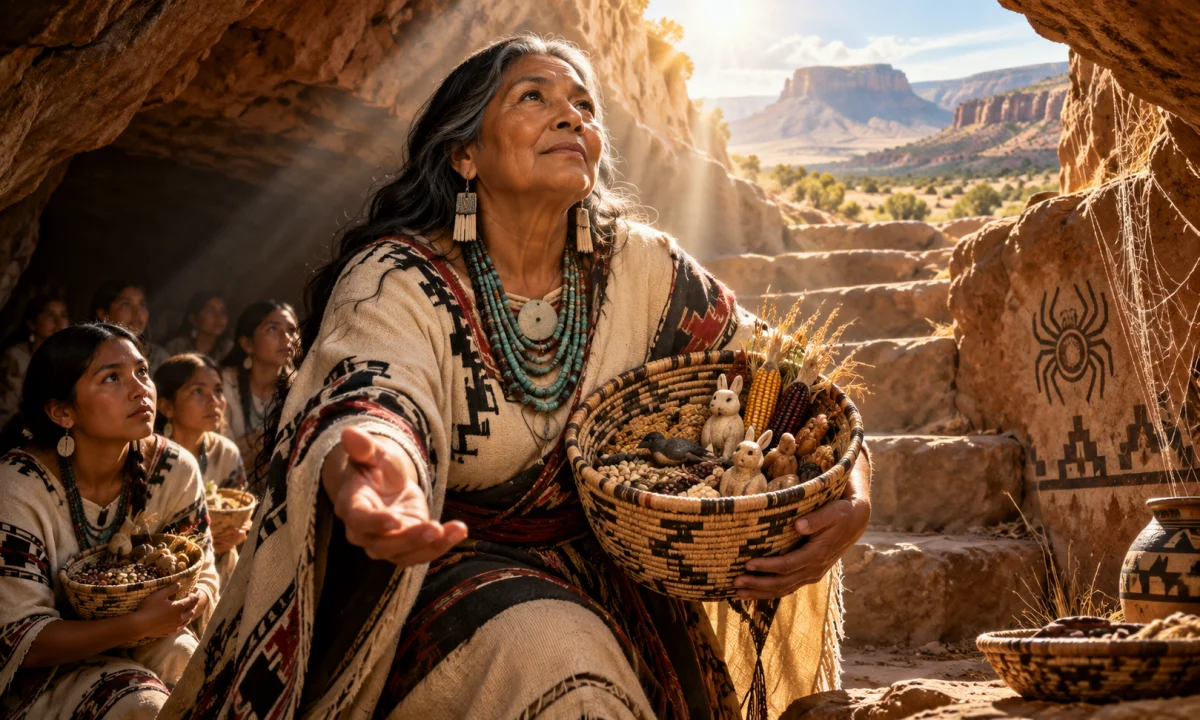
No stable traditional description of Tukupar Itar’s appearance is widely available. Popular illustrations or digital images may show a generic Native American warrior, a masked ceremonial dancer, or an imagined supernatural being, but such images should not be treated as historical evidence. There is no sound basis for assigning the figure a particular animal form, costume, weapon, colour scheme, or bodily shape.
Likewise, claims that Tukupar Itar controlled storms, protected warriors, led the dead, lived in a particular mountain, or commanded other spirits require specific documentation. These details are sometimes added to entries about obscure mythological names because catalogue writers expect every figure to have a complete profile. In the case of Tukupar Itar, the available record does not justify that level of certainty.
The safest description is that the name has been associated with martial or protective power in some secondary accounts. Even that association should be separated from claims about a formal pan-Hopi cult. Hopi ceremonial knowledge is diverse, and religious responsibilities may be distributed among communities, societies, and ritual specialists rather than concentrated in a single universally defined war god.
Stories and relationships
A recognised cycle of stories about Tukupar Itar is not clearly preserved in the commonly accessible record. There are no broadly accepted narratives establishing the figure’s birth, creation, marriage, rivalry, death, or transformation. In particular, Tukupar Itar should not automatically be made a companion, child, enemy, or alternate name of another Hopi supernatural being.
This absence of stories does not prove that no Hopi tradition ever connected the name with a narrative. Oral traditions can be local, restricted, ceremonial, or transmitted in forms that were never recorded in English. Religious knowledge may also be deliberately withheld from outsiders. The more precise conclusion is that a detailed account has not been securely established in the sources and summaries normally available to a general readership.
Some retellings may also confuse the name with figures from other Pueblo or Indigenous traditions. The cultural area surrounding the Hopi includes many distinct peoples, including the Zuni and several other Pueblo communities, each with its own languages, ceremonial systems, and religious histories. Similar-sounding names, broad themes of warrior protection, and the habit of treating all Indigenous traditions as one mythology can produce false identifications.
Relation to katsinam
Another possible source of confusion is the Hopi tradition of katsinam, often written in English as “kachinas.” Katsinam are powerful spiritual beings and also the masked ceremonial performers who represent them in particular contexts. They are connected with rain, fertility, ancestors, animals, social instruction, community welfare, and other aspects of Hopi life.
Calling every Hopi supernatural figure a “kachina” is inaccurate. A katsina is not simply an imaginary character or a carved doll. The term can refer to a spiritual being, a ceremonial manifestation, and, in some contexts, a representation made for teaching or exchange. The category has its own cultural and religious significance.
There is no clear evidence that Tukupar Itar should be identified as a katsina. A modern list may place the name beside katsinam because it treats all supernatural figures as equivalent entries, but proximity in a catalogue does not establish a traditional relationship. Nor should Tukupar Itar be confused with prominent ceremonial figures such as Eototo, Aholi, Soyoko, or Angwusnasomtaka, whose identities and ritual associations are documented in different ways.
Cultural interpretation
The idea of a Hopi “war god” can be misleading if it suggests that warfare was an isolated religious subject with no relationship to ethics, community, or the natural world. In Pueblo religious thought, power is commonly understood through obligations and relationships. Protection, social order, subsistence, rainfall, health, and ceremonial responsibility may overlap rather than form separate departments ruled by individual gods.
A martial figure, if Tukupar Itar belonged to a particular Hopi religious context, might therefore have represented more than violence or conquest. The figure could have been understood through duties of defence, courage under threat, or the preservation of communal life. These possibilities are interpretations, not securely documented attributes, and should remain distinct from the limited information attached to the name.
It is also worth recognising the effect of classification by outsiders. Early non-Indigenous writers often tried to fit unfamiliar religious beings into European categories such as god, demon, hero, or idol. Later encyclopaedias sometimes repeated those descriptions without explaining their origin. An entry that calls Tukupar Itar a “war god” may consequently tell readers as much about the habits of mythology compilers as it does about Hopi religious understanding.
Modern references and responsible use
Tukupar Itar appears mainly in modern English-language lists and brief reference entries rather than in a large, widely recognised body of traditional stories. Online summaries may present the figure with considerable confidence, adding dramatic powers or visual traits that cannot be traced to a dependable Hopi account. Such embellishments should not be mistaken for evidence of an ancient mythology.
Modern fiction, games, artwork, and fantasy writing may use the name as an evocative label for a Native American warrior spirit. Creative use is separate from the traditional record and should not be advertised as an authentic representation of Hopi belief. In particular, using the name for a generic “Native American god of war” erases the distinction between Hopi culture and the many other Indigenous nations of North America.
The most responsible description of Tukupar Itar is therefore a limited one: the name is associated by some secondary sources with Hopi martial or protective power, but its precise origin, meaning, status, and traditional narrative remain uncertain. It should not be assigned an elaborate biography or confused with better-documented Hopi beings without strong evidence.