WORLD
WORLD
Thunder Twins
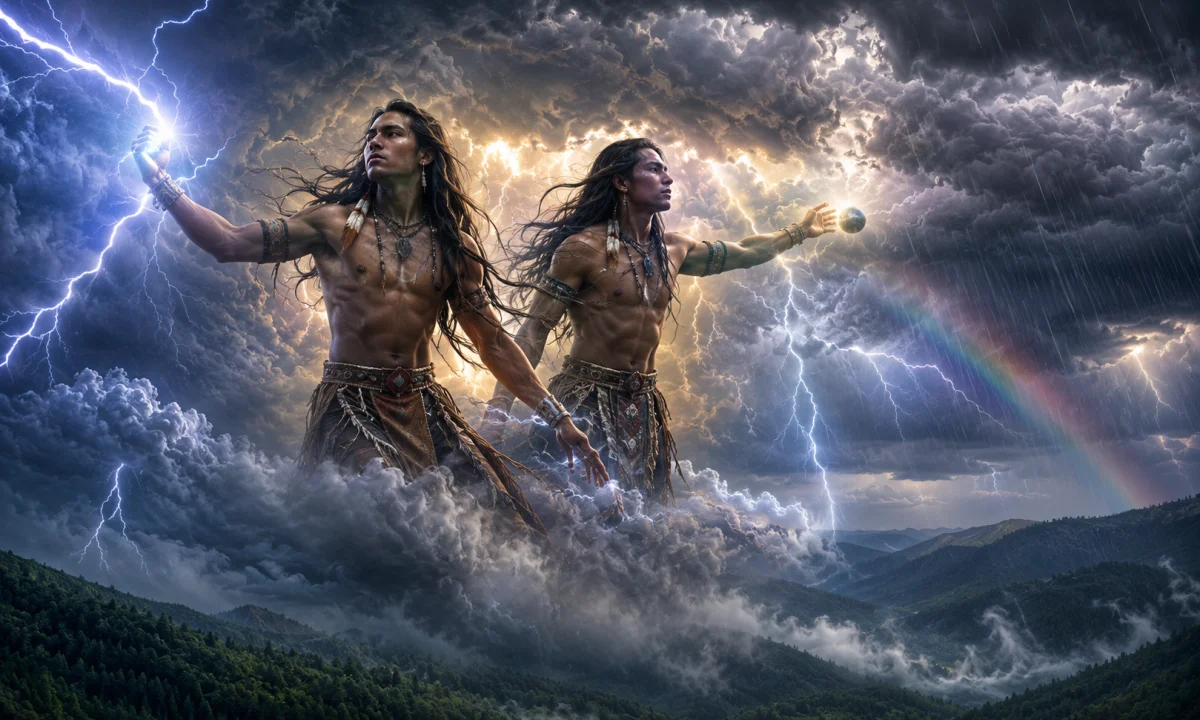
The Thunder Twins are often presented in English as a pair of supernatural brothers from Cherokee mythology. The name, however, does not identify one universally fixed Cherokee character comparable to a single, consistently described god. Cherokee traditions more securely attest a group of powerful Thunder Beings, commonly rendered in English as the Thunderers. In some retellings, these beings are described or represented as twins, while other accounts speak of several thunder spirits or of Thunder as a great supernatural power. The expression “Thunder Twins” should therefore be treated as a modern English label for a variable tradition rather than as an uncontested traditional title.
Cherokee cultural setting
The Cherokee are an Indigenous people of the southeastern woodlands of North America. Their traditional homelands included large parts of present-day Tennessee, North Carolina, Georgia, Alabama and adjacent regions. Cherokee religious life was closely connected with the natural world, seasonal change, hunting, agriculture, healing and the maintenance of proper relationships between human beings and spiritual powers.
Thunder, rain, wind and lightning were not merely meteorological events. They could be understood as expressions of powerful non-human beings. This did not mean that every storm was treated as a simple person in disguise. Rather, storms belonged to a sacred order in which spiritual forces could affect the wellbeing of communities, crops, animals and individuals.
Traditional Cherokee knowledge was transmitted primarily through oral teaching, ritual practice and storytelling. Early written accounts were produced by missionaries, ethnographers and other outsiders, often through translation and interpretation. Such records are valuable, but they do not preserve every local version or necessarily reproduce Cherokee concepts exactly. Spellings and English translations of Cherokee names consequently vary.
The Thunder Beings
The beings most closely associated with the Thunder Twins are the Cherokee Thunderers, sometimes written in romanized forms such as Aniyvdaquu or Ani-Yvdaquu. The spelling is not completely standardized in English, and the term is sometimes translated simply as “the Thunder Beings.” The name refers to a class or community of supernatural powers rather than, in every account, to two individual figures.
Older descriptions commonly place the Thunder Beings in the west. In traditional Cherokee geographical symbolism, the west could be associated with storms, sunset and powerful forces arriving from beyond the human settlement. The Thunder Beings were not automatically evil. They were often regarded as helpful or protective, particularly because rain was essential to crops and because thunder could oppose dangerous spiritual forces.
Some accounts describe a principal Thunder Being or chief, accompanied by other thunder spirits. Other traditions emphasize the group as a whole. This variation helps explain why English retellings sometimes turn a larger company of beings into a pair of brothers. “Twins” creates a memorable narrative structure, but it should not be assumed that every Cherokee teaching presents the Thunderers in exactly that form.
Why the twins are difficult to define
There is no single canonical Cherokee scripture that sets out a complete biography of the Thunder Twins. Cherokee sacred narratives were preserved through community traditions rather than through one authoritative written mythology. A storyteller, ritual specialist or family tradition might emphasize different details from those recorded elsewhere.
In addition, English-language collections have often simplified complex Indigenous concepts. A plural word may be translated as a pair, a class of beings may be presented as two named characters, and a symbolic relationship may be treated as a literal family connection. Later writers have also combined Cherokee thunder traditions with familiar ideas from other mythologies, especially the widespread image of divine twins who represent opposing forces.
For that reason, claims that the Thunder Twins always have fixed names, a definite parentage, a permanently good brother and an evil brother, or a specific appearance are not securely supported across Cherokee sources. These details occur in some modern summaries, but they should be identified as retelling or interpretation rather than assumed to be universal Cherokee tradition.
Storms, rain and lightning
The Thunder Beings are chiefly associated with thunder, lightning and rain. Their activity could bring the water required for fields and wild plants, but storms could also be dangerous. This dual character is important: a powerful being might be benevolent without being harmless. Respect, caution and proper ritual conduct were appropriate responses to supernatural power.
Thunder could be understood as communication or action from the spirit world. Lightning marked the presence of extraordinary force, while rain connected the sky with the fertility of the earth. A storm therefore carried both physical and religious significance. It could restore life to a dry landscape, threaten people and homes, or signal that powerful beings were active.
Some Cherokee traditions connect thunder powers with protection against beings considered harmful or disorderly. The Thunderers could act as defenders of the proper balance of the world. This does not make them identical to a simple storm god whose only function is to control weather. Their importance lies in their place within a broader sacred network involving the sky, the earth, animals, medicine and human conduct.
Healing and ritual importance
Cherokee religious specialists used prayers, formulas and ritual knowledge in healing and other situations. Recorded traditions associate thunder powers with medicine and protection, although the meaning of these associations is more complex than the idea that a thunder spirit simply “cures illness.” Cherokee healing involved relationships among the patient, the spiritual powers, plants, animals, words and ritual actions.
Thunder could be invoked as a force strong enough to remove danger or overcome harmful influences. The sound and violence of a storm also made it a fitting symbol of cleansing and defense. In this context, the Thunderers were not distant characters in a story alone. They belonged to a living religious understanding in which supernatural beings could be approached with respect and addressed through appropriate forms of knowledge.
It is important not to treat these practices as merely magical entertainment. Many recorded Cherokee formulas were connected with specialists, community responsibilities and religious restrictions. Details that appear in old written collections may have been restricted, incomplete or filtered through the assumptions of the recorder. A general description of the Thunder Beings cannot substitute for the teachings of Cherokee communities and cultural authorities.
The meaning of twins
Twins are a widespread mythological pattern, but the symbolic meaning of twins is not identical in every culture. Twin figures may represent complementarity, conflict, divided power, cooperation, or two aspects of a single sacred force. When Cherokee thunder traditions are retold through the image of two brothers, the pair may symbolize the contrasting effects of storms: rain that nourishes and lightning that destroys, protection and danger, or order and disruption.
These interpretations can be useful when clearly identified as interpretations. They should not be presented as a definitive Cherokee explanation unless supported by a particular Cherokee tradition. The presence of two figures does not automatically mean that one is morally good and the other morally evil. Thunder itself can help and harm, and the Thunder Beings are better understood through that complex relationship than through a simple hero-versus-villain pattern.
Some modern accounts also describe one twin as a bringer of rain and the other as a destructive storm spirit. Such descriptions may draw on general mythological patterns, local retellings or recent creative reconstruction. They are not consistent enough to define all Cherokee versions of the subject.
Appearance and supernatural abilities
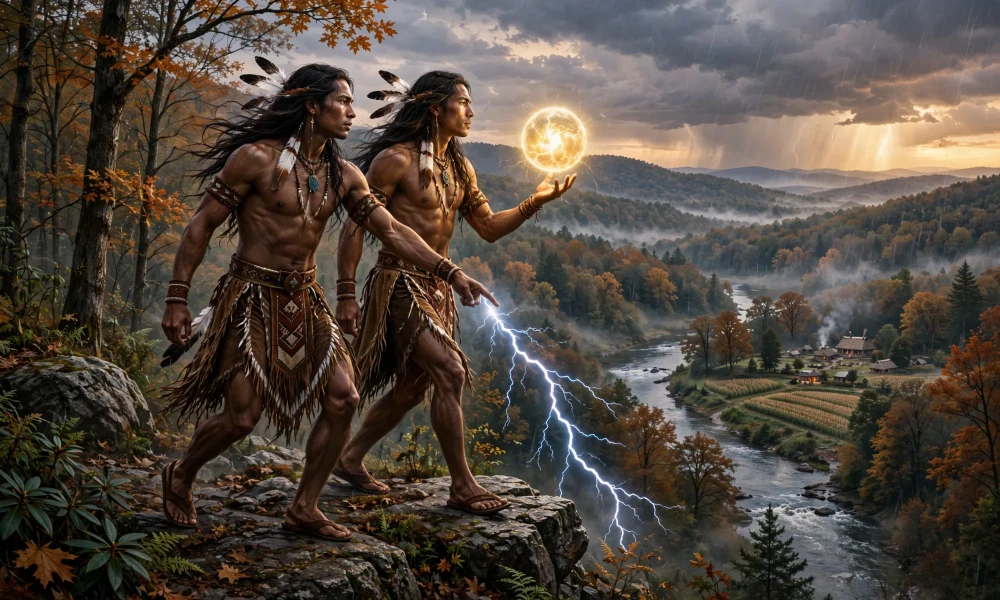
Traditional accounts do not provide one universally accepted physical portrait of the Thunder Twins. They may be imagined as powerful humanlike beings, as invisible presences revealed through their effects, or through symbolic associations with clouds, lightning and sound. The dramatic visual forms common in modern illustrations—armored brothers, blue-skinned giants, winged spirits or warriors carrying lightning weapons—belong largely to artistic interpretation unless tied to a specific source.
Their principal abilities are connected with the powers of a storm:
- bringing or withholding rain;
- producing thunder and lightning;
- protecting people or communities from dangerous spiritual forces;
- supporting the growth of crops and other life;
- acting through powerful weather that can also damage or frighten.
These should be understood as broad features of Cherokee thunder traditions, not as a fixed list of powers possessed by two named individuals in every version. The emphasis is on the sacred force of storms and their relationship to the wellbeing of the world.
Relationships with other Cherokee spiritual beings
The Thunder Beings belong to a wider Cherokee religious universe that includes numerous spiritual beings and powers associated with animals, places, celestial bodies, water and natural phenomena. They should not be isolated from that setting or treated as the single ruling group of all supernatural beings.
Cherokee stories also distinguish between beings that are helpful, beings that are dangerous and beings whose behavior depends on circumstances. Moral categories in traditional narratives do not always match the rigid division between “good gods” and “evil demons” familiar from some European religious frameworks. A storm spirit may be respected as a protector while still being feared for its destructive capacity.
Distinction from the Thunderbird
The Thunder Twins are sometimes confused with the Thunderbird, but the two ideas should not be merged. Thunderbird traditions occur in many Indigenous cultures of North America, with major differences in name, form and meaning from one community to another. In some traditions, a Thunderbird is a great bird or birdlike supernatural power associated with storms and protection.
Cherokee thunder traditions, as recorded in English, more often refer to Thunder Beings or Thunderers than to one standardized Thunderbird character. A modern artist may depict Cherokee thunder spirits as giant birds, but that image should not automatically be treated as an authentic universal Cherokee form. Nor should Thunder Beings from Cherokee tradition be combined with Iroquois, Plains, Pacific Northwest or other Indigenous thunder figures simply because they share control over storms.
Sources and the limits of the record
Knowledge of Cherokee mythology comes from oral traditions, community memory, ritual teachings and written records made at different times. Early collectors often translated Cherokee concepts into categories such as “gods,” “devils” or “myths,” terms that may not correspond neatly to Cherokee ideas. Some narratives were recorded in English, while others were written using inconsistent systems for representing the Cherokee language.
The result is a body of evidence that is both important and incomplete. A responsible account should distinguish between well-attested themes—such as the importance of Thunder Beings, their relationship to storms, their western association in recorded traditions and their protective or healing significance—and uncertain details about a particular pair of twins. Where sources disagree, the disagreement is part of the subject rather than a problem to be hidden.
Modern use of the name
“Thunder Twins” is especially attractive as a title for fantasy fiction, games, comics and illustrated mythology because it immediately suggests a pair of powerful brothers with contrasting abilities. Modern creators may give them personal names, weapons, costumes, family histories and sharply divided personalities. Such inventions can be legitimate creative works, but they are not evidence that those details belong to traditional Cherokee religion.
The respectful approach is to preserve the distinction between a living Indigenous tradition and a generalized fantasy motif. In Cherokee contexts, thunder is connected with spiritual power, rain, protection, healing and the responsibilities of maintaining balance. The most reliable description of the Thunder Twins therefore begins not with a fixed superhero-style biography, but with the Cherokee Thunder Beings and the recognition that the English label represents only one interpretation of a varied tradition.