WORLD
WORLD
Skili
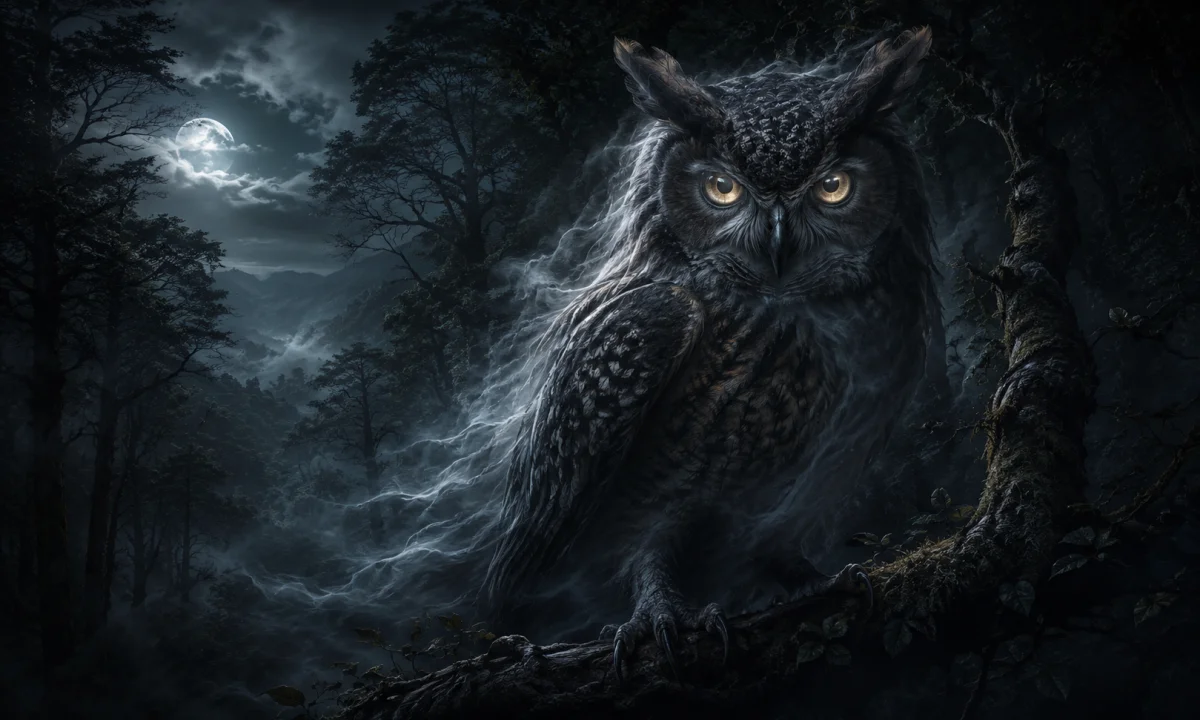
Skili is a name associated in some English-language accounts with a dangerous owl-like being in Cherokee traditional belief. It is often described as a supernatural owl, or as a witch or harmful spirit appearing in owl form. The available information is limited, however, and the name does not identify one universally defined Cherokee character with a single established appearance, biography, or myth. Spellings and descriptions vary, and some modern summaries present Skili more confidently than the surviving traditional evidence allows.
Cherokee cultural setting
Cherokee religious and mythological traditions come from the communities of the Cherokee people, whose homelands historically included large parts of the southern Appalachian region, especially areas now associated with western North Carolina, eastern Tennessee, northern Georgia, and northern Alabama. Cherokee traditions were transmitted through spoken narratives, ritual knowledge, family teaching, and relationships with the natural world. They were not organized as one fixed catalogue of gods and monsters.
Stories could differ between communities, speakers, and periods. A name recorded by an outsider might represent a Cherokee word, a local pronunciation, an imperfect transcription, or a descriptive label applied by an English-speaking collector. This is particularly important for lesser-known figures such as Skili. A short entry in a modern mythology list should not automatically be treated as evidence of a pan-Cherokee deity or a character known in every Cherokee community.
Owls nevertheless have an important place in the broader Cherokee understanding of animals, signs, night, and the boundary between ordinary and extraordinary experience. Their nocturnal habits, silent flight, unusual calls, and ability to see in darkness made them powerful symbols. In many traditional contexts, an owl could be regarded as an ominous presence, particularly when heard near a dwelling or associated with illness and death. Such beliefs should not be reduced to the idea that all owls were simply evil. Animals in Cherokee thought could possess their own powers and social significance, and their meaning depended on the circumstances.
Name and identity
The spelling Skili is the form most often encountered in modern English-language references to this figure. Other spellings may occur because Cherokee words have been represented through different systems of Romanization. A spelling in English does not necessarily preserve every feature of the original Cherokee pronunciation.
The identity of Skili is uncertain in three related ways:
- Some accounts treat Skili as a large or supernatural owl.
- Others describe the figure as a witch, harmful spirit, or witch-like being that takes the form of an owl.
- Some references provide little more than the name and a brief association with darkness, death, or danger.
These descriptions may preserve related ideas, but they should not be merged without qualification. A supernatural owl, an animal regarded as an omen, and a human practitioner of harmful magic are not necessarily the same figure. The word “witch” can also be misleading when applied to Indigenous traditions, because it carries assumptions drawn from European Christian and early modern folklore. In discussions of Cherokee belief, it is better to explain the reported function of a being than to assume that the English category exactly matches the original concept.
For that reason, Skili is best presented as a reported owl-associated supernatural figure whose precise traditional identity is not securely established. It is not safe to describe Skili as a Cherokee creator, supreme god, or universally recognized demon.
Appearance and associations
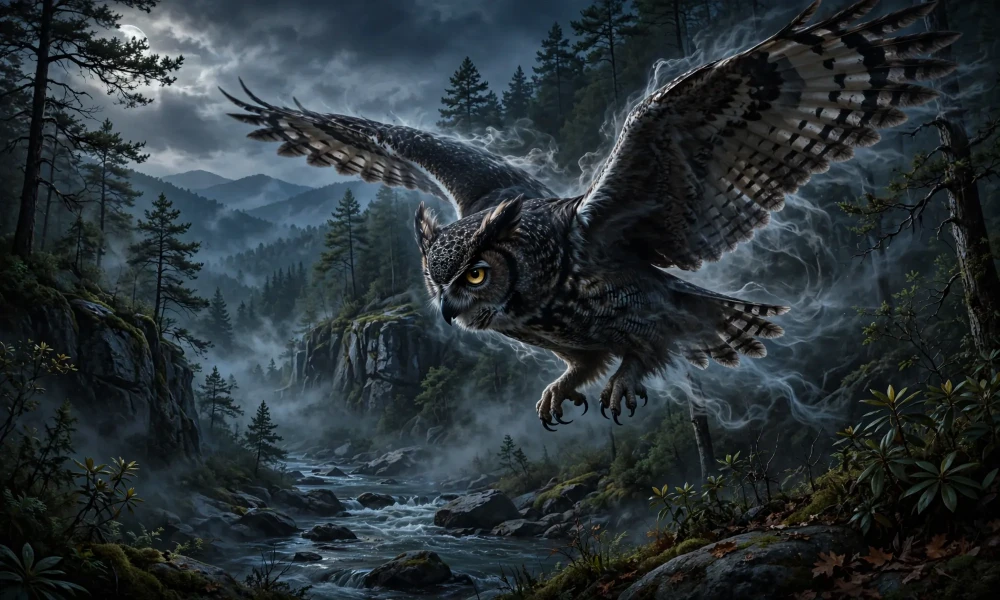
In modern descriptions, Skili is usually imagined as a very large owl or as a being with owl-like features. These accounts may emphasize enormous eyes, silent movement, darkness, and the ability to appear suddenly at night. Such details are common in later retellings and should not automatically be treated as elements of an old Cherokee narrative.
The more reliable general association is with the symbolic and supernatural power of owls. An owl’s cry could be interpreted as a warning or a sign of approaching misfortune. The bird’s presence at night connected it with hidden things, the dead, and forces that ordinary people could not easily see. In this setting, an owl-like being could function as a sign that a person had crossed into dangerous spiritual territory.
Possible attributes assigned to Skili in secondary accounts include:
- Movement or activity after dark.
- An association with death, sickness, or ominous warnings.
- The ability to frighten or watch human beings from concealed places.
- A connection with harmful magic or people believed to use supernatural power destructively.
- A form that is partly animal and partly human or spiritual.
Not every account includes all of these features. In particular, claims that Skili possesses a fixed set of magical powers, attacks travellers in a specific way, or rules a defined supernatural realm are not securely supported by the better-known body of Cherokee traditional literature.
Owls, danger, and spiritual boundaries
To understand why an owl-like being could be feared, it is useful to consider the place of animals in Cherokee cosmological thought. Cherokee narratives frequently describe animals as intelligent beings with their own communities, powers, and relationships with humans. Animals may teach, punish, assist, deceive, or reveal knowledge. The natural world is not merely a backdrop for human events.
At the same time, Cherokee stories often distinguish between ordinary animals and beings whose powers exceed normal limits. A creature may speak, change shape, possess unusual knowledge, or act as an intermediary between visible and invisible worlds. An owl can therefore be more than a bird in a narrative. It may be a warning, a messenger, a transformed person, or a sign of a dangerous presence.
Night is especially significant in stories about harmful forces. Darkness conceals movement and weakens ordinary human awareness. A nocturnal creature that flies silently and sees where people cannot see naturally becomes an image of hidden knowledge. The fear associated with Skili, where the name is used for a supernatural owl, may therefore arise less from a detailed monster profile than from the wider cultural meaning of an owl appearing at an ominous time or place.
It is important not to interpret this symbolism as proof that Cherokee people regarded nature as evil. The same animal could have different meanings in different circumstances, and traditional teachings could distinguish between respect, caution, fear, and moral judgment.
Stories and narrative evidence
Unlike major Cherokee figures such as the water monster Uktena, the giant hunter Tsul’kalu, or the culture hero and trickster Raven in particular narrative traditions, Skili is not represented in widely circulated Cherokee story collections by a large, consistent cycle of episodes. There is no generally accepted canonical story explaining Skili’s birth, family, territory, or defeat.
That absence matters. A name can survive in a glossary, a local account, a brief recollection, or a modern compilation without belonging to a long narrative tradition. It is therefore risky to supply a complete legend simply because readers expect every mythological being to have one. The uncertainty surrounding Skili is part of the subject’s historical record.
Some modern accounts may expand the figure into a night-flying predator or a shape-shifting witch. Such versions can preserve themes that are compatible with Cherokee ideas about owls, harmful magic, and supernatural danger, but expansion is not the same as documentation. Details should be identified as later retelling, interpretation, or popular description rather than presented as an ancient Cherokee story.
Skili and harmful magic
The connection between Skili and witchcraft appears in some descriptions, but it requires careful handling. Cherokee traditions include concepts of illness, spiritual harm, ritual power, and people who use knowledge for destructive purposes. These concepts existed within a religious and social system of their own; they were not simply copies of European ideas about witches.
Early European-American observers often translated unfamiliar Indigenous religious categories into words such as “witch,” “devil,” “sorcerer,” or “demon.” Those translations could flatten important distinctions. A person suspected of causing illness, a supernatural being encountered at night, and an animal viewed as an omen might all be described with similar language even though they had different meanings in Cherokee contexts.
When Skili is called a witch, the statement may therefore mean one of several things: that the being is itself a harmful supernatural agent, that it is an animal form associated with witches, or that a person with dangerous powers is believed to appear as an owl. These possibilities should remain separate unless a particular tradition clearly connects them.
Distinction from other Cherokee figures
Skili should not be confused with better-known Cherokee beings whose names and narratives are more clearly documented.
- Uktena is a powerful horned or serpent-like water monster. Its stories involve dangerous supernatural power, a shining jewel or magical stone in some versions, and encounters with human heroes. Uktena is not an owl being.
- Tsul’kalu, whose name is often interpreted in relation to a slant-eyed or giant being, is associated in Cherokee tradition with hunting and a powerful presence in the mountains. He is not simply another name for Skili.
- Raven Mocker is a harmful supernatural figure in Cherokee accounts, commonly connected with attacking people who are near death and stealing their life force. The Raven Mocker is not the same as an owl spirit, even though both may be linked in modern summaries with death and night.
- Spearfinger is a terrifying female monster from Cherokee storytelling, associated with a stone-like body and a sharp finger used to attack victims. She has no established identity as Skili.
- Tlanuwa refers in Cherokee stories to enormous supernatural birds. A giant bird and an owl-like being may look similar in a modern illustration, but they belong to different narrative descriptions and should not be merged.
These distinctions are more than matters of vocabulary. Combining every frightening night creature into one “Cherokee monster” removes the differences between stories, communities, and religious ideas.
Cultural significance
Skili’s significance lies primarily in the meeting point between animal symbolism and fear of hidden spiritual danger. An owl can represent awareness of what is concealed, but it can also signal that a person is approaching a boundary where ordinary explanations are inadequate. In a narrative or local belief, an owl-like presence may express anxiety about illness, death, social wrongdoing, or unseen hostility.
The figure also demonstrates the difficulty of reconstructing Indigenous mythology from scattered written records. Much Cherokee knowledge was oral, and written collections were often produced by outsiders working through translation. A short English label may preserve a genuine tradition while still failing to show its full context. Respectful interpretation requires acknowledging both possibilities: the name may reflect a real local or traditional concept, but the surviving record may not justify a complete standardized mythology around it.
For Cherokee people today, cultural identity and traditional knowledge are not frozen in the form given by nineteenth-century collectors or modern monster encyclopedias. Different Cherokee communities and individuals may have different relationships to older stories, animals, and religious practices. A respectful account should avoid presenting Skili as representative of all Cherokee belief or treating the figure as an exotic horror character detached from Cherokee cultural history.
Later reception and popular culture
Skili is sometimes reused in online mythology lists, fantasy fiction, role-playing games, and collections of legendary creatures. In these settings, the name may be turned into a giant owl, a nocturnal predator, or a shapeshifting spirit with powers borrowed from unrelated traditions. Such portrayals can make the name more familiar, but they are modern adaptations rather than evidence for an ancient, standardized character.
Illustrations that give Skili horns, glowing eyes, wings larger than a human body, or a fixed role as a forest demon should likewise be understood as artistic interpretation unless tied to a specific documented tradition. The most responsible modern use of the name preserves its uncertainty and avoids claiming that invented details belong to Cherokee religion.