WORLD

Temazcalteci

Temazcalteci is a Nahua goddess associated with the temāzcalli, the heated sweat bath of central Mexico. Her name is commonly translated as “Grandmother of the Temazcal” or “Grandmother of the Sweat Bath.” In accounts of Aztec religion, she is connected with healing, medicinal plants, childbirth, and the protective powers of the earth. She is also associated in some sources with the broader figure known as Toci, “Our Grandmother,” although the relationship between these names and identities is not entirely consistent.
Origins and cultural setting
Temazcalteci belongs to the religious world of the Nahua peoples of central Mexico, including the Mexica, often called the Aztecs. The temazcal was a small, enclosed structure heated by hot stones. Water poured over the stones produced intense steam, creating an environment used for bathing, recovery, treatment, childbirth, and ritual purification.
The temazcal was not merely an ancient version of a modern sauna. Its enclosed darkness, heat, steam, and association with the earth gave it strong symbolic meanings. Entering it could be understood as entering a protected interior space, sometimes compared by scholars with a womb. Emerging from it could represent renewal, recovery, or a return to ordinary life after a physical or ritual transition.
These meanings help explain why the temazcal had a female divine patron. Temazcalteci was associated with the bath as a place of warmth, restoration, and care. Her role also reflects the importance of women as healers, midwives, and custodians of knowledge about herbs and bodily treatment, although the surviving colonial descriptions do not provide a complete account of the people who managed every temazcal.
The meaning of the name
The name Temazcalteci is a Spanish-era representation of a Nahuatl name. The first element is related to temāzcalli, the Nahuatl word for a sweat bath or steam bath. The second element is generally understood as referring to a grandmother or elderly female relative. For that reason, “Grandmother of the Temazcal” is the most common English rendering.
Spelling varies because Nahuatl words were recorded by Spanish-speaking scribes using changing orthographic conventions. Forms such as Temazcalteci and slightly different spellings may appear in discussions of the goddess. The English phrase “goddess of the sweat bath” describes her function but is not a literal translation of the whole name.
The title “grandmother” is significant. In Nahua religious language, age could indicate authority, ancestral status, and accumulated knowledge rather than weakness. A grandmother figure could be a healer, a mother of other divine beings, or an embodiment of an ancient and powerful aspect of the natural world.
Identity and classification
Colonial sources describe Temazcalteci as a goddess of the temazcal and connect her with medicine and medicinal herbs. One important description also calls her the mother of the gods. These statements place her within a group of maternal and earth-associated divine figures rather than presenting her as a minor spirit limited to household bathing.
Her identity becomes less clear when she is compared with other female figures. Some sources and later interpretations identify Temazcalteci with Toci, “Our Grandmother.” Others connect Toci with Teteo Innan, “Mother of the Gods,” and with aspects of Tlazolteotl, a goddess associated with sexuality, impurity, confession, and purification. These associations reflect real overlaps in Nahua religious concepts, but they do not prove that all the names referred to one completely uniform deity.
Nahua religion did not always organize divine beings into sharply separated, fixed personalities in the manner of a modern catalogue of gods. A title could emphasize a particular function, place, age, or ritual manifestation. Different communities and different records could therefore use related names in ways that are difficult to reconcile. It is safest to describe Temazcalteci as a distinct name or aspect associated with the temazcal, while acknowledging that colonial writers linked her to broader grandmother and mother-of-the-gods figures.
Connection with healing and medicinal plants
Temazcalteci’s strongest traditional associations are with bodily care. Heat and steam were used to cleanse the body, relieve discomfort, and support recovery. The temazcal was especially important in connection with childbirth and the period after birth. Heat, massage, steam, and herbal treatments could form part of a woman’s care, although practices varied by place, period, and household.
Colonial descriptions associate the goddess with medicine and herbs. This does not mean that every medicinal plant was believed to be a personal gift from Temazcalteci, nor that a single standardized medical system existed across all Nahua communities. Rather, the goddess represented the sacred dimension of therapeutic knowledge and of the healing space itself.
Her association with the temazcal also places her near the boundary between physical and ritual purification. Bathing could remove sweat and dirt, but it could also mark a transition after illness, childbirth, or another vulnerable condition. The warm interior of the bath provided a controlled environment in which the body could be restored under the protection of a maternal power.
Appearance and attributes
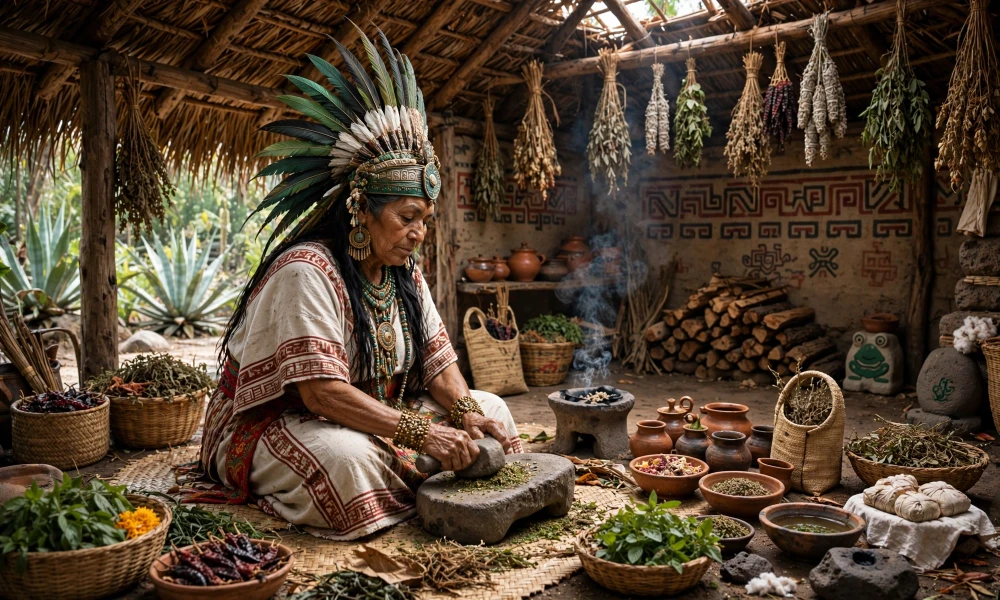
There is no universally agreed ancient portrait of Temazcalteci. Surviving manuscripts contain images of related goddesses and ritual impersonators, but identifying every image by a single modern name is difficult. Colonial artists and scribes also worked within European expectations about what a “goddess” should look like, which can complicate the interpretation of their illustrations.
When Temazcalteci is represented through her association with Toci or Teteo Innan, she may be imagined as an older woman or grandmother figure. This mature appearance conveys authority, fertility, ancestral power, and experience. Her age distinguishes her from youthful goddesses of beauty or sexual attraction, even though the boundaries between female divine roles could overlap.
Her principal attribute is not a weapon or a distinctive animal but the temazcal itself. The heated chamber, the stones, the steam, the herbs, and the act of emerging renewed all belong to her symbolic sphere. The earth is also an important interpretive association, because the temazcal is an enclosed, dark, earthen space that can evoke both the ground and the womb.
These interpretations should not be confused with a single official iconographic code. The surviving evidence supports her relationship with the sweat bath and healing, but it does not establish a complete list of fixed symbols comparable to the standardized attributes sometimes assigned to classical deities.
Temazcalteci, Toci, and the Ochpaniztli festival
The most important ritual context for understanding the grandmother and mother-of-the-gods complex is the festival of Ochpaniztli, whose name is often translated as “sweeping.” This festival involved themes of clearing, renewal, agricultural fertility, and the transition between old and new conditions. Colonial accounts associate it with Toci, Teteo Innan, and other female divine figures, though the details and names differ among sources.
Ochpaniztli included highly complex rites involving impersonation, public ceremony, warfare symbolism, fertility, and the renewal of sacred order. A woman could be selected to impersonate a goddess before being sacrificed, after which a priest associated with the ritual wore her flayed skin. These ceremonies are described in disturbing detail in colonial accounts, but their meaning cannot be reduced to a simple “death and rebirth” formula. They involved ideas of agricultural growth, divine embodiment, social order, and the transformation of an old power into a renewed one.
Because Toci was associated with grandmotherhood, earth, healing, and the mother of the gods, later writers have sometimes treated all references to Temazcalteci as references to the same festival goddess. That identification is plausible in some contexts but remains interpretive. The name Temazcalteci specifically highlights the sweat bath, whereas Toci and Teteo Innan could have wider ritual and theological ranges.
Surviving evidence and its limitations
Knowledge of Temazcalteci comes mainly from early colonial descriptions of Nahua religion, language, medicine, and daily life. The most important material was recorded after the Spanish conquest, when Indigenous informants, Nahuatl-speaking scribes, and European friars participated in the creation of texts and images. These records preserve valuable Indigenous information, but they are not untouched transcripts of pre-conquest belief.
Christian criticism influenced the way some practices were described. Spanish authors sometimes grouped very different Indigenous beings under broad categories such as “gods,” “idols,” or “devils.” At the same time, Nahua collaborators preserved names, ritual knowledge, and explanations that would otherwise have been lost. The evidence therefore requires comparison between descriptions, vocabulary, illustrations, and the wider cultural setting.
There is no surviving pre-conquest myth that gives Temazcalteci a long, clearly defined narrative comparable to the better-known stories of Huitzilopochtli, Quetzalcoatl, or Tezcatlipoca. Her importance is more visible in descriptions of ritual function and religious classification than in a single famous legend. A lack of surviving narrative should not be taken to mean that she was unimportant; many religious figures are known primarily through ceremonies, titles, and practical devotion.
Religious significance
Temazcalteci expresses the idea that healing is not separate from religion. The body, the household, the landscape, and the divine world were connected through practices such as bathing, herbal treatment, massage, childbirth care, and offerings. A sweat bath could therefore be a place where medical knowledge and sacred protection met.
Her grandmother identity also conveys continuity between generations. The temazcal was associated with women’s health and with the transmission of practical knowledge, while the goddess represented an ancient female authority standing behind that knowledge. In this sense, Temazcalteci can be understood as a guardian of bodily transformation: illness becoming recovery, pregnancy becoming birth, and impurity or exhaustion becoming renewed strength.
The earth-related dimension of her character adds another layer. The dark, heated interior of the temazcal resembles a sheltered earth chamber. This does not establish that Temazcalteci was simply an earth goddess under another name, but it helps explain why later interpretations connect her with fertility, the maternal body, and regeneration. Such interpretations should remain distinct from claims directly stated in the surviving records.
Distinction from similar figures
- Toci: The name means “Our Grandmother” and is closely associated in colonial accounts with grandmotherhood, healing, and the mother of the gods. Temazcalteci is sometimes identified with Toci, but the names should not automatically be treated as interchangeable.
- Teteo Innan: This title means “Mother of the Gods” and is linked with major maternal and earth-associated aspects of Nahua religion. It may overlap with Toci and with the identity assigned to Temazcalteci in some sources, but it is a title with a broader range than the temazcal-specific name.
- Tlazolteotl: Tlazolteotl is associated with sexuality, pollution or impurity, confession, and purification. She shares themes of bodily cleansing and female power with Temazcalteci, and colonial sources sometimes connect related figures. Nevertheless, Tlazolteotl should not be described simply as another name for the goddess of the temazcal.
- Chalchiuhtlicue: This goddess is strongly associated with water, rivers, springs, fertility, and childbirth. Since the temazcal uses water to create steam, modern descriptions may place the two figures together, but Chalchiuhtlicue is not the same deity as Temazcalteci.
- Modern temazcal spirits: Contemporary ceremonial practitioners may describe the temazcal through Indigenous, Christian, esoteric, or newly blended spiritual frameworks. Such teachings can be meaningful within their own communities, but they should not automatically be presented as unchanged Aztec doctrine.
Later reception and modern use
The temazcal has continued to exist in several Indigenous and Mexican traditions, although its forms, purposes, and interpretations have changed over time. Some contemporary practitioners preserve local healing customs, while others present the temazcal as part of cultural revitalization, Indigenous identity, wellness practice, or spiritual ceremony.
Modern books, festivals, wellness businesses, and popular media sometimes portray Temazcalteci as a universally recognized Aztec “goddess of steam,” assigning her a fixed appearance, a detailed mythology, or a direct equivalence with every grandmother and earth goddess in Mesoamerican religion. These portrayals may draw inspiration from genuine Nahua traditions, but many add modern symbolic systems that are not securely documented in pre-conquest or early colonial evidence.
A historically careful understanding keeps both aspects in view: Temazcalteci is a traditional Nahua divine name connected with the temazcal, medicine, herbs, and maternal or grandmotherly power; the wider claims made about her in modern spirituality may represent later interpretation rather than an established ancient teaching.