WORLD
WORLD
Tamendonare

Tamendonare is a figure associated with Tupi mythology in Brazil, especially with a traditional story about two brothers, a violent dispute and a catastrophic flood. He is usually presented as the more peaceful and constructive of the pair, in contrast with his brother Ariconte, who is characterised in many retellings as aggressive and warlike. The story survives through early European descriptions of Indigenous traditions and through later Brazilian retellings, but its details vary considerably. Tamendonare should therefore be understood as a figure in a recorded family of Tupi traditions rather than as a single, universally fixed character.
Cultural setting
The traditions connected with Tamendonare belong to the Indigenous cultures of eastern and southeastern South America, particularly the Tupi-speaking peoples of the Brazilian Atlantic coast. “Tupi” does not refer to one uniform religion or nation. It is a broad linguistic and cultural designation that includes historically distinct peoples, communities and traditions. The same story could be remembered, transmitted or interpreted differently in different regions.
Much of the surviving written information about Tamendonare comes from the colonial period, when European missionaries, travellers and chroniclers recorded accounts of Indigenous peoples. These records are valuable, but they are not neutral transcripts of oral tradition. They were produced by outsiders who often translated unfamiliar concepts into Christian, classical or European categories. Names were written according to the spelling habits of different authors, and stories that had existed in several local versions could be compressed into a single account.
For this reason, the flood story should not be treated as a complete statement of “Tupi religion”. It is better understood as one important mythic tradition connected with ideas of kinship, moral conflict, destruction and the renewal of human life.
Name and identity
The name appears in several forms, including Tamendonare, Tamendonaré, Tamandare and Tamandaré. Older records often used inconsistent spellings because Portuguese and French writers were attempting to represent Indigenous sounds with European alphabets. The form Tamendonare is common in modern discussions of mythology, while Tamandaré is also familiar in Brazilian historical and geographical contexts.
The precise meaning of the name is not securely established. Popular summaries sometimes offer confident translations or connect the name with particular natural phenomena, but such explanations are not equally supported by historical evidence. A responsible account should distinguish the recorded name from later attempts to derive an exact etymology.
Tamendonare is generally classified as a culture hero, ancestral figure or flood survivor rather than as a god in the strict sense. In the surviving narratives, he is a human or human-like ancestor who participates in a primordial crisis and helps establish the conditions for later human society. The boundaries between deity, ancestor, culture hero and legendary chief were not necessarily the same in Indigenous religious thought as they are in modern reference works.
Tamendonare and Ariconte
The central structure of the tradition is the opposition between Tamendonare and Ariconte. They are usually described as brothers, although the precise nature of their relationship and their position within the wider genealogy may differ between accounts. Their contrast is often moral and social as much as personal:
- Tamendonare is associated with peace, restraint, agriculture, domestic order or a less destructive way of life.
- Ariconte is associated with warfare, pride, aggression and the prestige of violent achievement.
This opposition should not be simplified into an absolute division between “good” and “evil” without qualification. Warfare, hunting, courage and chiefly power were significant subjects in the societies that preserved these traditions. The story is not merely a modern morality tale in which one brother is virtuous and the other wicked. It explores the dangers of rivalry between closely related men and the consequences when martial ambition overwhelms social balance.
Some versions make the brothers representatives of different social or ancestral lines. Later writers have sometimes connected them with the origins of historically named Indigenous groups, including the Tupinambá and Tupiniquim. Such associations are part of the way the story has been interpreted and transmitted, but they should not be treated as straightforward historical evidence that entire peoples descended from two individuals.
The quarrel and the flood
The most famous episode begins with a dispute between the brothers. The exact cause is uncertain. In several retellings, Ariconte returns from warfare displaying a trophy or a severed limb taken from an enemy. Tamendonare reacts with disapproval, seeing the act as an intolerable expression of violence or arrogance. Other versions alter the object, the circumstances or the words exchanged. The recurring element is a conflict over the value and consequences of war.
The quarrel leads to a supernatural disturbance. In commonly repeated accounts, Tamendonare strikes or stamps the ground, and water bursts forth. The waters rise until the land is submerged. Other retellings describe the flood as resulting from the brothers’ actions more generally, rather than assigning its beginning to one precisely described gesture. The myth does not always present Tamendonare as an entirely blameless victim: his anger, even when provoked, can become part of the destructive chain of events.
The flood is therefore more than a natural disaster. It is the physical expression of a breakdown in social and moral order. A dispute between brothers expands until it threatens the entire human world. The story gives cosmic scale to the consequences of violence, pride and uncontrolled anger.
Survival above the waters
When the flood covers the land, Tamendonare and Ariconte survive by climbing high into trees or taking refuge in elevated places. Palm trees are especially prominent in many modern summaries. The details of their refuge vary, however, and not every account agrees about the kind of tree, the presence of their wives or the length of the ordeal.
The image of the brothers above the flood connects the story with a widespread mythic pattern: destruction of an earlier world followed by the survival of a small number of people. It is important not to assume that every flood tradition is historically derived from the same event or belongs to one universal religion. Flood myths occur in many parts of the world for different cultural reasons. In the Tupi tradition associated with Tamendonare, the distinctive feature is the conflict between the brothers and the way social rivalry is woven into the catastrophe.
After the waters recede, the survivors descend and human life begins again. Some retellings describe the brothers and their companions as ancestors of later peoples or communities. Others focus more narrowly on their personal survival. The story’s ending is consequently not identical in every source: it may emphasise repopulation, division into different groups or the continuation of the brothers’ opposing ways of life.
Attributes and symbolic role
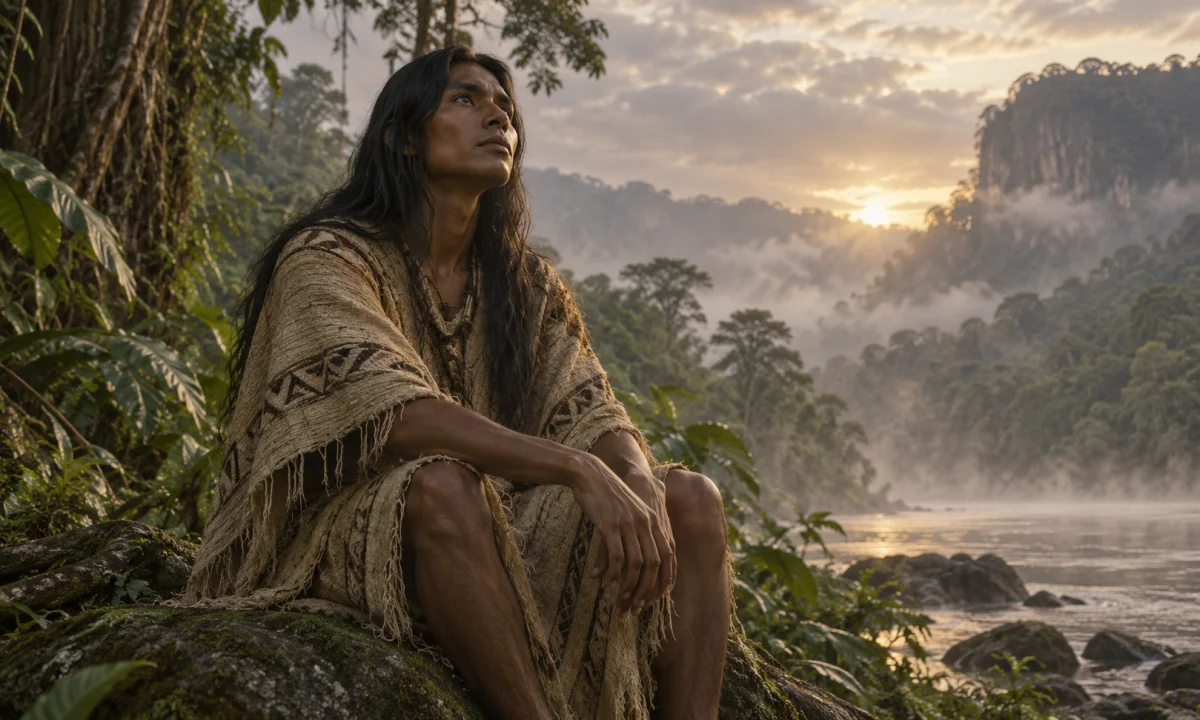
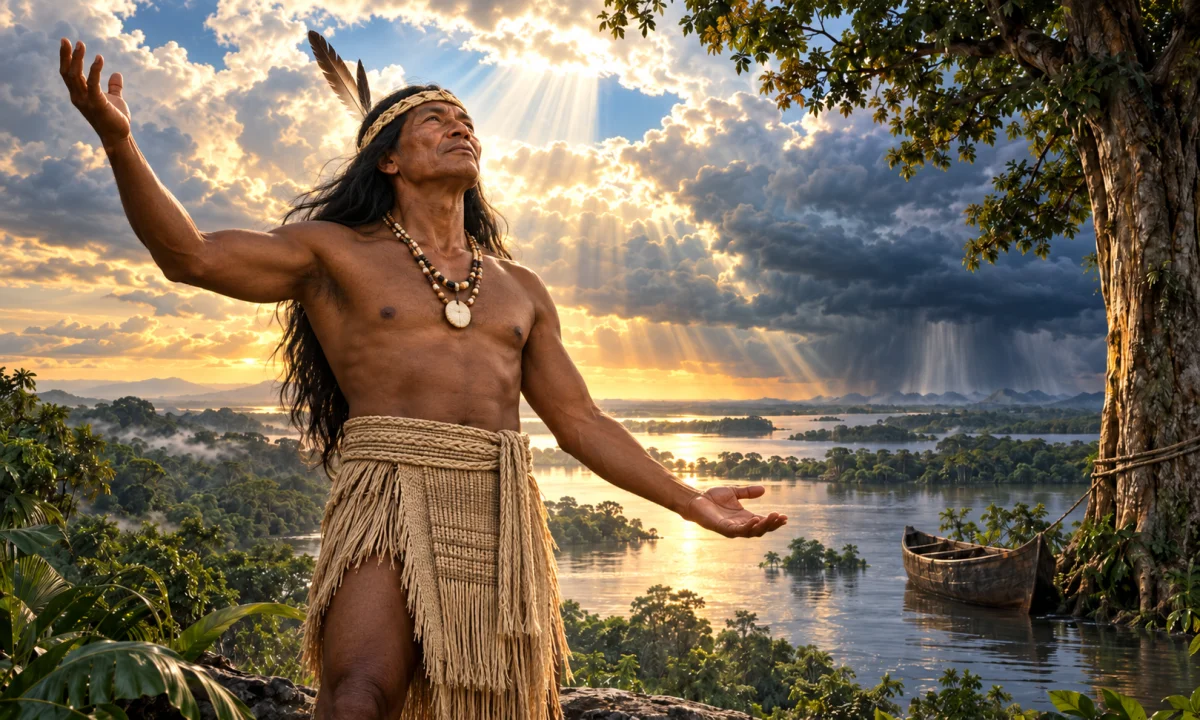
Tamendonare does not have a standard physical appearance comparable to the fixed iconography of many gods in classical or later popular traditions. Early accounts do not provide a consistent set of clothing, weapons, animals or bodily features. Modern illustrations may show him as an Indigenous chief, but that image is an artistic interpretation rather than a securely documented traditional form.
His most important attributes are ethical and narrative:
- Kinship: he is defined through his relationship with Ariconte, and the story’s crisis begins within the family.
- Restraint: he often represents a preference for peace, cultivation and social stability over destructive competition.
- Anger: despite his more favourable characterisation, his response to Ariconte can help trigger the catastrophe.
- Survival: he becomes one of the figures through whom human continuity is maintained after the flood.
- Ancestry: later interpretations treat him as a founder or forefather connected with the differentiation of human communities.
These features make Tamendonare a complex culture hero. He is not simply a creator who calmly brings the world into existence. He belongs to a narrative of destruction and renewal, in which a flawed human relationship produces a crisis and survival becomes possible only after the old order has been washed away.
Variants and limits of the evidence
There is no single canonical scripture containing the definitive story of Tamendonare. The surviving accounts are fragments of traditions recorded at different times and in different circumstances. Names, relationships and episodes may have been altered during translation, shortened by the recorder or combined with material from neighbouring communities.
Several details commonly repeated in popular versions should therefore be treated cautiously:
- The brothers’ parents are not consistently identified.
- The precise cause of their quarrel changes from one retelling to another.
- The object associated with Ariconte’s violent exploit is not described identically in all versions.
- The means of survival may involve trees, elevated refuges or other places, depending on the account.
- The identities of the people descended from the survivors are interpreted differently by later writers.
These variations do not make the tradition meaningless. Oral traditions often preserve a recognisable narrative framework while allowing details to change according to community, performer and historical context. What remains most stable is the relationship between the brothers, the danger of destructive rivalry and the flood as a turning point in the history of humanity.
Interpretation and cultural significance
One important interpretation sees the story as an examination of the tension between two forms of social power. Ariconte’s martial identity reflects the importance of warfare and reputation in many Indigenous societies of the region, while Tamendonare’s contrasting character points toward cultivation, peace and continuity. The myth does not necessarily reject courage or warfare in every circumstance. Instead, it warns that violence detached from social responsibility can become catastrophic.
The brothers can also be read as complementary rather than wholly separate opposites. A society may need bravery, leadership and the ability to defend itself, but it also requires food production, family life, cooperation and restraint. The conflict becomes disastrous when one mode of life attempts to dominate the whole social world.
The flood gives this conflict an environmental and cosmic dimension. Water erases settlements and familiar boundaries, creating a rupture between an earlier age and the world that follows. As with many origin traditions, the story explains not only how people survived but also why human communities may differ from one another. Difference is linked to ancestry, behaviour and the consequences of the brothers’ division.
It is also significant that the survivor is not portrayed as a flawless being outside ordinary human emotion. Tamendonare’s anger matters. The story suggests that even a person associated with peace may participate in destruction when drawn into a rivalry governed by pride and insult. This makes the myth less a portrait of perfect virtue than a reflection on responsibility within family and community.
Distinction from similar names and figures
Tamendonare is sometimes confused with other names from Brazilian history and folklore. Tamandaré is also the name associated with Joaquim Marques Lisboa, a nineteenth-century Brazilian naval commander who received the title Marquis of Tamandaré. That historical figure is not the same as the mythological Tamendonare, even though the names are related in spelling and have sometimes been discussed together in Brazilian cultural contexts.
The mythological name should also not automatically be identified with every local place-name or modern use of Tamandaré. Brazilian municipalities, streets, institutions and military references may preserve or reuse the name for historical reasons without representing the traditional Tupi figure.
Nor should Tamendonare be merged with Tamandua, the anteater, or with unrelated Indigenous beings whose names have been altered in translation. Similar spelling is not sufficient evidence of shared identity, origin or symbolism.
Later reception
Tamendonare has remained less prominent in global popular culture than figures from Greek, Norse or Egyptian mythology. His story is encountered mainly in Brazilian folklore collections, discussions of Indigenous mythology, educational materials and literary or artistic retellings. These later presentations often turn the brothers into a simple pair of “good” and “bad” ancestors, while reducing the uncertainties and regional variation found in the historical record.
Modern adaptations can preserve the flood, the brotherly conflict and the theme of renewal, but they should be distinguished from the older tradition. An illustration, novel, game or classroom summary may assign Tamendonare a fixed appearance, weapon, genealogy or supernatural power that is not securely documented in the surviving accounts. The traditional figure is most clearly defined not by a standard costume or a catalogue of powers, but by his place in a Tupi flood narrative about kinship, violence, survival and the fragile re-establishment of human society.