WORLD
WORLD
Sinaa
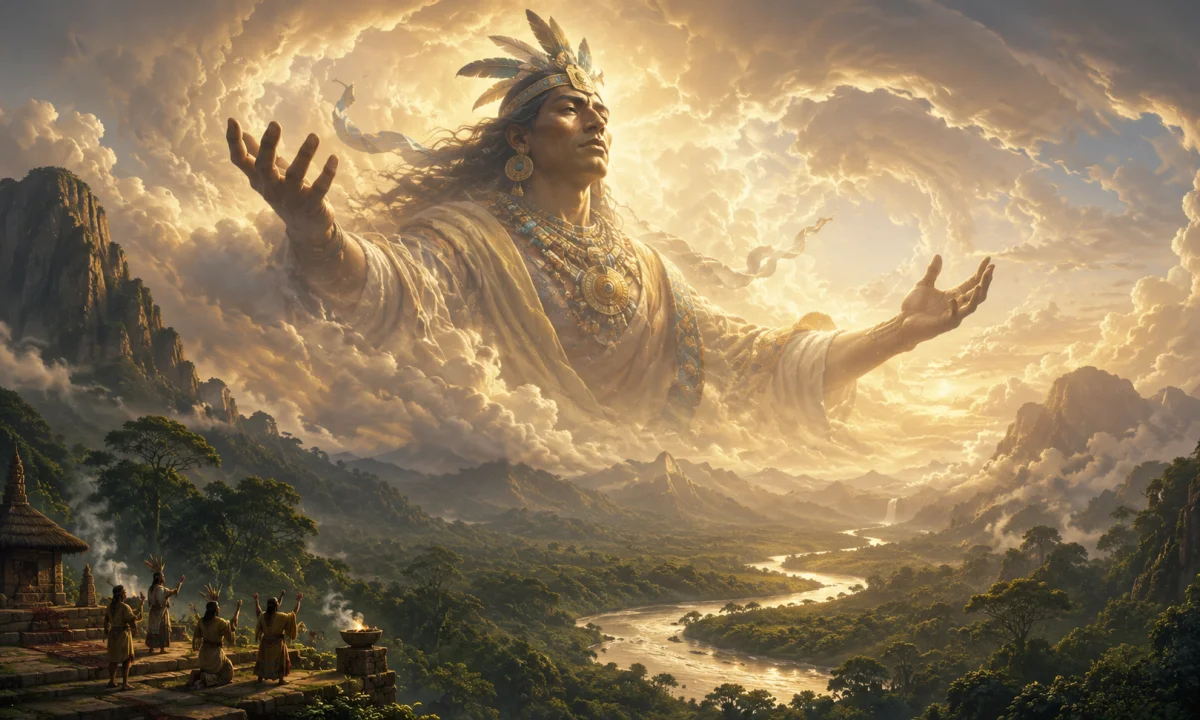
Sinaa is an obscure name associated in some modern compilations with Indigenous mythology from South America. It is sometimes presented as a creator, sky being or supreme spirit, but its cultural origin and traditional identity are not securely established. Unlike better-documented figures such as Inti, Pachamama, Yúcahu or Bochica, Sinaa does not have a clearly defined body of myths preserved in a widely recognised Indigenous tradition.
Origins and cultural setting
South America contains hundreds of Indigenous religious traditions, each with its own languages, ritual systems and ways of describing spiritual beings. Names recorded by missionaries, travellers, ethnographers and later writers were often written according to European spelling conventions. A single name could therefore appear in several forms, while different names could be treated as if they referred to the same being.
The name Sinaa is particularly difficult to identify because it is rare in reliable, easily verifiable discussions of South American traditional religion. Some secondary sources describe Sinaa as a high god or creator figure, while others provide little more than the name. These accounts do not agree consistently about the people who revered Sinaa, the being’s gender, powers or mythology.
For that reason, Sinaa should not be treated as a universally recognised South American deity. “South American mythology” is a broad geographical category, not the name of one shared religious system. A figure belonging to an Amazonian, Andean, Caribbean or southern South American tradition should be discussed within its own cultural setting rather than placed into a single continental pantheon.
Name and identity
The spelling Sinaa may represent a transcription, an alternate spelling or a later editorial form. Without a securely identified language and source tradition, the name’s original meaning cannot be stated with confidence. It is also unclear whether the final vowel represents a meaningful part of the original name or merely a spelling choice made by a modern compiler.
Some references use related forms such as Sina, but similarity of spelling does not prove identity. Indigenous languages of South America belong to many unrelated language families, and short names can resemble one another by coincidence. A name that means “father,” “spirit,” “sun” or something entirely different in one language may have no connection with a similar-looking name in another.
There is no firm evidence that Sinaa was part of a continent-wide pantheon, nor that the name was known across all Indigenous communities. Descriptions that call Sinaa “the South American god” are therefore misleading. At most, the name may refer to a figure in a particular local tradition that has been poorly recorded or inaccurately transmitted through later sources.
Classification as a deity or spirit
When Sinaa is included in modern lists of mythology, the figure is most often classified as a creator being, a sky-associated power or a supreme spirit. These classifications should be regarded as tentative rather than as established features of a well-documented cult.
The terms “god,” “deity” and “supreme being” can also conceal important differences. Many Indigenous traditions distinguish between a creator, an ancestral hero, a powerful animal, a culture-bringer, a guardian spirit and a being approached in ritual. European observers often translated all of these categories with words such as “god” or “demon,” even when the original religious concepts did not match European theology.
If Sinaa was originally a creator or sky being, that would place the figure within a widespread pattern found in South American religious thought. Many traditions tell of a primordial being who establishes the world, separates the sky from the earth, creates human communities or introduces fire, agriculture and social rules. Yet this general pattern cannot be used to reconstruct a specific Sinaa myth without evidence.
Attributes and powers
There is no stable traditional description of Sinaa’s appearance. The figure is not reliably associated with a particular animal, weapon, garment, celestial body or sacred object. Images sometimes created for modern mythology websites should not be mistaken for Indigenous representations.
Likewise, the powers attributed to Sinaa vary according to the source. The name may be accompanied by descriptions of creation, heavenly authority or protection, but these details are not consistently supported by a common set of narratives. It is safer to describe such attributes as reported or proposed rather than definitive.
No securely established tradition links Sinaa specifically with the sun, moon, rain, death, fertility or warfare. South American mythologies contain many important beings associated with those forces, but assigning one of these roles to Sinaa simply because it is common in comparative mythology would be speculative.
Stories and relationships
A clearly documented cycle of stories about Sinaa is not available. There is no widely accepted account of Sinaa’s birth, marriage, conflict with another deity, descent to the earth or relationship with a named pantheon. Nor is there a recognised sacred text devoted to Sinaa. The surviving evidence, where the name appears at all, is too limited to establish a narrative tradition comparable to the myths of Inca or Muisca religion.
This absence does not prove that no community ever told stories about a being called Sinaa. Indigenous traditions were transmitted primarily through oral performance, ritual and community memory. Many traditions were recorded only partially, and some were severely disrupted by colonisation, missionary activity, forced settlement and the loss of Indigenous languages. A local figure may therefore be poorly known outside the community that preserved the tradition.
At the same time, lack of documentation should not be used as permission to invent missing stories. A responsible account must distinguish between what is recorded, what is inferred and what is merely repeated by later sources. In the case of Sinaa, the recorded material is too uncertain to support a detailed mythology.
Possible confusion with other names
Sina and similar spellings
The form Sina occurs in various cultural and linguistic contexts, but similar spelling alone does not establish a relationship with Sinaa. Some modern lists may have expanded a short form, altered its spelling or copied an earlier error. Identifying the original language and the person who recorded the name would be necessary before treating Sinaa and Sina as the same figure.
Sintana in Kogi tradition
Sinaa should also be distinguished from Sintana, a name associated with Kogi religious tradition in Colombia. Sintana appears in accounts of Kogi creation and cosmology, but the two names are not interchangeable. The Kogi have their own complex sacred history, ritual specialists and concepts of cosmic order. There is no sound basis for changing Sintana to Sinaa or for presenting the figures as identical.
Inca and Andean deities
Sinaa is not an established alternative name for the major Inca deities. Viracocha is associated in colonial records with creation; Inti is the principal solar deity of the Inca state; and Mama Quilla is associated with the moon. Pachamama belongs to a much broader Andean religious sphere and remains an important living figure in many communities. None of these names should be replaced by Sinaa without specific historical evidence.
Caribbean and Amazonian traditions
Nor should Sinaa automatically be identified with figures from Taíno, Arawak, Warao or other Caribbean and Amazonian traditions. The region’s languages and histories are diverse, and similar-looking names may have different origins. For example, a creator or ancestral being in one Amazonian tradition cannot be equated with a vaguely described sky spirit in another merely because both are classified as “supreme gods” in English-language summaries.
Cultural and religious significance
The main significance of Sinaa today lies in the need for careful treatment of fragmentary Indigenous knowledge. A short entry in a modern list can make an uncertain name appear more securely documented than it really is. Repetition then gives the impression of authority: one website copies another, a spelling becomes standard through reuse and a tentative interpretation is eventually presented as ancient fact.
Such problems are especially serious when discussing Indigenous religions. The use of a name outside its language and community can remove it from the ceremonies, landscapes, social relationships and ethical teachings that originally gave it meaning. A deity is not simply a character with a list of powers. Religious identity may be expressed through songs, dances, offerings, sacred places, kinship obligations and responsibilities toward animals, ancestors and the environment.
If future linguistic or ethnographic research establishes a specific tradition for Sinaa, the figure should be described through that community’s own terminology and understanding. Until then, the most accurate interpretation is a cautious one: Sinaa is a poorly documented or possibly corrupted name whose alleged role as a creator or supreme spirit remains uncertain.
Sources and modern reception
There is no widely recognised ancient text devoted to Sinaa, and the name does not have the extensive historical documentation available for some Andean or Mesoamerican religious figures. Its presence in modern mythology collections may reflect secondary compilation rather than a continuous religious tradition.
Modern encyclopaedic websites, fantasy settings and illustrated mythology projects may use Sinaa as a convenient name for an invented or reconstructed South American deity. Such portrayals can give the figure a fixed appearance, personality and set of powers, but those features belong to modern adaptation unless they can be traced to a specific Indigenous source.
For WorldMythos, Sinaa is best presented as an uncertain and poorly attested figure, not as a confirmed member of a unified South American pantheon. The uncertainty is part of the historical record and should remain visible rather than being concealed beneath an elaborate invented mythology.