WORLD
WORLD
Sága

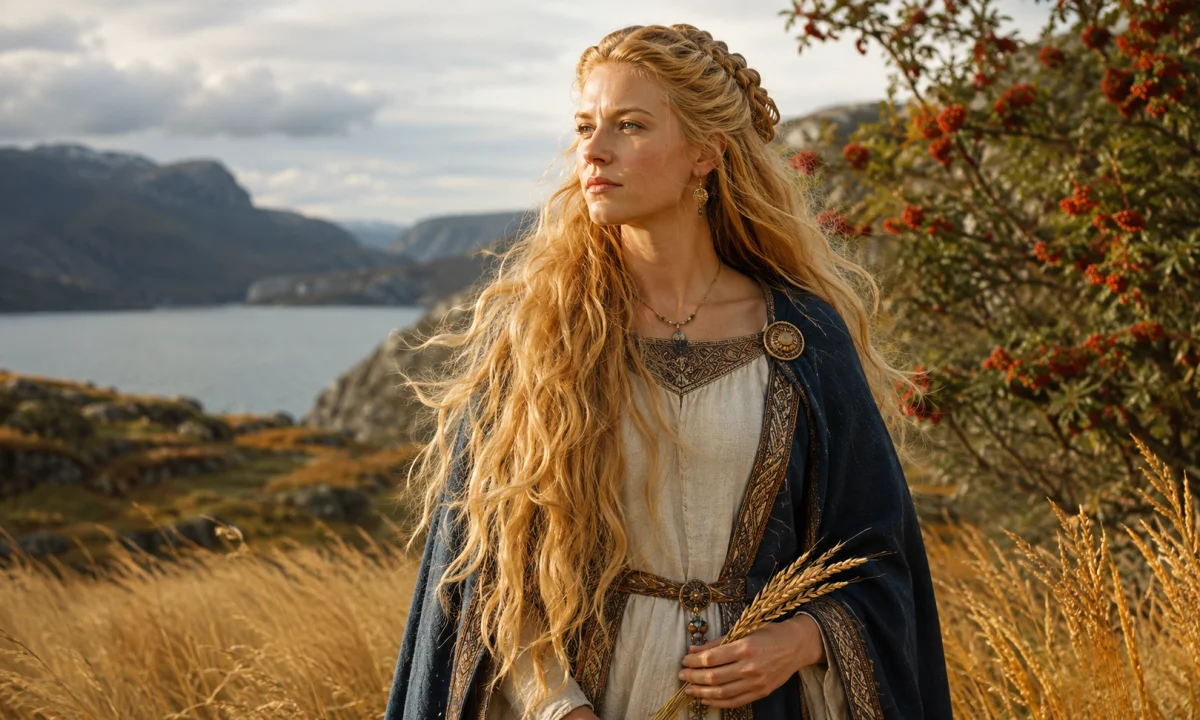
Sága is a little-known female figure in Norse mythology, counted among the ásynjur, the goddesses or women of the divine Æsir. Her name is associated with the Old Norse word-family connected with speech, saying and what is told, which has encouraged later interpretations of her as a goddess of stories, memory or historical knowledge. The surviving medieval sources, however, say very little about her. They identify Sága chiefly through her dwelling, Sökkvabekkr, and through a brief image of her drinking with Óðinn beside flowing waters.
Sága in Norse tradition
Norse mythology survives primarily through medieval Icelandic manuscripts that preserve older poetic and mythological material. These sources were written down in a Christian society several centuries after the Viking Age, and they do not provide a complete or systematic account of every deity. Some gods appear in many stories, while others are mentioned only in lists, kennings or brief descriptions. Sága belongs to the second group.
Her most important appearance is in Grímnismál, a poem preserved in the Poetic Edda. The poem presents the god Óðinn, disguised as Grímnir, describing the halls and dwellings of the gods. Among these is Sökkvabekkr, the home of Sága. The poem says that cool or refreshing waves flow there, and that Óðinn and Sága drink joyfully from golden vessels throughout the days.
Sága is also named by Snorri Sturluson in Gylfaginning, part of the Prose Edda. In Snorri’s catalogue of goddesses, she is listed as the second after Frigg. He states that she lives at Sökkvabekkr and that Óðinn goes there to drink with her. Snorri’s account closely reflects the older poetic image rather than expanding it into a separate narrative.
These references establish Sága as a recognised divine figure in the medieval Norse mythological tradition, but they do not preserve a developed cycle of myths about her. No surviving story explains her birth, ancestry, marriage, deeds or death. Claims about her personality and powers therefore need to be distinguished from later interpretation.
The meaning and spelling of her name
The name is commonly written Sága in modern discussions, following the Old Norse form. It should not be confused with the common modern English word saga, although the two are historically related through Germanic language and literary traditions. In Old Norse, the word-family associated with segja, “to say” or “to tell,” includes terms connected with speech, narrative and something said. The name Sága may therefore suggest “the one who tells,” “what is told,” or a related concept.
The exact interpretation is not completely secure. Etymological analysis of names from the medieval Norse tradition can be difficult because a name may preserve an old religious meaning, a poetic association or a form that was no longer fully understood by the time it was written down. The connection with verbal expression and narrative is plausible, but the surviving sources do not explicitly call Sága a goddess of storytelling or history.
The similarity between Sága’s name and the word saga has strongly influenced modern descriptions of her. In later Scandinavian languages, related words came to refer to a tale, story or narrative, and the Icelandic sagas became one of the best-known bodies of medieval literature. That literary association makes Sága appear, to modern readers, like an obvious patron of storytelling. It is useful symbolism, but it should not be presented as a firmly documented ancient title or office.
Sökkvabekkr, the home of Sága
Sökkvabekkr is one of the most distinctive features of Sága’s tradition. The name is often translated as “Sunken Bench,” “Sinking Bench” or “Submerged Bench.” Its precise imagery is uncertain, and translations vary because compounds in Old Norse can carry several related meanings. The name nevertheless suggests a place associated with water, depth or a hall situated below or beside a flowing body of water.
Grímnismál describes cool waves running through or around Sökkvabekkr. The setting differs from the more familiar halls of Norse mythology, such as Óðinn’s Valhǫll, Þórr’s Bilskírnir or Freyja’s Fólkvangr. It is not described as a battlefield, a royal hall crowded with warriors or a place of formal feasting. Instead, the poem creates an intimate and peaceful scene of drinking beside water.
The golden vessels mentioned in the poem connect the location with divine hospitality and elevated status. Drinking together is an important social act in Norse literary culture, where shared drink can express friendship, alliance, remembrance and the maintenance of social bonds. The image of Óðinn and Sága drinking at Sökkvabekkr may therefore indicate closeness or companionship, although the sources do not define their relationship in a formal way.
The water imagery may also have encouraged associations with inspiration, knowledge and the movement of speech. Such interpretations fit broader Norse ideas about wisdom and poetic power, including Óðinn’s pursuit of knowledge and his connection with poetry. Yet the poem does not say that Sága owns a fountain of wisdom, grants poetic inspiration or presides over a particular body of sacred knowledge. Those ideas belong to interpretation rather than explicit mythic description.
Identity and classification
Snorri places Sága among the ásynjur, the female members of the Æsir. This classification confirms that she was treated as a goddess within the mythological framework he presents. It does not, by itself, tell us whether she had once been worshipped widely, whether she belonged to a local tradition or whether she survived mainly in poetic naming.
Her placement near Frigg in Snorri’s list has sometimes led readers to look for a close connection between the two figures. The sources do not provide one. Sága is not described as Frigg’s daughter, attendant, sister or alternative name. Nor is there reliable evidence that she is another form of Frigg, despite the fact that both are female figures associated with Óðinn in different contexts.
Sága’s appearance in the catalogue of goddesses may reflect the way medieval mythographers organised divine figures, grouping together names known from poems and traditional lore. It should not be assumed that every figure in such a list had an equally extensive cult, mythology or independent identity. Some may have been important in traditions that are now lost; others may have survived chiefly in poetic or regional usage.
Relationship with Óðinn
The strongest surviving association of Sága is with Óðinn. In Grímnismál, the two drink together at Sökkvabekkr. Snorri repeats this relationship by saying that Óðinn goes to Sága’s hall to drink with her. The wording suggests that she is his companion or host in this setting.
It is not accurate to describe Sága simply as Óðinn’s wife. Norse mythology includes several female figures connected with Óðinn, most notably Frigg, but the sources do not explain every relationship in the same way. The association between Óðinn and Sága may be convivial, poetic or symbolic rather than marital.
Some modern interpretations connect Sága with Óðinn’s intellectual and poetic qualities. Óðinn is a god of wisdom, magic, poetry, rulership and the knowledge gained through sacrifice. A goddess whose name evokes speech or telling, and whose hall is a place where Óðinn drinks, can naturally be read as part of that wider sphere. Nevertheless, the texts do not give Sága a recorded role in the theft of the poetic mead, the acquisition of runic knowledge or any of Óðinn’s other famous quests.
Attributes and possible symbolism
Because Sága has no surviving narrative, her attributes must be reconstructed cautiously from her name and setting. The most defensible associations are:
- Water and a flowing environment: Sökkvabekkr is described in connection with cool waves or running water.
- Drinking and hospitality: Sága shares golden vessels with Óðinn in an atmosphere of pleasure and companionship.
- Speech and narrative: her name may belong to the same linguistic family as words for saying and telling.
- Divine status: Snorri identifies her as one of the ásynjur.
Later writers and popular summaries often expand these themes by calling her a goddess of history, storytelling, memory, knowledge or poetry. These descriptions are understandable interpretations of her name and context, but they are not directly stated in the surviving medieval passages. Sága should not be assigned a detailed portfolio with the same confidence used for figures whose functions are repeatedly described in myths or cultic evidence.
The setting may also be read as a contrast to the noisy and dangerous aspects of Óðinn’s mythology. Sökkvabekkr is presented as a place of calm conversation and shared drink. If Sága represents anything beyond her name, she may be understood as a figure of the social and reflective side of divine wisdom: the exchange of words, the preservation of what is remembered and the pleasure of recounting knowledge. This remains a modern interpretive framework, not a complete ancient theology.
Stories and surviving tradition
No independent myth of Sága survives in the major Eddic poems. She does not take part in the creation of the world, the death of Baldr, Þórr’s journeys, the binding of Fenrir or the events of Ragnarök. She is not listed among the combatants, victims or survivors of the final destruction and renewal of the world.
Her brief appearance in Grímnismál is still significant because the poem gives her a named home and places her directly beside Óðinn. In Norse mythic poetry, a single line can preserve traces of a figure whose fuller stories have disappeared. The absence of additional material does not prove that Sága was unimportant in every historical context, but it does mean that her original role cannot be securely recovered.
Snorri’s mention of her in Gylfaginning is similarly concise. He does not tell a story about her or provide an explanation of her name. His description shows that Sága remained part of the mythological catalogue available to medieval Icelandic writers, while also demonstrating how little narrative detail was attached to her in the surviving tradition.
Sága and other figures with similar names
Sága should be distinguished from the Norse norns, the female figures associated with fate, even though modern retellings may place all female supernatural beings under broad categories such as “goddesses of wisdom.” No source identifies Sága as a norn or gives her power over destiny.
She is also distinct from Frigg. Both are connected with Óðinn in different ways, and both appear among female divine figures, but the evidence does not make Sága an alternate name for Frigg. Treating them as identical removes the uncertainty that belongs to the sources.
Sága should not be confused with Sága or Saga from modern fantasy, fictional characters with similar names, or the literary genre known as a saga. The medieval Icelandic sagas are prose narratives about subjects such as Icelandic families, kings, legendary heroes and ancient Scandinavian history. Their existence helps explain why the name feels closely connected with storytelling today, but the literary genre is not itself evidence for a detailed cult of the goddess Sága.
Cultural significance
Sága illustrates an important feature of Norse mythology: the surviving tradition contains both richly developed gods and shadowy figures known from only a few lines. A name, a dwelling and a ritual image can survive while the stories that once explained them are lost. This makes Sága difficult to define, but it also shows how much of Norse religious culture cannot be reconstructed from the medieval texts alone.
Her association with Sökkvabekkr has particular imaginative power. The hall beneath or beside cool waters, the golden cups and the companionship of Óðinn create a scene of quiet divine fellowship unlike the heroic battle imagery that dominates many modern presentations of Norse mythology. Sága’s importance may lie less in a list of dramatic deeds than in the atmosphere attached to her: a place where words, drink and memory could be shared.
In modern interpretations, Sága is often presented as a patron of storytelling, history and the preservation of knowledge. These readings are most responsible when they are identified as interpretations based on her name and setting. The medieval evidence supports her existence as an ásynja associated with Sökkvabekkr and Óðinn; it does not preserve a full biography or an explicit catalogue of powers.