WORLD

Ruax
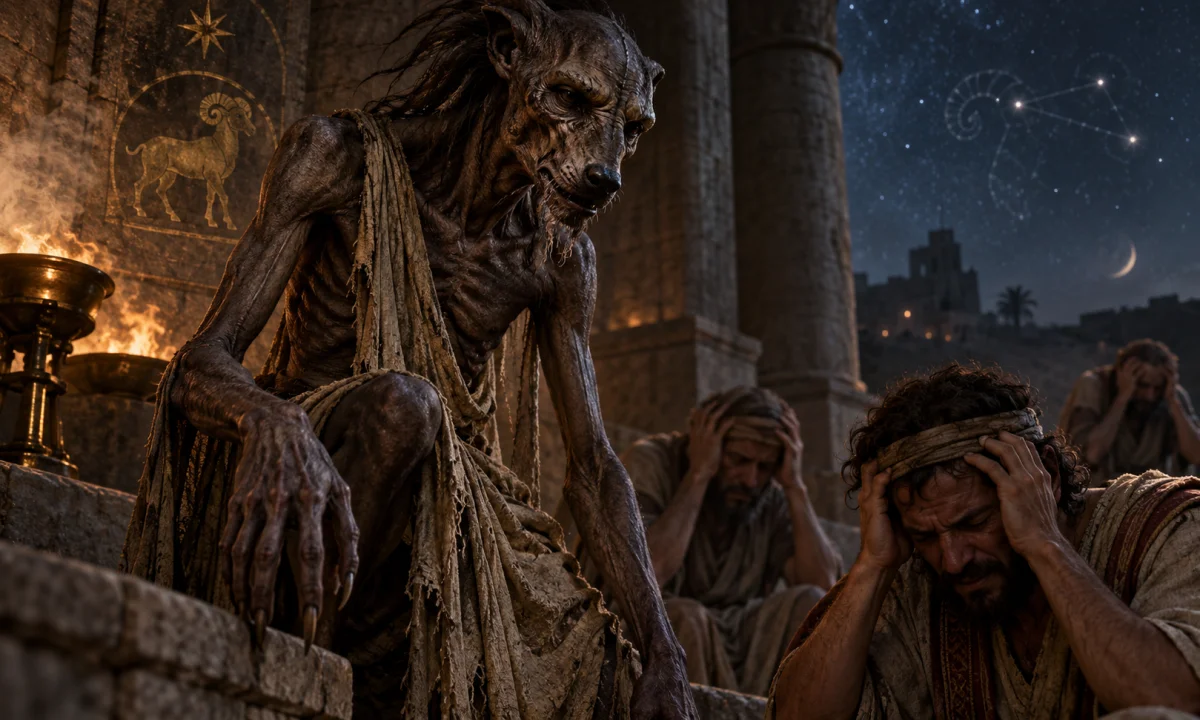
Ruax is a minor demon associated chiefly with the Testament of Solomon, a late antique pseudepigraphal work attributed to King Solomon. In the demonological catalogue connected with that text, Ruax is described as a spirit responsible for headaches or related pains of the head. The name and details vary considerably between manuscripts, editions and translations, so Ruax should not be treated as a universally fixed figure within demonology.
Origins and textual setting
The principal setting for Ruax is the Solomonic tradition. This body of literature presents King Solomon as a ruler granted exceptional wisdom and authority over spirits. According to the narrative framework, Solomon receives a ring or seal bearing the power of God, enabling him to compel demons, question them and assign them tasks connected with the construction of the Temple.
The Testament of Solomon is not part of the Hebrew Bible or the Christian canonical scriptures. It is a pseudepigraphal work, meaning that it was written under the name of a famous earlier figure rather than being a document demonstrably written by that figure. Its surviving form is generally understood as a composite text shaped over time. The work contains Jewish, Christian and wider late antique elements, including angelological traditions, magical practices, astrological ideas and popular beliefs about illness.
Ruax appears within material that links demons with specific physical afflictions. The work names numerous spirits and records the harm attributed to them, often in brief, catalogue-like statements. These passages do not provide a complete mythology for every named being. In Ruax’s case, the surviving tradition is especially limited: the demon is known primarily for an association with headaches rather than for a developed biography, genealogy or cycle of stories.
The text survives through manuscript transmission, and its wording is not entirely stable. Greek names were copied and later transliterated in different ways, while translators have sometimes chosen different English spellings. As a result, forms such as Ruax, Rauax and Rhyx may be encountered in discussions of the relevant demon catalogue. These forms should be checked against the particular edition or translation being used rather than automatically assumed to represent separate demons.
Name and identity
The identity of Ruax is therefore textual rather than broadly folkloric. There is no substantial independent tradition in which Ruax appears as a god, hero, ancestral spirit or major demon with a consistent personality. The name is preserved because of its place in a demonological list, not because a large body of stories about Ruax circulated across many cultures.
The exact meaning of the name is uncertain. It is unsafe to assign a definite Hebrew, Greek or Aramaic etymology without qualification. Some spellings may reflect the difficulties involved in representing an unfamiliar name across languages and writing systems. Similar-looking names in later occult books or online demon lists are not necessarily evidence of a separate ancient tradition, and apparent etymologies should not be treated as established facts.
Ruax is also not one of the seventy-two spirits of the Ars Goetia, the best-known section of the seventeenth-century Lesser Key of Solomon. The presence of a Solomonic name in one text does not mean that the figure belongs to every later system called “Solomonic.” The Testament of Solomon and the Ars Goetia are different works from different periods, with different catalogues, classifications and literary purposes.
Ruax and illness
Ruax’s principal attributed function is the infliction of headache. In accounts based on the relevant passage of the Testament of Solomon, the demon is named among spirits responsible for bodily suffering. This association reflects an older tendency to explain illness through personal agents, especially when a symptom was painful, recurring or difficult to understand.
The attribution does not necessarily mean that Ruax was imagined as a physician’s opposite, a tempter or a ruler of a particular underworld region. The text does not preserve a detailed system of medical demonology in which every spirit has a fully developed domain. Instead, the connection is functional: Ruax is the spirit blamed for a particular type of affliction.
Headache in the ancient world could be understood through several overlapping frameworks. Medical writers described bodily causes involving fluids, heat, injury, diet or other physical conditions, while religious traditions could interpret suffering as punishment, testing, pollution, fate or demonic attack. These explanations were not always mutually exclusive. A person might seek practical treatment and ritual protection at the same time.
The demonological attribution also gives a name to an otherwise invisible cause. Naming the spirit could make an unexplained experience more intelligible and could provide a target for prayer, adjuration or magical command. Within the Solomonic narrative, demons are not merely hostile forces; they are compelled to identify themselves and disclose the harm they cause. The catalogue therefore turns symptoms into classified supernatural effects.
Role within the Solomonic framework
The wider narrative of the Testament of Solomon portrays Solomon as exercising authority over demons through divine permission and a sacred seal. Spirits are summoned, interrogated and constrained. Some reveal their names and activities; others describe the heavenly beings or divine powers capable of opposing them. This structure places the demon beneath a higher religious order rather than presenting it as an independent rival to God.
Ruax belongs to the group of spirits whose importance lies in the affliction attributed to them. There is no reliable basis for giving Ruax a prominent relationship with Solomon, a distinct army, a consort or a particular infernal kingdom. Later summaries sometimes expand short catalogue entries into elaborate profiles, but those additions should be distinguished from the limited information preserved in the older textual tradition.
The text’s demonology is also not identical to the later Christian image of a strictly organized Hell ruled by Satan and populated by ranked princes. The spirits in the Testament of Solomon occupy a more varied world. They may be linked with diseases, disruptive passions, dangerous places, astrological divisions or other forms of harm. Their descriptions reflect the concerns of late antique religious literature rather than a single, standardized infernal hierarchy.
The decan and astrological context
Discussions of Ruax often mention the decan demons. A decan is a ten-degree division of the zodiac, producing thirty-six divisions across the celestial circle. The system has roots in ancient Egyptian calendrical and astronomical practice and was later incorporated into Hellenistic astrology. In late antique magical and astrological traditions, each decan could be associated with a figure, power or spiritual agency.
The relationship between the named spirits in the Testament of Solomon and the decans is not always presented consistently. Manuscripts and translations differ, and modern writers sometimes impose a more systematic structure than the text itself clearly supports. Ruax is consequently described in some accounts as one of the spirits connected with the decanal series, while other treatments focus only on the demon’s association with headache.
This uncertainty matters because the astrological setting does not automatically give Ruax a complete zodiacal personality. A connection with a decan, if accepted for a particular textual version, does not establish a fixed appearance, animal form, planetary allegiance or magical colour. Those details are often supplied by later occult systems rather than by the earliest material associated with Ruax.
Appearance and powers
No dependable ancient description establishes what Ruax looked like. The surviving tradition does not securely assign the demon horns, wings, claws, a human body, an animal form or a distinctive emblem. Illustrations that present Ruax with a particular appearance are artistic or modern occult interpretations, not evidence of a stable traditional image.
Likewise, the evidence supports only a narrow statement about Ruax’s power: the demon is associated with causing headaches or head pain. Claims that Ruax controls all neurological illnesses, possesses victims in a particular manner, governs a specific hour or commands other demons go beyond what can safely be inferred from the old textual material.
The same caution applies to rank. Ruax is not securely identified as a king, duke, prince, president or marquis in the manner of the hierarchical spirits listed in later ceremonial magic. Such titles belong especially to early modern and modern demonological catalogues, where spirits were organized according to systems influenced by monarchy, astrology and ritual magic. They should not be projected backward onto every demon named in a Solomonic text.
Symbolism and cultural significance
Ruax is significant less as a richly characterized personality than as an example of how premodern religious literature could personify disease. A headache is an inward and often invisible experience. By assigning it to a named spirit, the text transforms bodily pain into an encounter with an intelligible agent. This can be understood as part of a broader history in which illness was explained through combinations of physiology, environment, divine action and supernatural hostility.
The figure also illustrates the importance of classification in magical and religious texts. A demon’s name, sphere of activity and vulnerability to divine authority could be used to organize fear and uncertainty. The catalogue form suggests that supernatural dangers could be identified in much the same way that illnesses, stars or ritual impurities were classified.
At the same time, Ruax should not be used as simple evidence that all people in late antiquity rejected natural explanations of illness. The Testament of Solomon belongs to a literary and religious environment containing multiple approaches to the body. Its demonology reflects one strand of that environment, not a complete account of ancient medicine or popular belief.
Distinguishing Ruax from similar figures
Ruax is sometimes confused with other named spirits because demonological catalogues contain many unstable transliterations. A similar spelling does not by itself prove identity. The forms Ruax, Rauax and Rhyx may be connected through manuscript or translation history, but the precise relationship depends on the text under discussion.
Ruax should also be distinguished from demons associated with headaches in other magical, medical or religious traditions. Different cultures assigned bodily pain to different spirits, and a shared function does not establish a historical connection. Nor should Ruax be automatically equated with a demon of migraine, epilepsy, madness or possession unless a particular source makes that identification.
Finally, Ruax is separate from famous figures such as Asmodeus, Belial, Beelzebub and Lucifer. Those names have much broader and more complex histories across Jewish, Christian, Islamic, medieval and later literary traditions. Ruax does not occupy an equivalent position in religious history, and placing the demon within a universal infernal hierarchy obscures the narrow and uncertain nature of the evidence.
Later reception
Ruax has had limited visibility in modern popular culture. The demon occasionally appears in occult reference works, contemporary demonology websites, role-playing games and fictional bestiaries. These adaptations may provide Ruax with a visual design, a rank, magical correspondences or a more elaborate personality. Such features belong to modern creative or esoteric reception unless they can be traced to a specific earlier source.
Modern portrayals commonly expand a brief ancient description into a complete character. That process is normal in fiction, but it should not be confused with the historical tradition. The most defensible traditional description remains modest: Ruax is a variably spelled spirit in the Solomonic demonological material, associated principally with the causing of headaches, with no securely established appearance, biography or universal rank.