WORLD
WORLD
Roua
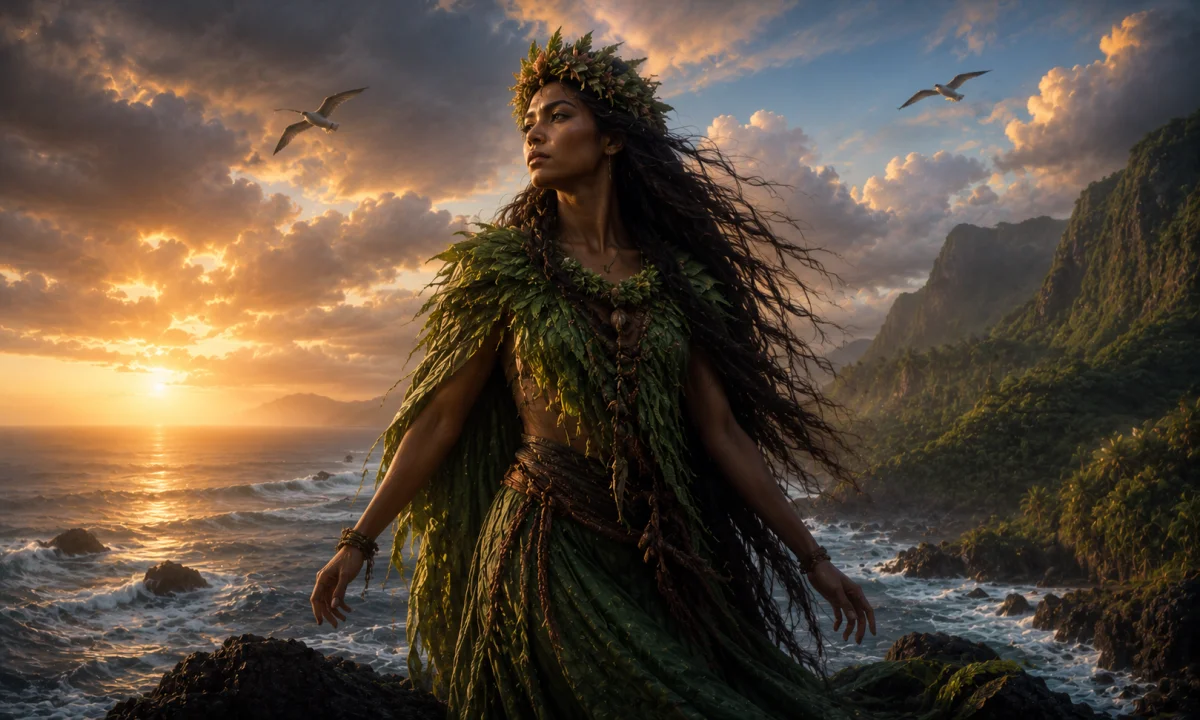
Roua is a name associated with Polynesian mythology, but its identity is uncertain and its traditional context is not securely established in the surviving record. Unlike widely documented Polynesian figures such as Māui, Tangaroa, Tāne, Rongo, or Kū, Roua does not have a consistently recorded mythology shared across the Polynesian world. The name may represent a local figure, a variant spelling, a transcription from an oral tradition, or a confusion with another Polynesian name.
Polynesian cultural setting
Polynesia is not a single culture with one uniform religious system. It includes many island societies scattered across the central and eastern Pacific, including Hawaiʻi, Aotearoa New Zealand, Tahiti and the Society Islands, the Cook Islands, Tonga, Samoa, Tuvalu, the Marquesas, Rapa Nui, and several smaller island groups. Each community developed its own languages, genealogies, sacred places, ritual practices, and accounts of the gods and ancestors.
Polynesian religious traditions commonly recognise powerful beings connected with creation, the sky, the sea, agriculture, warfare, fertility, death, navigation, and ancestry. Some names appear in several island groups, often because related languages preserve older forms inherited from a common ancestral culture. Even in such cases, however, the character and importance of a deity may differ greatly from one island society to another.
This cultural diversity is important when considering Roua. A name labelled “Polynesian” does not necessarily identify a pan-Polynesian god. It may instead belong to a single island tradition or to a modern classification that has detached the name from its original language and context.
The name Roua
The spelling Roua is not sufficiently stable to identify one figure with confidence. Polynesian languages have different systems for representing vowel length, glottal stops, consonants, and vowel combinations. Early European missionaries, travellers, and collectors also used inconsistent spelling conventions. A name written as Roua in one record might be written differently in another, but similar-looking forms cannot automatically be treated as identical.
Possible related spellings include forms such as Rua, Rū, or names containing Roa. These forms occur in several Polynesian languages, but they do not all refer to the same being. A word may also have an ordinary meaning in one language while functioning as a personal name, place name, title, or ancestral name in another.
The word rua, for example, has different meanings in different Polynesian languages. In some contexts it can refer to a pit, cavity, or second position; in others, a similar form may appear in personal names or mythological titles. The presence of a related sound is therefore not enough to establish that Roua was a god of the underworld, a creator, or any other particular category. Such identifications require a specific traditional record.
Identity and classification
There is no securely documented, widely accepted classification of Roua as a major Polynesian deity. Available descriptions of the name are too limited or inconsistent to establish a single set of attributes, family relationships, sacred animals, ritual functions, or geographical origin.
Roua should therefore not automatically be described as a creator god, sea god, sun god, trickster, ancestor, or demon. Those categories are frequently applied to Polynesian figures in general, but attaching one of them to Roua without a clear local tradition would create a misleading picture.
It is also uncertain whether Roua was traditionally understood as a god at all. Polynesian religious vocabularies distinguish among different kinds of sacred beings, although the categories do not map neatly onto modern European terms such as “god,” “spirit,” “ghost,” and “hero.” A named ancestor might possess supernatural power without being treated like a supreme deity. A local guardian might be associated with a particular reef, forest, house, or lineage rather than with a universal domain. A culture hero might be remembered in genealogical traditions as well as in sacred narratives.
Without knowing the language, island, storyteller, and original wording connected with Roua, the safest description is that Roua is an uncertain or poorly documented Polynesian mythological name, rather than a clearly defined member of a common pantheon.
Sources and the problem of preservation
Much of what is known about Polynesian mythology was preserved through oral transmission. Specialist priests, genealogists, navigators, elders, and ritual experts maintained different forms of knowledge, and not every sacred account was intended for public recitation. Stories could change according to the occasion, the status of the audience, or the relationship between a community and its ancestors.
Written records were generally produced after sustained European contact. Missionaries sometimes recorded traditional narratives while attempting to suppress practices they considered incompatible with Christianity. Travellers and colonial officials often wrote down stories through interpreters, using spelling systems that did not accurately represent local pronunciation. Later collectors could combine material from different islands or remove ritual details from their cultural setting.
These circumstances create several difficulties. A short entry in a modern list may preserve only a name without a story. A missionary spelling may obscure the original form. A local figure may be mistakenly presented as a universal Polynesian deity. Conversely, a real traditional name may be dismissed simply because it appears only once in the surviving written record.
Oral traditions also do not require every supernatural figure to have a long narrative cycle. Some beings are known primarily through chants, genealogies, prayers, place names, or ritual references. The absence of a lengthy story about Roua would not prove that the name was invented. It does mean that claims about Roua’s role should be made cautiously.
Attributes and symbolism
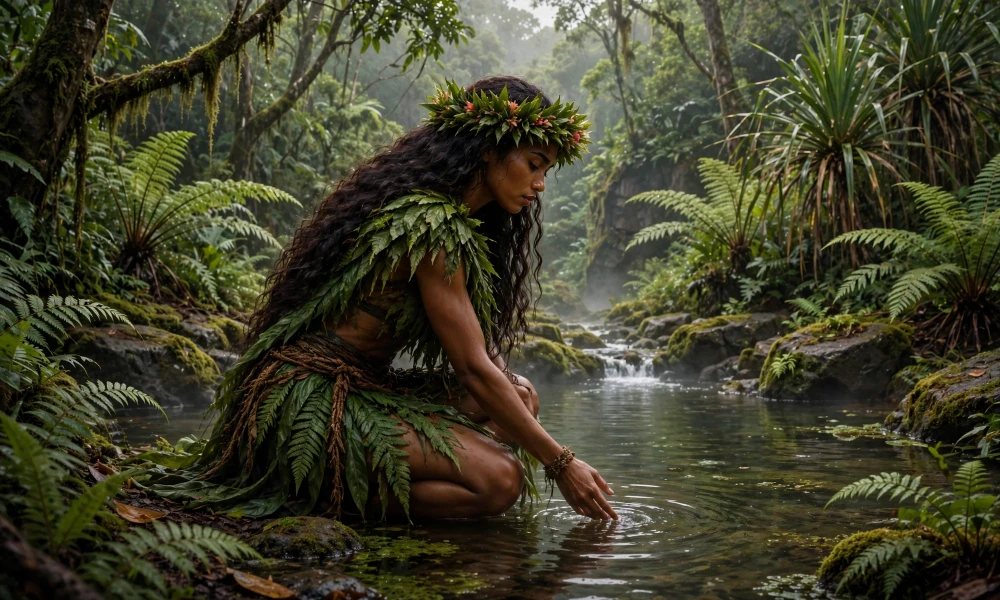
No dependable traditional description establishes Roua’s appearance, gender, powers, dwelling place, sacred objects, or symbolic animals. There is likewise no firm evidence that Roua was associated throughout Polynesia with the ocean, storms, fertility, death, warfare, or any other specific sphere.
It is tempting to assign familiar Polynesian symbolism to an uncertain figure. The sea, for instance, is central to many Polynesian cultures, and numerous deities and ancestors are connected with fishing, voyaging, reefs, tides, and marine life. Yet this general cultural importance does not demonstrate that Roua was a sea being. The same caution applies to creation motifs, which are widespread but take highly different forms from one island tradition to another.
If Roua belonged to a local tradition, the meaning of the name might have depended on a particular landscape. A sacred name could be tied to a cave, ridge, spring, reef, or settlement and might make sense only within the history of a particular community. Polynesian mythology often treats geography as part of sacred memory: places can preserve the actions of ancestors, the journeys of gods, and the boundaries between ordinary and restricted space.
Possible confusion with Rua and Rū
Roua should not be merged automatically with Rua or Rū. Similar spellings occur in several Polynesian traditions, but these names may designate separate figures or entirely different concepts.
In Māori tradition, Rūaumoko is associated with earthquakes and volcanic activity, while Rua appears in other names and mythological contexts. The Māori god commonly written Tū, also known in the longer form Tūmatauenga, is a major figure associated with war and human activity. Neither figure should be renamed Roua simply because a transcription appears similar.
In other Polynesian societies, forms resembling Rua can belong to stories about ancestors, underworlds, genealogical divisions, or sacred places. The same written form may also reflect a recorder’s attempt to represent a sound that the original language distinguishes differently. Similarity of spelling is a reason to investigate a possible relationship, not proof of one.
Roua should also be distinguished from Rongo, Rongo-mā-Tāne, and related names. Rongo is an important deity in several Polynesian traditions, often connected with cultivated food, peace, or ritual authority, although his functions vary by island. The names are not equivalent, and there is no sound basis for treating Roua as an alternative spelling of Rongo.
Interpretation and cultural significance
The uncertainty surrounding Roua illustrates a wider issue in the study of mythology. Modern encyclopaedias and mythology websites often arrange traditions into neat lists of gods and powers. Polynesian religious life was less uniform than such lists suggest. Names belonged to languages, communities, genealogies, and ritual systems, not merely to a universal catalogue of supernatural characters.
A responsible interpretation must keep several possibilities open. Roua may be a local divine or ancestral figure whose tradition has been poorly recorded. It may be a variant transcription of a better-known name, although the specific identification remains unproven. It may have been taken from a secondary compilation that did not preserve its original setting. It may also be a modern spelling created through the merging of forms that were separate in the source traditions.
For cultural and historical reasons, uncertainty should not be concealed. Treating an unidentified name as a fully developed god can erase the differences between Polynesian societies and give readers false confidence about traditions that survive only fragmentarily. At the same time, caution should not be mistaken for dismissal. A limited record may reflect the history of documentation rather than the insignificance of the figure within its original community.
Roua in modern reference material
Roua appears to have a much less established presence in modern reference material than the principal gods of Polynesian mythology. When the name is presented without an island, language, narrative, or historical context, its classification remains weak. Modern summaries may give the impression that every name in a list belongs to a clearly defined and widely recognised deity, even when the evidence is uncertain.
There is no well-established body of popular films, novels, games, or other major media adaptations centred on a traditional figure called Roua. If the name appears in contemporary fantasy or online mythology, those uses should be treated as modern creations or reinterpretations unless they can be connected to a documented local tradition. A fictional character bearing the name does not establish an ancient identity, mythology, or set of powers.
Roua is therefore best approached as an uncertain Polynesian mythological name whose precise origin and identity require further source-specific evidence. Any fuller account would need to identify the island or language involved, preserve the original spelling where possible, and distinguish traditional testimony from later transcription and modern invention.