WORLD
WORLD
Pulotu
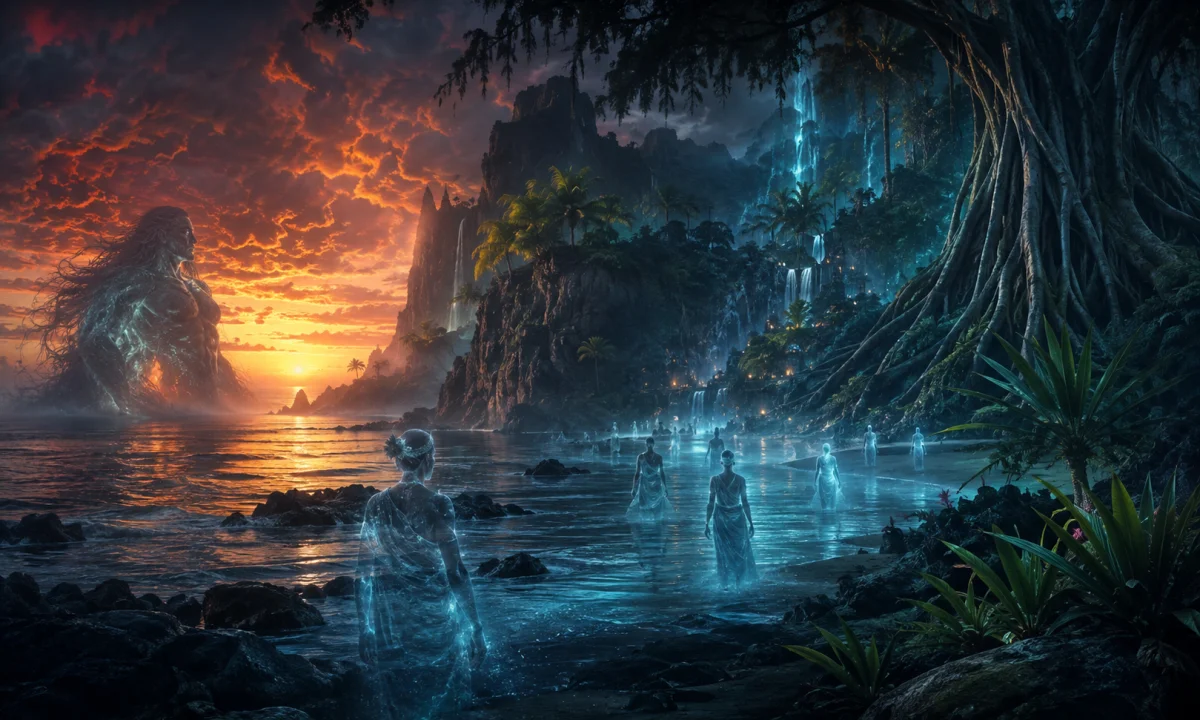
Pulotu is a name used in several Polynesian traditions for a supernatural realm associated with the dead, ancestral spirits and powerful deities. It is especially prominent in Tongan and Samoan religious traditions, although its meaning, location and ruler vary between islands and sources. Pulotu is often described as an underworld, but “underworld” can be misleading if it suggests only a place of punishment. In many accounts, it is also a homeland of gods, a destination of the dead and a realm connected with the origins of chiefly or sacred lineages.
Name and cultural setting
The spelling Pulotu reflects forms used in Polynesian languages, while older European records may use slightly different spellings. The word is not the name of one universally defined god or monster. It is primarily the name of a place or supernatural domain, though beings associated with that domain may sometimes be referred to through the same body of traditions.
Pulotu belongs to the wider religious world of western Polynesia, particularly Tonga and Samoa. These societies preserved complex traditions through genealogies, ritual knowledge, oral narratives, place names and specialist custodians of history and religion. Early European observers recorded some of these traditions, but their accounts were shaped by missionary assumptions, translation choices and the limited circumstances in which information was collected. As a result, no single written description can be treated as a complete or universally authoritative account of Pulotu.
Polynesian traditions do not form one uniform mythology. Related ideas may have developed from ancient shared concepts, but each island society gave them its own names, genealogies and religious significance. Pulotu in Tonga should therefore not automatically be treated as identical to Pulotu in Samoa or to every other Polynesian conception of the land of the dead.
Pulotu in Tongan tradition
In Tongan tradition, Pulotu is commonly presented as a supernatural homeland associated with the gods and the spirits of the dead. It may be imagined as lying beyond the ordinary human world, often in a direction connected with the setting sun or the western sea. Such directional associations are common in ideas about the realm of the dead, but they do not necessarily mean that Pulotu was understood as a geographical island that a living person could locate on a map.
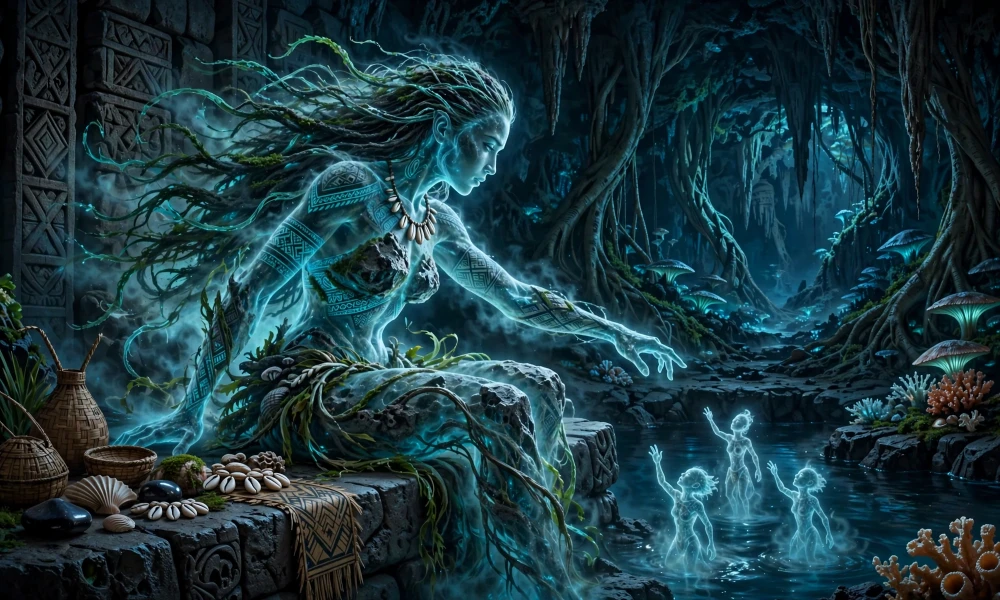
Pulotu is frequently linked with Hikuleʻo, a major Tongan deity associated with death, the underworld and immense supernatural power. Hikuleʻo is generally described in Tongan tradition as female, although older records and modern summaries do not always represent her consistently. Her name may appear with variations in spelling, including Hikuleo or Hikuleʻō, depending on the system used to represent Tongan sounds.
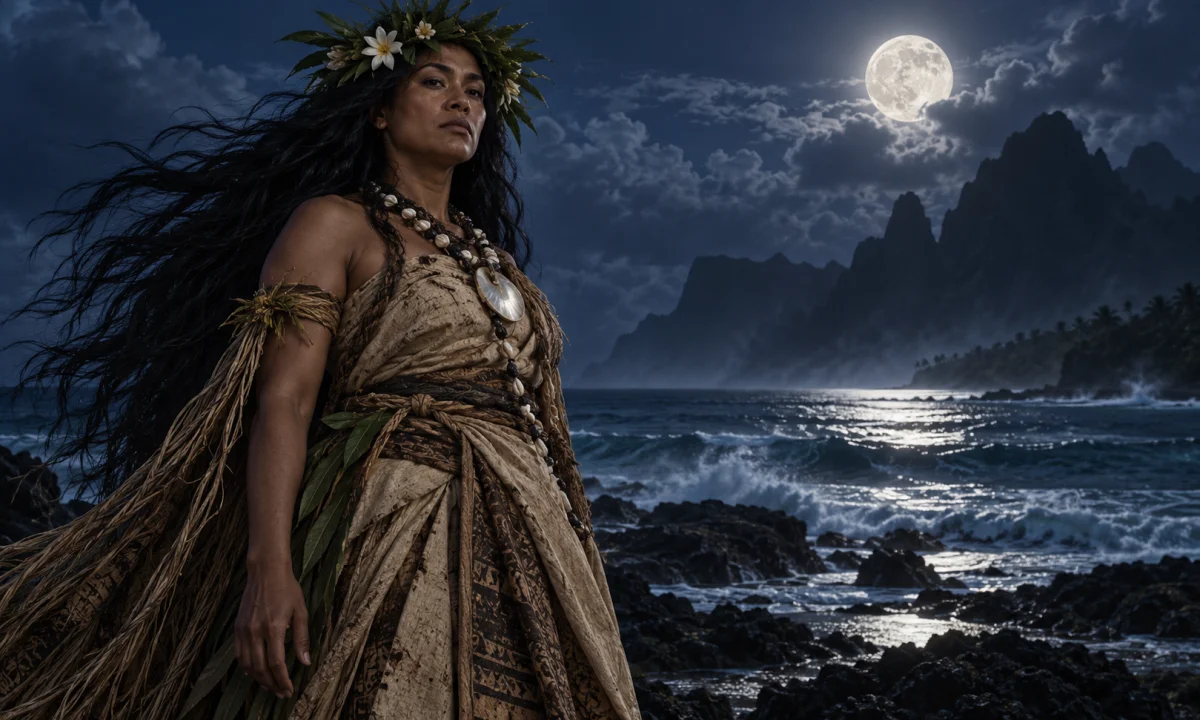
Hikuleʻo is often regarded as the ruler, guardian or principal power of Pulotu. The exact description depends on the tradition being followed. In some accounts, she presides over the realm of the dead; in others, she appears as a dangerous and autonomous divine force whose authority extends beyond death. She should not be reduced to a simple equivalent of a devil or a goddess of punishment. Tongan religious concepts of death and sacred power do not correspond neatly to the moral categories of later European Christian interpretation.
Tongan genealogical traditions connect the major gods in different ways, and the relationships among Hikuleʻo, Tangaloa, Maui and other divine figures vary in recorded versions. These variations reflect the fact that mythology was transmitted through distinct lines of tradition rather than through one fixed canonical scripture. Statements about Hikuleʻo’s exact parentage or position in a divine family should therefore be treated with care.
Pulotu in Samoan tradition
Samoan accounts also use Pulotu as the name of a realm associated with the dead and with supernatural beings. In Samoan tradition, the ruler most commonly connected with Pulotu is Saveasiʻuleo, whose name may be written with different punctuation or spelling in older English-language records. Saveasiʻuleo is a powerful figure in Samoan mythology and is often linked with the world beneath or beyond the human one.
Some Samoan genealogical narratives connect Saveasiʻuleo with Nafanua, the prophetic and war-associated figure who became one of Samoa’s best-known sacred personalities. The precise relationship and the surrounding genealogy vary between accounts. Nafanua’s importance is not limited to Pulotu: she is also remembered in connection with prophecy, political change and the establishment or recognition of chiefly authority.
Samoan Pulotu is sometimes described as a place beneath the sea or beneath the visible world, but its location is not consistent across all accounts. Descriptions of an underground realm, a distant island or a region beyond the horizon may represent different ways of expressing separation from ordinary human life rather than a single agreed cosmological map.
The Samoan and Tongan uses of the name are related in a broad Polynesian context, but Saveasiʻuleo should not be merged with Hikuleʻo. They belong to different local traditions and have different names, genealogies and narrative roles. Similarity between the names of Pulotu and its associated beings can create confusion, especially in older English-language writing where Polynesian sounds were represented inconsistently.
The realm of the dead
Pulotu is commonly understood as a destination for the dead, but Polynesian ideas about death rarely treat the afterlife as a simple final location detached from society. Ancestors could remain religiously significant after death, and the boundary between the living and the dead could be approached through genealogy, ritual, dreams, sacred places and acts of remembrance.
In this context, Pulotu could be both remote and closely connected to human life. It represented a place where the dead continued to exist, where ancestral powers were located and where divine beings exercised authority. The dead were not necessarily imagined as passive or erased. Their connection with descendants could help explain the continuing importance of family origins, chiefly succession and ritual obligations.
The realm’s association with the west is also significant. The sun’s disappearance beyond the horizon naturally provided a powerful image for death and departure. In some Polynesian cosmologies, the west was connected with the journey of the dead, while the east could be associated with birth, emergence or the arrival of light. These symbolic directions were not uniform throughout Polynesia, and they should not be assumed to have exactly the same meaning in every island society.
Pulotu could also be associated with abundance and supernatural resources. A realm belonging to the gods was not necessarily barren or terrifying. Traditions about the afterlife often reflect the values of the living society: fertile lands, secure food supplies, social continuity and the presence of revered ancestors. At the same time, access to Pulotu was not simply available to everyone as a place for ordinary travel. Its distance and sacred power marked it as fundamentally different from the human world.
Stories and divine relationships
Stories associated with Pulotu often appear within larger narratives about the origin of the gods, the settlement of the islands, the movement of culture heroes and the authority of chiefs. Rather than forming one continuous “myth of Pulotu,” they provide glimpses of the realm through genealogies and episodes involving divine beings.
In Tongan traditions, divine figures such as Tangaloa and Maui belong to a wider network of stories about the formation of the world and the ordering of human society. Some traditions describe interactions between gods of the sky, sea and underworld, but the details differ between versions. Maui, for example, is not simply a ruler of Pulotu, nor should every Polynesian story about a Maui figure be treated as part of Tongan Pulotu mythology. “Maui” is a name shared by culture heroes across Polynesia, but their individual stories are locally specific.
In Samoa, stories connected with Saveasiʻuleo and Pulotu intersect with genealogical and prophetic traditions. These narratives may explain relationships among divine beings or establish the sacred background of human leaders. Their purpose was not necessarily to provide an abstract description of the afterlife. Myth, genealogy and political memory could operate together, making a story about the supernatural world also a statement about social identity and authority.
Oral traditions often allow different versions to coexist. A genealogy might be emphasized in one chiefly line, while another community preserved a different relationship among the same figures. Changes in translation, conversion to Christianity and the selection of material by early ethnographers also affected the form in which Pulotu traditions reached later readers.
Religious meaning and interpretation
Pulotu is best understood as part of a religious system in which sacred power, ancestry and social order were closely connected. The realm of the dead was not merely a location after life; it helped define the relationship between human communities and the divine powers believed to shape fertility, danger, illness, kingship and the natural world.
The authority of figures connected with Pulotu could have an ambivalent character. They might be feared because they governed death and could bring destruction, yet they were also respected as ancient powers and sources of legitimacy. Such ambivalence is common in religious traditions: a deity associated with death may also protect boundaries, preserve order or maintain the continuity between generations.
European missionaries sometimes interpreted Polynesian divine beings through categories such as “devil,” “hell” or “false god.” Those labels may appear in historical records, but they describe the encounter from a Christian perspective rather than offering neutral translations of Polynesian concepts. Pulotu was not simply the Polynesian equivalent of Christian Hell. Its traditional meanings included ancestry, divine residence and the continuation of existence after death, not only punishment for sin.
Modern scholars and cultural historians also compare Pulotu with other Polynesian concepts of the afterlife. These comparisons can reveal possible ancient connections across the region, but they cannot prove that all traditions once formed a single identical belief system. Similar ideas may arise from shared ancestry, long-distance voyaging, common environmental experiences or independent developments.
Distinguishing Pulotu from related traditions
Pulotu should be distinguished from other Polynesian names for the afterlife or the realm of darkness. Māori traditions, for example, contain several concepts associated with the abode of the dead, including Rarohenga, while Hawaiian traditions speak of Pō in connection with darkness, night and the ancestral or divine realm. These concepts belong to their own cultural and linguistic settings.
The Fijian name Burotu is sometimes compared with Pulotu because of its similar sound and its association with a land of the dead or supernatural beings. Fiji lies in a region of intense cultural contact between Melanesia and Polynesia, and the relationship between Burotu and Polynesian forms has been discussed in comparative studies. Similarity of names alone, however, does not justify treating Burotu and Pulotu as exactly the same tradition.
Pulotu is also not a personification of death in the same sense as a single death god. In Tongan tradition, Hikuleʻo is the principal divine figure associated with Pulotu, while in Samoan tradition Saveasiʻuleo is commonly connected with the realm. The place and the deity must be kept distinct even when a narrative presents them as inseparable.
Sources and transmission
Knowledge of Pulotu comes from a combination of oral traditions, genealogies, ritual and historical records produced after European contact. There is no single ancient Polynesian scripture that defines Pulotu for all communities. Much of the surviving evidence was recorded in the nineteenth and twentieth centuries, often after major religious and political changes had taken place.
Missionary accounts, colonial reports and early ethnographic works can preserve valuable names and narratives, but they must be read critically. Authors may have simplified complex traditions, combined information from different speakers or translated sacred concepts into Christian vocabulary. Later retellings may then repeat those interpretations as though they were original Polynesian categories.
Contemporary Tongan and Samoan perspectives remain important because Pulotu is part of living cultural history, not only an entry in a catalogue of mythology. Cultural memory, language revival and renewed interest in ancestral traditions may preserve meanings that are absent from older English-language records. At the same time, modern retellings are not automatically identical to pre-Christian practice, and each version should be identified according to its context.
Modern reception
Pulotu appears occasionally in modern discussions of Polynesian mythology, comparative religion and Pacific literature. It may be presented as a general Polynesian underworld or used as a dramatic setting in fiction, games and other popular media. Such uses can draw attention to the name, but they often simplify regional differences or combine Tongan, Samoan and other traditions into a single fantasy cosmology.
In traditional context, Pulotu is more than a convenient name for an underworld. It is a sacred realm whose meaning depends on local language, genealogy and ideas about the dead. Understanding it requires keeping separate the Tongan association with Hikuleʻo, the Samoan association with Saveasiʻuleo and the wider Polynesian comparisons that may illuminate their history without making them identical.