WORLD
WORLD
Po
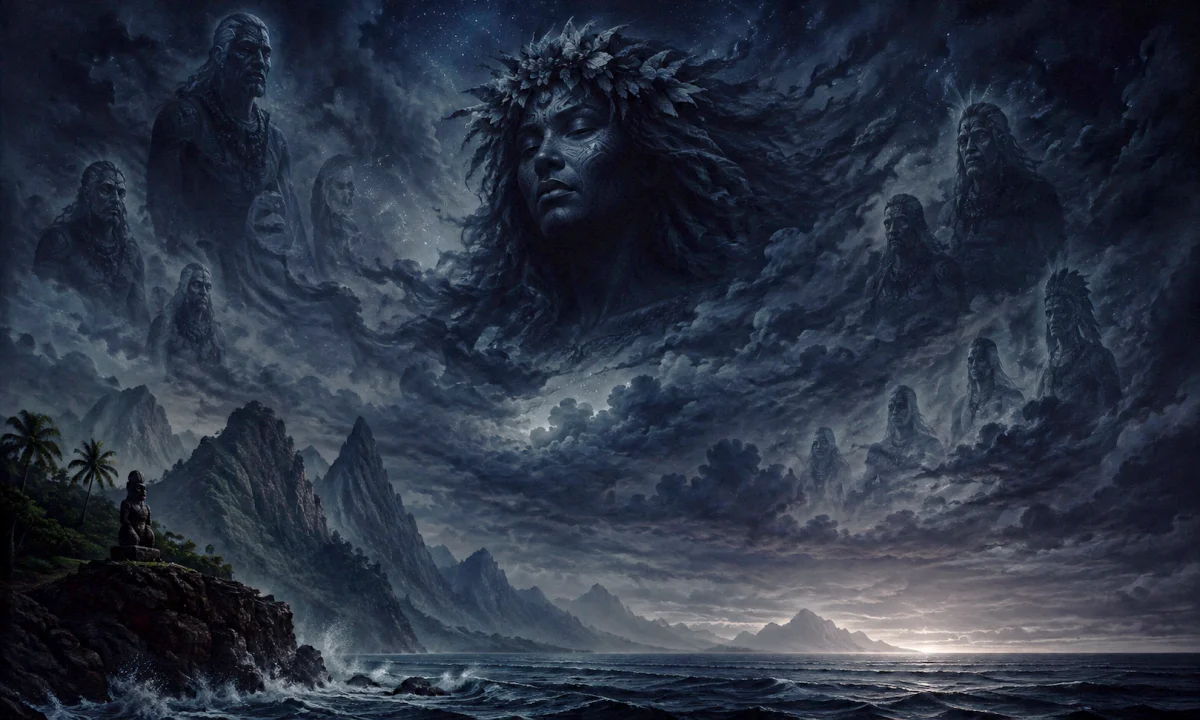
Po is a Polynesian concept associated with darkness, night, the unseen world and the earliest stages of creation. It is especially important in Māori and Hawaiian traditions, although the meaning and religious significance of the word vary across Polynesia. In many accounts, Po is not a single goddess or demon with one fixed biography. Rather, pō or te pō describes a primordial condition from which the ordered world, living beings and light gradually emerge.
Meaning and cultural setting
The word pō is found in several Polynesian languages, where it commonly means “night” or “darkness.” Related forms occur across the wider Polynesian language family. Darkness, however, does not necessarily have the negative meaning it often carries in later European fantasy. In Polynesian creation traditions, darkness can represent an original state of potential, gestation and sacred mystery.
Traditional Polynesian religions did not possess one universal mythology shared in exactly the same form by every island society. Māori, Hawaiian, Tahitian, Samoan, Tongan, Marquesan and other traditions developed distinctive genealogies, chants and accounts of creation. Their use of related words reflects ancient linguistic connections, but it does not prove that every community worshipped an identical being named Po.
The best-known discussions of Po come from Māori whakapapa, or genealogical traditions, and from Hawaiian cosmogonic chants, particularly the Kumulipo. These traditions were transmitted orally and recorded in written form mainly after sustained European contact. Written records preserve valuable knowledge, but they may reflect the choices of individual informants, translators and recorders. Different versions can therefore place Po differently within the sequence of creation.
Po in Māori traditions
In Māori cosmological thought, Te Pō is commonly associated with the long darkness before the emergence of the visible world. It is often discussed alongside Te Kore, the state of potential, nothingness or formlessness, and Te Ao, the world of light and life. These terms should not always be treated as rigid stages in a single standardized system. Their order and interpretation vary among traditions and scholarly explanations.
One influential pattern describes a movement from Te Kore, through Te Pō, and into Te Ao. In this reading, the darkness is a generative interval rather than an empty absence. It is the period in which the conditions for existence develop. The transition toward light expresses the appearance of differentiation, knowledge, life and the humanly perceptible world.
Other Māori accounts present the primal ancestors Ranginui, the sky father, and Papatūānuku, the earth mother, as emerging within or after primordial darkness. Their children are born in the confined darkness between their closely embracing bodies. The better-known episode in which Tāne and his brothers separate Rangi and Papa brings light into that space. This story is not simply a battle between light and evil darkness. It is a genealogical account of separation, growth and the establishment of the world in which gods, nature and human beings can exist.
In Māori thought, the word pō also retains its ordinary meaning of night. The everyday night and the primordial darkness are related through language and symbolism, but they should not automatically be treated as two forms of a single anthropomorphic deity. Some genealogical chants personify cosmic states and name successive phases of darkness, while other accounts use the terms more conceptually.
Po in Hawaiian cosmology
Hawaiian tradition provides another major context for Po. The Kumulipo, a genealogical creation chant, begins in a period of primordial darkness called pō. The chant traces the emergence of life through successive generations, beginning with the earliest cosmic conditions and continuing through forms of marine life, plants, animals, gods and humanity.
In the Kumulipo, Po is not merely the absence of daylight. It is the deep generative realm in which existence unfolds. The movement from darkness toward an inhabited and illuminated world is expressed through genealogy: one form of life gives rise to another, and the cosmos becomes increasingly differentiated. This approach reflects the close relationship between Hawaiian religion, ancestry, natural history and chiefly genealogy.
The Kumulipo is sometimes described in popular writing as a creation myth with Po cast as a goddess. That description can be misleading. The chant’s language is highly poetic and genealogical, and pō functions primarily as a primordial condition or realm. Some translations and interpretations use personifying language, but this does not establish a universally recognized Hawaiian goddess named Po with a fixed appearance, personality or set of myths.
Hawaiian religious language also uses pō in contexts connected with night, sacred mystery and the unseen. The precise meaning depends on the passage and the tradition in which it occurs. It is safer to understand Hawaiian Po as a broad cosmological and religious concept than to assign it the role of a single ruler of darkness based on European categories.
Identity and classification
Po is therefore best classified as a cosmological principle, primordial realm or personified state, depending on the tradition and the particular text. It is not accurately described as one pan-Polynesian deity in the same sense as a god whose name, family and stories are consistent throughout the Pacific.
Descriptions of Po as a “goddess of darkness” are usually modern summaries. They may be useful when they signal the feminine or generative imagery sometimes applied to primordial darkness, but they can also impose a misleading framework. Polynesian genealogies frequently personify natural forces, places and stages of existence without turning each one into an individualized deity with a human-like form.
Nor is Po simply equivalent to the Christian concept of hell or to the underworld figures of Greek, Norse or Mesopotamian mythology. In Māori and Hawaiian creation traditions, Po occurs at the beginning of cosmic development. Darkness is the womb or environment of emergence, not necessarily a place of punishment. Associations with death or the spirit world may exist in particular cultural contexts, but they should not replace Po’s primary cosmological meaning.
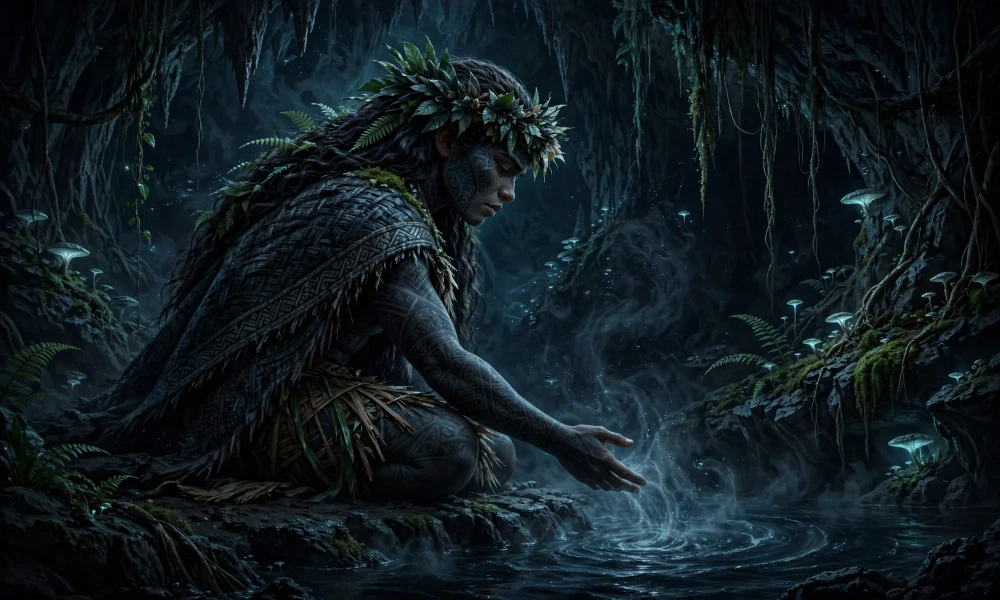
Attributes and symbolism
Because Po is generally not represented as a stable anthropomorphic character, traditional descriptions focus on qualities rather than physical appearance. Common associations include:
- Primordial darkness: the condition preceding the appearance of ordinary daylight and the ordered world.
- Gestation and potential: a concealed period in which life and structure develop before becoming visible.
- Night: the recurring darkness that contrasts with day and establishes the rhythm of time.
- Mystery and the unseen: the region beyond ordinary human perception and knowledge.
- Ancestral depth: the remote beginning of genealogies linking gods, nature and people.
- Transformation: the passage from darkness into light, differentiation and conscious existence.
These meanings are not mutually exclusive. A Polynesian cosmological chant may move between the literal night sky, the invisible realm, ancestral history and the beginning of life without separating them into the categories used by modern Western scholarship.
The contrast between Po and light also carries intellectual and spiritual meaning. The arrival of light may represent visibility, knowledge and the inhabitable world, while darkness represents what remains concealed or not yet formed. Yet darkness is not necessarily inferior. It is the necessary condition from which the visible world emerges.
Creation, genealogy and the emergence of light
Stories associated with Po often describe creation as a process rather than a single event. Instead of a creator making a finished universe at one moment, the cosmos unfolds through generations and transformations. Darkness gives way gradually to the conditions required for earth, sky, plants, animals, gods and humans.
This process is especially clear in the Hawaiian Kumulipo, where cosmic origins are connected with a sequence of living forms. The chant does not present nature as separate from the sacred. Marine organisms, plants, animals, gods and people belong to one extended order of ancestry. Po is the beginning of that unfolding genealogy.
Māori traditions likewise connect creation with whakapapa. The genealogical relationship between Ranginui, Papatūānuku, their children and the natural world expresses more than a family tree. It provides a framework for understanding obligations between people, ancestors, land, sky, waters and other living beings. Within this framework, the darkness before light is part of the ancestry of the world rather than an alien force opposed to it.
The separation of sky and earth is one of the most important transformations in Māori cosmology. While the children of Rangi and Papa remain in darkness, they deliberate over how to create space and light. Tāne eventually forces the parents apart, allowing the world to expand. The resulting light does not erase the significance of the earlier darkness; it creates a new condition in which relationships and life can develop.
Variations across Polynesia
Related concepts appear elsewhere in Polynesia, but their presence should not be mistaken for evidence of one identical Po myth. In many Polynesian languages, the ordinary word for night is cognate with pō. Religious traditions may use darkness in creation accounts, chants, rites or descriptions of the invisible world, while giving it different names and relationships.
Some island traditions emphasize a primordial darkness from which gods or ancestors arise. Others focus more strongly on a creator deity, a primal pair, an oceanic beginning or a succession of divine generations. Even within one island group, oral traditions may differ according to locality, family, ritual specialist or historical period.
For this reason, claims that Po is universally the “mother of all gods,” the wife of a particular deity or the ruler of a Polynesian underworld should be treated cautiously unless they are tied to a clearly identified tradition. Such details are not consistent across Polynesia and may result from combining separate myths.
Relationship to other figures
Po is sometimes confused with primordial ancestors, night deities or underworld beings from individual Polynesian traditions. In Māori mythology, it should not automatically be identified with Ranginui, Papatūānuku, Tāne or any one of their children. Those figures have more distinct genealogical identities and narratives.
In Hawaiian tradition, Po should not be treated as interchangeable with major gods such as Kāne, Kū or Lono. These deities occupy different positions in Hawaiian religious traditions, and the Kumulipo places the development of the cosmos within a broader genealogical sequence rather than reducing it to the actions of one darkness goddess.
Po is also distinct from every named spirit or deity associated with death in Polynesian cultures. The word may appear in contexts involving night or the unseen, but a primordial darkness in a creation chant is not automatically an afterlife or a place inhabited by the dead.
Cultural significance
Po’s importance lies in the way it expresses a Polynesian understanding of origins. It links darkness with birth, ancestry and the gradual emergence of order. The visible world is not isolated from what came before it; it is connected to invisible beginnings through genealogy and continuing relationships.
This perspective has implications for the treatment of land and the natural environment. In traditions where mountains, rivers, plants, animals and people descend from related ancestral lines, nature is not merely a collection of resources. It participates in a sacred network of kinship. Po stands at the remote depth of that network, before the distinctions between different forms of life became fully apparent.
Po also illustrates why translations of Polynesian religious concepts require care. Words such as “darkness,” “void,” “night,” “spirit world” and “nothingness” can suggest Western philosophical or religious ideas that do not precisely match the original context. Te Pō and Hawaiian pō may be rendered with these English terms, but their meaning depends on genealogy, language, ritual knowledge and the surrounding passage.
Later interpretations and modern usage
Contemporary writers, artists and media creators sometimes present Po as a named female deity, a powerful mother of gods or a supernatural queen of night. These portrayals can draw inspiration from the personifying language of Polynesian creation traditions, but they are modern interpretations unless they closely identify a particular traditional source.
Modern use of pō and Te Pō can also serve cultural, artistic and educational purposes, especially in works exploring ancestry, darkness, dreaming, birth and the origins of the cosmos. Such uses should not be confused with a single ancient character whose appearance and powers were described uniformly throughout Oceania.
The most accurate understanding of Po preserves its range of meanings: primordial darkness, night, concealed potential, ancestral beginning and the sacred threshold before the world becomes visible. Its significance belongs to particular Polynesian traditions, especially Māori and Hawaiian cosmology, rather than to a single standardized mythology covering every island society.