WORLD
WORLD
Pamuri Mahse
Pamuri Mahse is a name associated with the ancestral beings and origin traditions of Indigenous peoples in the north-western Amazon, especially communities of the Vaupés River region in present-day Colombia and Brazil. The name is commonly connected with the Tukanoan cultural world, although its spelling, pronunciation, meaning and precise reference vary between languages and communities. In accounts where Pamuri Mahse appears, the figure belongs to a sacred history of ancestral emergence, migration and cultural transformation rather than to a single, universally fixed character comparable to a god in a classical pantheon.
Cultural setting
The Vaupés region is a multilingual area of rivers, forest and rapids. Indigenous peoples living there include Tukano, Desana, Barasana, Makuna, Tatuyo, Tuyuka, Cubeo and other communities, each with its own language, ritual knowledge and historical traditions. These peoples have long maintained complex systems of exchange, marriage, ceremonial cooperation and linguistic identity. A story told in one community may resemble a story known elsewhere while assigning different names, roles or emphases to its ancestral beings.
Traditional knowledge in this region is often transmitted through several forms at once. Narratives explain the movement of ancestral beings and the establishment of human communities; songs and ritual speeches preserve sacred names; ceremonial objects embody relationships with the ancestors; and particular places in the landscape mark episodes in primordial history. The distinction between “myth,” “history” and “religion” is therefore not always equivalent to modern Western categories. A Pamuri Mahse tradition may be understood as a sacred account of how people became properly human, how their groups received their identities and how ritual obligations were established.
Much of the written information about Vaupés traditions comes from ethnographic work, missionary records and later publications based on Indigenous narrators. Such records are valuable but incomplete. They may preserve a version from one language community, translate names inconsistently or describe ritual knowledge outside the ceremonial context in which it has meaning. Pamuri Mahse should consequently not be treated as a figure with one definitive biography.
The name and its interpretation
The form Pamuri Mahse is also found in variant spellings such as Pamuri Mahsé, Pamuri Mahsë or forms adapted to the orthography of a particular Indigenous language. The final element is sometimes written with a diaeresis or an accent to represent a sound not present in Spanish or English. These differences do not necessarily indicate different beings.
The name is often translated approximately with expressions such as “people of transformation,” “transforming people” or “ancestral people of transformation.” These translations should be treated cautiously. Indigenous words can carry grammatical and ritual meanings that are not captured by a short English gloss, and a term translated as “people” may refer to an ancestral collectivity rather than to ordinary human beings. In some discussions, Pamuri Mahse is presented as a collective designation; in others, it is treated as the name of a principal ancestral figure or culture hero. The variation reflects differences in source, language and interpretation.
“Transformation” in this context does not necessarily mean a magical change in the modern fantasy sense. It can refer to the passage from an ancestral or undifferentiated condition into organized human society. It may also describe the way beings, places and ritual powers acquire their present forms. The idea is closely related to emergence: the ancestors travel, undergo stages of development and establish the order in which later generations will live.
The ancestral journey
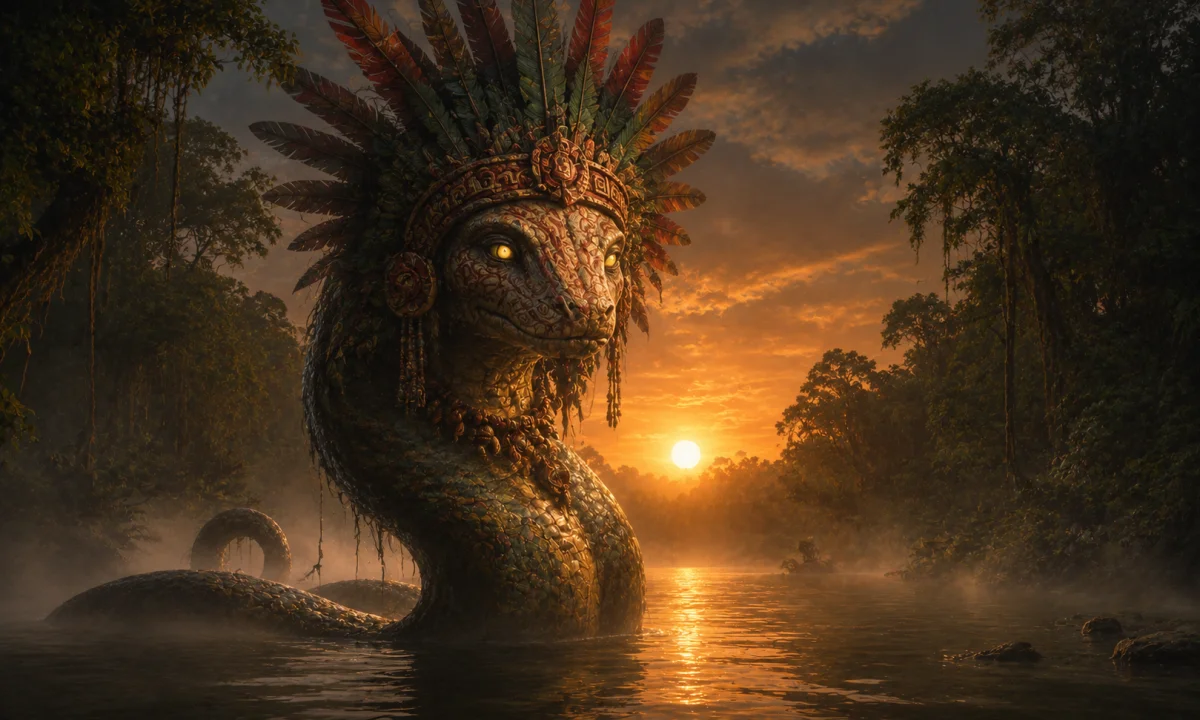
A central pattern in Vaupés origin traditions is the journey of ancestral beings along the great rivers. They are frequently associated with a sacred canoe, often described through the image of a serpent canoe or anaconda. The canoe is not merely a vehicle. It represents an origin of collective life, a passage through primordial waters and a connection between the ancestral beings and the rivers that still structure the region.
In versions connected with Pamuri Mahse, the ancestral people travel through the waterways before reaching the places where human groups are to emerge or settle. Rapids, rocks, islands and river mouths can function as points in this sacred geography. The route is not simply a journey from one physical location to another. It is a sequence of transformations through which the ancestors receive their distinctions, knowledge and responsibilities.
The exact details differ between traditions. Some accounts place the ancestors’ beginnings far to the east, followed by movement upriver toward the Vaupés. Others concentrate on a particular stretch of river or on the emergence of named groups at important rapids. A narrative may identify a leader, an elder or a transforming being, while another may give greater importance to the canoe itself, to its human and animal associations or to the places where the ancestors came ashore.
These stories can explain why a community belongs to a particular social order and why certain groups possess particular ritual knowledge. They may also establish the precedence of one ancestral group over another. In this sense, origin narratives are not only accounts of the remote past. They can express relationships involving marriage rules, ceremonial cooperation, territorial knowledge and the proper use of sacred objects.
Pamuri Mahse as ancestor and transformer
Where Pamuri Mahse is treated as an individual figure, the being resembles an ancestral culture hero more closely than a creator god. The emphasis is generally on bringing people into an ordered world, guiding a primordial migration and making social and ritual life possible. The figure’s importance lies in what is transmitted or established rather than in a catalogue of personal adventures.
The transforming ancestor may be associated with the differentiation of human groups. In many Vaupés traditions, communities understand themselves as descended from ancestral peoples who emerged in a particular order. That order can have ritual and social consequences. A group’s place in the sequence may be connected with its ceremonial role, its relationship to other groups or the knowledge it is expected to safeguard.
Pamuri Mahse may also be discussed alongside the origins of ritual instruments, songs, dances, medicines and forms of social conduct. It would be misleading, however, to assign every Vaupés origin motif to Pamuri Mahse. Similar themes appear in several related traditions, but the names and ownership of particular narratives can be specific to a community. Ritual knowledge is often restricted, and published descriptions may represent only an outline of teachings that remain the responsibility of Indigenous specialists.
Serpent imagery and the river
The serpent canoe is one of the most important images in the origin traditions of the north-western Amazon. Serpents are connected with rivers, fertility, danger, movement and the depths of the living world. The anaconda in these narratives is not simply an evil monster. It may be an ancestral power, a container of peoples or a being whose body corresponds to the river system itself.
The canoe’s interior can be imagined as a place where ancestral peoples are carried before their emergence into the visible world. This imagery links human origins to water and to the nonhuman beings who inhabit or govern aquatic environments. It also challenges a simple division between natural and supernatural. A river, a rock or an animal may be simultaneously a physical reality and a location or manifestation of sacred history.
For this reason, the landscape is not a neutral setting for the Pamuri Mahse traditions. Places associated with the ancestral route can possess ceremonial significance. Knowledge of them may include their names, dangers, ritual restrictions and connections with particular ancestral events. The stories help preserve a cultural map in which geography, genealogy and religious responsibility overlap.
Social identity and ritual order
Vaupés societies have traditionally been organized through networks of descent, marriage and exchange among distinct language groups. Origin narratives help explain this diversity without reducing it to unrelated populations. Groups may be understood as branches or successive communities arising from a common ancestral journey, while still retaining separate languages, names and ceremonial responsibilities.
The concept of transformation is therefore social as well as supernatural. Primordial beings become differentiated peoples; an undivided ancestral world becomes a patterned society; and places along the river become points of origin for later communities. The story gives meaning to distinctions that remain active in everyday life.
Ritual specialists may use origin narratives in ceremonies involving healing, initiation, mourning, seasonal knowledge or the circulation of sacred substances. The presence of a name in a published account does not mean that all ritual details are public or that the figure can be freely detached from the community that preserves the tradition. In Indigenous Amazonian religions, authority often depends on descent, apprenticeship, language and the correct ceremonial transmission of knowledge.
Variants and limits of comparison
Pamuri Mahse is sometimes discussed together with other ancestral figures from the Tukanoan region, including beings connected with the anaconda canoe, the first people and the establishment of ritual life. This comparison can be useful when examining broad regional patterns, but it can also cause confusion. A similar role does not prove that two figures are identical, and a related name in another language may refer to a collective, a place, a stage in creation or a different ancestor altogether.
Nor should Pamuri Mahse automatically be identified with Yuruparí. Yuruparí is a name used in different ways in the Amazon and in outside descriptions, sometimes for a culture hero and sometimes for sacred flutes, ceremonies or a body of traditions concerning male initiation. The terms may appear in discussions of the same regional religious world, but they are not interchangeable. The relationship between them, if one is drawn in a particular account, depends on the community and the source.
Likewise, Pamuri Mahse should not be merged with the generic figure of the “Amazonian anaconda” or with every serpent ancestor found in South American mythology. Serpent imagery is widespread, but each tradition gives it its own ritual and historical meaning. A careful account preserves those distinctions instead of turning several Indigenous cosmologies into one generalized myth.
Interpretation and significance
Researchers have interpreted Pamuri Mahse traditions as accounts of migration, social differentiation, religious transformation and the Indigenous historical understanding of the Vaupés region. These interpretations can illuminate recurring structures in the narratives, but they do not replace the meanings given by the communities themselves.
The stories are significant partly because they join several kinds of knowledge. They explain where people came from, why groups have particular relationships, how sacred authority was transmitted and why certain locations matter. They also present human society as dependent on negotiations with powerful nonhuman beings and on observance of inherited obligations.
Calling Pamuri Mahse a “god” can therefore be misleading. The term may suggest an individual ruler of the universe, whereas the traditions associated with the name are more concerned with ancestral emergence, transformation and the constitution of society. “Ancestral being,” “transformer” or “culture hero” may be more useful descriptions, provided they are understood as approximate English categories rather than exact equivalents.
Modern representation
Pamuri Mahse has not become a major figure in global popular culture in the way that some Greek, Norse or Mesoamerican beings have. When the name appears outside Indigenous contexts, it is more likely to be found in ethnographic writing, museum interpretation, educational material or discussions of Amazonian cosmology. These settings can preserve awareness of the tradition, but they may also simplify a collective and linguistically varied body of knowledge into a single character.
Modern presentations are most responsible when they identify the regional and Indigenous context, retain uncertainty about variant forms and avoid treating sacred traditions as a catalogue of fantasy creatures. Pamuri Mahse is best understood through the riverine cultures that preserve the ancestral histories: as a name linked to transformation, emergence and the continuing relationship between people, landscape and the sacred past.