WORLD
WORLD
Oculate Being
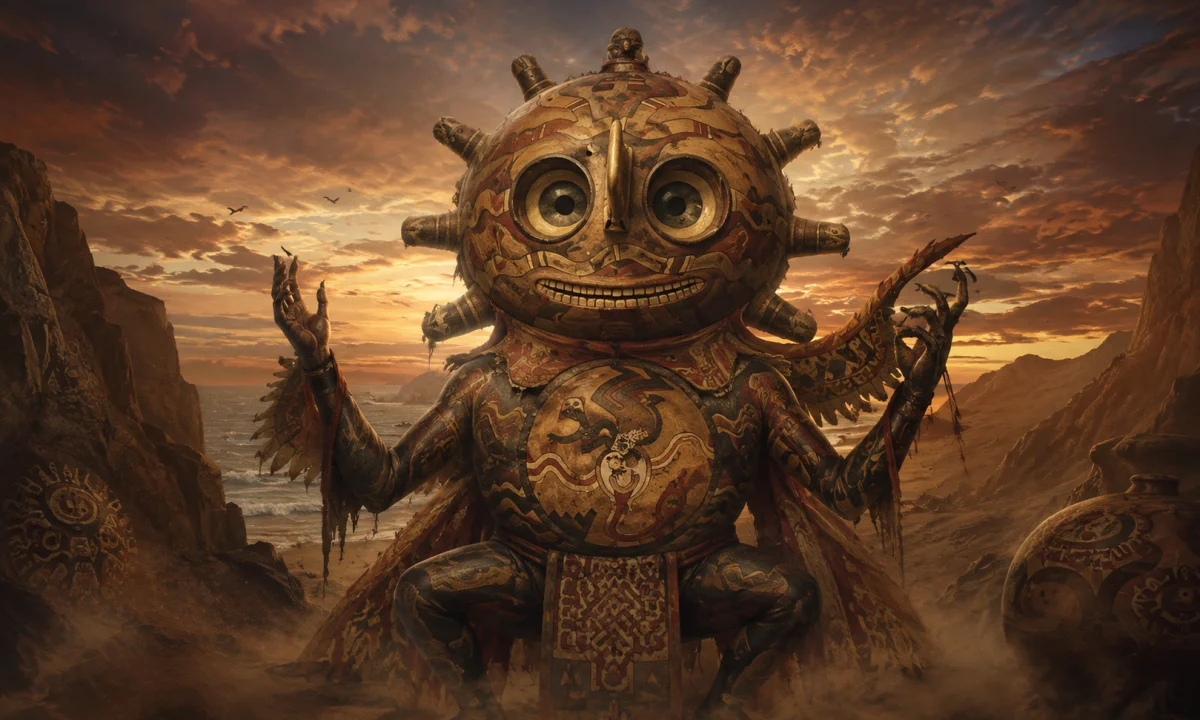
Oculate Being is a modern descriptive name for an enigmatic supernatural figure or iconographic type associated mainly with the ancient Chavín religious tradition of the central Andes. The term refers to representations marked by unusually prominent, staring eyes, often combined with fangs, feline features, serpents, and other signs of transformation. No surviving ancient text gives this figure a confirmed personal name, and scholars do not always use “Oculate Being” in exactly the same way.
Origins in the ancient Andes
The Oculate Being belongs to the religious and artistic world usually called the Chavín tradition or Chavín Horizon. This tradition developed in the Andes of present-day Peru during the first millennium BCE and had influence over a wide region through religious imagery, ceremonial practices, and artistic styles. Its principal ceremonial centre was Chavín de Huántar, located in the highlands of the present-day Ancash region.
Chavín de Huántar was not simply a settlement or political capital. It was a major ceremonial complex containing temples, galleries, plazas, carved stone monuments, and carefully controlled spaces. Pilgrims or visitors may have encountered powerful images in settings involving darkness, sound, restricted movement, and altered perception. These features suggest that religious experience at the site was deliberately structured, although the precise rituals and beliefs remain uncertain.
Knowledge of Chavín religion comes primarily from archaeology. Carved stones, pottery, textiles, ornaments, and architectural remains preserve images of supernatural beings, but there is no known Chavín scripture or written mythology explaining them. Later Andean traditions cannot simply be treated as direct translations of Chavín beliefs. They may preserve broad religious themes, but the Oculate Being cannot be identified securely with a named deity from the Inca or other later traditions.
Name and identity
“Oculate Being” is not a securely attested ancient name. Oculate means “having eyes” or “characterized by eyes,” so the expression is a modern scholarly or descriptive label rather than a word known to have been used by Chavín worshippers. It is useful because many Chavín images emphasize the eyes as a major part of the figure’s supernatural appearance.
The label may be applied to a particular recurring type of supernatural image, but its boundaries are not universally agreed. Some discussions use it for an anthropomorphic figure with large, staring eyes and powerful teeth. Others use related terms such as “feline deity,” “Chavín supernatural being,” or “Staff God” for images that may overlap in their features but are not necessarily identical.
It is therefore safer to treat the Oculate Being as an iconographic category or interpretive figure, not as a fully documented mythological personality with a known biography. The ancient people who created these images may have understood them as one deity, several related beings, different manifestations of a supernatural power, or visual forms whose significance depended on ritual context.
Appearance and visual features
The most striking feature associated with the Oculate Being is its eyes. They may be large, round, bulging, or shown in a fixed frontal gaze. In some works, the eyes appear unnaturally prominent compared with the rest of the face. This visual emphasis gives the figure an alert, confrontational, or otherworldly quality.
Other features commonly associated with the type include:
- Fangs or prominent teeth: These may suggest a predatory animal, especially a large feline, or a being that combines human and animal qualities.
- Feline facial characteristics: The nose, mouth, cheeks, and teeth can be arranged to evoke a jaguar or another powerful predator.
- Serpentine elements: Hair, eyebrows, ears, or ornaments may be transformed into snakes or snake-like forms.
- Clawed hands or feet: These reinforce the figure’s animal and dangerous character.
- Elaborate headdresses: Crowns and headgear may incorporate animals, plants, feathers, or repeated supernatural motifs.
- Frontal presentation: The figure is often shown facing the viewer, creating a direct visual encounter rather than a naturalistic scene.
- Composite anatomy: Human, feline, avian, and serpentine features may be combined in ways that resist ordinary classification.
Chavín artists frequently used a complex visual system in which human and animal forms merge. A face may contain smaller faces, tendrils may become hair or snakes, and limbs may be rearranged into symmetrical patterns. This style makes individual identification difficult for modern viewers. What looks like a single figure may contain several overlapping creatures or symbolic transformations.
Important Chavín monuments and related imagery
The Lanzón, a carved stone monument at Chavín de Huántar, is one of the most important works for understanding Chavín supernatural imagery. It represents a standing or vertically elongated figure with a powerful face, prominent teeth, large eyes, and mixed human-animal features. The monument was installed within a restricted gallery and may have been connected with the central religious authority of the sanctuary.
The Lanzón is sometimes discussed alongside the Oculate Being because of its enlarged eyes and feline characteristics. However, the identification is interpretive rather than certain. The ancient monument does not bear an inscription naming its subject. It may represent a major deity, an ancestral supernatural power, or a ritual image whose meaning cannot be recovered completely.
The Raimondi Stela presents another influential Chavín-related figure. It shows a richly ornamented anthropomorphic being holding staff-like objects, with elaborate headgear and a face incorporating supernatural features. This image is commonly called the Staff God in archaeological and art-historical discussions. Because it has large eyes, fangs, and transformed animal details, it may be compared with other oculate or feline beings, but it should not automatically be labelled the same figure.
Other works from Chavín and related Andean traditions show supernatural beings with circular eyes, fanged mouths, wings, claws, or serpentine appendages. Their similarities may indicate shared religious ideas, artistic conventions, or the circulation of imagery across the Andes. They do not by themselves prove that all such images represented one deity.
Possible meaning of the eyes
The eyes of the Oculate Being have encouraged several interpretations. A direct, oversized gaze may have conveyed vigilance, supernatural awareness, or the ability to see across ordinary boundaries. In a ceremonial setting, such an image could make the viewer feel observed by a power greater than the human community.
Some interpretations connect the eyes with altered states of consciousness. Chavín art includes imagery that may refer to transformation, trance, or encounters between human and animal forms. Archaeological evidence indicates that psychoactive plants were known in parts of ancient South America, and some objects from the broader Chavín world have been interpreted in relation to ritual transformation. Nevertheless, the evidence does not establish that every large-eyed figure represents a drug-induced vision, nor does it reveal exactly how worshippers understood the images.
The eyes may also have had a formal artistic purpose. Chavín artists used symmetry, repetition, and visual ambiguity to make figures appear unstable or alive. Enlarged eyes are especially effective in producing a sense of presence. A carved being that seems to stare outward from a dark gallery would have had a very different impact from a small image viewed in a modern display case.
Feline, serpentine and human qualities
The Oculate Being is often interpreted through the importance of powerful animals in ancient Andean symbolism. Large felines, birds of prey, and snakes appear repeatedly in Chavín art and in later Andean religious traditions. These animals may have represented strength, height, danger, fertility, water, or movement between different levels of the cosmos.
The feline element is particularly prominent in many Chavín images. Jaguars or related large cats were not native to the highland sanctuary itself, but they inhabited lower and more tropical regions connected to the wider Andean world. Their inclusion may have expressed the reach of the supernatural realm beyond a single ecological zone. A being combining human and feline features could represent transformation rather than a simple animal-headed god.
Serpents have an equally important visual role. They may appear as hair, whiskers, limbs, or ornamental patterns. Because Chavín art is highly stylized, it is often impossible to determine where the human face ends and the serpent begins. This ambiguity may have been intentional, emphasizing that the being belonged to a realm in which ordinary categories did not apply.
Role in Chavín religion
No surviving account states what the Oculate Being did, whom it helped, or what rites were performed in its honour. Interpretations must therefore remain cautious. The figure may have been associated with the authority of the sanctuary, the power of transformation, communication with nonhuman forces, or the maintenance of balance between different realms.
Its frightening appearance does not necessarily mean that it was an evil demon. Many religious traditions portray sacred powers as dangerous, overwhelming, or capable of punishment without classifying them as morally evil. In the Chavín context, fangs and claws may have expressed potency and sacred otherness rather than villainy.
The figure’s placement within temples is also significant. Images hidden in internal galleries were not necessarily intended for large public audiences. Access may have been restricted, and the experience of encountering them could have marked differences in status, initiation, or ritual knowledge. The Oculate Being may therefore have functioned within a religious system in which seeing and being seen were themselves important aspects of sacred power.
Relationship to the Staff God and other figures
Confusion is likely because Chavín supernatural images share many features. The Oculate Being may be compared with the Staff God, the Lanzón figure, and feline or serpent beings, but these terms do not necessarily identify one character.
- The Oculate Being is a descriptive label emphasizing large or striking eyes and related supernatural features.
- The Staff God refers mainly to a recurring figure shown with staff-like objects, especially in the imagery represented by the Raimondi Stela and related works.
- The Lanzón figure is the name commonly given to the supernatural image carved on the central stone monument at Chavín de Huántar.
- Feline deities or feline supernatural beings are broader interpretive categories covering images with jaguar-like or predatory traits.
These categories can overlap, but overlap is not proof of identity. Since Chavín imagery has no readable captions or mythological explanations, scholars continue to debate whether recurring visual elements represent a single pan-Andean deity, a family of related beings, or a shared artistic language.
Cultural significance
The Oculate Being is important less as a character in a preserved story than as evidence of how ancient Andean religion represented supernatural power. Its face brings together human and animal features, familiar and unfamiliar forms, and beauty with menace. Such combinations may have expressed the belief that sacred forces could not be reduced to ordinary categories.
The figure also illustrates the limits of interpreting prehistoric religion. Modern observers often want to assign a name, personality, or myth to an image. In the case of the Oculate Being, the surviving evidence supports discussion of visual patterns and ritual settings, but not a complete narrative. The absence of a recorded name is not evidence that the image lacked a specific identity in antiquity; it means that the identity has not survived in a form that can be securely recovered.
Chavín influence extended across parts of the ancient Andes, although the exact mechanisms of that influence remain debated. Similar eyes, fangs, and animal transformations in distant regions may reflect contact, imitation, shared religious ideas, or independent development. Each image must be considered within its own archaeological and cultural setting rather than treated as an automatic appearance of the same supernatural being.
Later reception
The Oculate Being has no continuous, well-documented popular cult extending from Chavín times into the present. Its modern identity comes chiefly from archaeological interpretation, museum display, academic writing, and the study of ancient Andean art. Contemporary artists, game designers, and writers may draw on its staring eyes and composite animal form when creating monsters or ancient powers, but such uses are modern adaptations.
Modern depictions should not be presented as recovered Chavín mythology. A dramatic image labelled “Oculate Being” may combine details from the Lanzón, the Raimondi Stela, other Chavín monuments, and entirely contemporary fantasy conventions. The traditional evidence supports an ancient Andean supernatural image or group of images, but it does not provide a single canonical design, a confirmed personal name, or a complete surviving legend.