WORLD
WORLD
Metsänhaltija
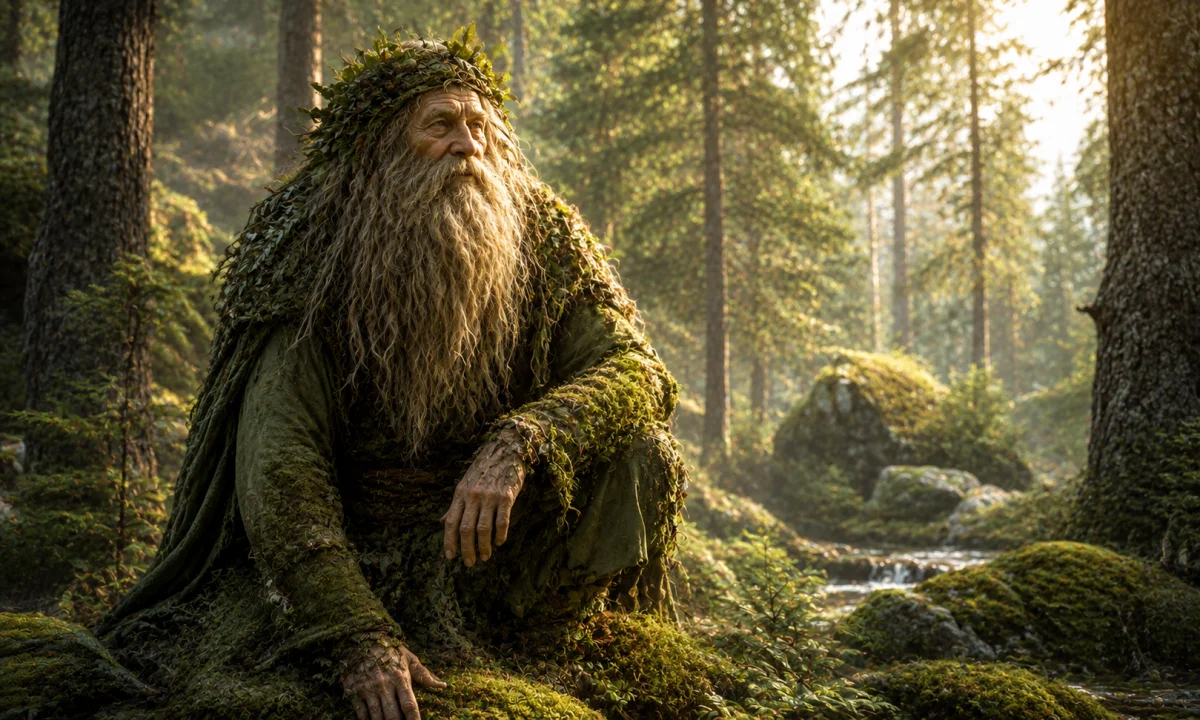
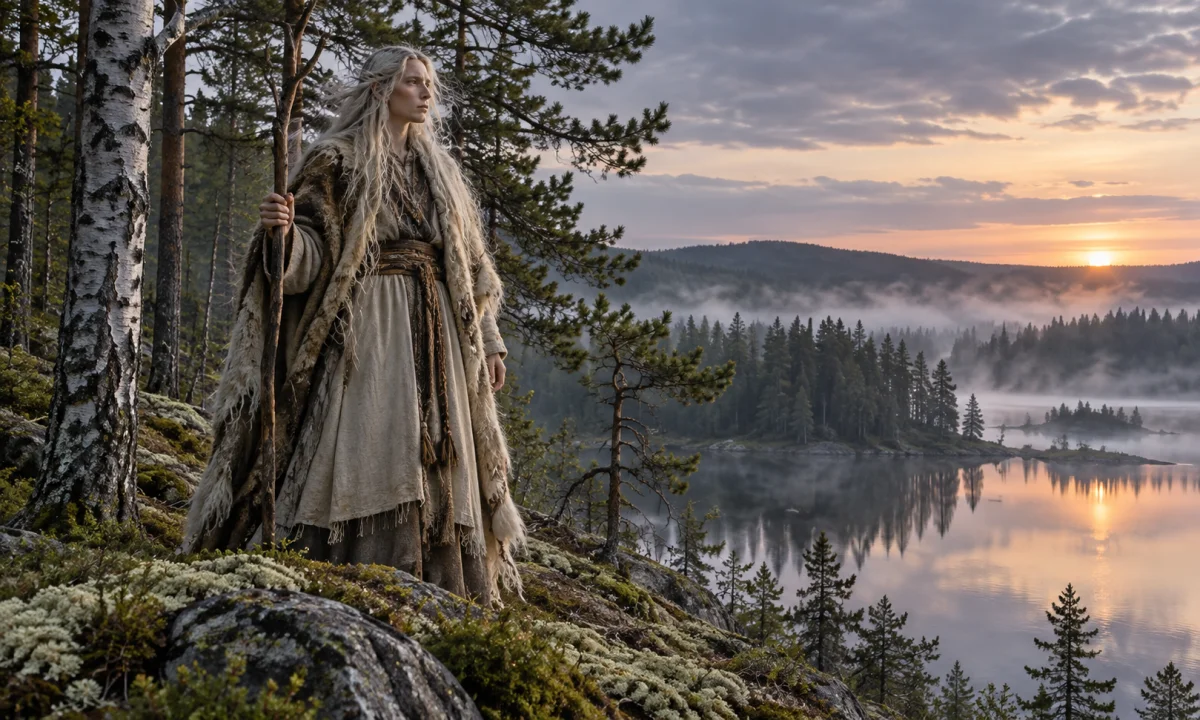
Metsänhaltija is a Finnish forest guardian or forest spirit. The name is usually understood as “the keeper” or “guardian of the forest,” although it does not always refer to one clearly defined individual. In Finnish folklore, the forest was a living, powerful realm inhabited and governed by many beings. A metsänhaltija could therefore be imagined as the spirit responsible for a particular forest, woodland area, or aspect of the forest’s order.
The term belongs to the wider Finnish tradition of haltijat, beings associated with places, households, natural features, and human activities. Finnish folklore does not present the metsänhaltija with one universally fixed appearance, biography, or set of stories. Its identity varies according to region, source, and the way a folklorist or later writer uses the word. In some contexts it is a general name for a forest spirit; in others it is treated as a distinct guardian figure connected with the forest and its animals.
The forest in Finnish traditional culture
For traditional Finnish communities, the forest was both a source of livelihood and a dangerous, unfamiliar environment. It provided wood, berries, mushrooms, game, medicinal plants, and pasture, but it could also conceal predators, difficult terrain, storms, and the threat of becoming lost. Hunting and gathering required knowledge, restraint, and good fortune. The forest was not simply an empty natural space. It was understood as a realm with its own inhabitants, powers, and rules.
This attitude formed part of an older Finnish and wider Finnic religious worldview in which natural places could possess agency or be connected with spiritual beings. Lakes, springs, rocks, hills, trees, houses, and forests might all have their own supernatural associations. The forest was especially important because hunters entered it to take animals that were regarded as belonging, in some sense, to the forest’s ruler or guardian.
Respectful conduct was therefore more than a matter of practical caution. A hunter might address the forest indirectly, use ritual language, make offerings, or observe rules concerning what could be taken. Such practices were not necessarily directed to a single figure called Metsänhaltija. They belong to a broader complex of Finnish beliefs about forest beings, forest masters, animal luck, and the proper relationship between humans and the non-human world.
Name and identity
The Finnish word metsä means “forest,” while haltija commonly means a holder, guardian, or supernatural being associated with a place or domain. Older and variant forms such as haltia may also occur, and spelling has not always been consistent in discussions of Finnish folklore. The word should not automatically be translated as “elf.” Although some modern descriptions use “forest elf” for convenience, haltija has a wider meaning and does not necessarily imply the small, human-shaped fairy of modern fantasy.
Metsänhaltija is best treated as a descriptive and folkloric category rather than as a single character with a fixed canonical myth. Finnish oral tradition was transmitted through local stories, charms, songs, beliefs, and customary practices rather than through one authoritative sacred mythology. The surviving record was also collected at different times and interpreted through different scholarly and literary frameworks.
Some accounts use the name for a guardian of the forest as a whole. Others may use it for a spirit that controls game animals, protects a particular woodland, or punishes people who behave disrespectfully. In still other contexts, the word functions as a modern explanatory label for several related traditional ideas. These uses should not be assumed to describe exactly the same being.
Sources and the problem of a fixed mythology
Knowledge of Finnish pre-Christian religion comes from several kinds of evidence. Ancient written descriptions are limited, and there is no surviving Finnish equivalent of a complete mythological scripture. Much of the evidence comes from oral poetry, charms, incantations, place traditions, customary practices, and folklore recorded especially in the eighteenth, nineteenth, and early twentieth centuries.
The Kalevala, Elias Lönnrot’s nineteenth-century literary epic, is important for the later reception of Finnish mythology, but it should not be treated as a straightforward transcript of an unchanged ancient religion. Lönnrot combined, edited, rearranged, and adapted oral materials. Its characters and episodes can preserve older poetic traditions while also reflecting the structure of a nineteenth-century national epic.
References to forest powers are found in Finnish and related Finnic oral traditions, but the exact word metsänhaltija does not establish that all these references concern one standardized supernatural person. A traditional song about the forest ruler, a local belief about a guardian spirit, and a modern encyclopedia entry may use overlapping language while representing different layers of interpretation.
Relationship to Tapio and other forest beings
The figure most likely to be confused with Metsänhaltija is Tapio. In Finnish mythology and folklore, Tapio is a powerful forest ruler or deity-like being associated with hunting, game, and the abundance of the woods. He appears in Finnish oral poetry and later literary representations, sometimes as a male lord of the forest. His female counterpart or companion is often named Mielikki, who is associated with the forest, its beauty, and the care or prosperity of its animals.
Other figures connected with Tapio’s forest include Nyyrikki, often described in poetic tradition as a forest being who helps hunters, and Tellervo, associated with Tapio’s family or with the forest’s animals and vegetation in later interpretations. The precise relationships among these figures vary in different poetic and scholarly accounts.
Metsänhaltija should not simply be declared another name for Tapio. Tapio is a specific named figure with a recognizable place in Finnish mythic poetry, whereas metsänhaltija is more often a generic or functional designation. A writer may describe Tapio as a forest guardian, but that does not mean every traditional forest guardian was Tapio, or that every use of metsänhaltija refers to him.
Nor should Metsänhaltija be merged with every spirit associated with woodland. Finnish folklore includes concepts such as metsänväki, “the forest folk” or “the people of the forest,” which can refer collectively to supernatural inhabitants or powers of the woods. There are also beliefs about forest maidens, animal spirits, wandering beings, and forces that could lead a person astray. These belong to related areas of tradition but are not identical to the metsänhaltija.
Appearance and character
Traditional accounts do not provide one agreed physical description of a metsänhaltija. The being may be imagined in human form, especially as an old man or woman connected with the forest, but such imagery is not universal. In some representations, the guardian is less a visible person than an unseen presence recognized through unusual events, the behavior of animals, or a sudden change in a hunter’s luck.
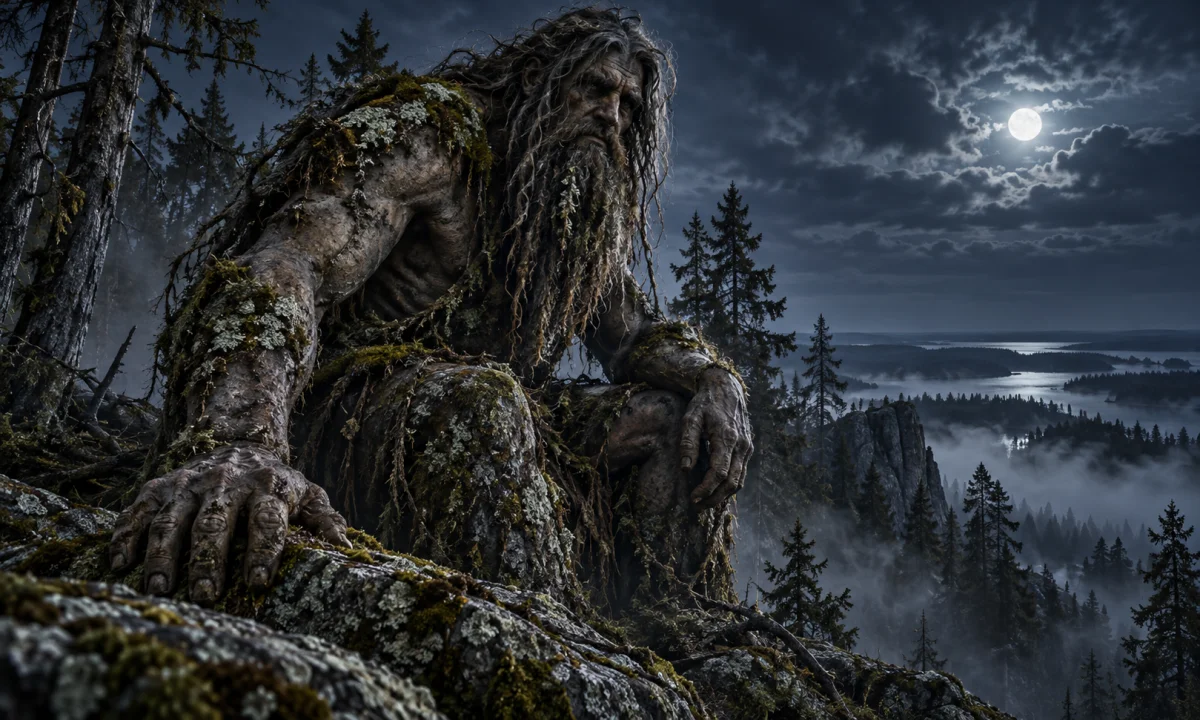
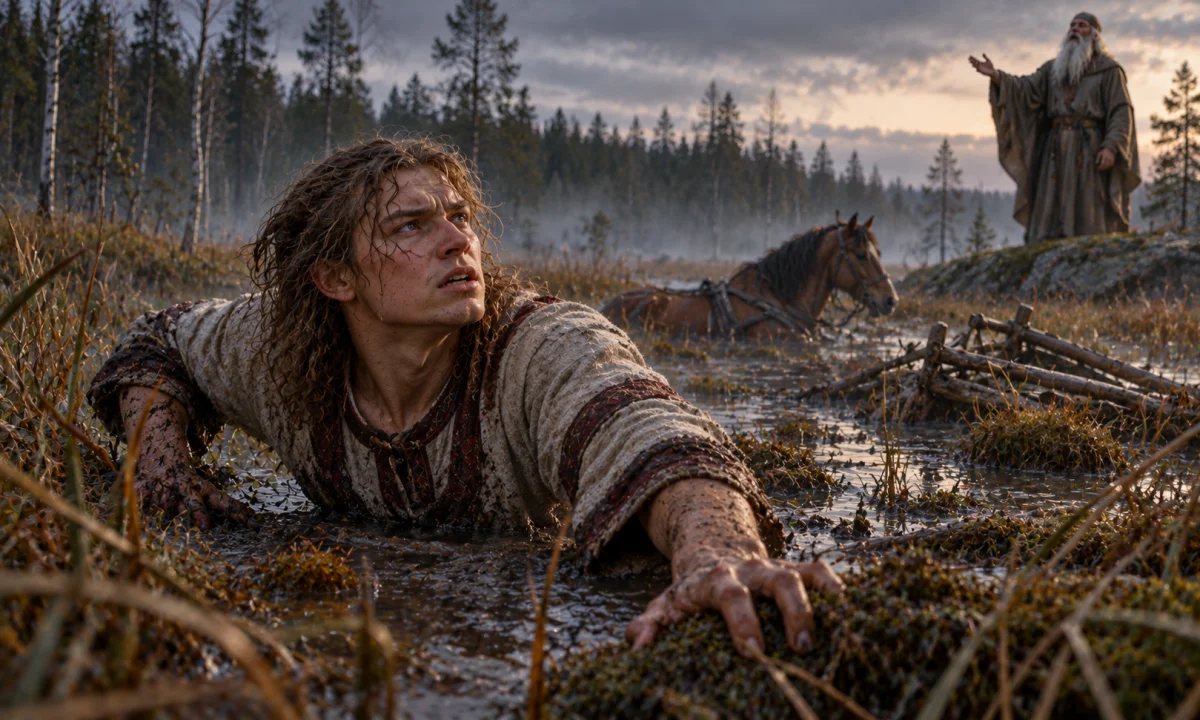
Later illustrations often give forest guardians a bearded, rustic, or vaguely humanoid appearance. This image can communicate age, authority, and closeness to nature, but it should not be presented as a universal feature of Finnish belief. The small winged or pointed-eared woodland creature common in modern fantasy is also not a reliable description of the traditional metsänhaltija.
As a guardian, the metsänhaltija may be benevolent toward people who act correctly and hostile toward those who are careless, greedy, or disrespectful. The distinction between benevolence and danger is not always absolute. A forest being could grant success to one person and deny it to another, not because it represented simple moral good or evil, but because the forest had its own interests and boundaries.
Potential signs of the guardian’s influence might include finding or losing game, becoming confused in familiar woodland, hearing unexplained sounds, or encountering an animal behaving unusually. These motifs are common in stories about powerful natural places, but no single list of powers belongs to every tradition concerning Metsänhaltija.
The guardian and the hunter
The relationship between forest spirits and hunting is central to understanding the figure. In traditional hunting culture, animals were not merely passive resources. They were connected with the forest and with the authority that governed it. A successful hunter depended on skill, knowledge, weather, equipment, and luck, but folklore could express that uncertainty through the idea that the forest’s guardian decided whether game would be revealed.
A hunter who took too much, violated customary conduct, or spoke boastfully might lose the forest’s favor. Conversely, respectful behavior could be associated with good fortune. Such ideas helped explain the unpredictable results of hunting and reinforced practical social values, including moderation, secrecy, care with sacred or dangerous places, and respect for the creatures on which human life depended.
The guardian was not necessarily imagined as an abstract symbol of conservation in the modern sense. Traditional beliefs arose in communities that depended directly on hunting, forestry, animal husbandry, and gathering. Nevertheless, the idea that the forest had an owner, ruler, or power capable of withholding its gifts could encourage restraint. It placed human activity within a relationship of obligation rather than treating the forest as entirely ownerless.
Offerings, charms, and respectful behaviour
Finnish and related Finnic traditions contain charms and ritual formulas connected with hunting, animal luck, healing, and protection. These materials may invoke named forest powers or address the forest in indirect and poetic language. The purpose could be to ask for success, gain permission, calm a dangerous force, or make amends after an offence.
It is difficult to create a single universal ritual for Metsänhaltija. Practices varied by location, occupation, family tradition, and historical period. Some accounts of Finnish folk religion describe offerings to spirits of particular places or natural powers, but an offering mentioned in one local tradition should not automatically be attributed to every forest guardian or to all Finnish people.
What remains consistent is the importance of correct conduct. The forest was approached with caution, and speech itself could matter. Names might be avoided, softened, or replaced with respectful expressions. In many traditional cultures, indirect language toward powerful beings was a way of showing respect and avoiding unwanted attention. Finnish forest lore includes this broader pattern, even when the exact being addressed is uncertain.
Symbolism and interpretation
The metsänhaltija can be interpreted as an expression of the forest’s autonomy. The figure gives a personal or social form to forces that humans could not control: the movement of animals, changing weather, loss of direction, sudden danger, and the uncertain availability of food. Instead of being a neutral background, the forest becomes a participant in human life.
The guardian also marks a boundary between the human settlement and the wild. Finnish traditional culture did not necessarily define “wild nature” as untouched wilderness in the modern environmental sense. Forests were worked, travelled, hunted, and used. Yet they remained morally and spiritually distinct from the farm, village, and household. Crossing into the forest meant entering a different order, one in which familiar rules could no longer be assumed.
Stories of forest guardians can therefore be read on several levels. They may preserve religious ideas about local spirits, provide practical warnings about dangerous places, explain hunting luck, or teach children and adults to respect the limits of human knowledge. A modern interpretation may emphasize ecological balance, but that is a later framework and should be distinguished from the original religious and folkloric meanings.
Finnish, Karelian, and wider Finnic context
Finnish folklore shares themes with neighbouring Karelian and other Finnic traditions, including forest rulers, animal masters, hunting charms, and powerful beings associated with natural places. Cultural boundaries in the region have never perfectly matched modern national borders. Oral traditions circulated across language communities and changed through local transmission.
At the same time, similarities do not prove that all related figures were identical. A Karelian forest being, a Finnish poetic character, and a modern Finnish description may have comparable functions while belonging to distinct local traditions. Terms such as “Finnish mythology” can simplify a diverse collection of regional beliefs, especially when they are used to describe material recorded centuries after the spread of Christianity.
Christianization also influenced the way older beings were remembered and described. Some traditional spirits were treated as remnants of pagan belief, while others survived in stories, customs, and popular explanations without functioning as objects of formal worship. The boundary between religious practice, folklore, and literary tradition is therefore not always clear.
Later literary and popular representations
During the nineteenth century, interest in Finnish oral poetry and mythology increased as scholars and writers sought cultural material for a Finnish national literature. Forest rulers and guardians appeared in poetic, artistic, and educational representations, sometimes with more definite personalities than they had possessed in local oral tradition. The Kalevala and related literary works helped make figures such as Tapio and Mielikki widely recognizable, but they also encouraged readers to imagine Finnish mythology as a system of neatly defined gods and characters.
In modern Finnish usage, metsänhaltija may be used in children’s literature, fantasy, games, environmental writing, and popular accounts of folklore. It can suggest a nature spirit, woodland protector, or magical guardian. These uses are legitimate modern adaptations, but they should not be confused with evidence for a single ancient being with a standardized design.
Modern fantasy may also blend Metsänhaltija with elves, fairies, dryads, nature spirits, or generic forest guardians from other traditions. Such comparisons can be imaginative, yet they do not erase the specifically Finnish context of the term. In traditional Finnish culture, the metsänhaltija belongs to a world of forest livelihood, hunting customs, local supernatural geography, oral poetry, and negotiated respect for the powers of the woods.