WORLD
WORLD
Nguruvilu
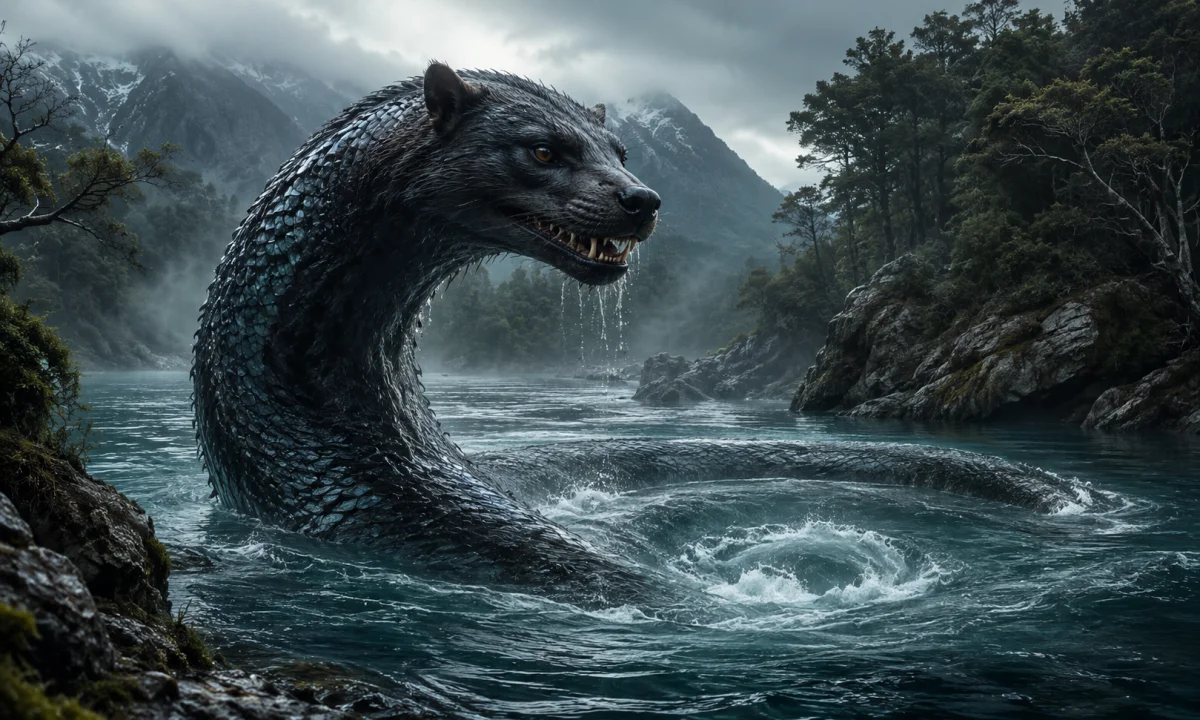
Nguruvilu is a water being associated with Mapuche tradition and with the folklore of southern Chile, especially the island of Chiloé. Its name is commonly explained through Mapudungun elements meaning “fox” and “snake,” reflecting its hybrid appearance: a fox-like animal with an elongated, serpent-like body or tail. Accounts differ in detail, but Nguruvilu is usually connected with rivers, deep channels, whirlpools and the danger faced by people who enter or cross unfamiliar water.
Origins and cultural setting
Nguruvilu belongs to a body of oral traditions shaped by the cultures of the southern Andes and the Chilean archipelago. It is most often discussed in relation to the Mapuche, whose historical territories extend across south-central Chile and parts of Argentina, and to the folklore of Chiloé, where Mapuche, Huilliche, Spanish and later local traditions have interacted for centuries.
There is no single ancient scripture or universally fixed mythology that gives one official description of Nguruvilu. Knowledge of the being has been preserved mainly through oral storytelling, local reports and written collections of folklore. As a result, descriptions can vary from one community or author to another. Some accounts present Nguruvilu as a river-dwelling monster, while others give it a more explicitly spiritual or guardian-like character.
The landscape is important to the tradition. Southern Chile contains fast rivers, forested waterways, lakes, channels and coastal inlets whose currents can be difficult to judge. In such settings, stories about a dangerous being beneath the surface can express more than fear of a monster. They can also communicate respect for water, caution around natural hazards and the idea that places possess powers or inhabitants that human beings should not treat carelessly.
The name Nguruvilu
The name is commonly written Nguruvilu, although forms such as Nguruvilú, Guruvilu and other spellings appear in Spanish-language and English-language sources. Mapudungun has been represented in several different spelling systems, and the variation does not necessarily indicate different beings.
The first element is generally connected with ngürü, meaning “fox,” while filu means “snake” or “serpent.” The compound therefore conveys the idea of a fox-serpent. Some popular explanations translate the name loosely as “fox with a serpent’s tail” or “fox-snake.” The exact form of the word and its pronunciation may differ according to regional usage and transcription.
The name should not be treated as proof that Nguruvilu is simply an ordinary fox transformed into a snake. It is a descriptive compound for a distinctive supernatural being. The hybrid name points to its mixed appearance and helps distinguish it from other water beings in Mapuche and Chiloé traditions.
Appearance
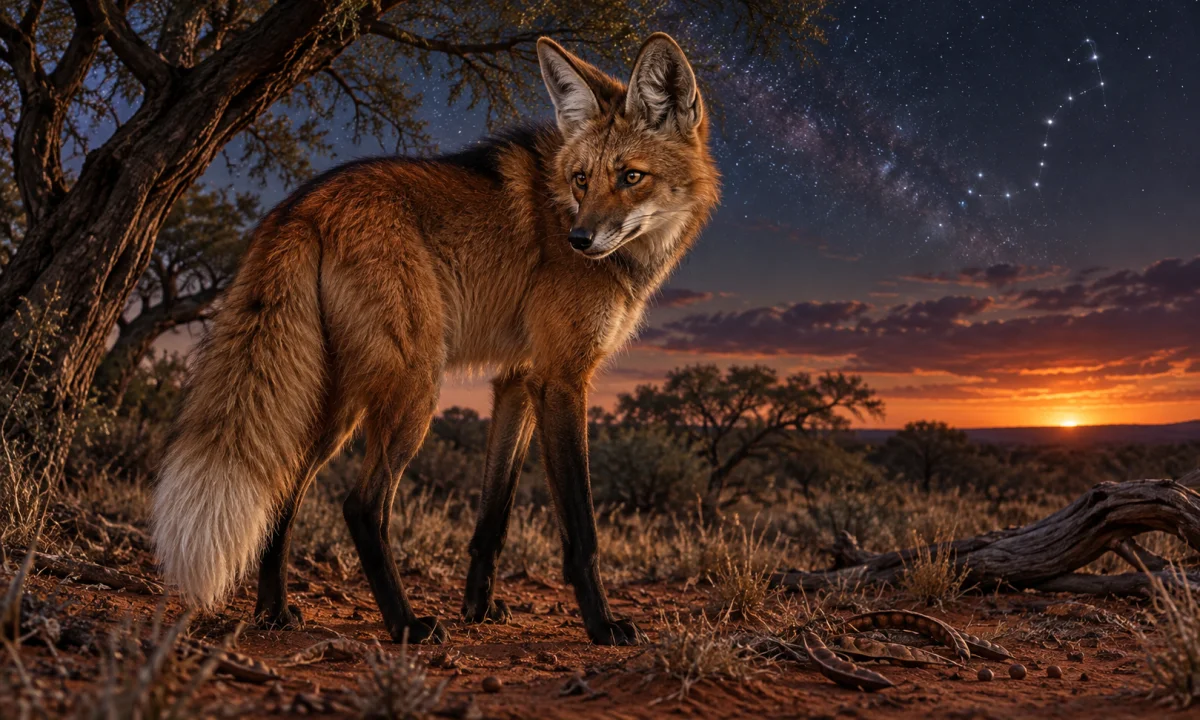
Descriptions of Nguruvilu generally combine features of a fox with those of a serpent or aquatic animal. It may be imagined as having a fox-like head and body, while its tail is unusually long, flexible and snake-like. In many accounts, the tail ends in a hook, claw or sharp appendage.
This clawed tail is one of the creature’s most recognizable features. It is said to seize people in the water, pull them beneath the surface or disturb the current around them. Some retellings emphasize an animal covered in fur; others make the body more serpentine and aquatic. The creature’s size is also not consistent. It may be described as large enough to threaten a person or as an elongated animal whose dangerous power comes less from its bulk than from its ability to manipulate the water.
Illustrations and modern retellings often give Nguruvilu a dramatic monster-like form, with a long reptilian body and a prominent clawed tail. Such images are interpretations rather than a standardized traditional portrait. Older oral accounts do not necessarily require the kind of fixed visual design expected in modern books, games or films.
Habitat and powers
Nguruvilu is most often said to live in rivers, particularly in deep or turbulent stretches of water. Depending on the version, it may also inhabit lakes, channels or other inland waters. Its presence is associated with whirlpools, sudden currents and unexplained drownings.
The creature’s most frequently reported power is the creation or control of a whirlpool. It may twist its body beneath the surface, draw water into a circular motion and make the river difficult or impossible to cross. A person who approaches the wrong place can be pulled from the bank, seized while swimming or dragged under while attempting to ford the river.
Nguruvilu is therefore not merely an animal that happens to live underwater. It is a being whose actions affect the character of the water itself. The river becomes dangerous because it is inhabited and actively controlled, rather than being dangerous only because of ordinary physical conditions.
Some accounts describe the being as deliberately hostile, while others present it as defending its territory. These interpretations are not always mutually exclusive. A powerful water inhabitant may be dangerous to humans without being evil in the same absolute sense as a demon in later European-influenced storytelling. The important point is that people entering its domain must act with care.
Stories of attack and drowning
The central narrative pattern involves a person entering a river or attempting to cross it. The water may initially appear calm, but Nguruvilu is believed to be concealed below. It then stirs the current, forms a whirlpool or uses its hooked tail to capture the victim.
In some versions, the creature attacks people who swim, bathe or cross without recognizing the danger of the place. In others, the story is linked to a particular river or stretch of water known for accidents. These stories can function as warnings to children and travellers, especially in regions where rivers are cold, swift and subject to sudden changes in depth.
Not every account treats an unexplained drowning as evidence of Nguruvilu. The being belongs to a narrative world in which natural events, spiritual presences and human conduct can be connected. A dangerous current may be understood both as a physical hazard and as a sign that a place should be approached respectfully.
Ritual specialists and responses to the being
Some retellings say that a machi, a Mapuche spiritual specialist and healer, can confront, drive away or control Nguruvilu. The details of these encounters vary considerably. There is no single procedure that appears in every account, and it is misleading to present one dramatic version as a universal Mapuche ritual.
The presence of a machi in these stories reflects the wider role of ritual specialists in negotiating relationships between human communities and the spiritual dimensions of the world. A machi is not simply a “monster hunter” in the modern fantasy sense. The figure belongs to a living religious and healing tradition, and stories involving a machi should be understood within that cultural context rather than reduced to an adventure narrative.
In some local versions, the being must be confronted because it has made a crossing unusable or has caused repeated deaths. In others, the emphasis is on restoring balance or persuading the being to leave. The variation suggests that the story is concerned not only with defeating an animal-like monster, but also with managing a disturbed relationship between people and a dangerous place.
Nguruvilu in Mapuche and Chiloé traditions
Nguruvilu is often presented as a Mapuche figure, but many descriptions known to modern readers come through collections of Chiloé folklore. Chiloé has a distinctive mythology containing numerous beings associated with the sea, rivers, forests and islands. Its traditions developed in a region where Indigenous beliefs and colonial Catholic culture interacted over a long period.
This does not mean that every Chilote account is identical to every Mapuche account, nor that all water beings of Chiloé are interchangeable. A story recorded in Chiloé may preserve a Mapudungun name while giving the creature local features, settings or narrative functions. The history of transmission is complex, and labels such as “Mapuche mythology” and “Chilote mythology” should not be used as if they described one completely uniform system.
In a broader Mapuche religious context, water is not merely an empty natural resource. Rivers, lakes and springs can be connected with beings, forces and places of spiritual significance. Scholars and cultural interpreters sometimes relate Nguruvilu to wider ideas about ngen, powerful beings associated with particular elements or places. However, Nguruvilu should not automatically be equated with every Mapuche water spirit or described as a universally recognized ngen-ko. The terminology and classification depend on the source and the community involved.
Symbolism and cultural significance
Nguruvilu represents the uncertainty and power of waterways. A river may support travel, fishing and communication, yet it can also conceal depth, cold, rocks and violent currents. Giving that danger a recognizable supernatural form makes the risk memorable and places it within a moral and cultural relationship.
The fox-serpent form is significant because it combines traits associated with land and water. A fox is a familiar terrestrial animal, while a serpent-like body suggests an alien or hidden aquatic presence. The hybrid shape marks Nguruvilu as something that crosses ordinary boundaries. It belongs neither wholly to the forest nor wholly to the riverbank, but moves between environments.
The hooked tail adds another layer to the imagery. Rather than attacking only with teeth or jaws, Nguruvilu reaches from a concealed position and catches people unexpectedly. The tail can be understood as an image of the river’s ability to seize travellers through undertow and circular currents. This does not mean that every traditional narrator intended a symbolic interpretation, but it helps explain why the creature’s form is so closely tied to the physical dangers of water.
Stories of Nguruvilu may also reinforce communal knowledge. People learn which places are dangerous, when a river should not be crossed and why children should not enter deep water alone. The supernatural explanation does not erase practical knowledge; it can preserve and intensify it.
Distinction from other South American water beings
Nguruvilu is sometimes confused with other legendary creatures because many traditions describe a dangerous being in a river or lake. It is not the same as the Cuero, a flat, hide-like creature in Chilean and wider southern South American folklore that is said to envelop people in the water. Nguruvilu is more characteristically associated with a fox-like form, a serpentine tail and a claw or hook.
It is also distinct from the Peuchén, a being whose descriptions vary but which is commonly linked with a flying or vampiric creature in Mapuche-related folklore. Nor should it be confused with the Camahueto, a powerful horned creature associated especially with Chiloé, or with the Caballo Marino Chilote, the supernatural sea horse said to carry other beings across the waters.
The Pincoya is another separate Chilote figure. She is generally described as a female spirit of the sea whose actions influence the abundance of marine life, not as a river monster that drags swimmers into whirlpools. Likewise, Nguruvilu has no necessary connection with Caleuche, the legendary ghost ship of Chiloé. These beings may appear together in modern lists of Chilean mythology, but they have different identities and narrative roles.
Later recording and modern representation
Written Spanish accounts and folklore compilations helped carry the name Nguruvilu beyond the communities in which the stories circulated orally. In these retellings, local variations are often compressed into a single “mythical creature” entry. That format can make the tradition easier to recognize, but it may conceal uncertainty about region, spelling and context.
Modern illustrations, fantasy writing and online encyclopedic lists commonly portray Nguruvilu as a cryptid-like river serpent or a monster with a fox’s head and a scorpion-like tail. These representations draw on traditional motifs but may add details that are not consistently found in older or local accounts. A fictional depiction should therefore be identified as an adaptation rather than treated as evidence for a fixed traditional appearance.
Nguruvilu remains most meaningful when understood as part of a living cultural landscape: a being of rivers and crossings, remembered through Indigenous and regional traditions, and connected with respect for places that can sustain human life while also threatening it. Its name, appearance and exact role vary, but the recurring image is clear—a hidden fox-serpent beneath the water, whose presence turns a river crossing into an encounter with a power that humans cannot safely ignore.