WORLD
WORLD
Nemain
Nemain is a figure of Irish mythology associated with war, terror and the violent confusion of battle. Her name appears in medieval Irish literature alongside those of Badb, Macha and the Morrígan, although the relationship between these figures varies from text to text. Nemain is not presented consistently as a single, fully defined goddess with one fixed biography. Instead, she belongs to a group of supernatural war powers whose identities could overlap in the surviving tradition.
Origins and cultural setting
Nemain belongs to the mythological world of early Ireland, especially the stories later grouped around the Tuatha Dé Danann and the heroic age of Ulster. The surviving evidence comes from medieval Irish manuscripts written down by Christian-era scribes, many centuries after the period in which the stories may have circulated orally. These manuscripts preserve older names, themes and narrative structures, but they do not provide a direct, unchanged record of pre-Christian Irish religion.
Irish mythology does not offer a single canonical system of gods. Different stories, manuscripts and local traditions can assign varying relationships and functions to the same divine figures. A supernatural woman who causes panic in one passage may be treated as a distinct being in another, or may be associated with a better-known war goddess. Nemain’s uncertain boundaries reflect this wider characteristic of Irish tradition.
Her principal setting is warfare among rival peoples, particularly the conflicts described in the Ulster Cycle. These stories portray battle not only as a contest of weapons and physical strength but also as a realm of supernatural influence. Fear, frenzy, prophecy, shape-shifting and violent fate can all enter the battlefield. Nemain represents the destructive psychological force that turns an army against itself or overwhelms warriors with terror.
The name Nemain
The spelling of the name varies. Nemain is a common modern scholarly form, while medieval texts may preserve related spellings such as Neman or other manuscript variants. Pronunciation and the exact historical development of the name are not entirely straightforward.
The name is often connected with an Old Irish word associated with frenzy, panic or warlike confusion. Some interpretations relate it to a term meaning venom or poison, although the etymology is debated. The semantic associations are more secure than any single modern translation: Nemain is repeatedly connected with fear, madness, battle and destructive disturbance.
Translations sometimes render her name or function through expressions such as “the furious one,” “the panic-bringer” or “the war goddess.” These are useful descriptions, but they should not be treated as a definitive literal translation. The medieval Irish vocabulary of warfare and supernatural violence does not always correspond neatly to modern categories such as “goddess of war.”
Identity and classification
Nemain is commonly described as a war goddess or battle goddess, but her role is more specific than a general patron of military victory. She is associated with the panic and frenzy that seize combatants. Rather than simply granting strength to one side, she brings disorder, terror and uncontrolled violence.
Some genealogical traditions identify Nemain as the wife of Neit, a male war deity or ancestral figure connected with battle. In other contexts, she appears among a group of female supernatural powers of war. These traditions do not always agree about her parentage, marriage or precise status, and there is no universally accepted family tree for her.
Nemain is often discussed together with Badb, Macha and the Morrígan. The relationship among these names is one of the most difficult issues in interpreting Irish mythology. Some medieval passages treat them as separate figures; others connect them closely or use overlapping titles and functions. Modern scholarship has therefore proposed several models: they may represent distinct goddesses whose roles gradually merged, different manifestations of related war powers, or names drawn from a fluid tradition in which divine identities were not rigidly separated.
It is inaccurate to assume that Nemain is automatically identical with the Morrígan in every story. The names can be associated, but they are not interchangeable in all surviving texts. Nemain should be retained as a distinct figure when a source names her separately.
Attributes and powers
Nemain’s most characteristic power is the ability to provoke terror and confusion among warriors. Her presence can affect an entire army rather than a single champion. She belongs to the supernatural side of battle, where courage can collapse suddenly and ordinary military order can disappear.
Medieval Irish descriptions of war goddesses frequently connect them with cries, shrieks, omens and dreadful appearances. Nemain’s power is therefore often understood through sound and psychological disturbance as much as through physical combat. A terrifying cry or supernatural manifestation may cause warriors to lose their reason, flee or attack one another.
She is also associated with slaughter on a large scale. In some accounts, her intervention is not a carefully directed blessing that ensures the victory of a chosen hero. Instead, it intensifies the destructive nature of war itself. This makes Nemain different from a simple personification of military success. Her domain is the uncontrollable side of conflict: panic, confusion, madness and the sudden collapse of human restraint.
Unlike the Morrígan, who is especially famous for shape-shifting and for her encounters with Cú Chulainn, Nemain has relatively few independent stories. The surviving material does not give her a stable visual form. She is not consistently described as a crow or raven, although war goddesses in Irish literature can take bird shapes and later interpretations may connect such imagery with the wider group of battlefield beings.
Nemain in the Ulster Cycle
Nemain’s most important literary setting is the Táin Bó Cúailnge, the great cattle raid of Cooley. The poem describes a military campaign by the armies of Connacht and their allies against Ulster, with Cú Chulainn defending his homeland through a series of single combats and extraordinary feats.
Different versions and episodes of the Táin preserve slightly different treatments of the war powers. Nemain is associated with the sudden terror and confusion of armies, and her intervention can lead warriors to kill or injure one another in panic. The important point is not that she functions as a battlefield commander with a fixed faction, but that she embodies a force capable of making organized warfare dissolve into chaos.
In some passages, Nemain is closely linked with Badb or appears in a context where the names of several war goddesses stand near one another. This has encouraged interpretations of Nemain as one member of a divine triad or as a form of the same broader war power represented by the Morrígan. The manuscripts, however, do not establish one simple answer.
The Táin also reveals why Nemain’s role matters symbolically. Battles in the poem are not controlled solely by human leaders. Warriors may be brave, skilled and physically powerful, yet still be overcome by supernatural fear. Nemain represents the vulnerability of an army to emotions that are stronger than discipline or loyalty.
Relationship with Badb, Macha and the Morrígan
Badb is another Irish war goddess associated with battlefields, slaughter, prophecy and terrifying cries. Her name is often connected with the hooded crow or a similar carrion bird, although the exact relationship between the word, the bird and the goddess is complicated. Badb and Nemain can appear as distinct beings, but their functions overlap strongly.
Macha is a name borne by several important figures in Irish tradition. Some Machas are connected with sovereignty, horses, fertility, punishment and the suffering imposed on Ulster. One Macha is also counted among the war powers. It is essential not to treat every figure named Macha as the same individual, since Irish literature uses the name in several different mythological contexts.
The Morrígan is a major supernatural woman of the Ulster Cycle, associated with sovereignty, war, prophecy and transformation. In some traditions she is presented as one goddess; in others, the name is connected with a group of related figures, sometimes including Badb and Macha. Nemain can be included in broader discussions of this group, but the evidence does not justify turning every war goddess into a single character.
Modern descriptions sometimes speak of a fixed “trinity” of Badb, Macha and Nemain, or of a triad consisting of Badb, Macha and the Morrígan. Such formulas can be useful shorthand, but they simplify a complicated body of medieval material. The composition of the group changes according to the source, and the word “trinity” may impose a level of theological systematization that the texts themselves do not consistently provide.
Nemain and Neit
Several genealogical traditions connect Nemain with Neit. Neit is a male figure associated with war and is sometimes described as the husband of Nemain. This relationship places her within the wider divine genealogies of Irish myth, but it does not produce a large cycle of stories about the couple.
Neit is not the same figure as Nuada, the important king of the Tuatha Dé Danann. The names can appear in discussions of the same mythological genealogies, but they belong to different figures. Likewise, Nemain should not be confused with similarly spelled names belonging to unrelated characters or words in Irish literature.
Symbolism and interpretation
Nemain can be interpreted as a personification of the psychological violence of war. Irish heroic literature often celebrates courage, honour and individual prowess, yet it also acknowledges that battle produces panic, confusion and irrational killing. Nemain gives mythic form to that frightening reality.
Her power is particularly significant because it is not limited to a single heroic opponent. A warrior can meet another warrior in a formal contest, but Nemain’s influence threatens the entire social body of an army. Under her power, distinctions between friend and enemy become unstable. The ordered structure of kingship, command and collective identity gives way to uncontrolled fear.
She may also be understood as part of a wider pattern in which female supernatural figures govern the boundaries between prosperity and destruction. Irish sovereignty figures can reward or punish kings; prophetic women can announce catastrophe; war goddesses can reveal the fate of peoples through cries, omens and battlefield appearances. These roles are not identical, but they show that feminine supernatural power in Irish myth is not confined to domestic or fertility functions.
Interpretations that describe Nemain simply as a “goddess of death” are too broad. She is certainly connected with slaughter and deadly warfare, but her distinctive emphasis is panic and battle frenzy. Nor is she best understood as a demon in the later Christian sense. Medieval Christian writers sometimes described pagan figures through categories familiar to Christian theology, but Nemain originates within an older Irish mythological tradition and should not automatically be classified as a demon or an evil spirit.
Appearance and representations
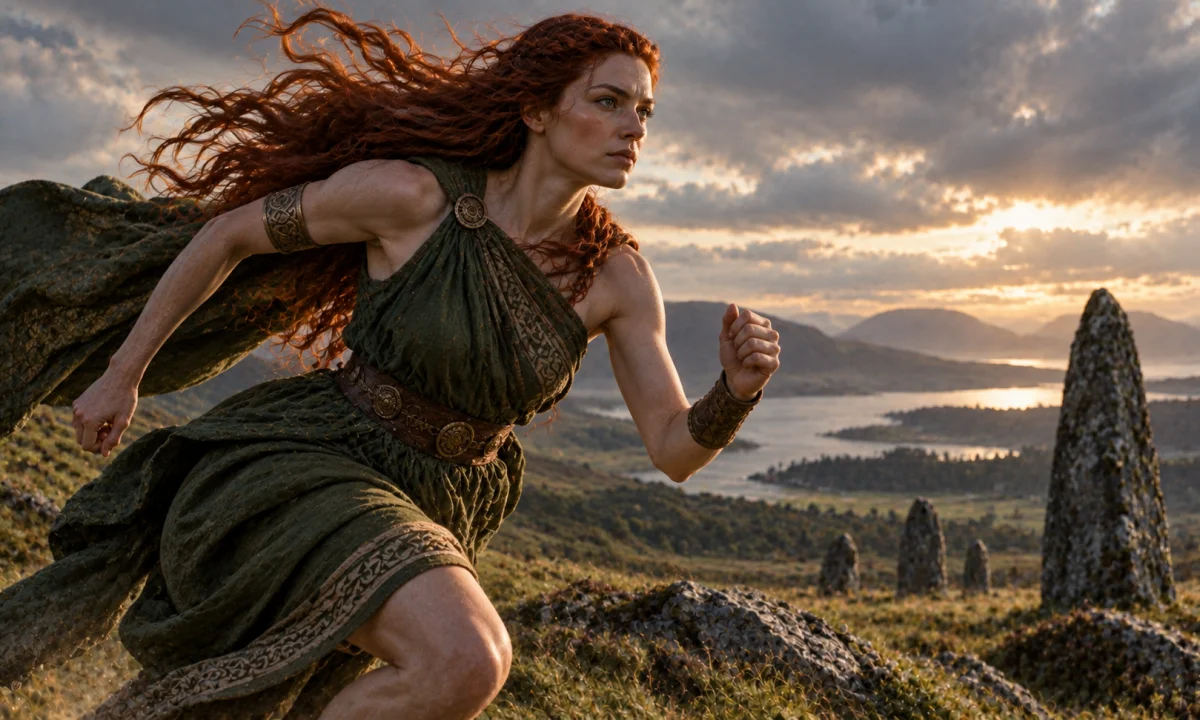
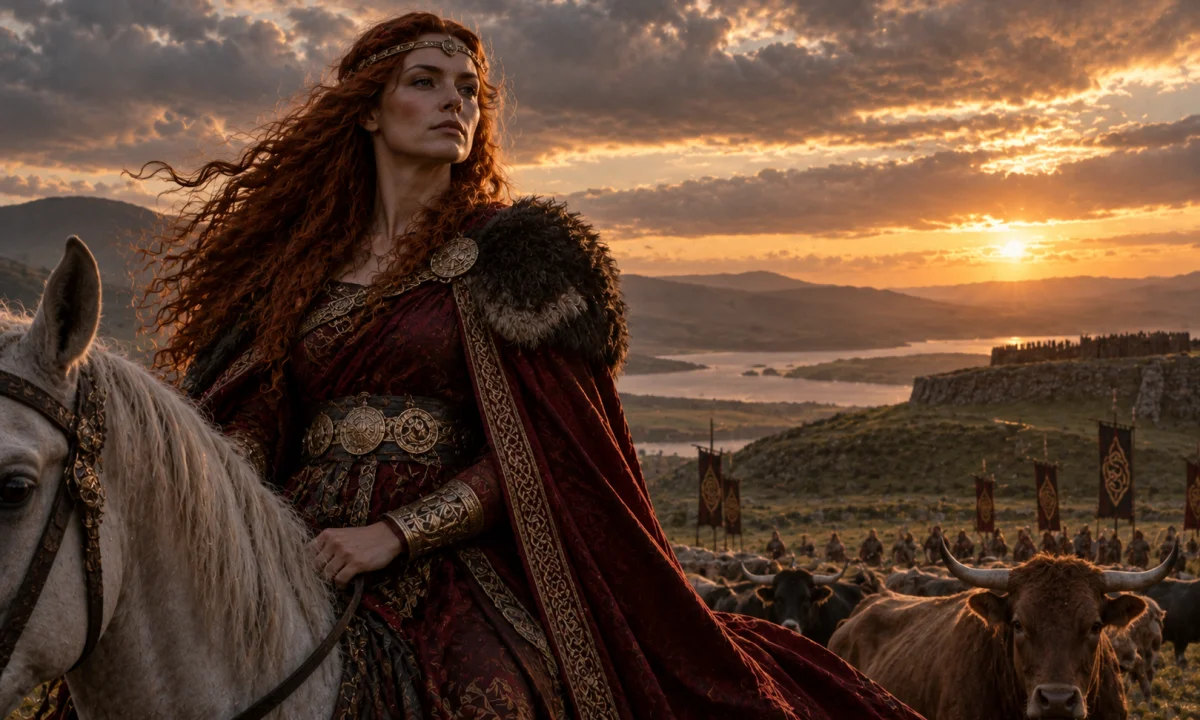
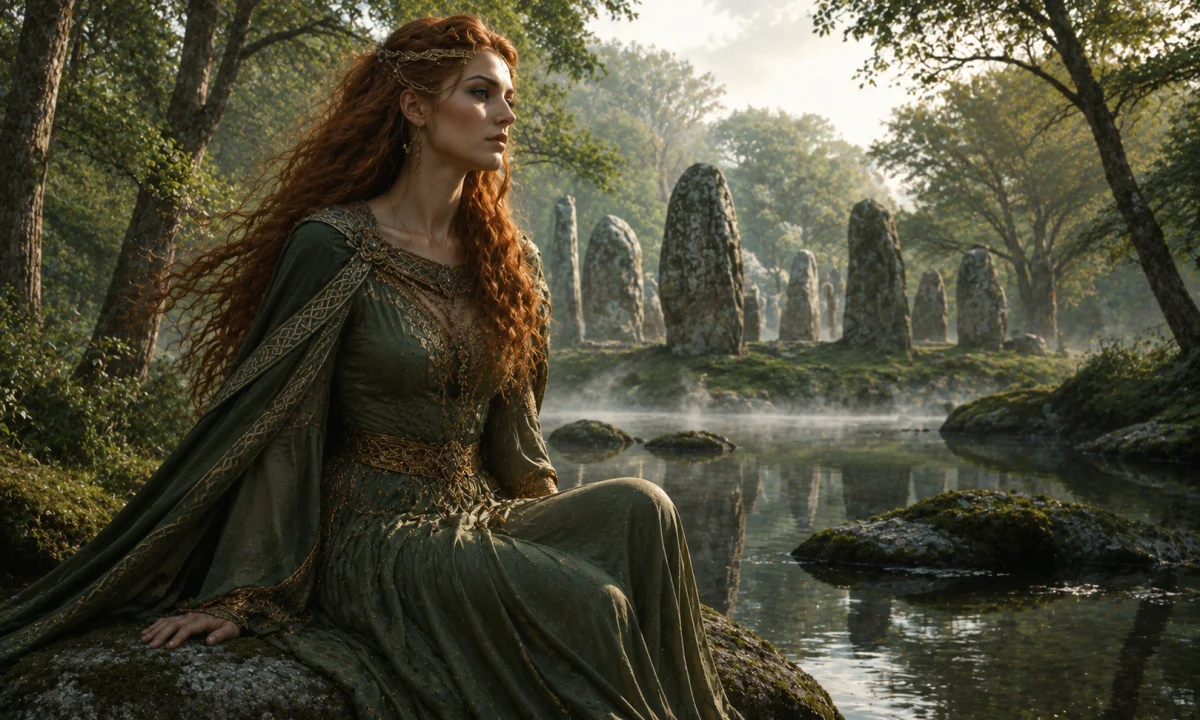
The surviving tradition does not provide a single canonical appearance for Nemain. She may be imagined as a supernatural woman, a terrifying presence or a power manifested through sound and collective panic. Unlike figures whose stories repeatedly specify an animal form, Nemain has no universally established physical shape.
Artists and modern retellings may depict her with weapons, dark clothing, battle armour, a crow or raven, or other imagery associated with Irish war goddesses. These choices can communicate her function, but they are modern visual interpretations rather than details securely fixed by ancient or medieval tradition.
Distinguishing Nemain from similar figures
- Nemain and the Morrígan: They are closely related in discussions of Irish war goddesses, but the names are not identical in every medieval source.
- Nemain and Badb: Both are associated with terror and battle, and some traditions overlap their roles. They should nevertheless be treated as distinct when a text names them separately.
- Nemain and Macha: Macha is a separate name connected with several different mythological women. Not every Macha is Nemain or a member of the same divine grouping.
- Nemain and Neit: Nemain is generally described as a female war power, while Neit is a male figure associated with warfare. They are sometimes presented as spouses.
- Nemain and Niamh: Niamh is a different name, best known from later heroic and Fenian-related stories such as those concerning Niamh Chinn Óir. Similar spelling in English does not indicate identity.
Later reception
Nemain has received less attention in popular culture than the Morrígan, whose name is now widely used in fantasy fiction, games, novels and modern spiritual movements. When Nemain appears in contemporary works, she is usually presented as a war goddess, queen of battle, personification of panic or member of a trio of Irish deities.
These portrayals often combine details drawn from Badb, Macha and the Morrígan, creating a more unified character than the medieval evidence supports. Such adaptations may be artistically effective, but they should be distinguished from the older tradition. The historical Nemain is best understood through the limited and variable literary evidence: a supernatural power of war, terror and frenzy whose identity sometimes stands apart and sometimes merges with the wider complex of Irish battle goddesses.