WORLD
WORLD
Namorodo
Namorodo is a name used in English-language accounts for a dangerous spirit being associated particularly with Aboriginal traditions of western Arnhem Land in the Northern Territory of Australia. The name is also written Namorrorddo, Namorrodor and in other ways, because Aboriginal words have often been recorded through different systems of English spelling. Descriptions likewise vary between communities and storytellers. Namorodo should therefore not be treated as a single, universally fixed “monster” belonging to all Aboriginal peoples of Australia.
Origins and cultural setting
Namorodo traditions are connected especially with the Kunwinjku-speaking peoples and neighbouring communities of western Arnhem Land. Arnhem Land contains many distinct Aboriginal languages, nations and cultural traditions, each with its own sacred geography, ancestral beings and systems of knowledge. A being known by a similar name in one community cannot automatically be assumed to have exactly the same meaning in another.
Much of the knowledge surrounding Namorodo comes from oral tradition, visual art and cultural explanations passed through generations. Such traditions should not be approached as a single written mythology with one official version. Aboriginal religious and social knowledge is often conveyed through stories, ceremony, place, kinship, law and images, with particular information being appropriate for particular people or contexts.
English descriptions commonly classify Namorodo as a dangerous spirit or malevolent supernatural being. That classification is useful as a broad explanation, but it does not fully express the role such beings can have within Aboriginal systems of law and moral understanding. A spirit that threatens people may also belong to a wider network of teachings about death, danger, the landscape, proper conduct and the boundaries between ordinary human life and the spirit world.
The name and its spellings
Namorodo is one of several English spellings. Namorrorddo and Namorrodor are especially common in discussions of Kunwinjku culture and Aboriginal art. Differences in spelling reflect attempts to represent sounds from an Aboriginal language using English letters; they do not necessarily indicate separate beings.
The grammatical form of the name can also vary. Some accounts use the word as the name of one being, while others speak of Namorodo as a class or group of spirits. English-language summaries sometimes move between singular and plural without explaining the difference. It is safest to recognise that both the identity and number of the beings may depend on the language, speaker and source tradition.
The spelling Namorodo is also sometimes used in popular lists of Australian monsters. Those lists may simplify the term into a generic “evil spirit” or “night monster.” Such descriptions can preserve a small part of the traditional idea while removing its cultural and linguistic setting.
Appearance and physical characteristics
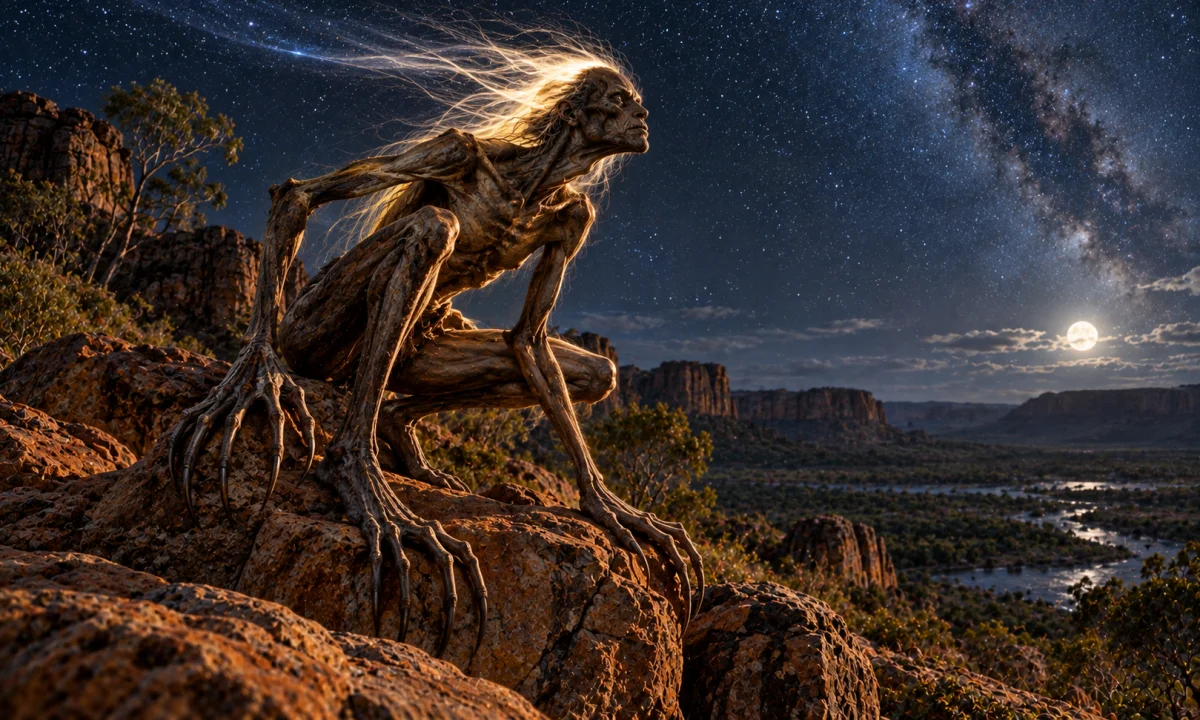
Descriptions of Namorodo often present the being as thin, elongated and human-like, but not as an ordinary person. Images may show a narrow body, prominent bones and sharp projections extending from the limbs or body. In some representations, the figure appears skeletal or emaciated. The visual emphasis is usually on unnatural thinness, angularity and danger rather than on a detailed, standardised anatomy.
Namorodo is frequently described as moving through the night or travelling through the air. Accounts often associate the being with a distinctive clicking or rattling sound. The sound can serve as a warning that the spirit is nearby, although the exact explanation and significance vary. In some tellings, people hear the being before they see it; in others, the emphasis falls on its sudden appearance and ability to attack from a distance.
Sharp bones are among the most frequently mentioned features of Namorodo stories. The being may be said to throw pieces of bone or use projecting bones as weapons. Some English accounts describe these attacks as causing sickness or death. The details are not identical across all descriptions, and there is no single canonical illustration that defines the being for every Aboriginal community associated with the tradition.
Contemporary paintings and drawings may depict Namorodo with long limbs, spikes, pointed features or a skeletal form. These images should not be assumed to be literal portraits. Aboriginal artists may use visual design to communicate a story, a place, a danger, a spiritual relationship or a body of cultural knowledge. The image’s significance depends on the artist, community and context in which it was made.
Role as a night spirit
Namorodo is commonly associated with darkness, remote places and the risks of travelling or sleeping outside after nightfall. In this respect, the being belongs to a broad category of supernatural dangers found in many cultures: figures whose presence marks the night as a time requiring caution and respect.
However, reducing Namorodo to a “scary story” loses much of the traditional context. Stories about dangerous beings can teach people where not to go, when to remain close to camp, how to respond to sounds in the landscape and how to behave in relation to places connected with the dead or with ancestral power. They may also express knowledge about the consequences of ignoring warnings or breaking customary rules.
Namorodo’s movement through the air gives the being a reach that ordinary predators do not possess. A person cannot necessarily protect themselves simply by staying on a path or hiding behind a physical barrier. The airborne nature of the spirit reinforces its supernatural status and helps explain why accounts often focus on sound, sudden attack and the vulnerability of people at night.
Some descriptions connect Namorodo with shooting stars or other lights seen in the night sky. This association is not presented consistently in every account, and it should not be treated as a universal attribute. Where it occurs, it illustrates how celestial events, landscape signs and spirit beings may be interpreted together within a particular cultural tradition.
Stories and variations
There is no single, standard Namorodo narrative comparable to a fixed literary myth. Different tellings may vary in the being’s appearance, habitat, sounds, method of attack and relationship to human beings. Some accounts emphasise an individual spirit; others describe a type of dangerous being. A short description in a museum catalogue, an artwork, an oral account and a popular encyclopedia may therefore present different aspects of the tradition without necessarily contradicting one another.
The most widespread outline describes a spirit that travels at night, produces a clicking noise and threatens people with sharp bones. The danger may involve direct physical attack, supernatural illness or death. In some versions, the being is encountered by people who are away from camp or sleeping in the open. The story’s force lies less in a sequence of adventures than in the warning it conveys: certain places, times and actions expose people to forces that must be treated seriously.
It is important not to invent a family tree or a set of relationships for Namorodo. General accounts do not establish one universally accepted parent, spouse, enemy or origin story. Nor should every frightening figure appearing in an Arnhem Land narrative be identified as Namorodo merely because it is dangerous or supernatural. Classification depends on the cultural and linguistic context of the particular account.
Religious and cultural significance
In Aboriginal Australian traditions, supernatural beings are often inseparable from land and law. A spirit may be connected with a specific waterhole, rock shelter, hill, pathway or region, even when a brief English description leaves that connection out. The significance of Namorodo therefore cannot be understood only through its appearance. Its importance may lie in what it teaches about place, conduct, mortality and the continuing presence of spiritual power.
Fear is one element of the tradition, but it is not necessarily the whole meaning. Dangerous beings can help maintain social boundaries by expressing what should not be done and where people should not go. They can also provide a language for discussing death and unexplained harm. Such stories do not function merely as entertainment; in their traditional setting, they may form part of a living body of cultural knowledge.
Descriptions written by outsiders have sometimes presented Aboriginal spiritual beings as “demons” or “devils.” These words can be misleading. They import ideas from Christian demonology and European folklore that may not match Aboriginal categories. Calling Namorodo a demon may communicate that the being is dangerous, but it does not establish that Namorodo has the same nature, moral status or religious role as a demon in Christian or European traditions.
Namorodo in Aboriginal art
Namorodo has become recognisable through Aboriginal visual art, particularly works associated with western Arnhem Land. Artists may depict the being as a narrow, spiked or skeletal figure, sometimes with an emphasis on the sound and motion associated with its nighttime presence. The image can be unsettling, but its meaning remains rooted in the artist’s cultural setting rather than in a universal horror iconography.
Artworks involving Namorodo may be made for different audiences and purposes. Some are connected to the continuation of cultural stories; others are contemporary interpretations created within an art market or exhibition context. A modern painting is not automatically a literal record of an ancient image, and an older rock-art figure cannot always be identified with certainty from appearance alone. Interpretation should take account of the artist’s explanation and the relevant community knowledge.
The continued appearance of Namorodo in contemporary Aboriginal art demonstrates that traditional beings are not simply relics of a vanished past. Artists can use established figures to explore memory, country, danger, cultural continuity and the relationship between inherited knowledge and present-day life. At the same time, outsiders should avoid treating every artistic depiction as permission to disclose restricted cultural information.
Distinction from similar figures
Namorodo is sometimes confused with other beings from Aboriginal Australian traditions, especially when all are described in English as monsters or evil spirits. These comparisons should be made carefully.
- Mimi spirits: Mimi are supernatural beings associated particularly with western Arnhem Land and are often described in connection with rock shelters, cliffs and artistic knowledge. They are not simply another name for Namorodo. Their forms, stories and cultural roles differ, even though English summaries may place both among Arnhem Land spirit beings.
- Yawk yawk: Yawk yawk are water-associated female spirit beings in parts of northern Australia, often connected with billabongs, rivers and other bodies of water. They belong to a different set of traditions and should not be merged with the airborne, dangerous figure commonly described as Namorodo.
- Bunyip: The Bunyip is associated mainly with Aboriginal traditions of southeastern Australia and has many regional forms. It is not an alternative name for Namorodo. The two may be grouped together in modern collections of Australian monsters, but their cultural origins are distinct.
- European demons and devils: Namorodo does not derive from Christian demonology. Similarities in descriptions of danger, death or nighttime activity do not prove a shared origin.
Modern reception
Outside Aboriginal cultural contexts, Namorodo is often presented in websites, books and media as a supernatural predator or “Australian monster.” These summaries commonly focus on its thin body, flying movement, clicking sound and bone weapons. Such features make the figure attractive to horror and fantasy treatments, but the simplified version may detach the name from the people, language and country with which it is associated.
There is no need to treat every modern use as equivalent to traditional knowledge. A fantasy work may borrow the name while inventing an entirely new creature, just as a popular monster encyclopedia may combine details from several accounts. Those adaptations should be identified as modern reinterpretations rather than presented as authoritative descriptions of Aboriginal tradition.
The most responsible understanding of Namorodo keeps both facts in view: the being has a strong presence in descriptions of western Arnhem Land spiritual traditions and Aboriginal art, yet the surviving English accounts do not provide one complete, universally agreed mythology. Its name, spelling, appearance and precise role vary, and those variations are part of the evidence that Namorodo belongs to living, community-based traditions rather than to a fixed catalogue of monsters.