WORLD

Dhakhan
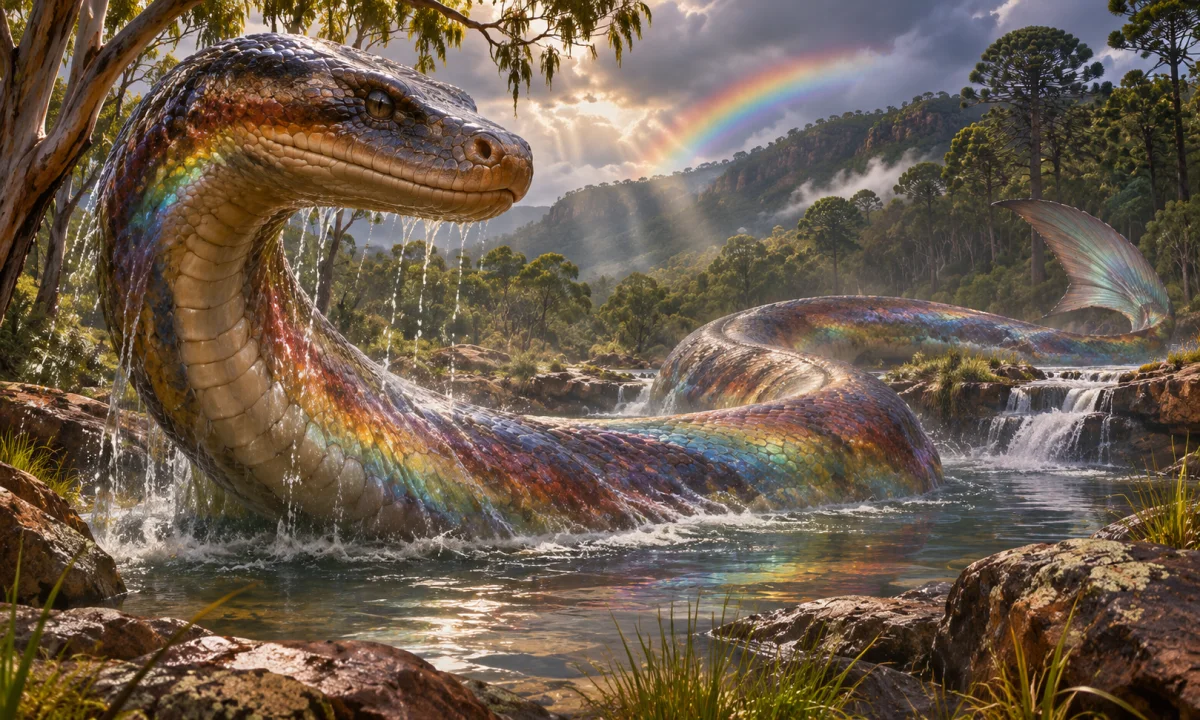
Dhakhan is a name associated in some English-language accounts with a serpent-like being in Australian Aboriginal mythology. The available information is limited, and the name is not documented with the same consistency as better-known figures such as the Rainbow Serpent, Baiame, Bunjil or Daramulum. Its exact cultural origin, language affiliation and traditional meaning are therefore uncertain.
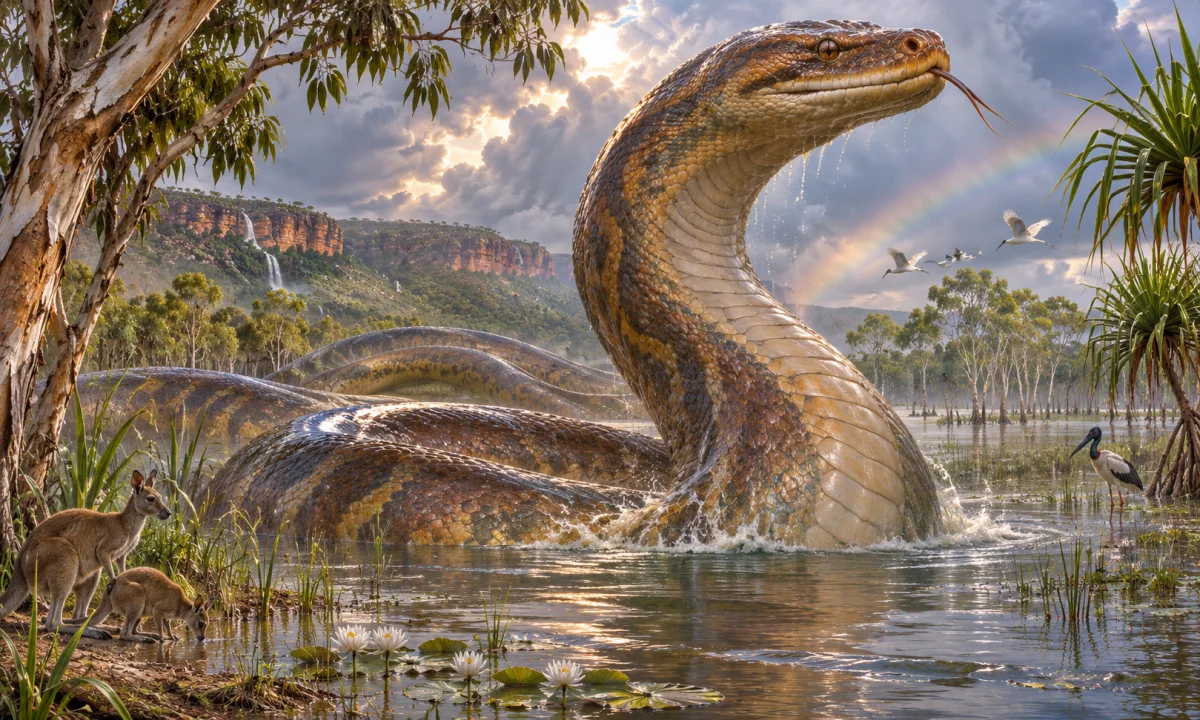
Descriptions of Dhakhan generally place the being among supernatural water creatures: a large serpent or dangerous spirit connected with rivers, waterholes or other waterways. These brief descriptions should not be treated as a single, universally accepted Aboriginal tradition. Aboriginal Australia contains hundreds of distinct cultural and language groups, each with its own laws, ancestral beings, place traditions and ceremonial knowledge. A name recorded in a general collection of “Aboriginal mythology” may have been detached from the community and country in which it originally had meaning.
Cultural setting
Traditional Aboriginal religious life is often described in English through the word Dreaming or Dreamtime. These terms refer not simply to a distant age of creation, but to an enduring network of ancestral events, laws, relationships, places and responsibilities. In many traditions, ancestral beings shaped the land while travelling through it, established social and ceremonial rules, and left continuing spiritual presence in particular hills, rivers, caves and waterholes.
Water beings therefore cannot automatically be classified as monsters in the modern sense. A serpent associated with a river might be understood as an ancestor, guardian, law-bearing power, dangerous presence or explanation for the character of a place. The same being may have different aspects depending on the community, story, location and purpose of the narration. Descriptions such as “good,” “evil,” “monster” or “god” can be misleading when they impose categories from European folklore.
Knowledge about sacred beings has traditionally been transmitted through oral teaching, ceremony, performance, visual design, song and relationships to Country. Some knowledge is restricted according to age, gender, initiation or cultural authority. Early European collectors often recorded only fragments, sometimes through interpreters and sometimes without identifying the speaker, language or precise location. Those circumstances help explain why a name such as Dhakhan may survive in a thin or inconsistent form.
Name and identity
The spelling Dhakhan is not supported by a widely standardized account in the general reference tradition. Similar spellings, including forms beginning with “D,” may appear in popular lists or secondary compilations, but resemblance between names does not prove that they refer to the same being. Aboriginal languages use sound systems and spelling conventions that vary between communities, and colonial transcriptions frequently altered pronunciation.
There is also uncertainty about whether Dhakhan was originally the name of a particular ancestral being, a regional water spirit, a word later interpreted as a creature, or a name repeated and reshaped by modern writers. The surviving descriptions are too limited to establish a secure biography, genealogy or fixed set of attributes.
For that reason, Dhakhan is best presented as a poorly documented serpent or water-associated figure rather than as a clearly defined pan-Aboriginal deity. It is not accurate to claim that all Aboriginal peoples traditionally recognized Dhakhan, or that the being has one canonical appearance and story across Australia.
Appearance and nature
Modern descriptions usually portray Dhakhan as a large snake or serpent-like creature. This imagery places the being within a broad and important Australian tradition in which serpentine ancestral powers are connected with water, fertility, weather, landscape formation and social order. However, the surviving references do not provide a dependable traditional description of Dhakhan’s colour, size, markings, head, limbs or other physical features.
Nor is there sufficient evidence for a detailed list of supernatural powers. Accounts may associate the figure generally with waterways or danger, but claims that Dhakhan created particular rivers, caused specific floods, guarded a named spring or possessed a fixed ability to transform people should be treated cautiously unless they can be tied to a clearly identified community tradition.
The danger attributed to water beings in Aboriginal traditions often has a practical as well as spiritual dimension. Rivers, billabongs and deep waterholes can contain strong currents, unstable banks, submerged hazards and sudden changes in water level. Stories about powerful beings may communicate rules concerning where people may travel, when water can be approached and how Country must be respected. A general description of Dhakhan as a threatening water serpent does not, by itself, reveal the full cultural purpose of the tradition behind the name.
Relationship to the Rainbow Serpent
Dhakhan is sometimes grouped with the Rainbow Serpent because both are described in serpent form and associated with water. That comparison can be useful as a broad point of reference, but the figures should not be merged. “Rainbow Serpent” is an English umbrella expression applied to many distinct Aboriginal ancestral traditions. Different communities have their own names, stories and understandings of powerful serpentine beings, and not every one of them corresponds to a single pan-Australian character.
Some Rainbow Serpent traditions describe an ancestral power that travelled across the land, formed waterways, regulated rain or controlled access to sacred places. Other traditions emphasize law, fertility, initiation, kinship or the protection of Country. The evidence available for Dhakhan is not detailed enough to show that it belongs to any one of these particular traditions. It is therefore safer to say that Dhakhan resembles the wider water-serpent motif than to identify Dhakhan as simply another name for the Rainbow Serpent.
Relationship to the bunyip
Dhakhan may also be confused with the bunyip, a name used in colonial-era accounts for a dangerous being inhabiting swamps, rivers, lagoons and waterholes. Bunyip traditions vary considerably, and the English word has often been used as though it described one creature throughout Australia. In practice, early writers frequently applied it to different local beings and stories.
The distinction is important. A bunyip is not automatically a serpent, while Dhakhan is generally presented in serpent-like form. A water habitat alone does not establish identity. Similarities between the two may reflect a shared concern with dangerous waters, or they may result from later writers grouping unrelated traditions under a small number of familiar labels.
Stories and variants
No single, well-attested cycle of stories about Dhakhan can be confidently reconstructed from the commonly available material. There is no securely established canonical account describing the being’s birth, travels, relatives, enemies or death. Details sometimes repeated in online encyclopedias and lists may be summaries created by later compilers rather than translations of a continuous traditional narrative.
This lack of a full story is itself significant. Aboriginal traditions are not deficient because they do not fit the format of a written mythology with one definitive text. Oral traditions can remain rich and authoritative while being known through local performance, ceremony and custodianship rather than through a published narrative. In the case of Dhakhan, however, the public record is too fragmentary to identify which community, if any, maintains a detailed account under this exact spelling.
Variants in spelling may represent differences in pronunciation, different transcription systems or entirely separate names. A similar-looking word from another Aboriginal language should not be assumed to refer to Dhakhan. Proper identification requires attention to Country, language, cultural authority and the context in which the name was recorded.
Interpretation and cultural significance
The most responsible interpretation of Dhakhan begins with place and relationship rather than with the image of a fantasy monster. If the being belongs to a particular local tradition, its significance would be connected to the waterways, ancestral history and laws of that Country. A serpent may express the presence of a life-giving but dangerous power: water sustains people, animals and plants, yet it can also punish careless behaviour or violations of customary rules.
Water-associated ancestral beings can also express the continuity between landscape and society. A river is not merely a physical feature in such a framework. It may be a record of ancestral action, a source of food and teaching, a boundary between groups, a ceremonial location or a site requiring particular forms of respect. Stories connected with such places can preserve environmental knowledge and affirm obligations to Country without reducing the tradition to a simple moral lesson.
At the same time, interpretation should not overstate what is known about Dhakhan specifically. It is reasonable to discuss the broader importance of serpent and water imagery in Aboriginal Australia. It is not reasonable to assign every common feature of those traditions to Dhakhan without clear evidence. The figure’s exact significance remains uncertain in the public record.
Sources and the problem of classification
The label “Australian Aboriginal mythology” is convenient for a general catalogue but conceals enormous cultural diversity. It places figures from distant regions beside one another and can suggest that they form a single religious system. Dhakhan should therefore be identified more cautiously than a figure with a well-documented regional tradition.
Written records of Aboriginal traditions were often produced by missionaries, anthropologists, travellers, settlers or later popular writers. Their work may preserve valuable information, but it can also reflect unfamiliarity with Aboriginal languages, pressure on Indigenous informants, mistranslation or the tendency to reshape ancestral beings as European-style gods and monsters. A short entry that calls Dhakhan a “mythical snake” may preserve a name while omitting the cultural setting that made the name meaningful.
Contemporary discussion should distinguish between community-held tradition, historical documentation and modern compilation. Where a precise language group or locality is not securely documented, the uncertainty should remain visible rather than being concealed by confident storytelling.
Modern reception
Dhakhan has little established presence in internationally familiar popular culture. The name may appear in modern lists of Australian mythical creatures, websites about legendary animals, fantasy databases or creative works inspired by Aboriginal themes. Such appearances generally simplify the figure into a generic giant serpent or water monster.
Those adaptations are modern interpretations, not evidence that every added feature belongs to traditional Aboriginal belief. A fictional Dhakhan may be given a detailed appearance, a personal history, magical abilities or a role in an invented plot. Unless those details are linked to a clearly identified Indigenous tradition, they should be treated as creative additions rather than recovered mythology.
Respectful use of the name requires avoiding claims that it represents all Aboriginal cultures and avoiding the appropriation of sacred knowledge. The most accurate account remains a careful one: Dhakhan is a sparsely documented Aboriginal water-serpent figure whose name and traditional identity require regional and linguistic clarification before more specific claims can be made.