WORLD
WORLD
Mimi
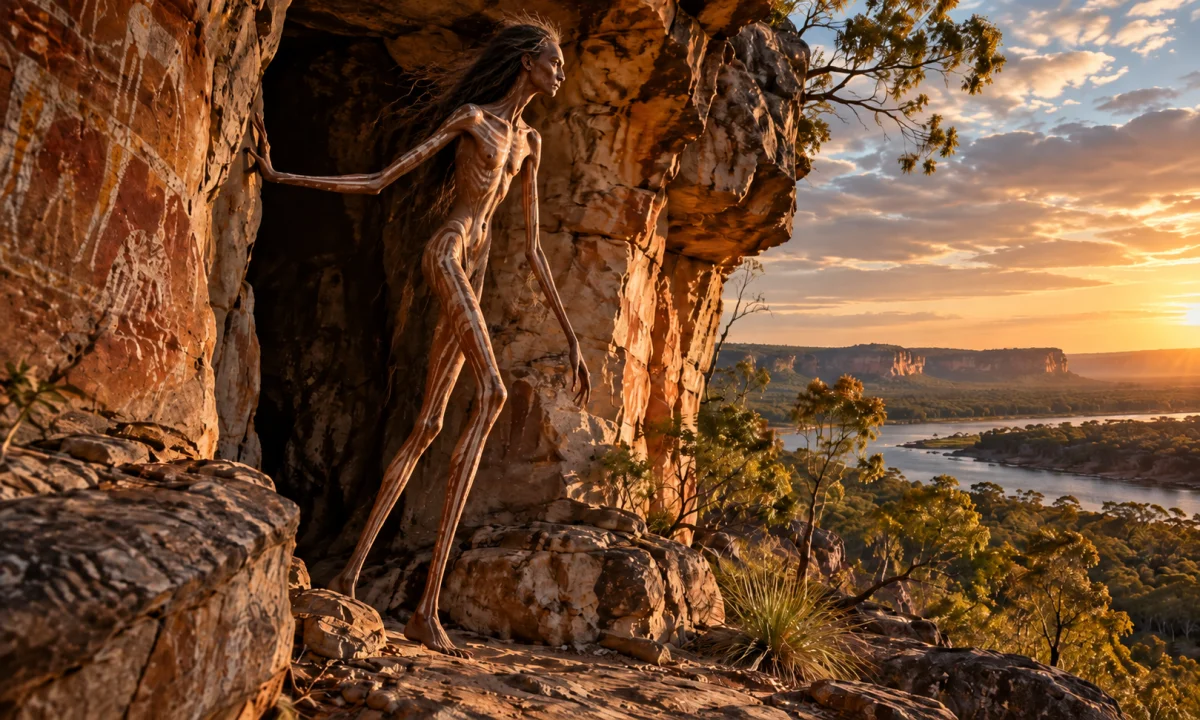
Mimi, also written mimih or mimih spirits, is a name used in Aboriginal traditions of western Arnhem Land in northern Australia, particularly among Kunwinjku-speaking Bininj people. Mimi are generally described as spirit beings associated with rocky escarpments, caves and secluded places. In traditional stories they may act as teachers, hunters, tricksters or dangerous neighbours, although their character and significance vary between communities and storytellers.
The word does not describe one universally fixed character. Aboriginal Australia contains many distinct language groups, each with its own religious traditions, ancestral beings and laws. Accounts of the Mimi belong chiefly to the cultural region around western Arnhem Land, rather than to a single mythology shared by all Aboriginal peoples. English-language writing has sometimes treated “Mimi” as if it were the name of one standardized supernatural species, but Indigenous traditions are more varied and locally grounded than that description suggests.
Origins and cultural setting
Mimi traditions are connected with the landscapes of Arnhem Land, especially the sandstone cliffs, rock shelters and escarpments of the western and central parts of the region. These formations are not merely scenic locations. In Aboriginal religious thought, places can hold ancestral presence, law, memory and spiritual power. A cave, cliff face or crevice may therefore be understood through stories about the beings who live there or who shaped the surrounding country.
Many accounts describe the Mimi as living in narrow cracks and hidden spaces in cliffs. They are said to emerge at night or to move through the landscape when people are not watching. Their secluded homes help explain why they are often imagined as elusive and difficult to encounter directly. A person who knows the country and its customary knowledge may recognize a Mimi place, while an outsider may see only an ordinary rock shelter.
The traditions were preserved primarily through oral teaching, performance, restricted cultural knowledge and relationships to country. Later descriptions also come from anthropological records, mission-era observations, interviews and the work of Aboriginal artists. These written accounts must be read carefully. Early European observers often translated complex Indigenous concepts into familiar categories such as “fairies,” “ghosts,” “spirits” or “little people.” Such labels can be convenient, but none is an exact equivalent of the cultural idea.
The name and identity of the Mimi
Mimi and mimih are English spellings associated with related regional terms. Spelling varies because the original languages were recorded using different systems, and because words were sometimes written down by people unfamiliar with the sounds or grammar of the language concerned. “Mimi” is therefore not necessarily the preferred form in every community or context.
Descriptions also vary in whether Mimi are treated as a group of beings, a broad class of spirits or particular named characters within local stories. Some accounts emphasize their resemblance to very thin human figures; others focus on their role as inhabitants of the rock country. The term can refer to beings known through story and ceremony, as well as to figures identified in the rock-art traditions of Arnhem Land.
It is important not to assume that every Aboriginal person uses the word in the same way. Religious knowledge may be connected to particular estates, clans, language groups or initiation systems. Some information may be public, while other knowledge is restricted according to age, gender, kinship or ceremonial authority. General descriptions consequently give only part of the meaning carried by Mimi traditions.
Appearance and physical characteristics
Mimi are commonly imagined as extremely thin, light-bodied beings with elongated limbs and narrow torsos. Their bodies are sometimes described as so delicate that a strong wind could injure them or break their necks. This unusual fragility contrasts with their extraordinary speed and ability to move through difficult country. In some stories they can run faster than ordinary people and disappear into the landscape before they can be caught.
Descriptions of their faces, hair and bodily details are not consistent across all accounts. Some representations show recognizable human anatomy, while others are more schematic or skeletal. Mimi may be depicted standing, running, dancing or hunting. Their thinness is often the most visually distinctive feature, but it should not be treated as a universal rule for every figure connected with the name.
Traditional accounts sometimes portray Mimi as having powers associated with invisibility, nocturnal movement and knowledge of hidden places. They may be able to avoid human observers, travel rapidly or use the rocks as a form of protection. These characteristics make them beings of the boundary between the familiar and the unseen: they resemble people, yet they belong to a different order of existence and follow their own ways.
Teachers, hunters and culture heroes
In some western Arnhem Land traditions, Mimi are credited with teaching people practical skills. Stories may associate them with hunting techniques, the use of fire, the preparation of food or other forms of knowledge needed for life in the country. Such stories do not necessarily present Mimi as benevolent instructors in the modern sense. A being may teach a valuable skill while remaining dangerous, unpredictable or capable of punishing disrespect.
The Mimi are also associated with hunting and the activities of men moving through the bush and rocky country. In some narratives they hunt animals or show humans how to approach game. Their expertise reflects close observation of the natural environment: tracks, wind, animal behaviour, shelter and the timing of movement. A story about a Mimi hunter can therefore communicate both spiritual significance and practical knowledge.
Some descriptions characterize Mimi as among the beings who occupied the country before or alongside human settlement. Others portray them as a separate spirit population that already knew how to live in the landscape. These versions should not be forced into a single chronology. Aboriginal accounts of ancestral time do not always correspond to the linear historical sequence assumed by European mythological writing. The important point is often the relationship between beings, people, places and customary law rather than a precise date of origin.
Behaviour and relationships with people
Mimi are frequently described as shy or wary of humans. Their tendency to remain in cliffs and to move at night reflects this reserve. Yet shyness does not make them harmless. A person who disturbs their home, breaks a customary rule or enters a spiritually significant place without permission may be exposed to danger.
Stories about encounters can express rules concerning appropriate conduct in the landscape. They may warn people not to wander alone, not to approach a restricted rock shelter, or not to treat a sacred place as ordinary terrain. The supernatural danger is therefore connected to social and religious responsibility. Mimi stories can teach attentiveness to country and respect for knowledge held by the relevant custodians.
As with many Indigenous traditions, the moral character of a being may be relational rather than absolute. Mimi are not simply “good spirits” or “evil spirits.” They can help, teach, deceive, frighten or punish depending on the situation. A person who acts correctly may receive knowledge or avoid harm; someone who behaves carelessly may encounter the more dangerous side of Mimi power.
Mimi in Arnhem Land rock art
Arnhem Land is renowned for its extensive rock art, including paintings of human figures, animals, ceremonial scenes and beings with unusual proportions. Some elongated, stick-like figures in the region are popularly called Mimi figures. Contemporary Aboriginal artists also use Mimi subjects in painting and sculpture, drawing on living traditions as well as the visual history of the country.
The relationship between Mimi stories and ancient rock art is complex. Aboriginal people may identify particular figures as Mimi, and local knowledge is essential when interpreting an image. At the same time, not every thin human figure in a rock shelter can automatically be identified as a Mimi. Rock art was produced across long periods, by different artists and for different purposes. Some images may represent ancestors, ceremonial participants, hunters, spirits or subjects that cannot be securely interpreted from their appearance alone.
Archaeological age and traditional identification are also different kinds of evidence. A painting may be very old, while the explanation attached to it today belongs to a later or continuing cultural tradition. This does not make the tradition unimportant or invalid; it means that the history of an image and the cultural meaning it carries should not be collapsed into one simple claim. Interpretation is strongest when archaeological evidence, local cultural knowledge and the limits of outside observation are all kept in view.
Meaning and cultural significance
Mimi traditions help express a distinctive understanding of the relationship between people and country. The beings are not merely inhabitants of an imaginary underworld. They are linked to actual cliffs, shelters, paths and hunting grounds. Their stories can locate spiritual power in particular places and remind people that the landscape contains histories and presences that are not immediately visible.
Their physical form may also symbolize a way of existing at the edge of ordinary human experience. Mimi are recognizably person-like, but their unusual bodies, speed and hidden homes separate them from everyday society. They belong to the rocky margins, the night and the spaces between visibility and concealment. These qualities make them especially suited to stories about knowledge that must be approached carefully.
Accounts of Mimi should not be reduced to a belief in “little people.” That phrase is sometimes used in popular writing because Mimi are often portrayed as small or slender supernatural beings, but it can impose European folklore categories on an Aboriginal tradition. Mimi are connected with specific languages, lands, cultural responsibilities and artistic practices. Their importance lies less in their resemblance to European fairies than in the ways they belong to Arnhem Land country and its systems of knowledge.
Distinguishing Mimi from similar figures
The name Mimi can cause confusion because similar words occur in other Aboriginal traditions and because English writers have applied the term broadly. Not every Aboriginal spirit called a “little person” is a Mimi. Australia has many regional traditions concerning ancestral beings, bush spirits, dangerous creatures and hidden people, but these figures should not be merged simply because they share a small or human-like appearance.
Mimi should also be distinguished from the Yowie, a creature of later Australian popular culture that is usually imagined as a large, hairy wild man. The two are unrelated in appearance and cultural history. Mimi are likewise not the same as the Wandjina or other major ancestral figures associated with Kimberley rock art. Similarity in being connected with Aboriginal art or spirituality does not establish a shared identity.
Nor should Mimi automatically be equated with ghosts. Some stories describe them as invisible, elusive or dangerous, but their identity is tied to a particular living tradition and to relationships with country. “Ghost” suggests the spirit of a dead human, whereas Mimi accounts do not all present them in that way.
Modern representation and cultural care
Mimi continue to appear in contemporary Aboriginal art, especially in work connected with western Arnhem Land and artists who draw on Kunwinjku cultural knowledge. In these contexts, Mimi may be part of a living artistic vocabulary rather than a relic of an ancient mythology. The meaning of a painting depends on the artist, the community, the story being represented and the level of knowledge the artist has permission to share.
Mimi have also appeared in museum displays, tourism writing, books about Australian folklore and general discussions of Aboriginal mythology. These settings can make the beings more widely known, but they may also simplify them into generic “Australian fairies” or mysterious cave-dwellers. Such portrayals often remove the local language, custodial relationships and cultural restrictions that give Mimi traditions their significance.
Responsible discussion therefore treats Mimi as part of continuing Aboriginal cultural knowledge, not as an exotic monster invented for entertainment. The most reliable descriptions acknowledge regional variation, avoid claiming that one story represents every community, and recognize that some teachings are not intended for unrestricted publication. Mimi are best understood through their connection with western Arnhem Land landscapes, Indigenous art and the responsibilities involved in knowing country.