WORLD
WORLD
Mokoi

Mokoi is a name used in some English-language accounts of Australian Aboriginal supernatural belief for a dangerous spirit associated with death, fear and attacks on sleeping people. The available descriptions are brief and inconsistent, however, and “Mokoi” should not be treated as the name of one universally recognised being shared by all Aboriginal peoples of Australia. Aboriginal societies have distinct languages, religious systems and ancestral traditions, so the identity and significance of a figure recorded under this spelling depend heavily on the community and source involved.
Origins and cultural setting
Australian Aboriginal religious traditions are not a single mythology. They include the laws, ceremonies, ancestral histories, sacred places and moral teachings of many different peoples. These traditions are often described in English through the broad concept of the Dreaming or Dreamtime, although individual communities use their own terms and understandings. The Dreaming is not simply a distant age of myths. It can refer to continuing ancestral realities that explain the formation of the land, social obligations, ritual knowledge and relationships between people, animals, places and spiritual powers.
Within this wide cultural setting, many communities recognise dangerous beings, ancestral presences, ghosts or beings connected with illness and death. Their roles cannot automatically be reduced to the European idea of a “demon.” A being that appears threatening in an English description may have a more specific function in its own cultural context, such as enforcing restrictions, explaining an unexpected death, protecting a sacred place or expressing the consequences of breaking social law.
The name Mokoi is not supported by a large, consistent body of widely available traditional narratives. Much of what is repeated about it comes from short reference entries and later summaries rather than from a clearly identified cycle of stories. Those accounts commonly describe Mokoi as a malevolent spirit or ghost that harms people during sleep. They do not establish a single appearance, genealogy, ritual system or geographical origin that can confidently be applied across Aboriginal Australia.
Name, spelling and identity
The spelling “Mokoi” appears principally in English-language writing. It may represent an attempt to record a word from an Aboriginal language, but the relevant language is not always identified. Without a language, place, community or original recorded form, the meaning of the name cannot be securely explained. It is therefore unwise to claim that Mokoi has one fixed translation, such as “killer,” “night spirit” or “demon.”
Spelling variation is common in older records of Aboriginal traditions. European observers often wrote unfamiliar sounds according to the conventions of their own language, and the same word could be transcribed in several ways. A later writer might also standardise, shorten or alter a name while removing the geographical information that originally accompanied it. Similar-looking names in separate languages may have no relationship to one another.
For these reasons, Mokoi is best described cautiously as a reported supernatural figure associated in some accounts with nocturnal danger. The term should not be presented as though it refers to a single pan-Aboriginal monster with a standard appearance and universally accepted powers.
Traditional descriptions
Short descriptions of Mokoi usually emphasise its hostility toward human beings. The being is often said to approach or attack people while they sleep. In this form, the tradition belongs to a broad class of night-related supernatural beliefs found in many cultures: a person’s vulnerability during sleep provides a way to explain nightmares, sudden illness, unexplained death or the presence of an unseen enemy.
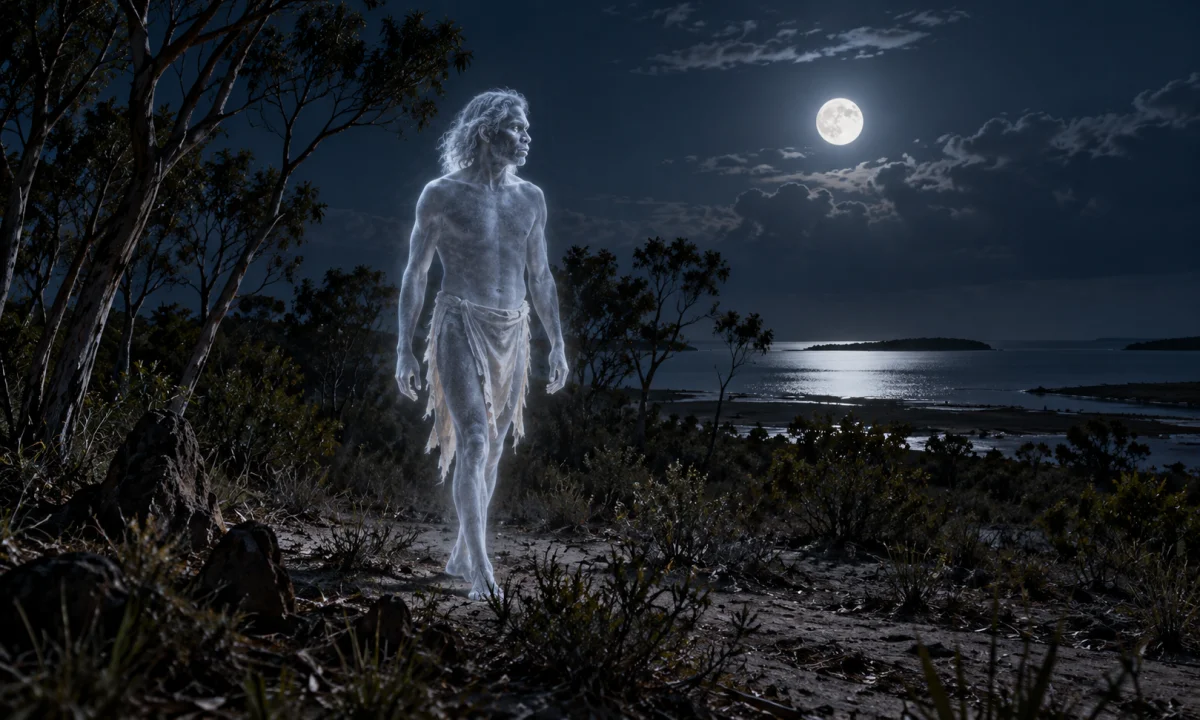
There is no dependable traditional description that establishes one canonical body for Mokoi. Modern lists may portray it as a ghost, spirit, shadowy figure or demon, but these visual details are not equally well supported. Images created for encyclopaedias, games or popular websites should not be mistaken for evidence of a traditional Aboriginal depiction.
Likewise, claims that Mokoi possesses a particular set of physical powers should be treated carefully. The recurring feature in popular summaries is its association with harm during sleep. Beyond that, accounts may differ or provide no information. It is safer to distinguish between the features found repeatedly in brief descriptions and later embellishments supplied by artists, fiction writers or compilers of monster lists.
Night, sleep and danger
Night has particular importance in many religious and storytelling traditions because ordinary protections are reduced after dark. People cannot see clearly, communities may be separated from one another and dreams can blur the boundary between the familiar and the unknown. A spirit that attacks sleepers can therefore symbolise more than physical violence. It may represent anxiety, vulnerability, illness, forbidden places or the consequences of ignoring warnings.
That symbolism should not be imposed as a universal interpretation. The meaning of a nocturnal being depends on the people who tell the story and the social circumstances in which it is told. A warning used to protect children from dangerous locations is not necessarily the same as a ritual account of death, and neither should automatically be treated as a simple “monster story.”
Stories and narrative variants
No single, widely attested Mokoi story can be identified with confidence from the limited material commonly circulated under this name. There is no securely established epic comparable in documentation to some better-known ancestral narratives, and no universally accepted list of relatives, enemies or victims.
Some retellings state that Mokoi comes to a sleeper and causes death. Others use more general language, presenting it as an evil spirit that wanders at night or preys upon vulnerable people. These versions may reflect different local traditions, loose paraphrase or the gradual expansion of a very short original notice. They should not be combined into one continuous legend without evidence that they derive from the same community.
In particular, the name should not be attached automatically to stories about every Australian Aboriginal spirit of the night. Aboriginal traditions include many beings associated with death, dangerous country, sickness, punishment and the violation of sacred law. A similarity of function does not prove identity. A being recorded in one region may have a name, appearance and religious role entirely different from those of Mokoi.
Religious and cultural significance
Calling Mokoi an “evil spirit” can be useful as a brief description of how some English sources classify it, but the phrase carries assumptions from Christian and European demonology. In Aboriginal contexts, supernatural beings may not fit neatly into categories such as angel, demon, ghost or god. Their relationships with human beings can involve danger, authority, ancestry, place and law at the same time.
A frightening spirit may serve a social purpose by reinforcing rules about conduct, travel, ritual behaviour or respect for particular places. Stories of supernatural danger can communicate knowledge that is practical as well as religious. They may discourage people from travelling alone at night, entering restricted areas or disregarding the instructions of elders. Such functions are not evidence that the figure is merely fictional in the dismissive sense; in a living religious tradition, story, law, landscape and spiritual reality may be closely connected.
It is also important to recognise that Aboriginal knowledge has traditionally been transmitted through performance, ceremony, kinship responsibilities, art, language and relationships with country. A short written description of Mokoi removes much of that context. Written records can preserve valuable information, but they may also reflect the purposes and misunderstandings of outsiders. The absence of a detailed published account does not demonstrate that a tradition was insignificant, nor does a brief reference prove that a figure was known throughout Australia.
Distinguishing Mokoi from similar figures
Mokoi is sometimes confused with other supernatural beings from Australia because general reference works place many unrelated figures under headings such as “Aboriginal monsters” or “Australian demons.” Such classifications are convenient but culturally imprecise.
- The bunyip is a much better-known name associated with dangerous water beings in Aboriginal traditions and later Australian folklore. Bunyip traditions vary considerably by region, and the term should not be used as another name for Mokoi.
- The Yowie is a separate figure in modern Australian popular culture, often represented as a large hairy human-like creature. Its modern image draws on several strands of Aboriginal and non-Aboriginal folklore and has no established identity with Mokoi.
- Mimi spirits are associated especially with Arnhem Land traditions and rock art discussions. They are not simply another name for a nocturnal killer or for Mokoi.
- Ghosts of the dead appear in many Aboriginal cultural settings, but a general belief in spirits or the returning dead does not establish that every such spirit is Mokoi.
Names such as these may be grouped together in modern supernatural encyclopaedias, yet their cultural origins, languages and narrative functions differ. Similarity in an English label—“spirit,” “monster” or “demon”—is not enough to merge them.
Sources and limits of the surviving record
Knowledge of Aboriginal traditions has reached written English through several different channels: early colonial observations, missionary records, anthropological fieldwork, interviews, local publications, museum collections, oral histories and later popular retellings. These forms of evidence do not have equal value. A record made in a community’s language and with attention to local custodianship is different from an unattributed list of creatures assembled for a general audience.
In the case of Mokoi, the lack of a consistently identified cultural origin is especially important. A responsible description should preserve that uncertainty instead of inventing a precise tribe, region or mythology. It should also avoid presenting an English classification as though it were an original Aboriginal category.
Where living communities maintain traditions concerning dangerous spirits, those traditions belong to their custodians and cultural settings. Not every sacred narrative is intended for unrestricted publication, and a name appearing in a public reference does not mean that all associated knowledge is public. Respect for cultural authority is therefore part of accurately discussing the subject.
Modern reception
Mokoi has had little clearly documented presence in mainstream film, television or literature compared with figures such as the bunyip or Yowie. Its main modern visibility comes from encyclopaedic lists, websites about monsters and short compilations of mythological beings. These formats often give the name a more definite appearance and personality than the surviving evidence allows.
When modern fiction depicts Mokoi as a standard horned demon, a shapeshifting monster or a humanoid predator, those features should be understood as creative adaptations rather than established traditional attributes. The same applies to game statistics, horror illustrations and claims that assign the being a universal habitat or a fixed set of magical powers.
The most accurate modern presentation retains both elements that recur in the available descriptions: Mokoi is associated with a threatening supernatural presence, particularly one connected with sleep or night-time harm, and its precise identity remains uncertain. Treating that uncertainty as part of the record is more respectful and more historically sound than turning a fragmentary name into a fully invented pan-Aboriginal legend.