WORLD
WORLD
Mokele-Mbembe
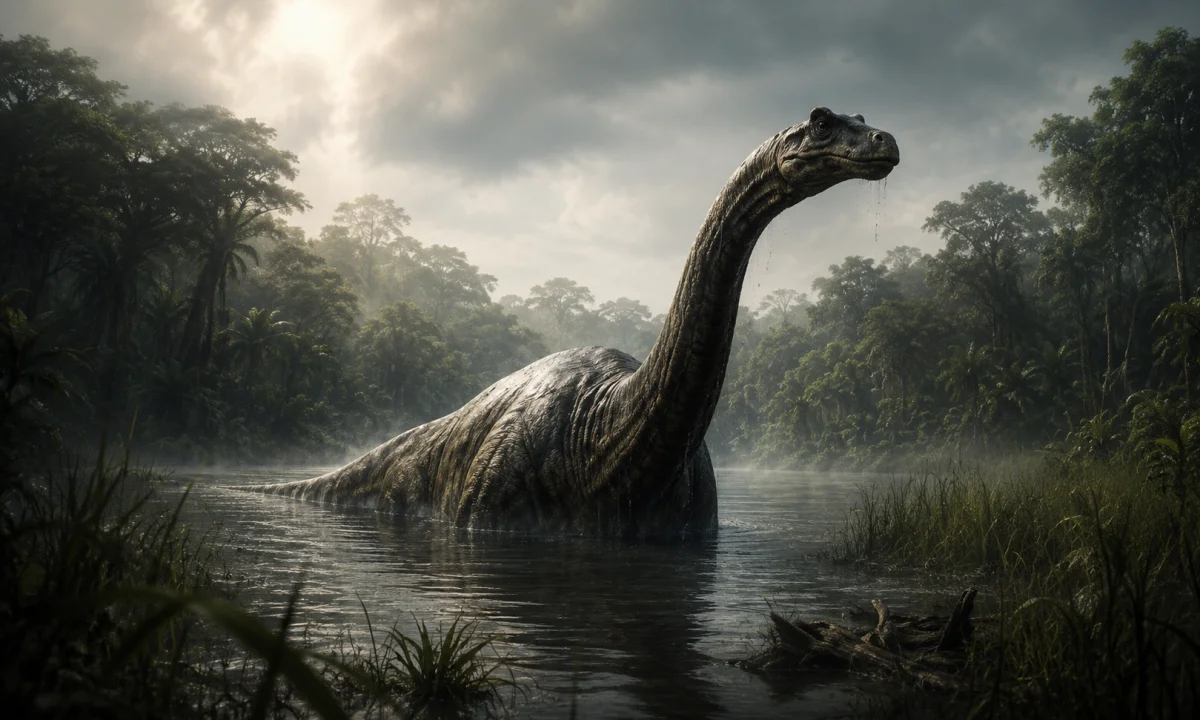
Mokele-Mbembe is the name most often given to a legendary creature said to inhabit the rivers, swamps and remote forests of the Congo Basin in Central Africa. In modern popular culture it is usually portrayed as a living dinosaur, especially a long-necked sauropod. That image, however, is not an established feature of a single ancient African tradition. Mokele-Mbembe is better understood as a modern cryptid tradition formed from reported encounters, translated names, oral accounts, colonial-era travel writing and later speculation about surviving prehistoric animals.
Origins and cultural setting
The Congo Basin contains one of the world's largest tropical forest regions, extending across several modern countries, including the Democratic Republic of the Congo, the Republic of the Congo, Cameroon, the Central African Republic and Gabon. Its rivers, lakes, flooded forests and swamps can be difficult for outsiders to navigate. Many communities have long possessed detailed knowledge of local animals, waterways, spirits and dangerous places, but the existence of a remote environment does not by itself establish the presence of an unknown large animal.
Accounts associated with Mokele-Mbembe are often connected with the western and northern parts of the Congo Basin, particularly the Likouala region of the Republic of the Congo. The name has also been applied more broadly to reports from different places and peoples. These reports do not form a single consistent body of traditional literature. They come from a mixture of oral testimony, interviews conducted by outsiders, missionary and travel accounts, newspaper reports, popular books and cryptozoological investigations.
There is no securely documented ancient epic, religious scripture or continuous indigenous legend that describes Mokele-Mbembe as a dinosaur in the modern sense. Some local traditions in Central Africa include river beings, forest spirits, dangerous animals and guardians of particular places. Such traditions vary greatly between communities and languages. It is therefore misleading to treat every account of a water monster or forest spirit as an early reference to Mokele-Mbembe.
The name and its uncertain meaning
Mokele-Mbembe is commonly translated as “one who stops the flow of rivers” or “one who blocks the rivers.” This translation has become central to the creature's popular identity, but the linguistic history is not entirely settled. The expression is generally associated with Lingala or related usage, yet spellings, pronunciations and translations vary in written accounts. Some researchers have questioned whether the phrase was originally used as a fixed personal name, a descriptive expression or a term adapted by outsiders.
Alternative spellings include Mokèlé-mbèmbé, Mokele Mbembe and forms with different punctuation or accents. These variations do not necessarily indicate separate beings. They often reflect differences in transcription, pronunciation and the languages used by investigators. Reports also sometimes attach the name to stories gathered far from the region in which the term is most familiar.
The supposed meaning of the name suggests a powerful creature associated with waterways, but it does not prove that the being has the body of a dinosaur. Names for dangerous animals, spirits and places can describe their effects or reputation rather than their physical appearance. The name may also have been interpreted through the expectations of reporters who were already interested in the possibility of an undiscovered prehistoric animal.
How the dinosaur image developed
The best-known image of Mokele-Mbembe is that of a large, four-legged animal with a long neck, a long tail and a body resembling a sauropod dinosaur. Sauropods were plant-eating dinosaurs such as Diplodocus and Brachiosaurus. They lived millions of years ago and are not known to have survived into human history.
This description was not consistently present in early reports. The association developed through twentieth-century accounts in which African testimony was translated, summarized or reshaped by European and American writers. One influential strand of the story connected Mokele-Mbembe with claims that dinosaur-like animals might still live in inaccessible regions of Africa. The idea gained particular attention during the early twentieth century, when popular science, exploration literature and dinosaur discoveries were capturing public interest.
Some versions of the story refer to German explorer and animal dealer Carl Hagenbeck, who was said to have heard of a large reptilian creature during an expedition or proposed expedition in the early 1900s. The details of this episode are uncertain and have often been repeated without a clear, consistent documentary basis. Later authors used such stories as evidence that reports of Mokele-Mbembe predated modern cryptozoology, but the surviving accounts are too vague to establish a reliable early sighting.
Descriptions collected in later decades vary substantially. The creature may be described as the size of an elephant, smaller than an elephant, or merely larger than a hippopotamus. It may have a long neck, a large body, a tail, horns, a reptilian head or an appearance that is difficult for the witness to classify. Some reports portray it as a plant-eater that avoids people; others describe it as aggressive or capable of killing animals and overturning boats.
Reported characteristics
In the standard cryptid profile, Mokele-Mbembe is a large semi-aquatic animal. It is said to spend much of its time in rivers, oxbow lakes, swamps or dense vegetation close to water. A typical account describes a creature with:
- a long, flexible neck;
- a bulky body supported by four legs;
- a long tail;
- smooth, grey, brown or reddish skin;
- a preference for plants, especially vegetation growing near riverbanks;
- a habit of avoiding human settlements and open water.
These features resemble a sauropod, but they are not stable across all accounts. Other descriptions sound more like a large crocodile, hippopotamus, monitor lizard or an unidentified mammal. Some witnesses may have seen familiar animals under difficult conditions, particularly in murky water or dense forest. A hippopotamus can appear unexpectedly large and unfamiliar to someone viewing only its back or head, while floating logs, crocodiles and groups of animals can produce misleading impressions.
Claims that Mokele-Mbembe is hostile often focus on its alleged territorial behaviour. It is said to attack boats or kill hippopotamuses, which are sometimes described as creatures it will not tolerate. These motifs are difficult to assess because they usually come from retellings rather than independently documented observations. No verified carcass, skeleton, tissue sample, photograph or video has demonstrated the existence of a large unknown animal matching the popular description.
Traditional belief, spirits and dangerous places
When accounts of Mokele-Mbembe are discussed, traditional religious and cultural ideas require careful treatment. Many Central African societies have rich systems of belief involving ancestors, forest beings, water spirits, sacred places and beings that regulate relationships between people, animals and the environment. A creature associated with a river may therefore have cultural significance that is not reducible to zoology.
At the same time, there is no single Central African religion with one standard Mokele-Mbembe doctrine. The name is not generally documented as the name of a universally recognized god, demon or spirit across the Congo Basin. Reports differ over whether the being is understood as an animal, a spirit, a guardian of a place or simply a dangerous presence. Some writers have grouped Mokele-Mbembe with local water-monster traditions, but such comparisons can obscure important differences between communities.
Outsiders have sometimes treated African accounts of unusual beings as if they were imperfect memories of dinosaurs. That approach can dismiss the religious, ethical and ecological meanings of local traditions. A story about a forbidden pool, a river guardian or an animal that should not be disturbed may function as a warning about danger, hunting practices or socially restricted places. It does not necessarily represent a claim about biological species in the modern scientific sense.
Modern reports and expeditions
Interest in Mokele-Mbembe increased during the twentieth century through books, magazine articles, television programmes and expeditions. Researchers and adventurers travelled to parts of the Congo Basin seeking tracks, photographs, eyewitnesses or physical remains. Expeditions were particularly publicized from the 1970s onward, when cryptozoology became a popular subject in North America and Europe.
Several expeditions reported conversations with local residents who had heard of a large creature or claimed to have seen something unusual. Some investigators also reported footprints, disturbed vegetation, distant shapes or unexplained sounds. These observations have not produced independently verifiable evidence. In a rainforest environment, tracks can be altered by water, mud and other animals, while eyewitness reports gathered through translation may be influenced by the questions and expectations of investigators.
One frequently repeated episode concerns a supposed photograph or film showing a large animal in a Congolese body of water. The image has been interpreted by supporters as a possible Mokele-Mbembe, but it is too indistinct to identify the object reliably. Other alleged photographs have proved to show ordinary animals, vegetation, shadows or ambiguous shapes. The absence of clear evidence is especially significant because a breeding population of very large land animals would be expected to leave recognisable ecological traces.
The region's political instability, difficult terrain and limited infrastructure have made field research challenging. Those practical obstacles explain why investigation is difficult, but they do not function as evidence for the creature's existence. A claim remains unverified until observations can be independently checked and supported by physical or photographic evidence of adequate quality.
Scientific assessment
Zoologists and evolutionary biologists generally regard a surviving sauropod in Central Africa as extremely unlikely. Non-avian dinosaurs disappeared from the fossil record about 66 million years ago, and there is no accepted evidence that any sauropod lineage survived into the human era. A large population would also require sufficient food, breeding conditions and territory, and would be expected to leave bones, dung, tracks, carcasses or other ecological evidence.
The possibility of an undiscovered species should not be confused with the possibility of a living dinosaur. New species, including large mammals and reptiles, continue to be identified, but the discovery of a very large land animal is much less likely than the discovery of a small, nocturnal or geographically restricted species. The Congo Basin has supported genuine zoological discoveries and continues to contain poorly studied habitats, yet those facts do not confirm Mokele-Mbembe.
Several explanations may account for individual reports. Misidentification of hippopotamuses, crocodiles, elephants or large monitor lizards is possible. Witnesses may also describe different animals using a shared label supplied by interviewers or later writers. Folklore can change as it passes between languages and media, and accounts may be influenced by the desire to satisfy an investigator searching for a prehistoric monster. These possibilities are not mutually exclusive.
Distinction from similar beings
Mokele-Mbembe is sometimes confused with other African legendary creatures, but the names do not refer to one combined tradition. Emela-ntouka, for example, is often presented in cryptozoological literature as a horned, rhinoceros-like animal associated with Central African waterways. It is not simply another name for Mokele-Mbembe, and the evidence for both traditions is similarly varied and difficult to verify.
Mbielu-mbielu-mbielu is another name appearing in reports from the Congo region. It has sometimes been described as an animal with bony plates along its back, leading popular writers to compare it with a stegosaur. The available accounts are not consistent enough to establish whether the name refers to a distinct creature, a local story, a translated description or a modern cryptozoological reconstruction.
Nguma-monene has also been described in some modern sources as a large serpent or reptilian being. Its reported form and supposed habitat differ from the usual long-necked image of Mokele-Mbembe. These labels should not be treated as interchangeable merely because they are associated with the same broad region.
Nor should Mokele-Mbembe be confused with mami wata traditions, which involve water spirits found in various parts of Africa and the African diaspora. Mami Wata is a complex and diverse religious and cultural tradition, often represented in human or human-like form, and is not a dinosaur or a generic river monster. Similar confusion can arise when every aquatic being is classified as a cryptid without regard to its local religious meaning.
Cultural significance and ethical questions
Mokele-Mbembe occupies an unusual place between folklore, exploration history and popular science. For some audiences it represents the possibility that remote ecosystems still contain unknown animals. For others it demonstrates how colonial travel narratives and modern media can transform local knowledge into an exotic monster story. The figure is therefore significant not only because of what it might be, but because of how stories about Africa have been collected, translated and marketed.
Responsible discussion should distinguish testimony from proof and should avoid presenting African communities as naïve witnesses awaiting scientific correction. Local people may identify ordinary animals accurately while using a traditional name or narrative framework that outsiders do not understand. Conversely, an account attributed to a local community may have been heavily edited by an interviewer or popular author. The identity of the original speaker, the language used and the circumstances of the report are often unclear.
It is also important not to imply that an entire region is unexplored. The Congo Basin is inhabited, travelled and known through the expertise of its communities, even though outsiders may find parts of it difficult to study scientifically. Calling it an untouched “lost world” can erase human presence and encourage sensational portrayals of Central Africa.
Reception in popular culture
Mokele-Mbembe became widely known outside Central Africa through cryptozoological books, documentaries, newspaper features and television programmes about living dinosaurs. It has appeared in speculative fiction, adventure stories, games and films, usually as a hidden sauropod surviving in an isolated swamp. These portrayals draw on the modern dinosaur interpretation rather than on a single well-documented indigenous mythology.
Popular treatments often give the creature a fixed appearance, behaviour and geographical home, even though the reports behind the tradition are inconsistent. They may also present unverified sightings as a continuous historical record. A clearer distinction is to describe Mokele-Mbembe as a modern legendary cryptid associated with the Congo Basin, while acknowledging that its supposed biological identity remains unproven and that its cultural sources are diverse and disputed.