WORLD
WORLD
Minawara
Minawara is a name associated in some modern reference works with Australian Aboriginal mythology, but its identity is not securely established across the published record. Unlike widely documented figures such as Tiddalik, the Rainbow Serpent, or the bunyip, Minawara does not have one universally recognised story, appearance, or cultural affiliation. Descriptions vary, and some accounts appear to repeat information from unsourced lists rather than preserve a clearly identified Indigenous tradition.
Origins and cultural setting
“Australian Aboriginal mythology” is a broad English label for the many sacred traditions of Aboriginal peoples across Australia. These traditions belong to hundreds of distinct language groups and cultural communities, each with its own laws, ancestral beings, places, ceremonial knowledge, and systems of transmission. A figure known in one region cannot automatically be treated as part of a single mythology shared throughout the continent.
Traditional knowledge was generally transmitted through spoken narratives, song, ceremony, dance, visual design, and relationships with particular landscapes. Stories could explain the origin of animals, waterways, plants, stars, social obligations, and ritual practices, but they were not merely “myths” in the narrow modern sense. They could also contain restricted knowledge intended only for particular people or stages of initiation.
This setting is important when considering Minawara. The name is not supported by a well-known, stable body of published tradition comparable to the major ancestral figures recognised in Aboriginal studies. It is therefore unsafe to assign Minawara to all Aboriginal peoples, or to describe the being as though a single canonical account existed.
The name Minawara
The spelling Minawara is found mainly in modern English-language discussions and lists of Australian Aboriginal beings. The available use of the name does not by itself establish its language of origin, pronunciation, region, or traditional meaning. Aboriginal languages have their own sound systems and spelling conventions, and names may be written differently when recorded by outsiders.
A name may also be separated from its original cultural setting when it is copied into a general encyclopaedia of monsters or legendary creatures. Once that happens, an ancestral figure, spirit, place-name, or word from a particular language can be presented as a generic “creature” belonging to Aboriginal mythology as a whole. That process can obscure both the original community and the meaning of the tradition.
For Minawara, the most responsible description is therefore a qualified one: it is an obscure or uncertain name attributed by some secondary sources to Aboriginal Australian tradition, not a clearly documented pan-Aboriginal being. Claims about a precise origin should be treated cautiously unless they identify the relevant community, language, storyteller, and publication context.
Reported identity and classification
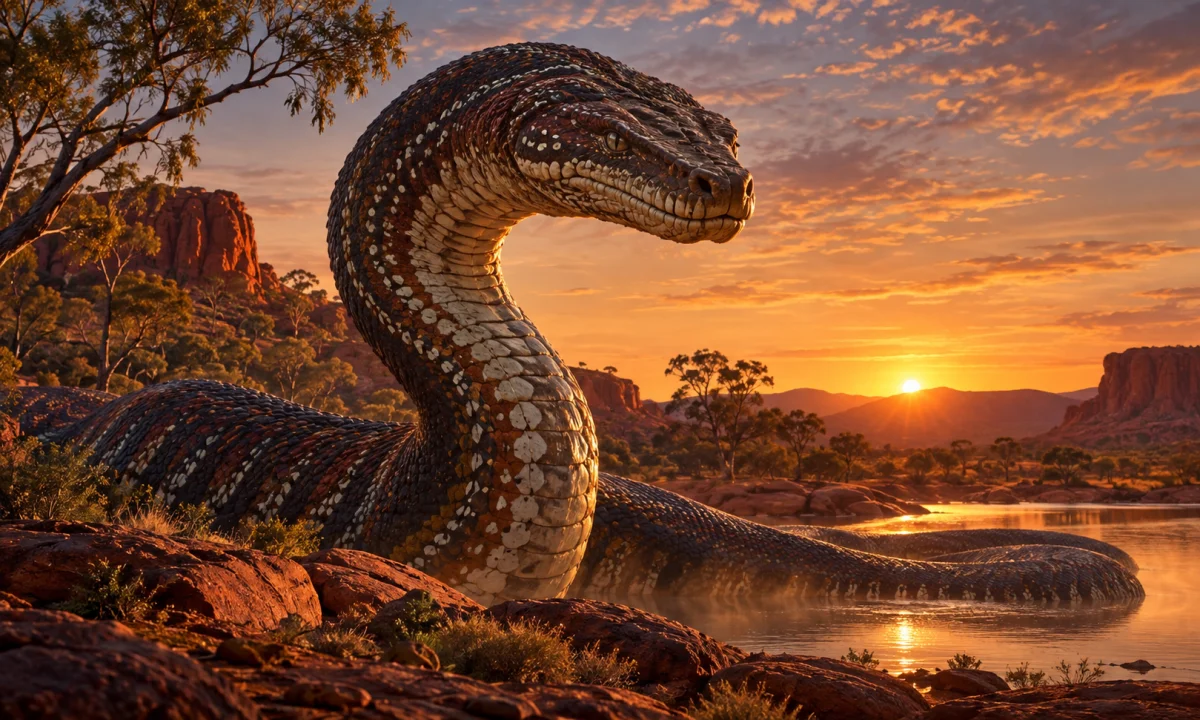
Some modern listings classify Minawara as a supernatural or water-associated being. Such descriptions are often brief and provide little information about the community from which the account supposedly comes. They may portray Minawara as a dangerous spirit or as a creature connected with waterways, but there is no sufficiently consistent record to establish these features as universal traditional attributes.
It is also uncertain whether Minawara was originally understood as an animal-like monster at all. English-language categories such as “monster,” “demon,” “water spirit,” and “mythical creature” do not always correspond to Aboriginal concepts. A being may be an ancestral presence, a guardian, a law-giving figure, a danger associated with a particular place, or part of a sacred narrative rather than a separate species of supernatural animal.
Accordingly, details sometimes repeated about Minawara’s size, body, habitat, powers, or behaviour should not be treated as established facts without a traceable cultural source. There is no reliable basis for presenting a definitive physical description.
Possible connection with water-spirit traditions
The association of Minawara with water is understandable within the wider context of Australian Aboriginal storytelling. Rivers, billabongs, springs, lagoons, coastal waters, and deep pools often have profound cultural significance. They may be connected with ancestral journeys, creation events, ceremonial responsibilities, food resources, and rules concerning behaviour.
Many Aboriginal traditions also contain warnings about dangerous places and beings. A story about a presence in a deep pool may teach children not to approach hazardous water, while also expressing a sacred relationship between the community and the landscape. The supernatural element cannot be separated from the social and environmental knowledge carried by the story.
However, the existence of many water-associated beings in Aboriginal traditions does not prove that Minawara belongs to any particular one of them. The bunyip, for example, is a broad English term applied historically to a variety of stories about dangerous beings associated with wetlands and waterways. Muldjewangk is another water being connected with traditions from the Murray River region. Neither name should be used as evidence for Minawara’s identity.
Stories and narrative evidence
No single, widely accepted traditional narrative about Minawara can be securely summarised. Accounts that provide only a name and a short description do not reveal whether the figure had relatives, enemies, a creation role, a specific dwelling place, or a relationship with human communities.
This absence is not evidence that Aboriginal people had no stories concerning a being called Minawara. Oral traditions may remain within their communities, may have been recorded under another spelling, or may not have been published because the knowledge is restricted. It is also possible that the name entered popular reference material through a transcription error, a local term detached from its context, or an unsupported modern compilation.
Traditional narratives should not be judged only by whether they appear in written books. Much Aboriginal knowledge was, and remains, maintained through living cultural practice rather than through publicly available texts. At the same time, a name appearing on the internet or in a list of legendary creatures is not enough to establish an ancient tradition.
Interpretation and cultural significance
The most significant point about Minawara may be the uncertainty surrounding its documentation. The name illustrates the difficulties involved in turning diverse Indigenous traditions into a single catalogue of “Australian mythology.” Such catalogues can make culturally unrelated beings appear to belong to one shared system and can give the impression that every name has a fixed definition.
A careful interpretation should distinguish three levels of information:
- Traditional knowledge: material preserved within a specific Aboriginal community and connected with its language, country, law, ceremony, or oral history.
- Historical documentation: information recorded by anthropologists, linguists, missionaries, settlers, or other observers, often imperfectly and sometimes without the permission or participation of the communities concerned.
- Modern compilation: descriptions repeated in encyclopaedias, websites, games, or lists of legendary beings, which may simplify, combine, or misattribute older material.
In the case of Minawara, the name is more securely placed in the third category than in a clearly documented traditional narrative. That does not make it meaningless, but it does limit what can responsibly be said about it. The lack of firm evidence should be acknowledged rather than replaced with an invented appearance or a detailed story.
Distinction from similar names and figures
Min-Min lights
Minawara should not be confused with the Min-Min lights, mysterious lights reported in parts of inland Australia. Min-Min lights belong to a different body of Aboriginal and settler folklore, and the name “Min-Min” is not evidence that it is a shortened or alternative form of Minawara.
Mimi spirits
Minawara is also distinct from the Mimi or Mimi spirits associated particularly with Aboriginal traditions of western Arnhem Land. Mimi beings are often described in connection with rock shelters, cliffs, hunting knowledge, and ancestral or spirit activity. Their stories belong to specific regional traditions and should not be merged with an uncertain name from general reference lists.
Bunyip traditions
The bunyip is sometimes used as a catch-all comparison for any alleged Aboriginal water monster. This is misleading. “Bunyip” itself has a complex history, involving different regional traditions and later colonial interpretations. Minawara should not be called a bunyip unless a specific cultural source makes that identification.
The Rainbow Serpent
Nor should Minawara automatically be described as a form of the Rainbow Serpent. Rainbow Serpent traditions vary between communities, but they generally concern powerful ancestral beings associated with water, fertility, creation, country, and law. A vague water association is not enough to establish a connection.
Modern reception
Minawara has little established presence in major works of literature, film, television, or popular games. Its modern visibility appears to come chiefly from English-language catalogues of mythical creatures and websites that present short entries without detailed cultural attribution. In these settings, the name may be treated as a monster with fixed characteristics even though those characteristics are not consistently documented.
Such retellings can introduce a little-known name to new audiences, but they may also transform a culturally specific term into fantasy material. Using Minawara in fiction, games, or educational content requires care: the creator should avoid claiming that one invented version represents all Aboriginal cultures, and should not present uncertain modern descriptions as ancient fact.
Where the name is used in a cultural or educational context, the most accurate approach is to identify the uncertainty, avoid unsupported physical details, and seek information from the relevant Aboriginal community if a regional origin can be established. Respect for cultural authority is especially important when stories may involve sacred places, restricted knowledge, or living traditions.
What can be said with confidence
Minawara is best understood as an obscure and uncertain name associated by some secondary material with Australian Aboriginal mythology. It cannot confidently be defined as a universally recognised Aboriginal monster, spirit, ancestor, or deity. Its regional origin, original language, traditional meaning, appearance, and stories remain unclear in the accessible record.
The uncertainty does not diminish the richness of Aboriginal mythologies. Instead, it shows why those traditions should be studied in their own cultural and linguistic settings. A reliable account of Minawara would need more than a repeated name: it would require a documented community, a specific tradition, and evidence showing how the figure was understood by the people to whom the tradition belongs.