WORLD
WORLD
Wandjina
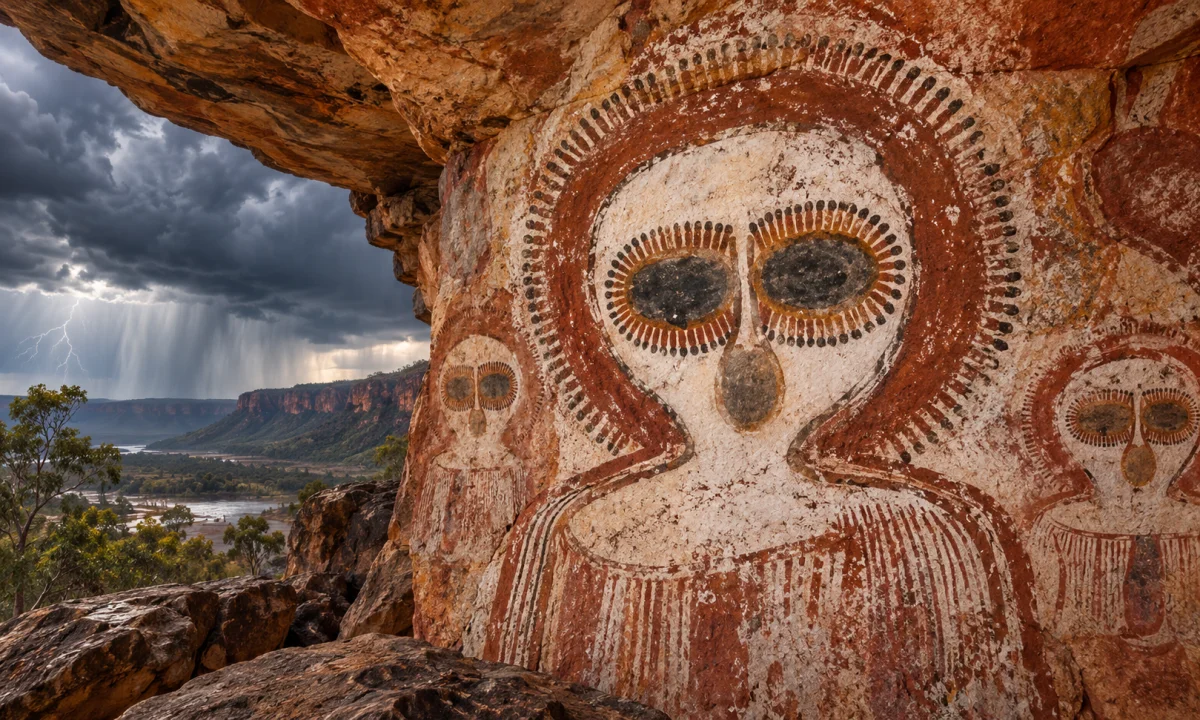
Wandjina refers to powerful ancestral beings represented in the rock paintings of the Kimberley region of north-western Australia. The figures are especially associated with Wunambal, Ngarinyin and Worrorra peoples, although the meanings, names and relationships attached to them vary between language groups and communities. In English, Wandjina is also used for the painted images themselves. These beings belong to living Aboriginal religious traditions concerning ancestral power, law, Country, rain and the continuing responsibilities of custodians.
Cultural setting
The Kimberley is a culturally diverse region containing many Aboriginal language groups and distinct traditions. Wandjina beliefs are most strongly associated with the north-western Kimberley, including areas around the Mitchell Plateau, the Prince Regent River and nearby coastal and inland Country. It is important not to treat every Kimberley community as having an identical account of the Wandjina. Names, stories, ceremonial knowledge and restrictions can differ according to language, family and place.
Wandjina traditions are part of what Aboriginal English commonly calls the Dreaming. This term does not simply mean a story about a distant mythical past. It can refer to ancestral events, the laws established through those events, the features of Country created or named by ancestral beings, and the continuing spiritual relationships connecting people, places, animals and ceremonial obligations. For many Aboriginal peoples, ancestral time is not separate from the present: it remains active in Country and in the responsibilities of living people.
Within this framework, Wandjina are not merely decorative characters or “rain gods” in the narrow sense. They are ancestral powers whose actions helped shape the land and its social and religious order. Their presence may be connected with storms, cloud, rain, waterholes, fertility and the seasonal cycle, but their significance also involves law, identity, custodianship and the proper care of sacred places.
The name and its spelling
Wandjina is the spelling most familiar in museums, books and general English-language discussion. Other spellings include Wanjina, Wondjina and forms based on local pronunciation and orthography. The English spelling reflects the history of transcription by outsiders as well as later usage by Aboriginal communities and researchers. The exact meaning and linguistic origin of the word should not be assumed to be identical in every Kimberley language.
The word can be used in two related ways. It may identify an ancestral being, or it may refer to a particular painted representation of such a being. In some contexts, people speak of “the Wandjina” collectively; in others, an individual image has its own name, history and relationship to a particular place. The plural form Wandjinas is common in English, although local languages may use different grammatical forms.
Classifying Wandjina as “gods” can be misleading. They may have powers and responsibilities that resemble those assigned to deities in some other religions, but Aboriginal religious categories do not map neatly onto the European distinction between gods, spirits, heroes and ancestors. Ancestral being is generally a more careful description. It acknowledges that Wandjina are powerful sacred figures while avoiding the assumption that they belong to a universal category of gods.
Wandjina rock paintings
Wandjina images are among the most recognisable forms of Australian rock art. They are usually painted on sheltered rock walls and overhangs, often in places that remain protected from direct weather. Many figures have a large, rounded or oval head surrounded by radiating lines or a halo-like form. The face commonly includes large eyes and a broad nose, while a mouth is often absent. The body may be shown below the head with simple limbs, clothing-like markings or other designs.
The figures vary considerably. Some are tall and imposing, while others are smaller or grouped with additional forms. Colours may include white, red, yellow and black mineral pigments. The visual style is not perfectly uniform across the Kimberley, and paintings have been repaired, renewed or altered over long periods. A single shelter can contain several layers of imagery, making it difficult to treat every apparent difference as evidence of a separate mythological character.
The absence of a mouth is one of the most discussed features of Wandjina paintings. Explanations differ between communities and sources. Some interpretations connect it with the beings’ extraordinary power, while others relate it to local stories or ceremonial knowledge. There is no reliable universal explanation that applies to every Wandjina image. The idea that all Wandjina lack mouths for one single symbolic reason is an oversimplification.
The radiating lines around the head are sometimes described by outsiders as a halo, crown, hair or headdress. Their meaning also varies. They may be understood in relation to cloud, lightning, rain or ancestral identity, but an art-historical description should not automatically be treated as a complete religious interpretation. The apparent “head” of a Wandjina may contain several elements whose significance is known most fully to the custodians of the site.
Ancestors of rain and storm
Wandjina are widely associated with the wet season and with the forces that bring rain. Their imagery is found in a region where the arrival of seasonal rains is central to life, travel, food resources and the renewal of Country. In some traditional accounts, Wandjina travelled through the landscape, created or shaped places, established laws and left their images behind. Their continuing presence is connected with rain, clouds and the fertility of the land.
Some accounts describe Wandjina as coming from the sea or from the sky, while others focus on their emergence and activities within particular areas of Country. These are not necessarily contradictions. Aboriginal traditions are place-based and may preserve different accounts for different sites, ancestral groups or ceremonial contexts. Public descriptions often combine information from several communities, which can make a local tradition appear more uniform than it really is.
Wandjina paintings may be renewed with fresh pigment by authorised custodians. This practice is not simply conservation in the museum sense. Repainting can be a religious and cultural act that maintains the relationship between the ancestral power, the site and the living community. The renewed image may continue to be associated with rain and the wellbeing of Country. The authority to repaint, explain or enter a site belongs to particular people and is not automatically shared by all visitors.
Relationships with other ancestral beings
Wandjina traditions are sometimes discussed alongside the Wunggurr, also spelled Wungurr or by other local forms. Wunggurr is often described in English as a rainbow serpent or a major ancestral being associated with water, creation and the organisation of Country. In some interpretations, Wandjina and Wunggurr are closely related: Wandjina may be understood as powerful rain beings whose activity is connected to the Wunggurr, or as manifestations within a broader ancestral system.
There is no single relationship accepted across all relevant communities. In some accounts, Wunggurr is a distinct being; in others, the terms and roles overlap or are understood through local ceremonial knowledge. It is therefore inaccurate to state categorically that Wandjina are simply another name for the Rainbow Serpent. Nor should every rainbow-serpent tradition in Australia be identified with Wunggurr or Wandjina. Rainbow-serpent traditions occur among many Aboriginal peoples, but their names, stories and meanings are not interchangeable.
Wandjina should also be distinguished from the imagery known historically by the colonial name “Bradshaws”, now more appropriately called Gwion Gwion in many discussions. Gwion Gwion figures form a different artistic tradition in the Kimberley, often characterised by slender human-like bodies, elaborate costumes and dynamic poses. The relationship between the age, authorship and interpretation of Gwion Gwion art remains a subject of archaeological and cultural discussion. The figures should not be casually labelled as early Wandjina or treated as an earlier version of the same beings.
Age and surviving evidence
The rock paintings provide important evidence for the long history of Wandjina traditions, but their exact age is difficult to establish. Pigment paintings can be renewed, covered, damaged or repainted, and direct dating of the visible surface does not always reveal when the first image was created. Estimates for particular sites vary, and claims about a single precise beginning for all Wandjina paintings are not secure.
Written records made by European explorers and researchers are comparatively recent and cannot substitute for Aboriginal knowledge. Nineteenth-century expeditions recorded painted figures in the Kimberley, sometimes using spellings and interpretations that reflected European assumptions. Later anthropologists, rock-art researchers and museums also selected, translated and classified Indigenous material in ways that could simplify local distinctions. Oral transmission, ceremonial practice, place-based knowledge and continuing custodianship remain essential to understanding what the images mean.
Rock art should not be treated as an isolated illustration of mythology. A painting is part of a cultural landscape that may include a water source, a story place, a route taken by ancestral beings, a ceremonial area or a site with access restrictions. Its position, condition, surrounding marks and relationship to other places can be as important as the figure’s appearance. Interpretations based only on visual comparison often miss these relationships.
Religious and cultural significance
Wandjina traditions connect spiritual power with practical obligations. The beings are associated with the continuity of life in a difficult environment, particularly through the arrival of rain and the replenishment of water. They also represent the authority of ancestral law. People with the appropriate inherited or community-recognised responsibilities may be expected to care for particular sites, observe restrictions and pass on knowledge in suitable contexts.
This knowledge is not necessarily open to everyone. Some information may be public, while other details are restricted by age, gender, initiation, kinship, ceremony or custodianship. Descriptions written for a general audience therefore provide only a partial account. A visually familiar Wandjina image may still carry meanings that are not intended for public explanation.
The paintings have also become important expressions of Aboriginal identity and artistic continuity. Contemporary Aboriginal artists from the Kimberley and other regions may engage with Wandjina imagery in ways that affirm Country, ancestral responsibility and the survival of cultural traditions. Such work should not be confused with an unbroken, identical artistic style: contemporary artists make decisions within modern art institutions and markets while negotiating their own community obligations and cultural authority.
Colonial representations and cultural appropriation
European and later popular representations have often removed Wandjina from their cultural setting. Reproductions may present the figures as mysterious extraterrestrials, generic spirits or decorative symbols of an imagined prehistoric Australia. These interpretations are not part of the traditional religious framework and usually depend on treating facial features and head designs as puzzles rather than as culturally meaningful images.
Claims that Wandjina depict ancient astronauts have no basis in the traditional evidence. The large eyes, radiating head forms and unusual proportions reflect a distinctive regional artistic and religious tradition; they are not evidence of visitors from outer space. Similar claims also disregard the continuing authority of Aboriginal custodians and convert sacred images into entertainment.
Unauthorised copying can be particularly harmful when Wandjina images are placed on commercial products, clothing, advertising, vehicles or public art without permission. The issue is not only artistic ownership. Sacred imagery may be subject to cultural rules, and using it outside those rules can misrepresent the beings and offend the communities responsible for their care. Museums, tour operators, artists and visitors are expected to follow local restrictions, including rules about photography, access and reproduction.
Wandjina in modern culture
Wandjina appear in Australian museums, school materials, tourism promotion, books, documentaries and contemporary Indigenous art. These settings can increase public awareness of Kimberley cultures, but they can also flatten distinct traditions into a single national symbol. Responsible interpretation identifies the relevant language groups, acknowledges that meanings vary by place and avoids presenting Aboriginal religion as a relic of the past.
The continuing significance of Wandjina rests in living relationships between people, ancestral beings and Country. The paintings are not merely remnants of an ancient mythology. They remain connected with cultural authority, seasonal knowledge, ceremonial responsibility and the protection of sacred places. Any public account can describe their broad associations with rain, creation and law, but a complete interpretation belongs to the communities whose ancestors and Country the Wandjina represent.