WORLD
WORLD
Mephistopheles

Mephistopheles is a demon and tempter best known from the European Faust tradition. He is not a major figure of ancient mythology or a universally recognised demon in Christian scripture. Instead, Mephistopheles emerged in early modern German literature as the supernatural companion and negotiator in the story of Faust, a learned man who seeks forbidden knowledge and worldly power. Later plays, poems, operas and novels transformed him into one of the most recognisable embodiments of the sophisticated, ironic and intellectually seductive devil.
Origins in the Faust tradition
Mephistopheles belongs to the cultural world surrounding Faust, a legendary scholar associated with magic, astrology, alchemy and illicit knowledge. The character was probably inspired in part by the historical Georg or Johann Faust, a wandering German practitioner of astrology and magic who lived around the late fifteenth and early sixteenth centuries. Historical evidence about him is limited, and later stories greatly expanded his reputation. The literary Faust is therefore a combination of historical memory, Protestant-era anxieties and imaginative legend.
The earliest important source for the literary Faust is the anonymous German book commonly known as the Historia von D. Johann Fausten, printed in Frankfurt in 1587 by Johann Spies. Often called the Faustbuch, it presents Faust as a magician who turns away from ordinary Christian learning and enters into an agreement with the devil. The book is a warning against pride, curiosity without moral restraint and the rejection of religious authority.
In this early narrative, the demonic companion's name appears in forms such as Mephostophiles, rather than the spelling most familiar today. The text does not establish a single, fully consistent theology for the figure. Mephostophiles is a spirit who serves the infernal powers and acts as Faust's intermediary, but later writers altered his status, personality and relationship to Satan. The character developed through successive literary versions rather than descending from one fixed ancient tradition.
The name and its uncertain meaning
The spelling Mephistopheles is only one of several forms. Other variants include Mephostophiles, Mephistophilis, Mephisto and Mefistofele. The differences reflect changes between German, Latin, English, Italian and other literary traditions, as well as the habits of individual authors.
The origin and meaning of the name remain uncertain. Various explanations have connected it with Greek, Hebrew or other ancient languages. Proposed interpretations include ideas such as “one who avoids the light” or “one who loves not the light,” but these explanations are not securely established as the original meaning. Some may be later scholarly guesses or learned reinterpretations rather than evidence of how the name was formed in the sixteenth century.
Because the name first appears in the Faust literature, it is safer to describe Mephistopheles as a literary demon whose name has an uncertain origin than to claim that he is an ancient demon inherited directly from Jewish, Christian or classical mythology. Later occult and demonological works sometimes treated him as though he possessed an independent place in a systematic hierarchy of spirits, but such classifications are not consistent across sources and do not represent a single ancient doctrine.
Identity and classification
Mephistopheles is generally classified as a demon, devil or infernal spirit. In the older Faust stories, he functions as a servant or agent of the devil and as the being who conducts Faust toward damnation. His exact position varies. Some accounts imply that he is subordinate to a greater devil; others make him appear to be the principal spirit attached to Faust. Later works often give him a distinct personality, allowing him to act as a character in his own right rather than merely as an anonymous emissary of hell.
He should not automatically be identified with Satan or Lucifer. Christian traditions use these names in different ways, and literary works frequently adapt them for dramatic purposes. In the Faustbuch, Mephostophiles is a separate demonic figure associated with Faust's pact. In some later interpretations he serves Satan, represents a facet of the devil, or becomes an independent embodiment of negation and temptation. These are literary relationships, not a universally accepted religious genealogy.
Nor is Mephistopheles simply another name for every tempter or demon in Christian folklore. His defining identity comes from the Faust narrative: he is the spirit who approaches, accompanies or manipulates Faust in connection with a bargain for knowledge, pleasure, magical ability or extended worldly experience.
Appearance and character
Early accounts do not provide one standard physical appearance. Like many spirits in demonological and literary writing, Mephistopheles may be imagined as capable of changing form. His visible appearance is less important than his ability to speak persuasively, provide supernatural assistance and conceal the moral consequences of Faust's desires.
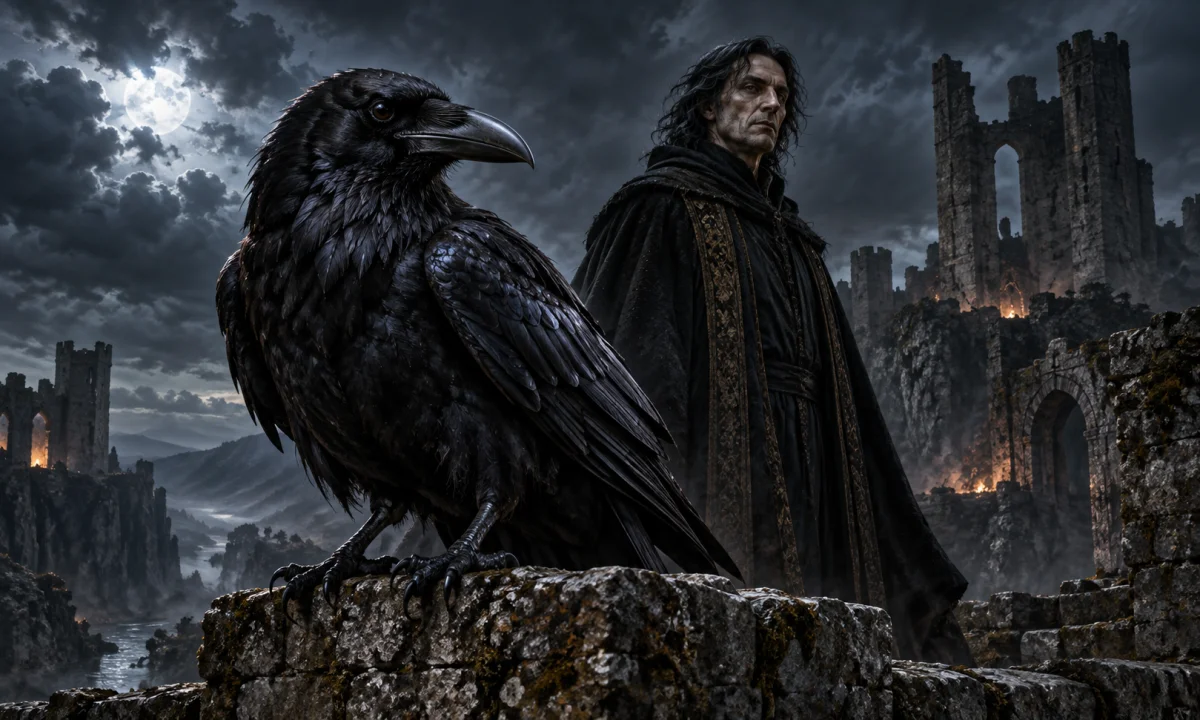
Later artists often depict him with conventional demonic features: horns, claws, a tail, wings, red or black colouring and a pointed beard. These images belong largely to the visual language of European devils and are not a fixed description from the earliest Faust story. Other representations show him as an elegant gentleman, a courtly intellectual or a fashionable stranger. This refined appearance is especially important in modern interpretations, where his danger lies in charm and intelligence rather than brute monstrosity.
Mephistopheles is commonly portrayed as clever, sarcastic, eloquent and observant. He understands human weakness and exploits vanity, impatience, lust for knowledge and dissatisfaction with ordinary life. He may offer miracles and pleasures, but he rarely gives without demanding a price. His promises often contain technical conditions or hidden consequences, allowing him to appear truthful while still deceiving the person who trusts him.
The pact with Faust
The central event of the Faust tradition is the pact between the scholar and the demonic world. The details vary considerably. In some versions Faust signs a written contract in blood and agrees to surrender his soul after a fixed period. In others, the agreement concerns a particular moment of perfect satisfaction: if Faust ever wishes time to stop because he is completely fulfilled, he will be claimed by the devil.
Mephistopheles serves as the negotiator, witness, instructor and companion associated with this bargain. He can provide magical services, summon spirits, answer questions and lead Faust through experiences that ordinary human life cannot offer. Yet the pact is not merely a transaction for supernatural information. It dramatizes the danger of treating moral limits, divine law and other people as obstacles to personal ambition.
In the older moralising tradition, Faust's fate is usually disastrous. His intellectual gifts become instruments of pride, and his search for unrestricted experience ends in repentance, punishment or damnation. Mephostophiles is therefore not only a monster but also the mechanism through which Faust's choices become visible. The demon tempts him, but the story's religious message generally places responsibility on Faust as well.
Mephistopheles in early drama
The Faust story quickly spread beyond German prose. Christopher Marlowe's English play Doctor Faustus, first performed around the turn of the seventeenth century, uses the name Mephistophilis. Marlowe's demon is a powerful and articulate figure who explains aspects of hell and assists Faustus, while also exposing the limits of the knowledge and pleasure the pact can provide.
Marlowe's play preserves the religious seriousness of the earlier legend but gives greater dramatic attention to Faustus's inner conflict. The scholar repeatedly has opportunities to turn back, yet his pride, fear and attachment to temporal pleasures prevent a decisive return to repentance. Mephistophilis is consequently both a tempter and a reminder of the spiritual reality Faustus is trying to deny.
The play also helped establish the image of Mephistopheles as a speaking, psychologically perceptive demon. He is not merely a supernatural special effect. His conversations with Faustus explore sin, despair, free will, knowledge and the possibility of salvation.
Goethe's Mephistopheles
The most influential later interpretation appears in Johann Wolfgang von Goethe's Faust. Goethe published Part One in 1808 and Part Two in 1832. His Mephistopheles differs substantially from the demon of the older chapbook and from Marlowe's Mephistophilis.
In Goethe's drama, Mephistopheles is a brilliant, mocking and urbane spirit who defines himself through negation. He is associated with denial, destruction and scepticism toward human ideals. He ridicules religion, love, scholarship and social convention, yet his cynicism does not make him omnipotent. He is restricted by the terms of the drama and repeatedly fails to control the full consequences of Faust's actions.
The opening heavenly scene presents a wager between the Lord and Mephistopheles concerning Faust's character and ultimate direction. This arrangement changes the emphasis of the older Faust legend. Faust remains restless and dangerously self-absorbed, but the drama asks whether striving itself can lead toward moral development. Mephistopheles attempts to reduce human life to appetite, boredom and self-interest, while the broader structure of the poem allows for possibilities that exceed his understanding.
Goethe's famous formulation that Mephistopheles is associated with the power that always wills evil yet produces good is often treated as a definition of the character. It should be understood within Goethe's philosophical and dramatic system, not as a universal statement about Christian demonology. Goethe's Mephistopheles is a literary personification of negation, irony and destructive temptation as much as he is a traditional devil.
Relationships with other figures
Mephistopheles is most closely linked to Faust, but their relationship changes across versions. In the early Faustbuch, the connection is one of master and demonic servant, though the power balance is unstable. Faust commands supernatural services, while Mephostophiles controls access to forbidden knowledge and ultimately serves the interests of hell.
In Marlowe, the relationship is more openly adversarial and theological. Faustus wants power over nature and human society, while Mephistophilis represents the fate he has chosen. In Goethe, the two are companions, antagonists and intellectual foils. Mephistopheles encourages Faust's experiences but also exposes the emptiness of many of his ambitions.
Goethe's drama also places Mephistopheles in relation to Gretchen, or Margaret, whose tragedy reveals the human cost of Faust's pursuit of experience. She is not simply another participant in a supernatural adventure. Her seduction, pregnancy, social abandonment and imprisonment show how the pact's consequences fall on vulnerable people. Mephistopheles helps create the conditions of the tragedy, but Faust's decisions remain central to it.
Religious and cultural significance
Mephistopheles reflects concerns that were particularly powerful in early modern Christian Europe: the temptation to seek knowledge outside accepted religious boundaries, the fear of magic and necromancy, and the belief that pride could lead a learned person away from God. The original Faust tradition belongs to a period when theological warnings about sorcery, heresy and illicit dealings with spirits circulated alongside fascination with science, medicine, astrology and the occult.
At the same time, the figure cannot be reduced to a simple symbol of curiosity. Faust's desires include social status, sensual pleasure, power over others and escape from ordinary limitations. Mephistopheles gives these desires a voice and a strategy. He often makes evil appear practical, amusing or intellectually sophisticated, which is one reason the character has remained compelling.
Later interpretations have used Mephistopheles to represent scepticism, materialism, political corruption, artistic rebellion or the destructive side of modern progress. These meanings are not all present in the earliest sources. They arise from authors and audiences adapting the Faust legend to new arguments about knowledge, freedom, science and moral responsibility.
Distinctions from similar figures
- Satan: Satan is a major figure in Christian scriptural and theological traditions, although his role and interpretation vary. Mephistopheles is usually a separate literary demon associated specifically with Faust.
- Lucifer: Lucifer may refer to the Latin word for “light-bearer,” the morning star, or, in later Christian usage, the fallen angel identified with Satan. Mephistopheles is not simply another spelling of Lucifer.
- Faust: Faust is the human scholar or magician who makes the bargain. Mephistopheles is the demonic intermediary, tempter or antagonist.
- Mephisto: “Mephisto” is generally a shortened form of Mephistopheles, especially in later literature and popular culture, rather than a separate ancient being.
- Generic devils: Traditional European art and folklore contain many unnamed devils and tempters. Mephistopheles belongs to a specific literary cycle and should not be treated as a collective name for them.
Later reception and popular culture
Mephistopheles became a major figure in nineteenth-century European literature, music and theatre. Operatic adaptations include Arrigo Boito's Mefistofele, which draws heavily on Goethe and presents the demon as a commanding stage presence. Other composers, poets and novelists used the Faustian bargain without reproducing the character exactly, sometimes turning Mephistopheles into a symbol of intellectual rebellion or seductive corruption.
Modern films, comics, television series, games and fantasy fiction often use the name for a powerful devil or occult antagonist. These versions may give him an elaborate hierarchy, distinctive powers, a particular appearance or a direct identity with Satan. Such features belong to modern invention unless a work explicitly presents them as an adaptation of an older source.
In contemporary speech, a “Mephistophelean” character usually means a refined and manipulative tempter: someone charming, witty and apparently helpful whose assistance carries a hidden moral cost. That image preserves the most enduring feature of the tradition. Mephistopheles is frightening not only because he belongs to hell, but because he can make destructive choices seem reasonable, intelligent and desirable.