WORLD
WORLD
Marchosias
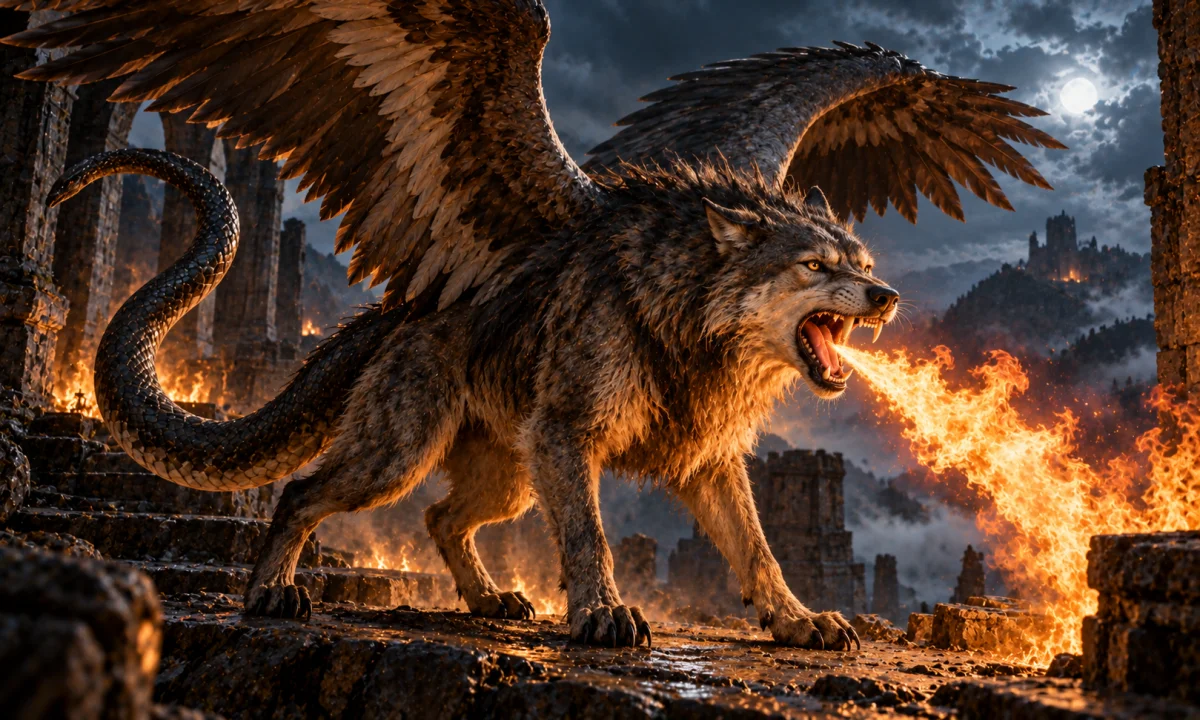
Marchosias is a demon in the Solomonic tradition of Western ceremonial magic, best known from the Ars Goetia, the first section of the Lesser Key of Solomon. He is listed as the thirty-fifth spirit and is given the rank of a great marquis. In the grimoire, Marchosias appears first as a composite beast with the body of a wolf, the wings of a griffin, a serpent’s tail and fire issuing from his mouth. He is then said to assume human form when commanded by the magician.
Marchosias belongs to a specifically early modern system of Christian demonology and ritual magic. He is not a clearly attested demon from ancient Mesopotamian, Greek, Roman or biblical religion, nor is there strong evidence for an independent medieval cult devoted to him. Most information about the figure comes from manuscript and printed versions of Solomonic grimoires, whose descriptions combine biblical language, Christian angelology, medieval ideas about spirits and the imaginative conventions of magical catalogues.
Origins in Solomonic demonology
The principal source for Marchosias is the Ars Goetia, a catalogue of seventy-two spirits that became widely known through the Lesser Key of Solomon. The work survives in manuscripts and printed editions from the seventeenth century onward, although its materials draw on older magical and demonological traditions. Its supposed connection with King Solomon is legendary rather than historical. There is no reliable evidence that Solomon wrote the work or that the catalogue preserves a single ancient system.
Solomonic literature presents spirits as beings who can be summoned, constrained and questioned through ritual authority. The magician is typically instructed to use divine names, prayers, protective signs, circles and formal commands. Within this setting, Marchosias is not described as an object of worship. He is a spirit who is compelled to appear and answer questions, at least according to the claims of the grimoire.
The catalogue gives each spirit a rank, a number and a characteristic appearance or function. These details are not consistent with the hierarchy of demons found in every Christian theological work. Instead, they form the internal structure of a particular magical tradition. Marchosias’s title of marquis therefore belongs to the pseudo-courtly organization of the Ars Goetia, in which spirits are assigned titles such as kings, dukes, princes, marquises, presidents and earls.
Name and classification
The name appears in several spellings. Marchosias is common in modern English editions, while Marchocias and other minor variations can also be encountered in manuscripts, translations and occult reference works. These forms generally refer to the same Goetic spirit, although the precise history of the name is uncertain. It does not have a securely established meaning in a known ancient language.
Marchosias is classified as a marquis and, in versions of the Goetic catalogue, is associated with thirty legions of spirits. The number is part of the catalogue’s military and aristocratic imagery. It should not be understood as evidence for an actual historical army or a standardized demonological census. Different editions sometimes vary in wording, spelling and the amount of information they preserve.
The text also states that Marchosias was formerly of the Order of Dominations. Dominations, or Dominions, are one of the nine orders in the Christian angelic hierarchy associated especially with the writings of Pseudo-Dionysius the Areopagite and later theological tradition. In Christian demonology, fallen angels may be described as having once belonged to angelic orders. This claim gives Marchosias a place within a Christian cosmological framework, but it is not a teaching found in the Bible about a demon named Marchosias.
The statement that he hopes to return to the “Seventh Throne” after 1,200 years is similarly part of the grimoire’s narrative. Its meaning is unclear, and the wording varies among versions and translations. The expression does not correspond to a universally recognized doctrine of Christian theology. It may present Marchosias as a fallen spirit who retains some expectation of restoration, release or return, but the text does not explain the idea in detail.
Appearance
Marchosias’s initial form combines several powerful and symbolically charged animals:
- A wolf’s body: The wolf can suggest ferocity, predation and wildness. In European Christian symbolism it may also evoke danger, deception or the threat posed to a flock, although the grimoire does not explicitly assign these meanings.
- Griffin wings: The griffin, usually imagined as a creature with the body of a lion and the head and wings of an eagle, was a longstanding symbol in European and Near Eastern art. In Marchosias’s description, the wings emphasize his composite and supernatural nature.
- A serpent’s tail: The serpent carries strong associations with cunning, danger and demonic temptation in Christian culture, particularly through the interpretation of the serpent in Genesis. A serpent-like tail also marks Marchosias as an unnatural hybrid.
- Fire from the mouth: Breath or speech that produces fire is a conventional sign of destructive supernatural power. It links Marchosias visually with dragons, fiery monsters and infernal imagery.
The combination is not a portrait inherited from one single ancient mythological creature. It is better understood as a deliberate assemblage of familiar monstrous features. Grimoires often use hybrid bodies to signal that a spirit belongs to a world beyond ordinary nature. Marchosias’s appearance places him between animal, dragon-like monster and fallen celestial being.
After appearing as the hybrid beast, Marchosias is said to take the shape of a man at the magician’s command. The text does not give a detailed description of this human form. The transformation is important because it suggests that the terrifying animal body is a manifestation adopted by the spirit rather than its only possible shape. It also reflects a wider grimoire convention in which spirits appear in symbolic forms but can be compelled to become more recognizably human.
Abilities and role
Marchosias is characterized above all as a strong and valiant fighter. The martial language agrees with his rank as a marquis and with the image of an aggressive wolf-like creature. His description is shorter than those of some other spirits in the catalogue, so the grimoire does not provide a large collection of specialized powers.
He is also said to give true answers concerning things past, present and future. This places him within the divinatory side of Solomonic magic. The claim should be understood as a ritual assertion within the grimoire, not as historical proof that Marchosias was consulted by identifiable practitioners or that his predictions were verified. The text presents truthful answers as an expected function of the spirit when properly summoned and controlled.
Marchosias’s abilities can therefore be grouped into three related ideas:
- Combat: He is associated with courage, strength and military action.
- Revelation: He is described as capable of answering questions about time and hidden knowledge.
- Transformation: He can move from a monstrous animal form into a human appearance under ritual command.
These functions make Marchosias a relatively direct figure within the Goetic catalogue. He is not primarily described as a tempter, seducer, teacher of a craft or bringer of wealth. His identity depends more on his martial character, monstrous form and claimed capacity for truthful speech.
Relationships and narrative elements
Marchosias has no extensive myth cycle comparable to the stories of figures such as Lucifer, Beelzebub or Astaroth. The Ars Goetia does not provide a biography, a genealogy or a series of adventures. His “story” consists mainly of catalogue information: a title, an appearance, an office, a former angelic affiliation and the statement about a possible return to the Seventh Throne.
The reference to the Order of Dominations creates a relationship between Marchosias and the broader Christian idea of fallen angels. In this framework, demons are often imagined as angels who rebelled against God and retained corrupted versions of their former powers or ranks. Yet the Goetic catalogue does not offer a consistent account of how every spirit fell, when the fall occurred or how the spirits relate to one another. Marchosias’s former membership in the Dominations should therefore be treated as an isolated classification rather than part of a fully developed biography.
His supposed hope of returning after 1,200 years introduces an unusual note of limitation or possible redemption. Many demonological descriptions portray demons as permanently hostile and condemned. Marchosias’s stated hope suggests a more complicated condition, in which a demon may remember a prior celestial status or anticipate a change in his position. The text does not say whether the period begins at a particular historical moment, whether the return is possible, or what the “Seventh Throne” represents.
Cultural and religious significance
Marchosias illustrates how early modern demonology absorbed and rearranged older religious concepts. His claimed angelic origin reflects Christian ideas about spiritual hierarchies and rebellion. His title reflects medieval and early modern social structures, translating aristocratic and military ranks into the organization of an invisible world. His body draws on the long European tradition of hybrid monsters, while his function as a source of answers belongs to practices of ritual magic and divination.
The figure also shows that demonological catalogues were not always concerned with moral narratives. A spirit could be classified according to rank, appearance and magical office without receiving a detailed account of particular sins. Marchosias is presented less as a character in a sacred story than as an entry in a working catalogue for ceremonial operations.
From a historical perspective, it is important to distinguish the theological ideas surrounding Marchosias from the practices of ordinary Christian communities. Church authorities often condemned conjuration and the attempted control of spirits, while learned magicians and occult writers developed elaborate ritual systems of their own. The existence of a grimoire description does not show that the figure was widely believed in by the general population or that it had an ancient popular cult.
The imagery of Marchosias can also be read symbolically. The wolf may represent uncontrolled force, the griffin wings a connection with elevated or celestial realms, the serpent’s tail cunning or corruption, and the fire a dangerous form of speech or power. These interpretations are modern analytical possibilities rather than meanings explicitly defined by the original text. The grimoire gives the features but does not provide a complete symbolic explanation for each one.
Variants and distinctions
Marchosias should not be confused with every demon or monster portrayed as a wolf, griffin, serpent or fire-breathing beast. His identifying combination of features belongs specifically to the Goetic description. Many mythological and folkloric beings share one or more of these traits without having any historical relationship to Marchosias.
He is also distinct from the broader figure of a werewolf. Marchosias does not originate in European werewolf folklore, and his transformation is not a curse affecting a human being. His change from a hybrid animal form into a man occurs within the ritual setting of a spirit catalogue.
Nor should he be equated with Marchosias-like figures in modern fantasy merely because they use a wolf-headed or winged design. Contemporary creators may borrow his name while changing his rank, personality, powers, allegiance or appearance. Such portrayals belong to adaptation rather than to the historical Goetic tradition.
Later reception and modern adaptations
Marchosias has remained a comparatively specialized figure in occult literature. His name appears in discussions of the Ars Goetia, ceremonial magic, demonology and the visual study of grimoire spirits. Illustrators and modern occult artists commonly emphasize the most memorable elements of the description: a wolf-like body, broad wings, a serpent’s tail and a mouth filled with flame.
In contemporary popular culture, Marchosias may appear in novels, games, comics, music and other fantasy media. These works often treat Goetic spirits as characters with individual motives, dialogue and supernatural abilities. Such portrayals can make Marchosias more familiar, but they should not be taken as evidence for details absent from the historical grimoires. A game may present him as a summonable warrior, a fantasy story may make him a tragic fallen angel, and an occult-themed work may expand his divinatory powers. These are creative interpretations of a brief demonological entry.
The most historically grounded image of Marchosias remains the one supplied by the Solomonic catalogue: a high-ranking spirit who first appears as a fiery hybrid beast, can assume human form, is associated with combat and truthful answers, and is linked by the text to the angelic order of Dominations. Beyond those features, claims about his personality, worship, ancient origin or detailed mythology require caution because the surviving tradition does not establish them securely.