WORLD
WORLD
Malphas
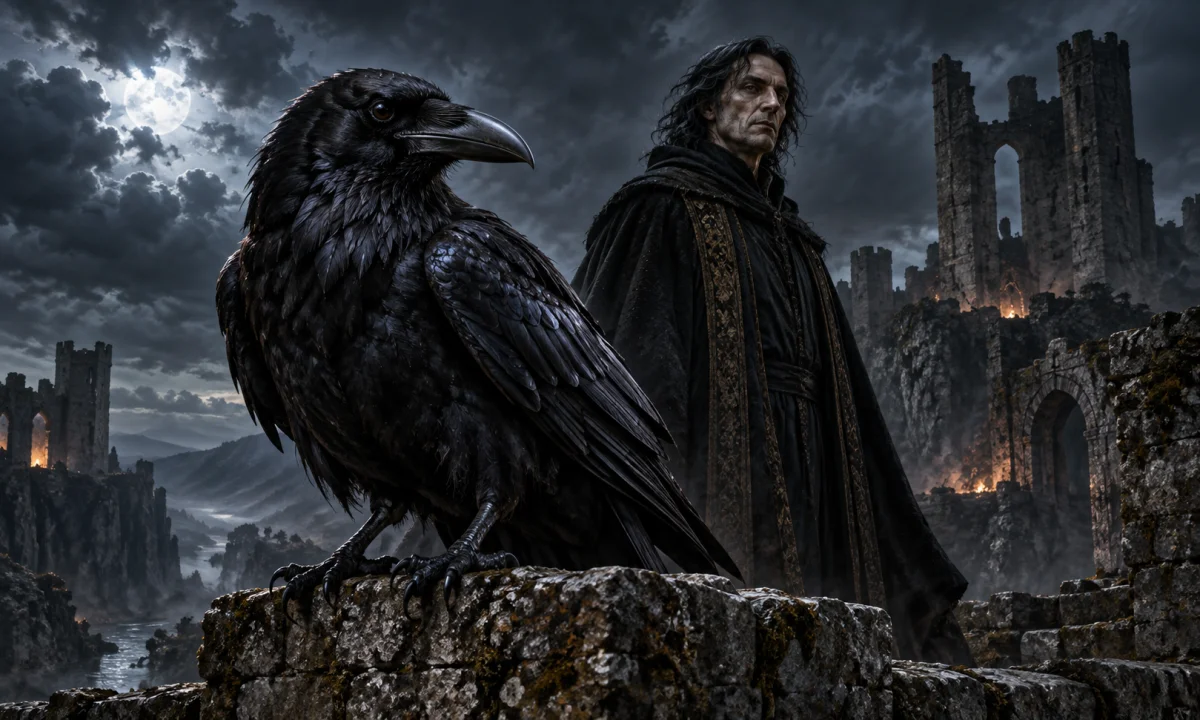
Malphas is a demon of early modern European grimoire tradition, best known as the thirty-ninth spirit listed in the Ars Goetia, the first section of the Lesser Key of Solomon. He is described as a great president of Hell who initially appears as a crow before taking human form. The grimoire associates him with building houses and towers, supplying skilled spirits or “familiars,” discovering the thoughts of enemies, and destroying their works. These descriptions belong to a literary and magical tradition rather than to ancient mythology, biblical religion, or a widely documented pre-Christian cult.
Malphas in the grimoire tradition
The principal surviving account of Malphas appears in the Ars Goetia, a catalogue of seventy-two spirits traditionally connected with the legendary King Solomon. The work survives in manuscripts and printed editions from the seventeenth and eighteenth centuries, although its materials draw on older European lists of spirits, magical handbooks, and demonological writings. Its attribution to Solomon is part of the text’s traditional framework, not evidence that the work was actually written by the biblical king.
Within the Ars Goetia, Malphas holds the rank of president. In this system, a president is a high-ranking spirit with authority over a number of subordinate spirits. Malphas is said to command forty legions. The number is a conventional feature of the catalogue and should not be treated as an independently verifiable description of a supernatural hierarchy.
The account presents Malphas as a spirit who can be summoned for practical and strategic purposes. His abilities concern construction, intelligence, military or defensive works, and the weakening of opponents. The entry is short, like many of the notices in the Ars Goetia, and gives no extended myth about Malphas’s origin, fall from Heaven, family, or role in a larger sacred narrative.
Name and textual variants
The spelling Malphas is the most familiar form in modern editions of the Ars Goetia. Earlier demonological catalogues and related manuscripts may use different spellings. In Johann Weyer’s Pseudomonarchia Daemonum, published in 1577, a closely related entry is commonly printed as Malthus. The relationship between these forms reflects the unstable spelling and transmission of demonological names across manuscripts, languages, and editions.
Names in European grimoires were often copied by hand, transliterated from other languages, or altered by printers. As a result, a difference in spelling does not automatically indicate a separate spirit. At the same time, the surviving texts do not provide a secure etymology for Malphas. Claims that the name derives from a particular ancient deity, language, or religious title are speculative unless supported by historical evidence. There is no well-established ancient god or demon whose identity can confidently be equated with Malphas.
Malphas should therefore be understood primarily as a figure of grimoire demonology. His identity is defined by the descriptions attached to his name in early modern magical catalogues, rather than by an independent body of ancient myths or popular religious traditions.
Appearance and voice
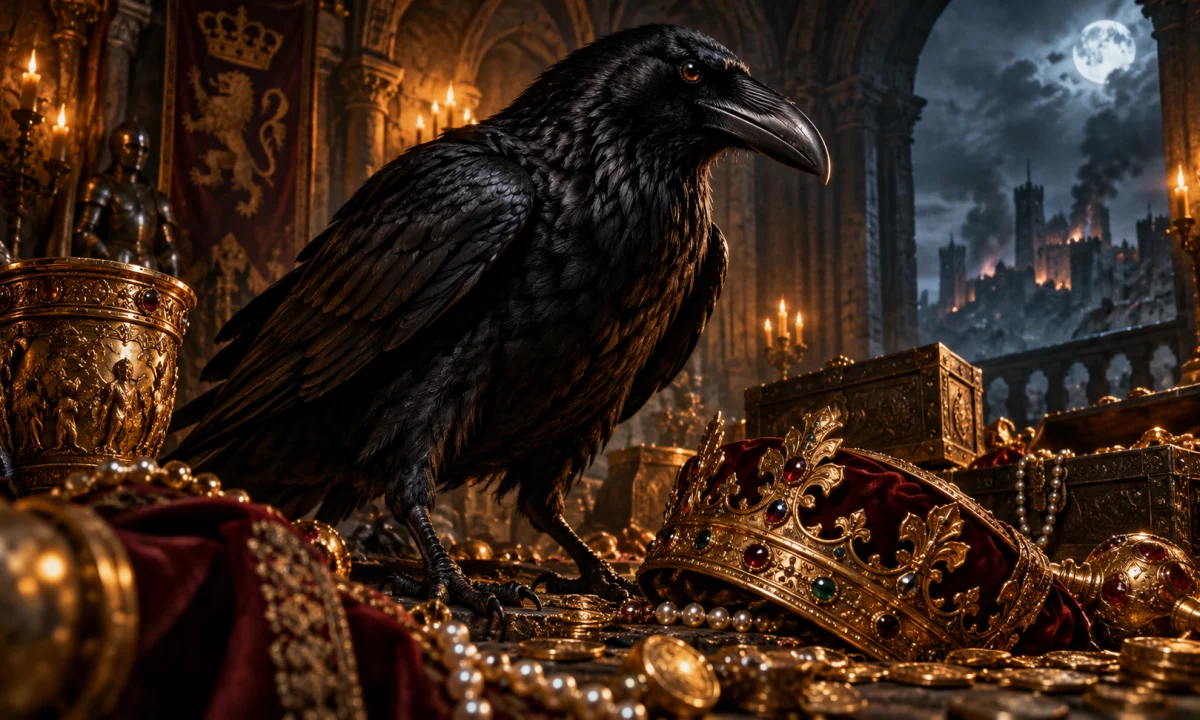
The Ars Goetia states that Malphas first appears in the form of a crow. After being commanded, he assumes human shape. This transformation is one of his most recognizable characteristics and has strongly influenced later illustrations and fictional depictions.
The text also describes him as speaking with a hoarse voice. The detail is brief but significant because grimoire entries often identify spirits through a combination of visual form, sound, title, and function. Malphas’s crow form gives him an association with an intelligent, watchful, and potentially ominous bird, while the hoarse voice contributes to his threatening and nonhuman character.
The source does not provide a detailed physical description of his human appearance. It does not establish a fixed costume, age, facial expression, animal companions, or elaborate visual symbolism. Later artists and writers have supplied these features according to their own tastes, but those additions should not be confused with the original grimoire description.
Abilities and domains
Construction and architecture
Malphas is said to build houses and high towers. The wording makes him unusual among many goetic spirits, whose powers more often involve knowledge, seduction, wealth, warfare, divination, or bodily transformation. Malphas’s principal image is connected with building and fortification.
The buildings attributed to him can be interpreted in practical terms within the logic of the grimoire. A magician might invoke him for assistance with construction, the planning of defensive works, or the acquisition of skilled helpers. The reference to towers also places him in a setting of walls, surveillance, authority, and military security. These associations arise from the text itself, rather than from a documented architectural cult or an older tradition of Malphas as a builder-god.
Destruction of enemies’ works
Malphas is also credited with destroying the towers or structures of an enemy. This creates a deliberate contrast between construction and destruction. He can raise a stronghold for one party while weakening or demolishing the stronghold of another. In symbolic terms, his powers concern the organization of power and the vulnerability of the systems that protect it.
The association with enemies reflects the adversarial character of many ritual instructions in European grimoires. Such texts frequently describe spirits in terms of what they can do for a practitioner: reveal information, provide assistance, restrain opponents, or damage hostile forces. These descriptions should not be read as evidence that historical communities uniformly worshipped Malphas or regarded him as an independent religious patron.
Familiars and subordinate spirits
The Ars Goetia says that Malphas gives good familiars. In early modern magical language, a familiar could mean a supernatural assistant serving a magician, although the term also had wider meanings in folklore and witchcraft accusations. Here, the phrase belongs to the operational vocabulary of the grimoire: Malphas is portrayed as a spirit capable of supplying other spirits to assist the practitioner.
His stated command of forty legions supports the image of an organized supernatural authority. Yet the text does not name these subordinate spirits or describe a developed court, army, or genealogy. The number functions chiefly as a rank marker within the catalogue.
Knowledge and intelligence
Malphas is associated with discovering the thoughts of enemies and revealing information about them. Different translations and editions vary in their wording, but the general emphasis is on hostile intentions, hidden knowledge, and the ability to expose or frustrate opponents.
This intelligence-gathering role complements his architectural powers. A tower is useful for watching and defending, while knowledge of an enemy’s plans makes it possible to protect one’s own position or undermine another’s. Malphas can therefore be read as a grimoire spirit of surveillance, strategic advantage, and contested power, although the text does not present a formal symbolic interpretation.
Ritual context in the Ars Goetia
The Ars Goetia is written as a manual of ceremonial conjuration. Its procedures assume a ritual practitioner who uses divine names, protective measures, formal commands, seals, and other elements of learned magic. These practices belong to the world of Christian-influenced Western esotericism, where spirits are called and constrained through a hierarchy that places the magician beneath divine authority but above the summoned entities in the ritual setting.
The entry for Malphas includes the customary warning that the spirit must be offered sacrifices and will receive them favorably. The statement is part of the grimoire’s ritual language, but it does not establish that Malphas received sacrifices in an ancient temple or that a historical community maintained a cult devoted to him. The word “sacrifice” in magical manuscripts can also be interpreted differently across editions and scholarly discussions, and it should not automatically be equated with the sacrificial worship practices of ancient religions.
No reliable historical evidence shows that Malphas was worshipped as a god, invoked in a pre-Christian sanctuary, or preserved through an unbroken folk tradition. His documented setting is the textual culture of learned magic and demonology, especially the catalogues that circulated in manuscript and print form during the early modern period.
Religious and cultural setting
European Christian demonology commonly classified spirits according to ranks such as kings, dukes, princes, marquises, presidents, and counts. These titles resemble secular and aristocratic systems of government. They helped writers organize a large number of named demons into a hierarchy that mirrored familiar human institutions.
Such classifications were not consistent across all authors. A spirit might have one rank in one catalogue and another rank in a different source. Descriptions could also change as names were copied, translated, abbreviated, or combined with material from other books. Malphas’s position as a president is therefore specific to the relevant goetic tradition, not a universally recognized rank in all demonology.
The figure also illustrates how Christian demonological texts transformed older magical habits into a framework of forbidden or dangerous spirits. The Ars Goetia does not offer a systematic theology of demons comparable to a formal church doctrine. It is instead a practical and literary compilation that draws on several strands of Western occult writing. Its spirits are presented as named entities with particular powers, but the text does not always explain their origins or provide a coherent account of their relationship to Satan, fallen angels, or biblical events.
Symbolism of the crow and the tower
Interpretations of Malphas often focus on the contrast between the crow and the tower. The crow can suggest intelligence, observation, scavenging, death, or an unsettling presence at the boundaries of human settlement. These meanings are common in European folklore and literary symbolism, but the Ars Goetia itself does not explain why Malphas appears as a crow. Any interpretation should therefore be described as symbolic analysis rather than as an explicit teaching of the source.
The tower represents height, defense, authority, and watchfulness. It can protect a community, display power, or become a target for an enemy. Malphas’s ability both to build towers and to destroy those belonging to opponents gives him a liminal role between guardian and saboteur. He is not simply a patron of architecture. His powers concern the construction of structures that organize security and the exposure of weaknesses within them.
Modern readers sometimes interpret these features psychologically, treating Malphas as a symbol of planning, ambition, hostile surveillance, or the collapse of institutions. Such interpretations can be productive, but they are modern readings rather than established doctrines of the historical grimoire tradition.
Distinguishing Malphas from similar figures
Malphas is sometimes confused with other named demons because demonological catalogues contain many variant spellings and overlapping titles. The name Malthus in Weyer’s related catalogue is generally treated as a textual variant or closely corresponding form, although exact relationships can depend on the edition and editorial tradition.
Malphas should not be identified with Moloch, the ancient biblical and later demonological figure associated in different sources with a disputed form of sacrifice. The names resemble one another only superficially, and the surviving descriptions are different. Malphas is also not the same as Marchosias, another spirit in the Ars Goetia who has a birdlike appearance, or Stolas, who is associated with an owl-like form and knowledge. Similar animal imagery does not establish a shared identity.
Nor should Malphas be treated as a fallen angel from a specific biblical narrative. The Bible does not name him, and the canonical Christian scriptures do not describe his crow form, rank, or architectural abilities. His classification as a demon results from later demonological literature.
Later reception and popular culture
Malphas has become increasingly visible through modern occult publishing, fantasy fiction, role-playing games, horror media, comics, music, and video games. These works often expand his character beyond the brief grimoire entry. He may be portrayed as a crow-headed ruler, an architect of infernal cities, a master of spies, or a powerful antagonist connected with elaborate demonic politics.
These portrayals are creative adaptations rather than additional evidence about the historical tradition. Features such as horns, armor, elaborate wings, a fixed personality, a detailed biography, or a place in a demonic family tree usually come from modern imagination or from later occult reinterpretation. Even when an adaptation retains the crow and tower motifs, its narrative role may differ substantially from that of the spirit described in the Ars Goetia.
In contemporary esoteric practice, some people approach Malphas as a symbolic figure, a spirit of transformation, a patron of building projects, or an emblem of strategic power. These personal or modern religious interpretations should be distinguished from the early modern grimoire account. The historical record presents Malphas as a named president in a catalogue of conjurable spirits, with a crow form, a hoarse voice, architectural abilities, destructive power against enemies’ structures, and authority over subordinate spirits.