WORLD

Mdi
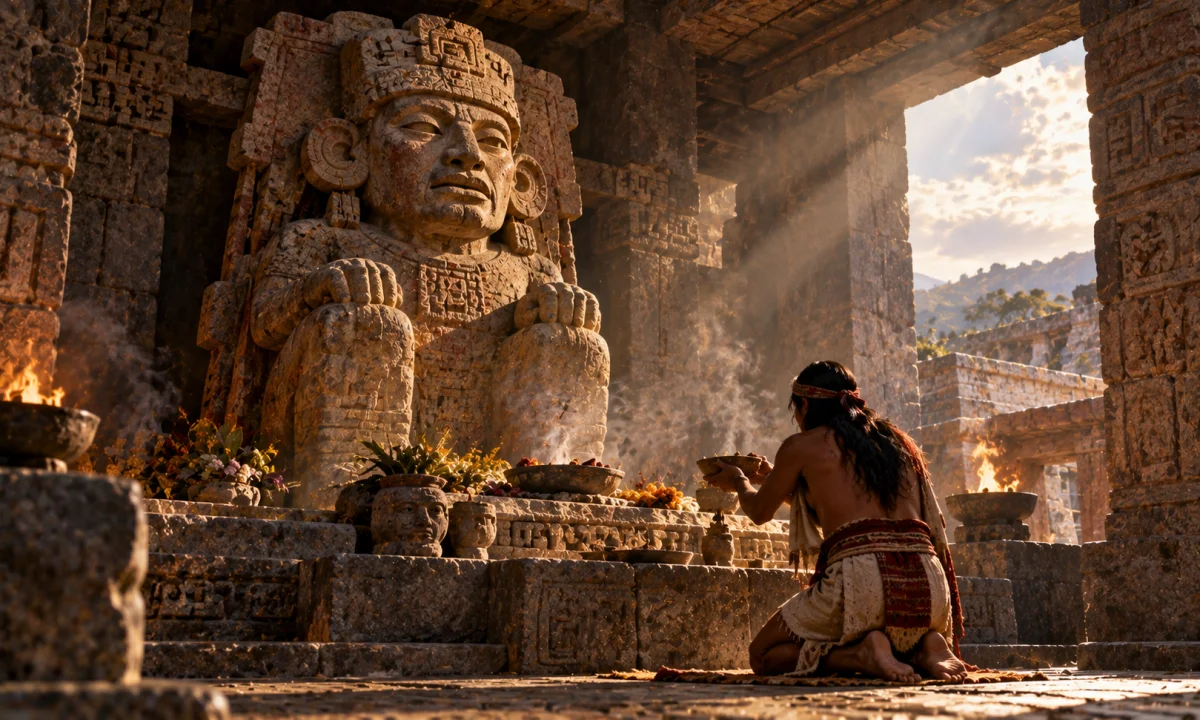
Mdi is a name associated in some modern compilations with death or the underworld in Zapotec mythology. Its status is uncertain, however. Unlike better-attested Zapotec figures such as Cocijo, the rain and lightning deity, or the death-related lord often called Coqui Bezelao, Mdi is not supported by a large, consistent body of precolonial descriptions. The name may reflect a regional word, a variant transcription, a colonial-era gloss, or a later attempt to identify a particular supernatural being. It should therefore be treated cautiously rather than presented as a universally recognized Zapotec god.
Zapotec religious setting
The Zapotec peoples have lived for centuries in the region now known as Oaxaca, in southern Mexico. Zapotec-speaking communities developed major centres including Monte Albán, established during the first millennium BCE, and later urban and political traditions in the Central Valleys, the Sierra, and the Isthmus of Tehuantepec. “Zapotec mythology” does not describe one fixed system shared identically by every community. It includes ancient religious practices, colonial accounts, local oral traditions, and beliefs that have changed over time.
Precolonial Zapotec religion was closely connected with agriculture, rain, lightning, fertility, rulership, ancestors, caves, mountains, and the movement of the sun. Religious images and offerings appear in archaeological contexts, but images rarely provide the exact names or stories of the beings they represent. Many names known from the colonial period were recorded by Spanish missionaries using unfamiliar spelling conventions, and the surviving descriptions were shaped by Christian attempts to classify Indigenous religions.
For this reason, a name found in a modern list of “Zapotec gods” cannot automatically be treated as evidence for a clearly defined deity worshipped throughout the ancient Zapotec world. The same caution applies to Mdi.
The name Mdi
The spelling Mdi is brief and difficult to interpret without knowing the Zapotec variety, the original orthography, and the context in which it was recorded. Zapotec is not a single uniform language but a group of closely related languages and dialects. Words that look similar in writing may have different meanings in different communities, while the same word may be transcribed in several ways by Spanish-speaking or English-speaking writers.
Modern presentations commonly describe Mdi as a death god or an underworld figure. That description may have arisen from an interpretation of a Zapotec term connected with death, the dead, or a supernatural power. It is not clear, however, that the name refers to an independent deity with a stable mythology. Available summaries do not establish a widely agreed genealogy, appearance, temple cult, or cycle of myths belonging specifically to Mdi.
The name may also be the result of a shortened or altered transcription. Colonial records sometimes wrote Indigenous words according to Spanish spelling habits, and later writers sometimes copied names without preserving their original linguistic context. A form that appears as “Mdi” in one source may not be identical to a similarly named word in another Zapotec language. Without a reliable local-language explanation, assigning a precise translation is unsafe.
Mdi and the realm of the dead
When Mdi is discussed, the most frequent interpretation places the figure in the sphere of death, ancestors, or the underworld. This association is plausible within the general structure of Zapotec religious thought, where death was not simply the end of existence. The dead remained connected with families, places, and ritual obligations, while caves, mountains, springs, and other landscape features could be understood as points of contact with powerful nonhuman beings.
That general context should not be confused with evidence for a specific Mdi myth. There is no securely established set of traditional stories describing Mdi’s birth, family, dwelling, weapons, animals, or dealings with human heroes. Descriptions of a skeletal body, a throne beneath the earth, a particular consort, or control over the fate of every dead person are often presented in popular accounts, but these details should not be assumed to belong to an ancient Zapotec tradition unless independently supported.
Death-related beings in Mesoamerican religions were not all equivalent. Some guarded or ruled a realm of the dead; others represented disease, night, ancestors, decay, or dangerous sacred places. A death-associated name might also refer to an attribute, a ritual expression, or a class of supernatural force rather than to a fully personified god. The limited evidence for Mdi does not allow these possibilities to be separated with confidence.
Better-attested Zapotec death figures
Mdi is sometimes confused with Coqui Bezelao, also written in forms such as Coqui Beze-lao, Coqui Bezelao, or Coqui Xee in different discussions. The name is commonly translated or described as “Lord of the Dead,” although the spelling and interpretation vary. Colonial and later sources associate this figure with death and the underworld, and some accounts connect him with Xonaxi Quecuya, a female supernatural figure linked in certain traditions with death, earthquakes, or the earth.
These traditions are themselves not entirely uniform. Colonial writers often rearranged Indigenous religious concepts into categories resembling Christian ideas about devils, heavens, and hells. Later historians and popular writers sometimes combined information from different regions or periods. Coqui Bezelao is therefore better documented than Mdi as a death-related Zapotec figure, but even his portrayal should be read in relation to regional variation and the limitations of the sources.
Another important distinction concerns Pitao, a title or element used in the names of several Zapotec sacred beings. Pitao Cocijo, for example, is associated with rain, lightning, storms, and agricultural power. “Pitao” does not necessarily identify one single god, and it should not be used to build an unsupported connection between Mdi and other deities. Similar-looking names in lists of Zapotec gods may represent titles, linguistic variants, or separate beings.
Sources and the problem of reconstruction
Knowledge of precolonial Zapotec religion comes from several kinds of evidence. Archaeological remains include temples, tombs, carved monuments, painted ceramics, funerary objects, and offerings. Colonial dictionaries and religious accounts preserve Indigenous words and fragments of ritual knowledge. Modern ethnographic work records beliefs and ceremonies among Zapotec communities, although these traditions belong to living societies and cannot simply be projected unchanged into the distant past.
None of these sources provides a complete Zapotec equivalent of a classical mythology book. Images can be difficult to identify, and colonial descriptions may omit local meanings or reinterpret them through Christian theology. A name copied in a modern encyclopedia may therefore have a complicated history: it may come from an old word, a missionary record, a local oral tradition, or an unverified secondary source.
In the case of Mdi, the principal difficulty is the lack of a stable and detailed tradition attached to the name. A cautious description can say that some modern accounts associate Mdi with death or the underworld. It cannot confidently claim that all Zapotec communities recognized Mdi, that Mdi was worshipped at Monte Albán, or that the figure possessed a standard appearance and biography.
Possible meaning and classification
Classifying Mdi as a “god” may be convenient but is not necessarily precise. Indigenous religious vocabularies do not always divide supernatural beings into categories that correspond to the English words god, spirit, ancestor, devil, or monster. A being connected with death might be a lord, ancestor, sacred force, guardian of a place, or personification created by an outside interpreter.
The short form “Mdi” also gives no secure indication of gender. Some popular illustrations portray the figure as male because the English word “god” is used, while other interpretations could treat the name as gender-neutral or as referring to a nonhuman power rather than a person-like deity. Claims about a crown, skeletal body, black clothing, animal companion, or particular weapon should therefore be regarded as speculative unless tied to a clearly identified Zapotec source.
It is also important not to infer a complete theology from the association with death. In Zapotec communities, ideas about the dead have included continuing relationships between families and ancestors, commemorative ritual, offerings, and sacred geography. These practices are richer than the idea of a single ruler who simply punishes or receives the dead. Mdi, if the name preserves a genuine traditional figure, would need to be understood within that broader network rather than through a generic “god of death” template.
Distinguishing Mdi from other Mesoamerican figures
Mdi is not the same figure as Mictlantecuhtli, the male lord of the dead in Mexica religion, nor as Ah Puch, a name used in older popular literature for a death-related Maya deity. Those figures belong to different cultural and linguistic traditions. Their skeletal imagery, underworld associations, and modern popularity have sometimes encouraged writers to merge separate Mesoamerican religions into one generalized mythology.
Nor should Mdi be automatically identified with any Maya, Mixtec, or Aztec death deity simply because all these traditions contain beings associated with the dead. Oaxaca was home to multiple peoples and long-standing cultural exchanges, but cultural contact does not erase differences in names, rituals, and religious institutions. A Zapotec name requires evidence from Zapotec linguistic and historical contexts.
Mdi should likewise not be treated as another spelling of Coqui Bezelao without proof. The two names are often brought together because both are associated in secondary material with death, but similarity of subject matter is not evidence that they refer to one being. They may represent different regional traditions, different stages of transmission, or one well-attested figure and one uncertain name.
Cultural significance of death in Zapotec traditions
The uncertainty surrounding Mdi does not make Zapotec ideas about death unimportant. Funerary practices, tombs, offerings, and depictions of sacred beings show that relations between the living and the dead were central to Zapotec religious life. Ancestors could be sources of identity, legitimacy, protection, and obligation. Rulers and elite families used burial practices and monuments to connect political authority with sacred ancestry.
Place was also significant. Mountains, caves, springs, and cultivated land could carry religious meaning, and the boundaries between the human world and the world of sacred powers were not necessarily imagined as a distant realm. Death-related beliefs therefore formed part of a wider system involving agriculture, kinship, rulership, and the land itself.
If Mdi represents a local or poorly preserved death-related tradition, its significance may lie less in a dramatic myth than in the way the name classified a relationship with the dead or with a sacred force. The absence of a surviving narrative should not be filled with details borrowed from other Mesoamerican religions.
Mdi in modern reference works
Mdi appears most often in short modern lists, online mythological catalogues, and generalized summaries of Zapotec religion. Such sources may preserve a name that deserves further investigation, but they frequently provide no distinction between ancient evidence, colonial interpretation, and modern reconstruction. A brief entry can make an uncertain figure appear as firmly established as Cocijo or Coqui Bezelao.
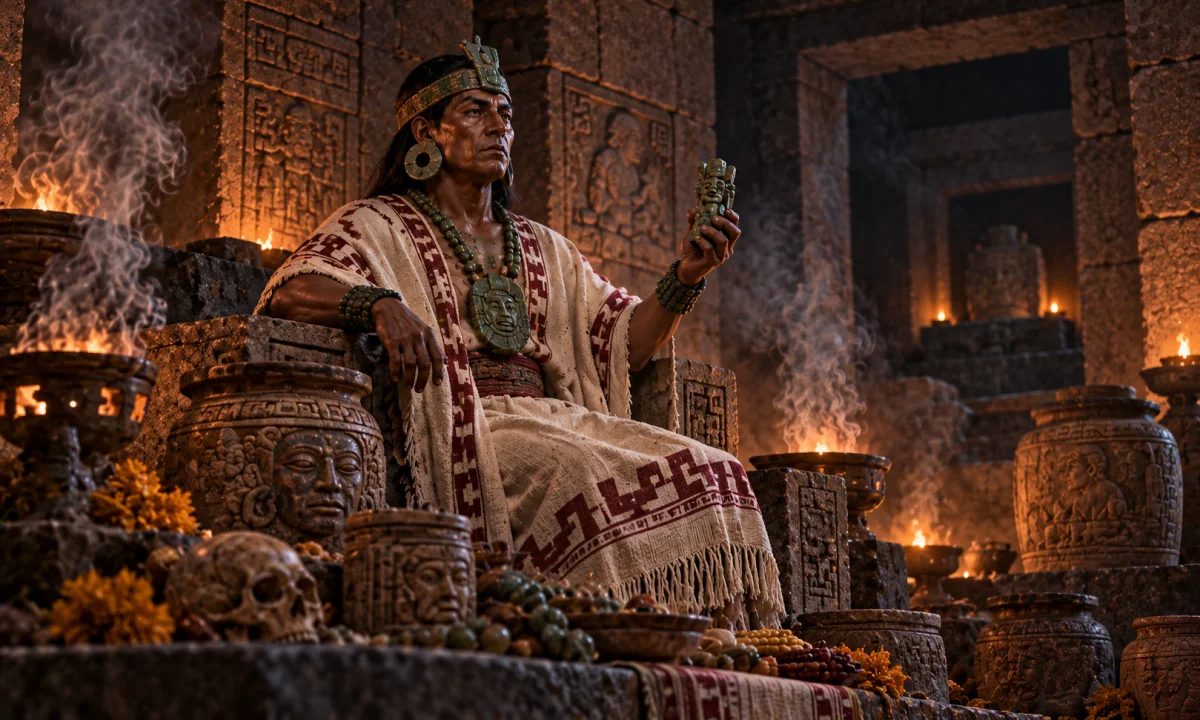
Modern artwork may depict Mdi as a skeletal underworld monarch, sometimes using visual motifs familiar from Mexica death imagery or contemporary Día de Muertos aesthetics. These representations can be creative interpretations, but they are not evidence that ancient Zapotec communities imagined Mdi in that form. The same applies to video games, fantasy fiction, and social-media lists that assign powers or family relationships to the figure.
The most responsible description is therefore a limited one: Mdi is a name sometimes associated with death or the underworld in accounts of Zapotec mythology, but the identity, linguistic meaning, antiquity, and traditional attributes of the figure remain uncertain. It should be kept distinct from the better-attested Zapotec death figure Coqui Bezelao and from death deities belonging to other Mesoamerican cultures.