WORLD
WORLD
Mar’rallang
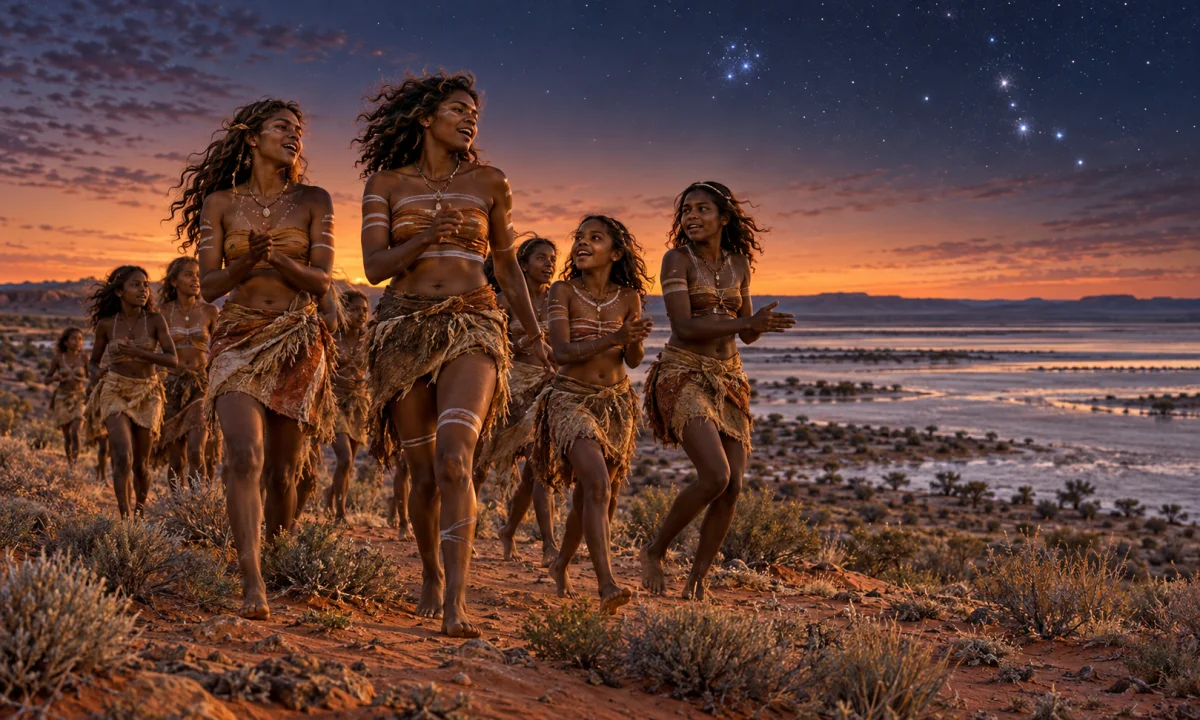
Mar’rallang is a name associated with Yolŋu Aboriginal astronomy and mythology in north-eastern Arnhem Land, in the Northern Territory of Australia. It is generally used for a pair of female figures represented in the night sky by two prominent stars associated with the Yolŋu story of Djulpan, the canoe of three brothers. Mar’rallang is therefore not usually described as a single monster, god or ancestral hero. The name refers to a pair, and its meaning and narrative details can vary between accounts and communities.
Cultural setting
Yolŋu peoples live across north-eastern Arnhem Land and the surrounding islands. Yolŋu societies contain many distinct clans and language groups, each with their own bodies of knowledge, ceremonial responsibilities and relationships to ancestral beings and places. It is consequently misleading to speak of one uniform “Aboriginal mythology”. Stories connected with Mar’rallang belong specifically to a regional cultural and astronomical tradition rather than to all Aboriginal peoples of Australia.
For Yolŋu communities, the sky is not separate from life on Earth. Stars, constellations and celestial movements can be connected with ancestral narratives, seasonal change, law, ceremony, navigation and practical knowledge. A star story may therefore carry several meanings at once. It can describe the appearance of a group of stars, recall the actions of ancestral beings, and help communicate knowledge across generations.
Much of the surviving information about Mar’rallang has been recorded through discussions of Yolŋu astronomy and oral tradition. Such records should be treated with care. Traditional knowledge is transmitted through living communities, and published descriptions may select only one version, translate names imperfectly or simplify relationships that have deeper ceremonial significance. The spelling Mar’rallang is also not the only form that may appear in English-language material.
Name and identity
The apostrophe in Mar’rallang reflects a sound represented in some Yolŋu writing systems. English spellings without the apostrophe, including forms such as Marrallang, may also be encountered. These spellings should not automatically be assumed to represent different beings. At the same time, similar-looking words from different Aboriginal languages cannot safely be treated as equivalent without linguistic and cultural evidence.
Mar’rallang is commonly identified as a pair of women or wives associated with the three brothers of Djulpan. In astronomical descriptions, the two figures are often linked with the bright stars Betelgeuse and Rigel, which appear on opposite sides of Orion’s Belt. The precise identification can vary according to the account being followed, and the name should not be detached from its Yolŋu cultural setting and reduced to a simple list of Western star names.
The term is sometimes explained as referring to “two” or to a pair of female figures, but translations are not always consistent. Yolŋu words can carry meanings shaped by context, grammatical form, kinship and ceremonial use. A short English gloss may therefore convey only part of the name’s significance.
Mar’rallang and Djulpan
The best-known setting for Mar’rallang is the celestial canoe called Djulpan. Djulpan is commonly associated with the three stars of Orion’s Belt, which are understood as three brothers travelling together in a canoe. The surrounding stars form part of a larger narrative arrangement rather than merely serving as a visual picture of a boat.
In accounts that connect Mar’rallang with Djulpan, the two women are the brothers’ wives or companions. Their stars lie close enough to the canoe’s stellar region to be understood as part of the same sky story. Other stars and features in the area may also be interpreted as fish, fishing equipment or other elements of the brothers’ journey. These details are not identical in every description, and the relationship between the figures may have meanings that are not fully expressed by the English word “wives”.
The story of Djulpan is often used to explain the seasonal appearance of fish and the movement of celestial objects. When the constellation becomes visible at particular times of year, it can signal seasonal changes and the availability of foods or activities. Astronomical knowledge is thus embedded in a narrative that links the sky with land, water, social relationships and the obligations of living beings.
Appearance and celestial position
Mar’rallang does not have one fixed physical appearance in the way that a creature in a modern fantasy story might. The figures are primarily known through their celestial representation. They are understood as two female beings or ancestral figures, with their presence expressed through a pair of stars in the night sky.
Many English-language accounts associate the pair with Betelgeuse and Rigel. Betelgeuse is a reddish supergiant star in Orion, while Rigel is a blue-white supergiant in the same constellation. Their striking brightness makes them visually important, although the scientific descriptions of these stars belong to modern astronomy and should not be confused with the Yolŋu story itself.
The use of Western constellation names can be convenient when explaining the location of Mar’rallang to an international audience, but Orion is not the same cultural object as Djulpan. “Orion” is a constellation defined within a Greco-Roman astronomical tradition and later standardised in modern astronomy. Djulpan is a Yolŋu interpretation of the sky, with its own narrative, social and ceremonial context.
Roles and significance
Mar’rallang’s significance lies in the relationship between the paired women, the three brothers and the broader Djulpan story. The figures show how kinship can be represented in the sky. Their placement is not simply decorative: it places relationships, movement and obligations within a visible celestial pattern.
The story also illustrates the way Yolŋu knowledge can join practical observation with ancestral law. The rising and setting of stars can help mark the changing year, while the associated narrative gives the astronomical pattern social meaning. Knowledge of the sky is not necessarily divided into separate categories called “myth”, “religion” and “science”. Those modern categories may overlap in a Yolŋu context.
Stories of this kind can teach attentiveness to seasonal conditions and the behaviour of the natural world. They can also reinforce the importance of proper relationships between people. The actions of ancestral figures are often connected with rules concerning food, marriage, kinship, ceremony and responsibility. A brief retelling that identifies Mar’rallang only as “two stars” leaves out much of the cultural depth carried by the story.
Variants and limits of the evidence
There is no single universally authorised English version of the Mar’rallang tradition. Differences may occur in the spelling of the name, the identity of the stars, the relationship between the women and the brothers, and the surrounding events in the Djulpan narrative. Some accounts focus on the astronomical pattern, while others place greater emphasis on ancestral law or seasonal knowledge.
These variations should not automatically be treated as contradictions. Aboriginal oral traditions are maintained by communities with distinct languages, clans and ceremonial responsibilities. A researcher, teacher or popular writer may also record only the parts of a story that can appropriately be shared publicly. Sacred or restricted knowledge should not be assumed to be available simply because a name appears in a published description.
For the same reason, it is inappropriate to add familiar features from unrelated mythologies. Mar’rallang should not be turned into a generic star goddess, a mermaid, a demon, a fairy or a “wife” in the narrow literary sense used in European folklore. Nor should every Aboriginal story about women, stars or Orion be merged with the Yolŋu tradition of Mar’rallang.
Distinction from other Aboriginal sky traditions
Australia contains hundreds of Aboriginal language groups, with extensive and varied traditions concerning the heavens. Some communities describe the Pleiades as a group of sisters, while others have their own stories for Orion, the Milky Way, the Sun, the Moon and individual stars. Similar themes do not prove that the stories share one origin.
Mar’rallang is particularly associated with Yolŋu interpretations of the stars around Djulpan. It should therefore be distinguished from the “Seven Sisters” traditions found in several parts of Australia, from the Wawalag sisters of Yolŋu ancestral narratives, and from female figures in other regional sky stories. The Wawalag sisters, in particular, are important ancestral beings in Yolŋu tradition, but they are not simply another name for Mar’rallang.
Mar’rallang should also be distinguished from the three brothers of Djulpan. The brothers and the paired women occupy related positions in the same broad celestial narrative, but they are not interchangeable figures. Treating all the stars in the region as one character obscures the relationships that give the story its structure.
Modern presentation and cultural care
Mar’rallang is occasionally mentioned in modern discussions of Indigenous astronomy, Aboriginal star knowledge and the cultural interpretation of the night sky. In planetarium programs, educational material and popular writing, the name may be presented alongside the Western names Betelgeuse, Rigel and Orion. Such comparisons can help audiences locate the stars, provided that the Western astronomical framework is clearly separated from the Yolŋu tradition.
Modern educational presentations should avoid suggesting that Aboriginal astronomy is merely an early or less accurate version of European astronomy. Yolŋu sky knowledge has its own purposes, categories and standards of transmission. The stars may be observed with great precision, but their importance also comes from their relationships to ancestral beings, country, ceremony and social law.
Respectful treatment also requires acknowledging the limits of public accounts. Not every part of a living tradition is intended for unrestricted circulation, and an English summary cannot reproduce the authority of Yolŋu custodians or the contexts in which knowledge is taught. Mar’rallang is best understood as part of a continuing Yolŋu system of cultural and astronomical knowledge, rather than as an isolated character removed from the communities that preserve its meaning.